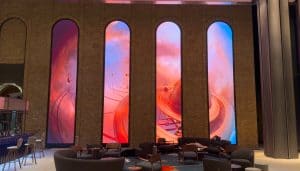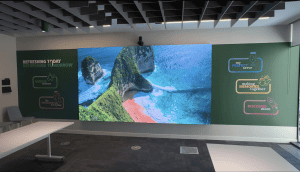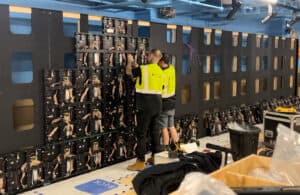
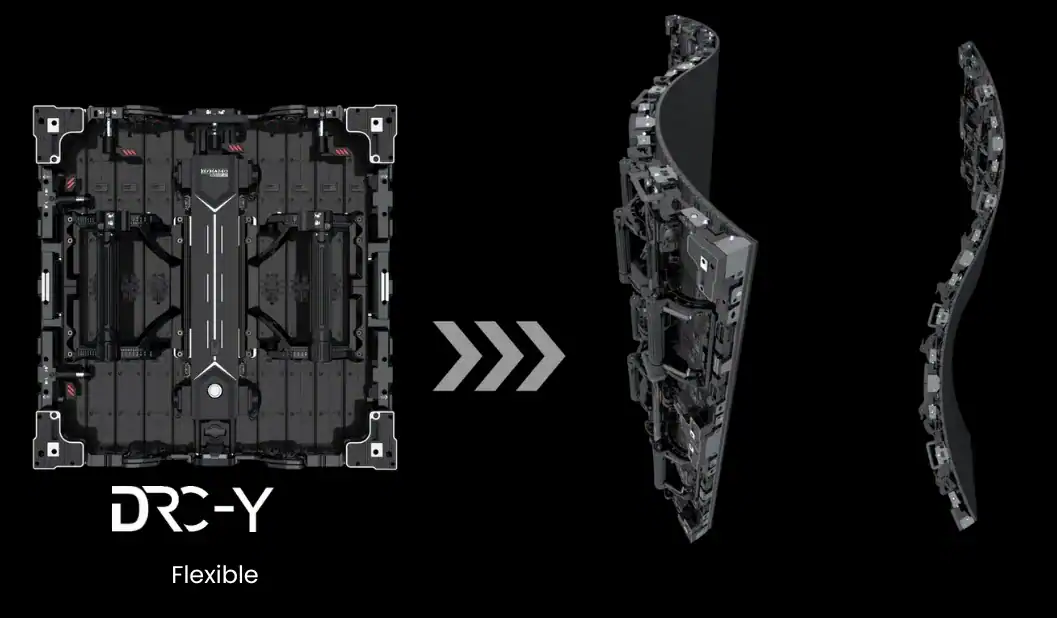
A flexible LED video display is an LED screen built on a bendable substrate, so it can wrap columns, follow concave walls and form spheres that rigid cabinets cannot. Modules bend to radii from about 100 mm, weigh a fraction of a rigid panel, and Dynamo has installed them at pitches down to 1.86 mm.
Updated September 2026.
Quick answer: what a flexible LED video display does
Flexible LED screens use soft, bendable LED modules that can be curved, wrapped, or shaped to fit non-standard architectural surfaces. They are used in creative installations, curved displays, cylindrical columns, and irregular architectural features. Dynamo LED Displays, based in London and operating since 2013, supplies and installs flexible LED screens across the UK.
This guide covers everything you need to know — from the underlying technology and construction methods, through the practical specification considerations, to the design integration advice that separates a good flexible LED installation from a great one. Whether you are at early concept stage or ready to specify, this is the reference we wish existed when we started working with flexible displays.
What is a flexible LED screen? A flexible LED screen is a display panel built on a thin, bendable substrate — typically rubber PCB or mesh backing — that conforms to curved, cylindrical, spherical and freeform surfaces. Unlike rigid cabinets, flexible modules bend without damaging the LEDs or circuitry, enabling curved video walls, column wraps and sculptural display geometries.
Key Takeaways
- A flexible LED screen uses thin, bendable PCB substrates or mesh-style construction to conform to curved, cylindrical, spherical and freeform surfaces that rigid cabinets cannot follow.
- Two primary construction methods exist — soft module (rubber PCB with magnetic mounting) and mesh strip (individual LED strips on flexible backing) — each suited to different applications and bend radii.
- Minimum bend radii typically range from 100 mm to 500 mm depending on pixel pitch and module design, enabling column wraps, concave curves and even full spherical enclosures.
- Pixel pitches for flexible panels currently span from P1.5 to P10, covering everything from close-viewing reception walls to large-format stage backdrops.
- Flexible LED modules weigh significantly less per square metre than rigid equivalents — typically 6–12 kg/m² versus 25–40 kg/m² — reducing structural load requirements on curved and suspended installations.
- Design teams should specify flexible LED early in the architectural process, not as a retrofit, to ensure proper structural support, power distribution and content mapping are integrated from the outset.
- Flexible does not mean fragile — properly installed flexible LED screens deliver the same brightness, colour uniformity and operational lifespan as their rigid counterparts.
📖 Quick Definitions
- Bend radius — the tightest curve a flexible LED module can achieve without damaging components. Measured in millimetres from the centre of the curve to the panel surface.
- Soft module — a flexible LED panel built on a rubber or silicone PCB substrate, typically with magnetic mounting. The most common flexible LED format for architectural installations.
- Mesh LED — a semi-transparent flexible display where LED strips are mounted on an open mesh backing, allowing 40–70% light transmission. Suited to building facades and glass-fronted applications.
- Pixel pitch — the distance in millimetres between the centre of one LED pixel and the next. Smaller numbers mean higher resolution and closer viewing distances.
- IP rating — Ingress Protection rating indicating dust and water resistance. IP30 is indoor-only; IP65 is suitable for direct outdoor weather exposure.
What Is a Flexible LED Screen and Curved LED Display?
A flexible LED screen is a display panel built on a thin, bendable substrate that can conform to curved, concave, convex, cylindrical or irregular surfaces. Unlike rigid LED cabinets with fixed aluminium frames, flexible modules use rubber or thin composite PCBs that allow the panel to bend without damaging the LED chips or circuitry. A curved LED display is the most common result — a seamless video surface that follows the architecture of the space rather than fighting against it.
The concept is straightforward, but the engineering behind it is not. Every element of a traditional LED panel — the PCB, the driver ICs, the data connectors, the power distribution — must be redesigned to tolerate repeated flexing without fatigue failure. The result is a display technology that opens up installation possibilities that were simply not achievable with conventional LED video wall cabinets.
In plain terms: instead of bolting flat rectangular screens to a wall, flexible LED lets you wrap, curve and shape a display to match any surface — columns, archways, reception curves, even full spheres.
Flexible LED has moved well beyond novelty. According to the Society for Information Display (SID), flexible display technology has advanced significantly with the development of lightweight, high-density soft LED modules that maintain colour accuracy across curved surfaces. It is now a mature, commercially proven technology deployed in permanent architectural installations, touring stage productions, retail environments and corporate headquarters worldwide. The technology gives architects, designers and creative agencies the ability to treat LED not as a flat rectangle bolted to a wall, but as a dynamic surface that follows the geometry of the space itself.
How Flexible LED Technology Works
Understanding the construction of flexible LED screens is essential for specifying the right product. There are two primary approaches, each with distinct characteristics.
Soft Module Construction
Soft modules use a flexible rubber or silicone PCB as the base substrate. The LEDs — typically SMD (surface-mount device) packages — are soldered directly onto this flexible board, along with miniaturised driver ICs and data/power traces. The entire module is backed with a thin magnetic sheet or fitted with lightweight mounting brackets.
In plain terms: think of it like a thin rubber mat with thousands of tiny LED lights embedded in it. The mat bends, the lights stay put.
Key characteristics of soft modules:
- Consistent pixel pitch — the LED spacing remains uniform even when bent, because the substrate stretches and compresses predictably
- Front or rear serviceability — modules typically attach magnetically, allowing individual panel replacement without disturbing adjacent units
- Moderate bend radius — most soft modules achieve a minimum bend radius of 200–500 mm depending on pixel pitch
- Seamless tiling — module edges are designed to butt together cleanly on curved surfaces without visible seam lines
Soft modules are the most common flexible LED format and account for the majority of architectural and retail installations we encounter.
Mesh / Strip Construction
Mesh-style flexible LED screens take a different approach entirely. Rather than a continuous PCB, individual LED strips are mounted on a flexible mesh or ribbon backing. The strips are spaced apart, creating a semi-transparent display with a high degree of flexibility.
In plain terms: imagine LED fairy lights sewn onto a net curtain. You can see through it, and it bends around almost anything.
Key characteristics of mesh construction:
- Extreme flexibility — mesh panels can achieve tighter bend radii (down to 100 mm in some configurations) and can wrap around complex compound curves
- High transparency — the open mesh structure allows 40–70% light transmission, making it suitable for glass facades and applications where see-through capability matters
- Lighter weight — mesh panels can weigh as little as 4–6 kg/m², significantly less than soft modules
- Lower resolution — the strip spacing typically limits pixel pitch to P6 and above, making mesh displays better suited to distance viewing
The choice between soft module and mesh construction is fundamentally a trade-off between resolution and flexibility. Soft modules deliver higher resolution for closer viewing distances; mesh panels deliver greater conformability and transparency for larger architectural applications.
Types of Flexible LED Screen and Curved LED Display
The flexibility of these panels enables a range of curved LED display geometries that go far beyond the standard flat video wall. Here are the most common configurations we design and install.
Curved Screens
The most common application — flexible LED panels mounted on a curved subframe to create concave or convex display surfaces. Curved screens are widely used for immersive LED environments — such as the Pixel Artworks Lighthouse, where curved and shaped LED panels created a fully immersive room-scale experience — as well as command centres, broadcast studios and reception areas where a wraparound visual experience is required.
Cylindrical Wraps
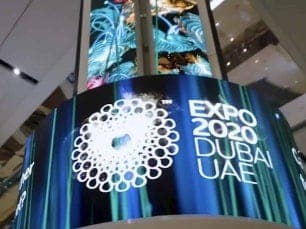
Flexible LED modules wrapped around cylindrical structures — columns, pillars, drums and rotundas. This is one of the most visually striking applications, transforming structural columns from dead space into dynamic content surfaces. At Dubai Airport’s arrivals terminal, we wrapped flexible LED modules around structural columns to create dynamic arrival information displays — a project that demonstrated exactly how flexible LED transforms otherwise static architecture. Pixel pitch selection is critical here: the tighter the cylinder radius, the finer the pitch needed to maintain image quality at close viewing distances.
Spherical and Dome Displays
Full or partial sphere enclosures using custom-cut flexible modules. Spherical LED displays are engineered on a project-by-project basis, with modules mapped to the sphere geometry using specialist content-mapping software. These are high-impact installations typically found in museums, brand experience centres and public art installations.
Wave and Freeform Shapes
Flexible LED panels mounted on custom undulating or organic subframes to create wave, ribbon or sculptural display surfaces. The subframe is typically fabricated in steel or aluminium to the architect’s exact geometry, with flexible modules attached using magnetic or bracket mounting systems. Content must be mapped to the 3D surface using dedicated LED controller hardware capable of geometry correction.
Modular Soft Panels
Lightweight, portable flexible LED panels designed for rapid deployment in event and rental applications. These modules connect together to form temporary curved or flat surfaces and are designed for fast load-in/load-out cycles. They are commonly used for touring concerts, exhibitions and brand activations where the display geometry changes between events.
Applications
Flexible LED screens have found their way into a broad range of sectors. Here are the applications we work with most frequently.
Stage Backdrops and Touring Production
Curved and shaped LED backdrops are now standard in concert touring, theatre and live broadcast. Flexible panels allow production designers to create concave wrapping stages, curved side screens and overhead LED canopies that rigid cabinets cannot achieve. The lighter weight of flexible modules also reduces rigging load — a critical consideration when flying LED above performers and audiences.
Column Wrapping
Retail spaces, hotel lobbies, corporate headquarters and transport hubs are full of structural columns that interrupt sightlines and waste visual real estate. Wrapping these columns with flexible LED transforms them into dynamic content surfaces — wayfinding, branding, advertising or ambient visual content. We have delivered column wraps from 300 mm diameter upwards.
In plain terms: that concrete pillar in the middle of the lobby becomes a 360° video screen instead of dead space.
Curved Reception and Feature Walls
A curved LED feature wall in a reception area or boardroom makes a strong visual statement. Flexible LED enables sweeping concave curves that draw the eye and create an immersive first impression. These installations typically use fine-pitch soft modules (P1.5–P2.5) to ensure crisp image quality at close viewing distances.
Retail and Brand Experience
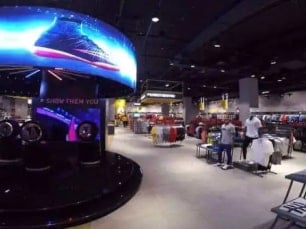
Retail designers use flexible LED to create curved display surfaces, wraparound product showcases and immersive brand environments. The ability to integrate LED into curved fixtures and custom geometries gives retailers a display medium that goes beyond flat screens and projectors.
Events and Exhibitions
Temporary installations at trade shows, product launches and exhibitions benefit from the portability and adaptability of flexible LED. Modular soft panels can be configured into different shapes for each event, maximising the return on the display investment across multiple activations.
Flexible vs Rigid LED: A Direct Comparison
Choosing between flexible and rigid LED is not always straightforward. Both technologies have their strengths, and the right choice depends entirely on the installation requirements. Here is a direct comparison across the key specification areas.
| Specification | Flexible LED | Rigid LED |
|---|---|---|
| Surface geometry | Curved, cylindrical, spherical, freeform, flat | Flat only (angled arrangements possible with brackets) |
| Pixel pitch range | P1.5 – P10 | P0.7 – P10+ |
| Weight per m² | 6 – 12 kg (soft module); 4 – 6 kg (mesh) | 25 – 40 kg |
| Minimum bend radius | 100 – 500 mm (varies by product) | N/A (rigid) |
| Cabinet thickness | 12 – 30 mm | 60 – 120 mm |
| Brightness | 800 – 5,000 nits | 800 – 10,000+ nits |
| IP rating (typical) | IP30 – IP65 | IP30 – IP68 |
| Serviceability | Front service (magnetic); some rear service | Front or rear service depending on cabinet design |
| Install complexity | Higher — requires custom subframe and content mapping | Lower — standard mounting, flat surface |
| Structural requirements | Lower load (lighter panels) | Higher load (heavier cabinets) |
| Suited to | Curves, wraps, lightweight installs, creative shapes | Flat walls, high-brightness outdoor, ultra-fine pitch |
The key takeaway: flexible LED is not a replacement for rigid panels. It is an additional tool in the display designer’s toolkit, purpose-built for installations where geometry, weight or thickness constraints rule out conventional cabinets.
In plain terms: if your surface is flat, rigid panels are usually better value. If it curves, bends or wraps, flexible LED is likely your only practical option.
Specification Considerations for Flexible LED Screens
Getting the specification right on a flexible LED project requires attention to several parameters that do not apply — or apply differently — to standard flat video walls. Here is what to focus on.
Minimum Bend Radius
This is the single most important specification for any curved LED display installation. The minimum bend radius defines the tightest curve the module can achieve without damaging components or creating visible pixel spacing inconsistencies. Always specify the actual installation radius and confirm it falls within the module’s rated minimum. Going tighter than the rated radius risks cracking solder joints and reducing lifespan.
In plain terms: bend radius tells you the smallest curve the panel can handle. Try to force a tighter curve and you will break it.
Pixel Pitch
The relationship between pixel pitch and viewing distance applies to flexible LED just as it does to rigid panels. However, curved surfaces introduce an additional consideration: on a concave curve, the viewer may be closer to the centre of the screen than the edges, creating a variable viewing distance across the display surface. Specify pixel pitch based on the closest expected viewing point, not the average.
For guidance on optimising image quality once installed, our LED display calibration guide covers the colour and brightness uniformity process in detail.
IP Rating
Indoor flexible LED screens are typically rated IP30 to IP40. For outdoor or semi-outdoor applications (covered atriums, open-sided structures), IP54 or IP65-rated flexible panels are available but the product range is more limited and the modules are generally thicker and heavier. Confirm the IP rating matches the installation environment before committing to a product.
In plain terms: IP rating tells you how weatherproof the panel is. Higher numbers mean more protection against dust and water.
Weight per Square Metre
One of the key advantages of flexible LED is its lower weight. This matters enormously for suspended installations, column wraps on non-structural columns, and retrofit projects where existing structures may not support the load of rigid cabinets. Always provide the structural engineer with confirmed module weights including cabling and subframe.
Serviceability
Front serviceability is essential for most curved and wrapped installations, where rear access is physically impossible. Most flexible LED modules use magnetic attachment to the subframe, allowing individual modules to be removed and replaced from the front without disturbing neighbouring panels. Confirm the service method and minimum clearance required before finalising the installation design.
Transparency
For mesh-type flexible LED, the transparency ratio determines how much light passes through the display. Higher transparency (60–70%) preserves the view behind the screen but reduces LED density and therefore resolution. Lower transparency (30–40%) delivers higher resolution but blocks more ambient light. The right balance depends on whether the primary function is display or architectural glazing.
Design Considerations: What Architects and Designers Need to Know
Flexible LED technology enables distinctive creative outcomes, but only when it is properly integrated into the design process from the outset. Here is what we consistently advise architectural and design teams.
Specify Early, Not Late
The most common mistake we see is flexible LED being added to a project as an afterthought — “can we wrap that column in LED?” asked at fit-out stage, when the column has no power feed, no data route, and the structural engineer has already signed off. Flexible LED should be in the design brief from RIBA Stage 2 at the latest, allowing power, data, structural support and thermal management to be designed in, not bodged in.
Subframe Design Is Critical
Flexible LED modules do not self-support. They require a precisely fabricated subframe — typically steel or aluminium — that defines the exact geometry of the display surface. The subframe must be accurate to within ±1 mm across the entire surface to avoid visible steps or gaps between modules. For complex curves, we recommend 3D scanning the subframe before module installation to verify tolerances.
In plain terms: the metal frame behind the LED has to be perfect. If it is even slightly off, you will see the joins.
Content Mapping
Content designed for a flat rectangle will not work on a curved or wrapped surface without geometry correction. Specialist LED controllers and media servers can map flat content onto 3D surfaces, but the strongest results come from content created specifically for the display geometry. Budget for content production alongside the hardware — a curved screen showing distorted content is a wasted investment. The right controller hardware is essential for this process.
Thermal Management
Flexible LED modules generate heat, and curved installations can create thermal pockets where airflow is restricted — particularly inside cylinders and concave curves. Ensure adequate ventilation behind the display surface. For enclosed installations (full cylinders, spheres), active cooling may be required. Thermal analysis should be part of the design process, not an afterthought.
Viewing Angles and Content Zones
On a curved surface, different parts of the screen are oriented at different angles relative to the viewer. This affects perceived brightness and colour accuracy. Most quality flexible LED modules offer viewing angles of 140–160° horizontally and vertically, but on tight curves, the extremes of the surface may fall outside comfortable viewing angles for some audience positions. Map your expected viewer positions and confirm acceptable image quality across the full display surface.
Power and Data Distribution
Curved and irregular display surfaces require more careful power and data cabling than flat walls. Cable runs must follow the surface geometry without creating stress points, and power distribution should account for the total load across the surface with appropriate redundancy. Data distribution via standard Ethernet or fibre should be specified with sufficient port capacity on the sending controller.
From the Field — Daniel Reynolds
“We have been specifying and installing flexible LED for over five years now, and the technology has matured significantly. The early products were genuinely difficult — inconsistent module tolerances, limited pixel pitch options, and magnetic mounting systems that were not reliable enough for permanent installations. Today’s flexible panels are a different proposition entirely. The tolerances are tight, the mounting systems are proven, and the pixel pitch range covers most practical applications.”
“The advice I give every design team is the same: involve your LED integrator at concept stage. The difference between a flexible LED installation that looks exceptional and one that looks acceptable almost always comes down to how early the display technology was considered in the design process. Subframe accuracy, content mapping, thermal management — these are all solvable, but only if you plan for them.”
The clearest recent example is the AutoTrader Manchester HQ installation, where a 21.76 m × 1.12 m flexible LED ribbon at 1.86 mm pitch (11,696 × 602 px) curves on two planes at once above the café area. A 17.92 m × 320 mm halo ticker and a contoured plinth use the same flexible GOB-protected tiles, all carried on a steel frame fabricated off-site to the architectural drawings. It is the reference we point design teams to when they ask what compound curvature looks like in a working office.
Flexible LED video display: frequently asked questions
What is the minimum bend radius of a flexible LED screen?
Soft module flexible LED screens typically achieve a minimum bend radius of 200–500 mm, whilst mesh-type panels can go as tight as 100 mm. Finer pixel pitches generally require a larger minimum radius due to component density. Always confirm the rated bend radius with the specific product datasheet before finalising your installation geometry.
Can flexible LED screens be used outdoors?
Yes, but outdoor-rated flexible panels are more limited than indoor options. Models with IP54 to IP65 ingress protection are available for sheltered and fully exposed outdoor environments respectively. Outdoor flexible modules tend to be thicker and heavier due to additional weatherproofing — confirm the IP rating suits your specific site conditions.
What pixel pitch is available for flexible LED?
Flexible LED screens are currently available from approximately P1.5 to P10. Soft module construction supports finer pitches (P1.5–P4), whilst mesh-type displays typically start at P6 and above. Choose based on viewing distance — finer pitches for close-up reception walls, coarser for large-scale facades viewed from a distance.
Are flexible LED screens more expensive than rigid panels?
Generally, yes — flexible modules carry a premium due to more complex manufacturing. However, the total installed cost comparison is nuanced: lighter panels reduce structural steelwork costs, thinner profiles reduce build-out depth, and curved mounting can be simpler than angled rigid bracket systems. Compare total project cost, not just panel price.
How are flexible LED screens installed?
Flexible LED modules mount onto a custom-fabricated subframe — typically steel or aluminium — that defines the display surface geometry. Modules attach using magnetic mounting, hook-and-loop fasteners, or lightweight brackets depending on the product. The surface is then cabled for power and data, connected to the LED controller, and calibrated for uniform brightness and colour.
What shapes can flexible LED screens achieve?
Flexible LED conforms to concave curves, convex curves, cylindrical wraps, S-curves, wave forms, partial spheres and full spheres. Some mesh products also achieve compound curves (bending in two axes). The shapes are constrained by the module’s minimum bend radius and subframe fabrication limits — we recommend early consultation for complex organic geometries.
Conclusion
Flexible LED screens have evolved from experimental curiosities into a reliable, commercially proven display technology. They give architects, designers and creative agencies the freedom to break away from the rectangular flat screen and integrate dynamic visual content into curved, wrapped and sculptural surfaces.
The technology is not without its considerations — custom subframes, content mapping, thermal management and early-stage specification are all essential to a successful outcome. But when these elements are properly addressed, flexible LED delivers installations that are genuinely transformative.
At Dynamo LED Displays, we have the experience to guide your project from initial concept through to a completed, calibrated installation. Whether you are wrapping a column, curving a reception wall or creating an immersive sculptural display, we can help you navigate the product selection, structural engineering and content strategy to get it right.
Related Guides
- Indoor LED Displays: Complete Guide
- Transparent LED Displays: Complete Guide
- The Complete Guide to LED Video Wall Technology
- How Much Does an LED Video Wall Cost in the UK?
- Outdoor LED Displays: Complete Guide
- LED screen hire
- Flexible LED modules on a curved shopfront at Dublin Airport Terminal 1: case study
Start your flexible LED video display project
Tell us the surface, the curve and the closest viewing distance, and we will provide product recommendations, indicative specifications and next steps.
Get a quote for a flexible LED video display. Contact Dynamo LED Displays or call 020 3489 9878.
Sources & Further Reading
- Flexible Electronics — Wikipedia — technical background on flexible substrate and display construction
- Society for Information Display (SID) — display industry research on flexible and curved display technologies
- AVIXA — AV industry standards for display installation and specification
- Display Daily — industry coverage of flexible LED display technology and applications
- Flexible LED specifications referenced from published manufacturer product data. For creative display standards, see AVIXA (avixa.org).
- Specification data compiled from published manufacturer product datasheets.
Related flexible LED resources: L-V-W FlexCurtain — flexible mesh LED curtain · NovaStar processor sizing guide.