What Is an LED Video Wall?
Key Takeaways
- LED video walls use modular cabinets tiled together to create seamless displays at virtually any size, with no visible bezels between panels.
- Pixel pitch — the distance in millimetres between each LED cluster — is the single most important specification, and the right choice depends entirely on your minimum viewing distance.
- Indoor and outdoor LED video walls differ significantly in brightness, weatherproofing (IP rating), pixel pitch, and cost — selecting the wrong type wastes budget.
- LED video walls outperform LCD video walls and projectors on brightness, lifespan, seamlessness, and total cost of ownership over a 7–10 year period.
- A proper video wall installation includes the screen hardware, a video processor or controller, content management software, structural mounting, and an ongoing maintenance plan.
- Viewing distance determines pixel pitch: the general rule is minimum viewing distance in metres × 1 = the approximate pixel pitch in millimetres you need (e.g., 3m viewing = ~P3 or finer).
- Total cost of ownership should factor in energy consumption, maintenance access, spare module availability, and content management — not just the upfront hardware price.
- UK supply-and-install costs for indoor fine-pitch LED video walls typically start from around £2,500–£5,000 per square metre depending on pixel pitch and installation complexity.
How LED Video Walls Work
Understanding the core components of an LED video wall helps you make better specification decisions and ask the right questions during procurement. There are three main elements: the LED modules (cabinets), the video processor, and the content delivery system.LED Cabinets and Modules
An LED video wall is assembled from individual cabinets — typically die-cast aluminium or sheet steel frames housing one or more LED modules. Each module contains thousands of tiny LED clusters (typically red, green, and blue diodes) arranged in a grid. These cabinets lock together mechanically and electronically to form the complete display surface. Leading manufacturers include leading LED manufacturers, specialist LED manufacturers, leading LED manufacturers, and NovaStar — each offering product ranges from ultra-fine pitch broadcast screens to robust outdoor displays. Cabinet sizes vary by manufacturer and product range, but common formats include 500mm × 500mm and 600mm × 337.5mm for indoor products, and 960mm × 960mm for outdoor installations. The physical cabinet size affects your total screen dimensions — your video wall width and height must be a multiple of the cabinet size.Pixel Pitch Explained
Pixel pitch is the distance in millimetres between the centre of one LED pixel cluster and the centre of its neighbour. It is expressed as a “P” value — P1.5 means 1.5mm pitch, P2.5 means 2.5mm pitch, and so on. A lower pixel pitch means higher resolution for any given screen size, because you are packing more pixels into the same area. But finer pixel pitches cost more per square metre, so specifying a tighter pitch than your viewing distance requires is a waste of budget. We cover the viewing distance calculation in detail below.Video Processors and Controllers
The video processor sits between your content source (a media player, laptop, live camera feed, or CMS) and the LED cabinets. It performs several critical functions:- Scaling — maps your input resolution to the native pixel resolution of the wall
- Colour processing — adjusts white balance, gamma, and colour temperature
- Input management — switches between sources, supports picture-in-picture or multi-window layouts
- Sending card distribution — splits the processed signal across the physical sending cards connected to the cabinets
Quick Definitions
| Term | What It Means |
|---|---|
| Pixel pitch | The distance in millimetres between the centre of adjacent LED pixels. Smaller = sharper at close range. Expressed as P1.5, P2.5 etc. |
| Nits | A unit of brightness (candelas per square metre). Indoor screens: 800–1,500 nits. Outdoor screens: 5,000–10,000+ nits. |
| Refresh rate | How many times per second the image redraws (Hz). 1,920Hz is fine for direct viewing; 3,840Hz+ required if the screen will be filmed or photographed. |
| HDR | High Dynamic Range — a display capability that produces a wider range of brightness levels and richer colours. HDR content looks more vivid and lifelike, especially for video playback and digital art installations. |
| CMS | Content Management System — software used to schedule, update, and remotely manage what displays on the screen. Cloud-based options (e.g., NovaStar Cloud) allow remote updates from any device. |
Indoor vs Outdoor LED Video Walls
Indoor and outdoor LED displays are engineered differently. Choosing the wrong category will either leave you with a screen that cannot survive the environment, or one that dramatically overspends for the conditions.| Specification | Indoor LED Video Wall | Outdoor LED Video Wall |
|---|---|---|
| Typical pixel pitch | P0.9 – P4 | P3 – P16 |
| Brightness | 600 – 1,500 nits | 5,000 – 10,000+ nits |
| IP rating | IP20 – IP40 (no weather protection) | IP65 – IP68 (rain, dust, wash-down proof) |
| Cabinet material | Lightweight die-cast aluminium | Heavy-duty steel or aluminium with gaskets |
| Viewing distance | 1.5m – 20m+ | 5m – 100m+ |
| Cooling | Passive (convection) | Active fans or forced-air |
| Power consumption | Lower (200–400W/m² typical) | Higher (400–800W/m² typical) |
| Installation | Wall-mount, floor-stand, recessed, or hung | Steel structure, ground-mount, or building-mounted |
Pixel Pitch Guide: What Do You Need for Your Viewing Distance?
This is the question we answer most often. The relationship between pixel pitch and viewing distance is straightforward, but getting it wrong is expensive — either you overspend on unnecessary resolution, or you end up with a screen that looks pixelated at normal viewing range.The Viewing Distance Rule
The widely accepted formula is: Minimum comfortable viewing distance (metres) ≈ pixel pitch (mm) × 1 to 1.5 So a P2.5 screen is comfortable from about 2.5–3.75 metres. A P1.2 screen is sharp from about 1.2–1.8 metres.In plain terms: Think of pixel pitch like the dots on a printed page. Get too close and you can see the individual dots — step back and it looks like a solid, crisp image. The “P” number tells you roughly how many metres back you need to stand for the picture to look seamless. A P2.5 screen needs you 2.5m away. A P1.2 screen looks sharp from just 1.2m. If people will be standing right next to your screen, you need a lower “P” number — which costs more. If the closest viewer is 5m back, a P4 or P5 will look just as good for much less money.
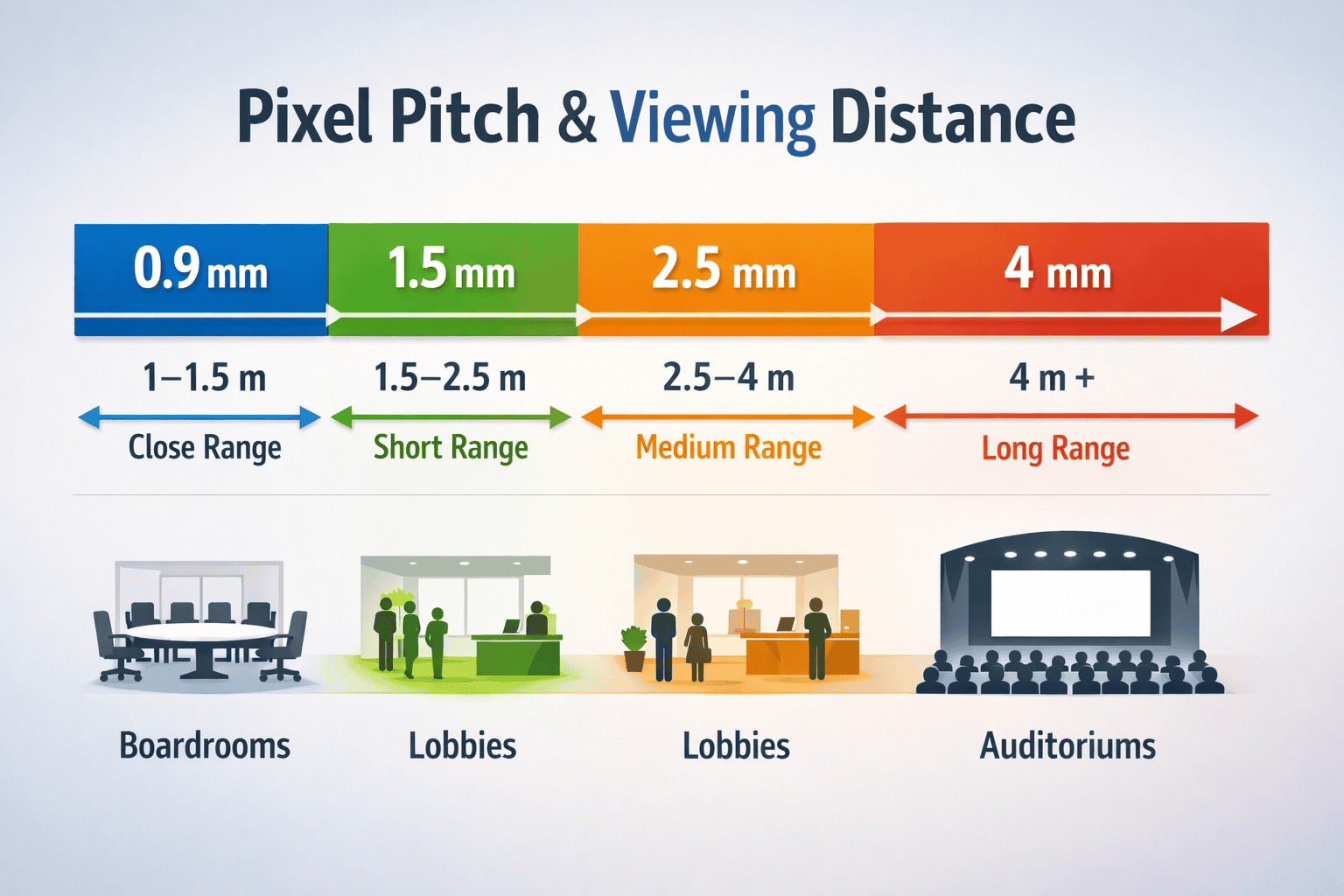
| Pixel Pitch | Min. Viewing Distance | Best Use Case |
|---|---|---|
| P0.9 – P1.2 | 1 – 1.8m | Control rooms, boardrooms, close-viewing lobbies |
| P1.5 – P1.8 | 1.5 – 2.7m | Corporate reception, retail, meeting rooms |
| P2.5 | 2.5 – 3.75m | Conference halls, large lobbies, showrooms |
| P3 – P4 | 3 – 6m | Event stages, large retail, houses of worship |
| P5 – P6 | 5 – 9m | Stadium concourses, outdoor semi-close |
| P8 – P10 | 8 – 15m | Outdoor advertising, building wraps |
| P16+ | 16m+ | Motorway signage, large-format outdoor |
LED Video Wall Projects: Real-World Examples
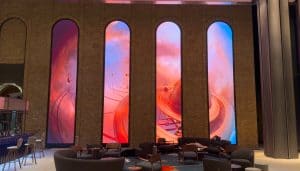
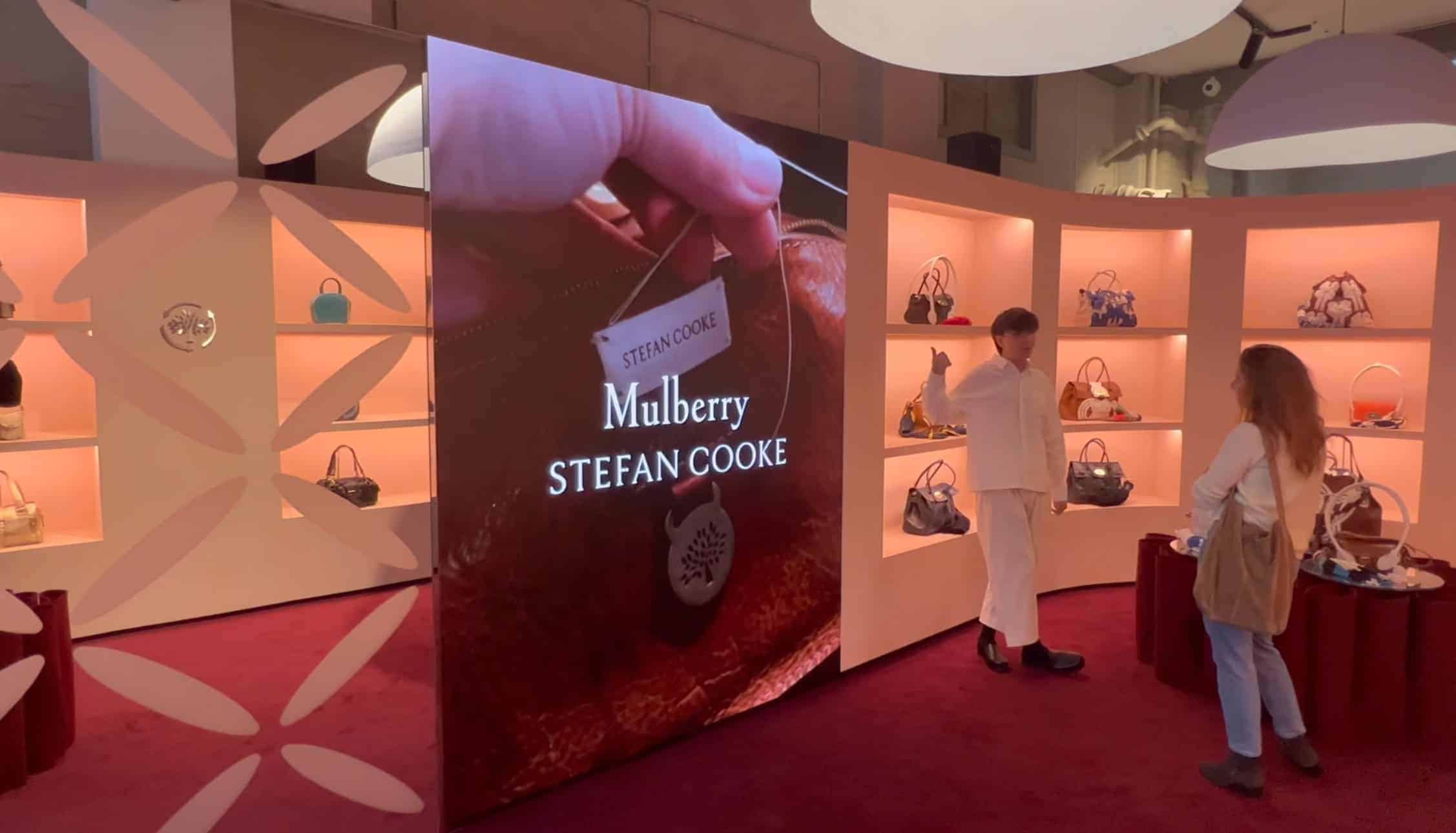
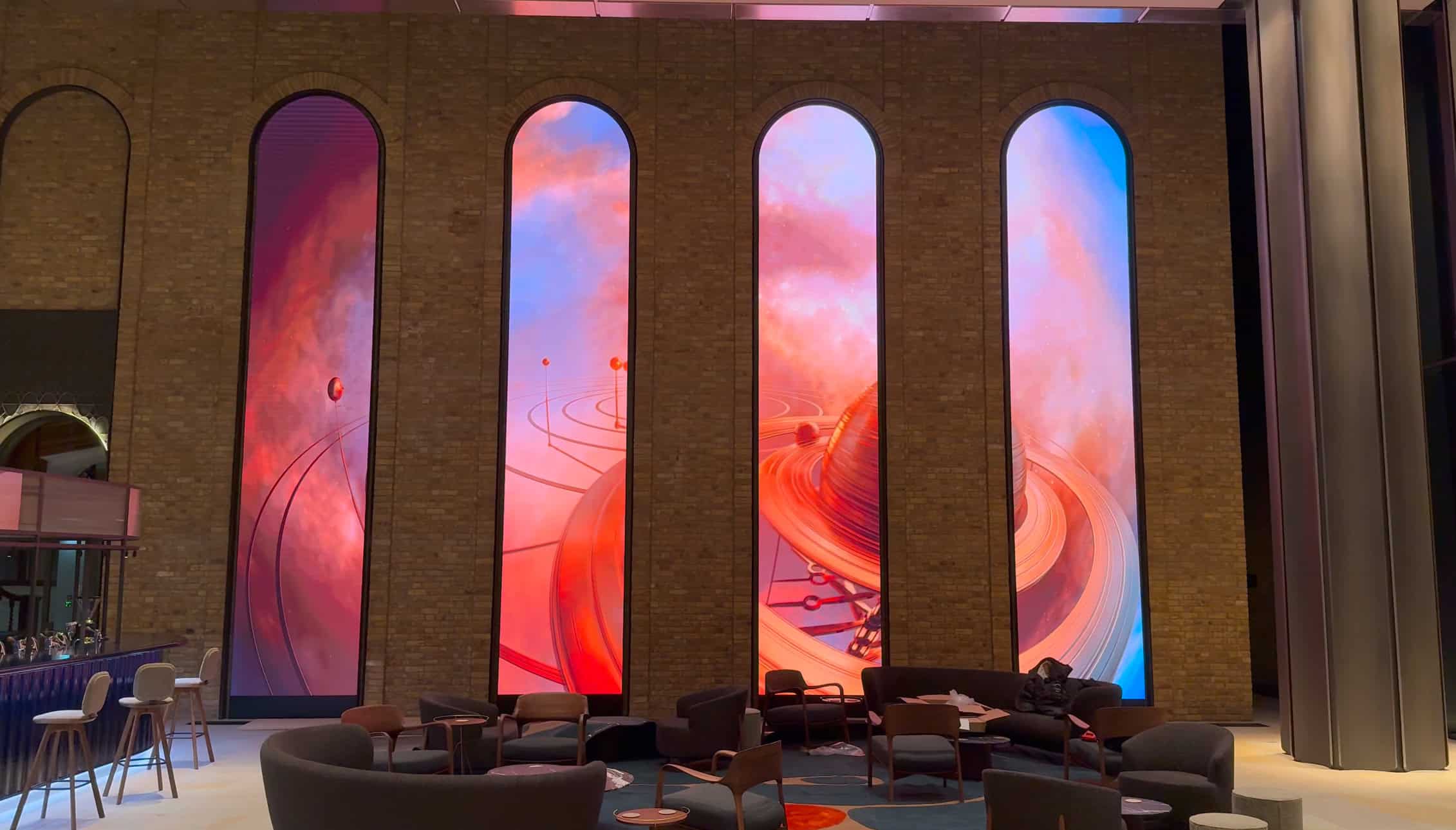
Dynamo has delivered LED video wall projects across a wide range of environments. Here are three examples that illustrate the breadth of applications and the importance of correct specification.40 Leadenhall Street, London
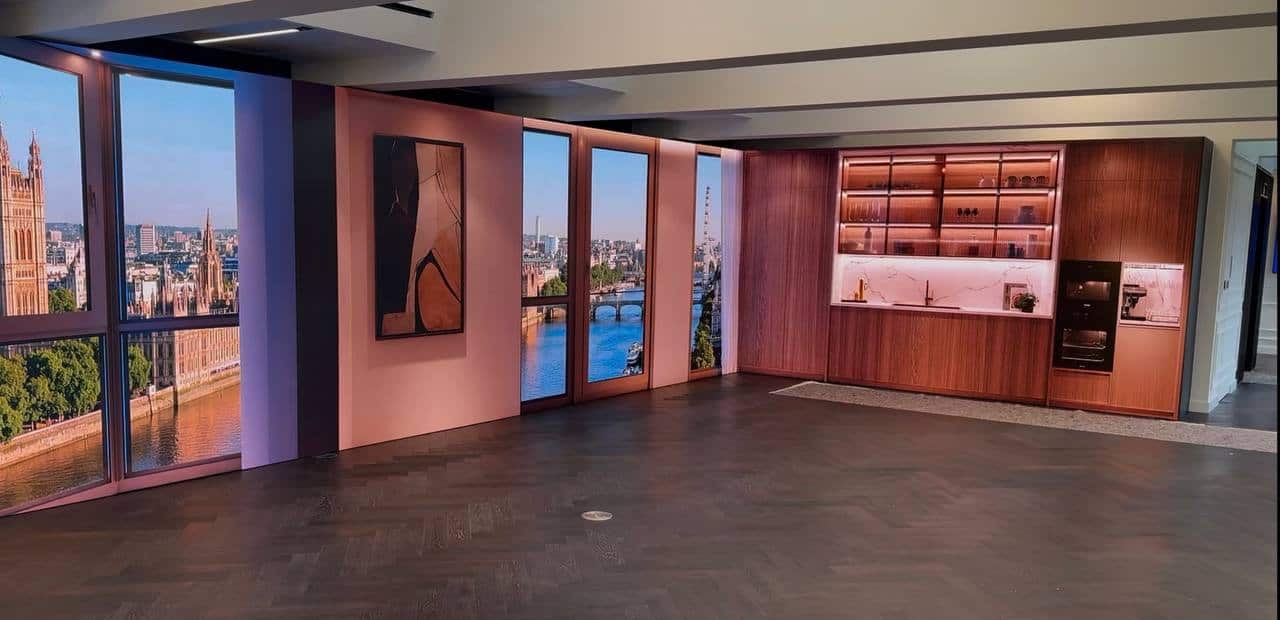
Luxury Apartment LED Windows, Mayfair
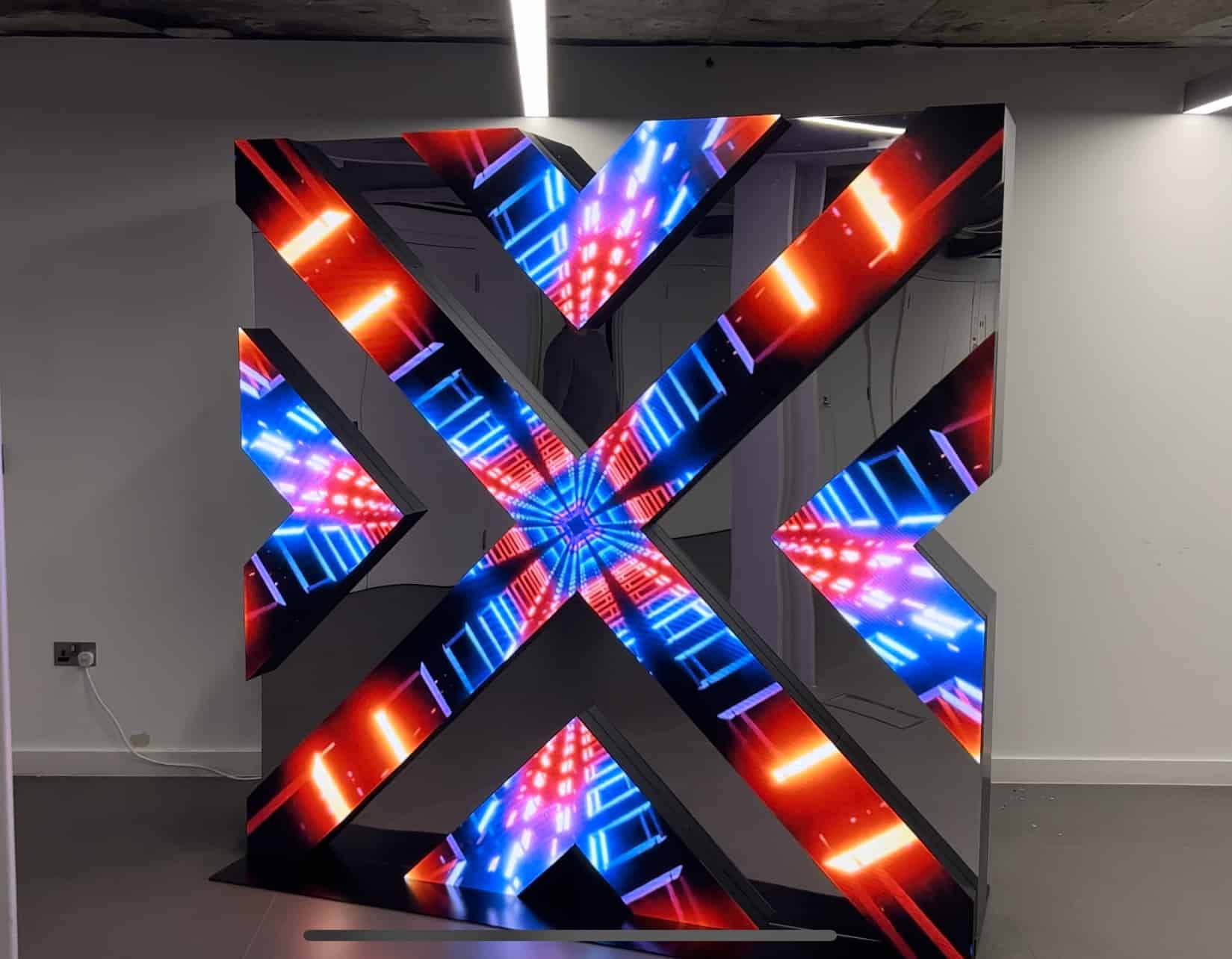
VML/Y&R Custom LED Snowflake
LED vs LCD vs Projector: Which Display Technology Should You Choose?
LED video walls are not always the right answer. Here is an honest comparison against the two main alternatives — LCD video walls and projectors. According to AVIXA (Audiovisual and Integrated Experience Association) display standards, brightness, seamlessness, and total cost of ownership over the installation lifecycle are the three primary evaluation criteria for permanent large-format displays — areas where LED video walls consistently lead.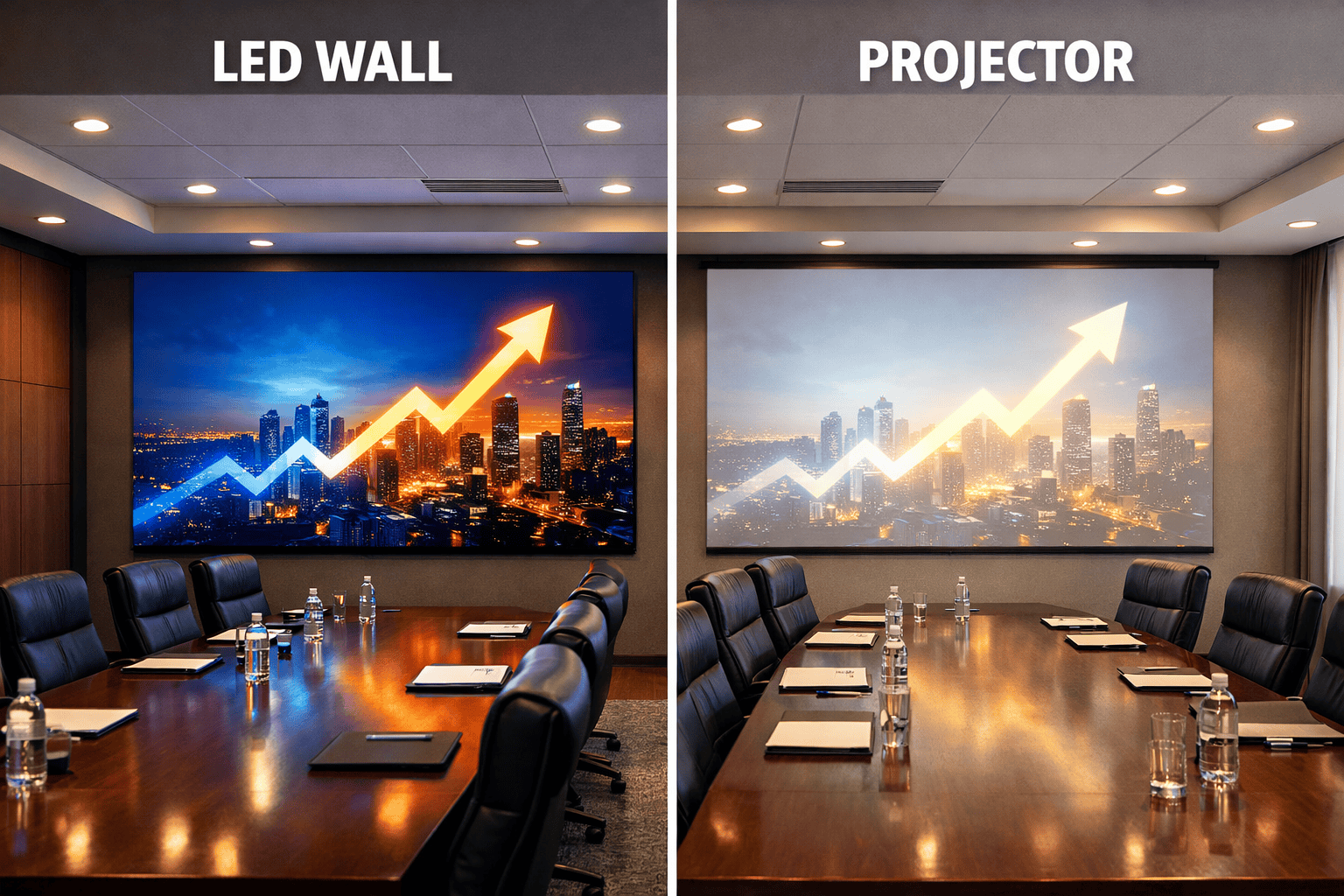
| Factor | LED Video Wall | LCD Video Wall | Projector |
|---|---|---|---|
| Seamlessness | No visible bezels | Visible bezels (0.88mm–3.5mm typical) | Blending artefacts on multi-projector |
| Brightness | 1,000–10,000+ nits | 500–700 nits typical | 3,000–30,000 lumens (ambient-light dependent) |
| Lifespan | 100,000+ hours to 50% brightness | 50,000–60,000 hours | 20,000–30,000 hours (laser), less for lamp |
| Max size | Virtually unlimited | Practical limit ~10×6 panels | Limited by throw distance and ambient light |
| Ambient light performance | Excellent | Good (with anti-glare coatings) | Poor to moderate |
| Maintenance | Front or rear module swap | Full panel replacement | Lamp/filter replacement, alignment |
| Depth/footprint | 50–120mm typical | 80–150mm typical | Requires throw distance (1–10m+) |
| Upfront cost | Higher | Lower for smaller sizes | Lowest for single-screen |
| Running cost (7yr) | Low (efficient, no consumables) | Moderate | Higher (lamp/laser replacement, energy) |
LED Video Wall Applications by Sector
LED video walls have moved far beyond broadcast studios. Here is where we see them deployed most — and what each sector typically demands.Corporate and Office
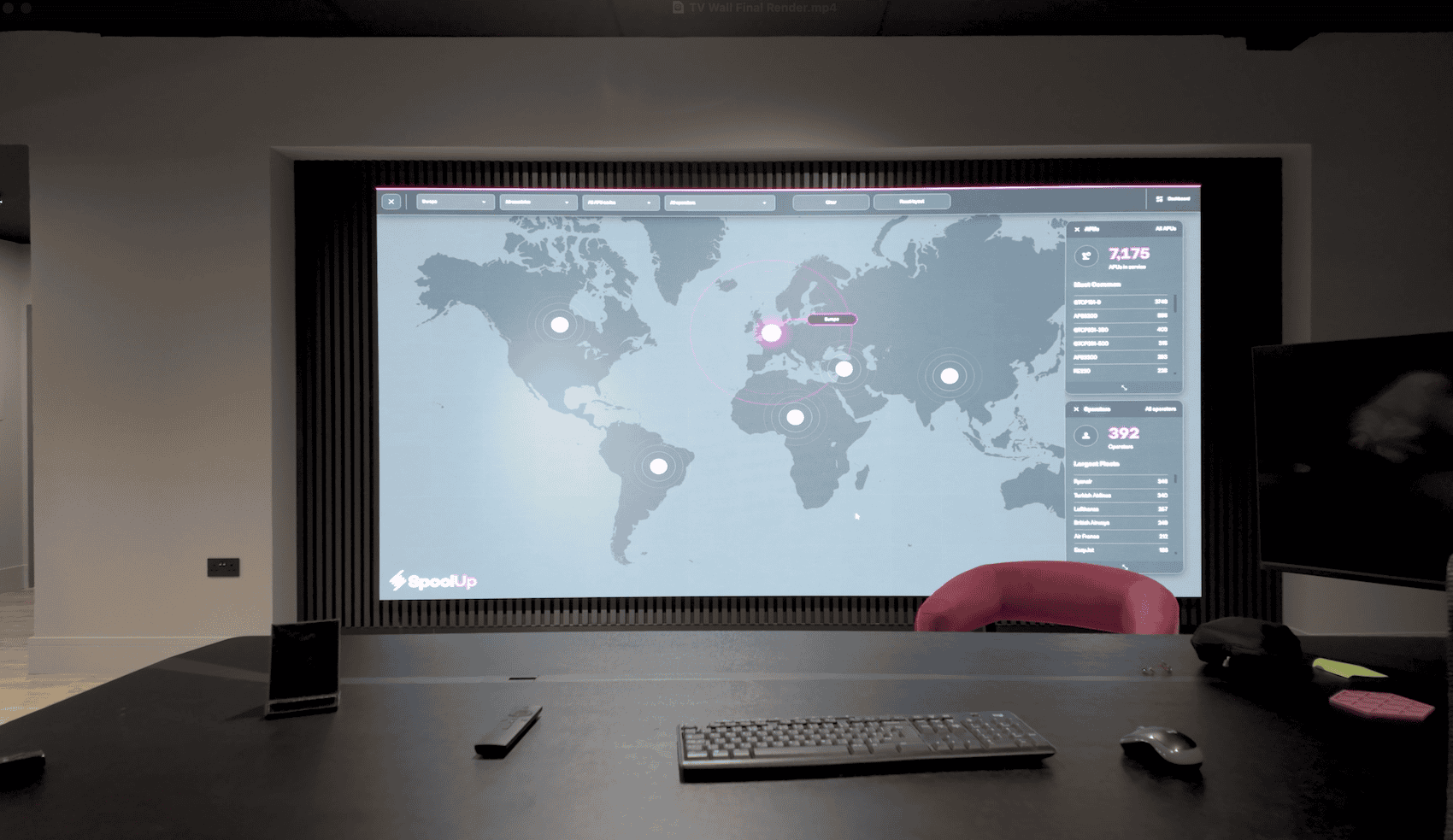
Boardrooms, reception feature walls, town-hall presentation spaces, and experience centres. Fine-pitch screens (P1.2–P2.5) dominate here, paired with simple CMS or room-booking integration. A recent example: Spool Up, a Winchester-based tech company, commissioned Dynamo to install a 4m × 2m DX Series P1.9mm LED video wall in their boardroom. With a minimum viewing distance of 1.5–3m, the P1.9mm pitch delivers crisp detail for presentations and video calls — and the front-serviceable cabinets mean any future module replacement takes minutes, not days. See the full Spool Up Winchester case study. We have published a detailed guide on office LED video wall installations, covering common layouts, structural considerations, and integration with corporate AV systems.Architectural and Feature Installations
LED technology increasingly appears in architectural contexts — integrated into building facades, atriums, and sculptural features. Dynamo’s installation at 40 Leadenhall Street in the City of London is a strong example: bespoke LED arches built into the building’s entrance lobby, creating an immersive digital experience for tenants and visitors. These architectural applications demand close collaboration between LED specialists, architects, and structural engineers from the earliest design stages.Retail and Hospitality
Window displays, in-store feature walls, menu boards, hotel lobbies, and restaurant ambience screens. Retail applications often require high brightness (1,500+ nits for window-facing) and robust content scheduling. Transparent LED and poster-format screens are increasingly popular for retail windows where natural light must be preserved.Events and Hire
Concert stages, conference backdrops, exhibition stands, award ceremonies, and corporate events. Event LED is designed for rapid build and strike — lightweight cabinets with quick-lock connectors, flight-case packaging, and touring-grade durability. If you need screens for a single event or a seasonal campaign, LED screen hire often makes more financial sense than a permanent purchase.Broadcast and Studios
Virtual production (VP) stages, news studio backgrounds, and on-set LED volumes. These applications demand high refresh rates (3,840Hz+), excellent colour accuracy, and moiré-free performance on camera. Genlock and frame-sync capabilities are essential for broadcast-quality output.Transport and Public Space
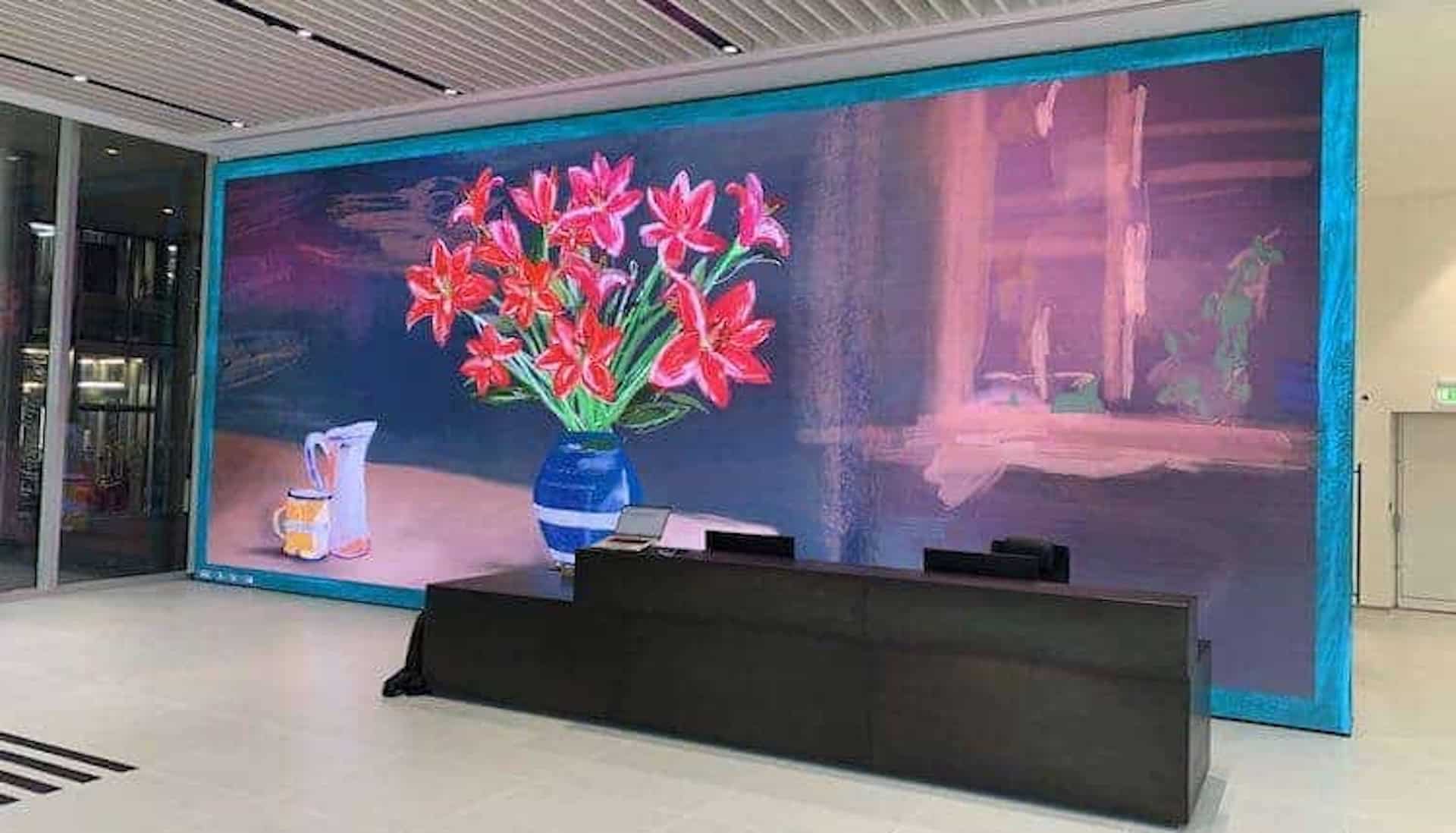
Airport departure boards, train station information displays, wayfinding totems, and municipal signage. Reliability and remote management are priorities — screens in these environments run 18–24 hours a day and must be serviceable without specialist access equipment. Dynamo’s Citypoint London installation — a 10.88m × 4.68m LED wall displaying dynamic digital art in a busy commercial atrium — is a strong example of a high-footfall, continuous-operation deployment in a public-facing space.What to Look for When Specifying an LED Video Wall
Beyond pixel pitch and screen size, several specifications separate a reliable installation from a problematic one.Brightness (Nits)
Brightness is measured in nits (candelas per square metre). According to AVIXA display specification guidelines, minimum brightness levels for comfortable viewing in different environments are: 800–1,200 nits for fully indoor controlled-lighting environments; 2,500–5,000 nits for semi-outdoor or high-ambient-light spaces (shop windows, glass-roofed atriums); and 5,000 nits minimum — ideally 6,000–8,000+ — for full outdoor installations. Specifying insufficient brightness results in a washed-out image. Specifying too much wastes energy and accelerates LED degradation.Refresh Rate
Refresh rate determines how many times per second the image is redrawn. For direct human viewing, 1,920Hz is acceptable. For any environment where the screen will be filmed or photographed (events, broadcast, retail with social media activity), specify 3,840Hz or higher to eliminate visible scan lines on camera.IP Rating
The Ingress Protection rating tells you what the screen can withstand. IP20 means no water or dust protection (indoor only). IP54 handles dust ingress and splashing water. IP65 is fully dust-tight and can withstand water jets — the minimum for outdoor permanent installations. IP68 means full immersion protection, used for in-ground or water-feature applications.Serviceability
How will faulty modules be replaced? Front-serviceable cabinets allow a technician to swap a module from the viewing side using a suction tool or magnetic key — essential when the screen is mounted flush against a wall with no rear access. Rear-serviceable designs require access behind the screen, which means either a maintenance corridor or the ability to swing cabinets open on hinges. If your installation has no rear access, front serviceability is non-negotiable. Confirm this before procurement — retro-fitting access is far more expensive than specifying correctly upfront.Colour Calibration and Uniformity
LED cabinets from the same production batch should be closely matched in colour and brightness. Over time, LEDs age at slightly different rates, causing visible inconsistencies across the wall. A proper LED display calibration regime — both at installation and periodically thereafter — keeps the image uniform across the entire surface.What to Specify: A Decision Framework
If you’re planning an LED video wall, these are the questions to answer early:1. Where will it be installed?
- Indoor or outdoor? This determines IP rating requirements, brightness, and cabinet type.
- What is the ambient light level? Bright atriums and outdoor locations need higher brightness (3,000+ nits). Controlled indoor environments can use 800–1,500 nits.
- What are the structural constraints? Wall-mounted, freestanding, recessed, ceiling-hung, or floor-mounted? This affects cabinet type, weight limits, and access for maintenance.
2. What is the viewing distance?
This determines pixel pitch. Don’t guess — measure the actual distance from the nearest and furthest expected viewer positions.3. What content will be displayed?
- Video only? More forgiving on pixel pitch.
- Text-heavy (tickers, data)? Requires tighter pitch for legibility.
- Interactive? Requires touch overlay or sensor integration.
- Multiple sources simultaneously? Requires a capable video processor.
4. What resolution do you need?
Resolution is calculated from the number of cabinets and their pixel count — not from the screen’s physical size alone. A common mistake is assuming that a larger screen automatically means higher resolution. It doesn’t. A 10 m² screen at P3.9 will have a lower resolution than a 5 m² screen at P1.5.5. How will it be maintained?
- Front access or rear access? If the screen is flush-mounted against a wall with no rear access, front-serviceable cabinets are essential.
- What is the service response time requirement? Mission-critical installations (broadcast, trading floors) need faster response than a restaurant feature wall.
6. What is the total budget?
Not just the panels. The total cost of an LED video wall includes:- LED cabinets
- Mounting structure / framework
- Control system (sending card, receiving cards, video processor)
- Media server or content management system
- Installation labour and equipment (scaffolding, access platforms)
- Commissioning and calibration
- Content creation
- Ongoing maintenance and warranty
How Much Does an LED Video Wall Cost in the UK?
Cost is the most searched follow-on question — and for good reason. LED video wall pricing varies significantly based on pixel pitch, screen size, environment (indoor vs outdoor), and installation complexity. Here are realistic indicative ranges for UK supply-and-install projects in 2025–2026:| Product Type | Pixel Pitch | Indicative Cost (per m², supply & install) |
|---|---|---|
| Indoor fine pitch — boardroom/reception | P1.2 – P2.0 | £3,500 – £6,000/m² |
| Indoor standard — conference/retail | P2.5 – P4 | £1,500 – £3,500/m² |
| Outdoor permanent — building-mounted | P4 – P10 | £2,500 – £5,500/m² |
| Event/hire grade — touring | P2.5 – P4 | £500 – £1,500/day hire (size dependent) |
Total Cost of Ownership
The purchase price of the LED hardware is only part of the story. A realistic total cost of ownership (TCO) calculation over 7–10 years should include:- Hardware — LED cabinets, video processor, sending cards, cabling
- Structural work — mounting frame, any building modifications, power supply upgrades
- Installation — rigging, commissioning, calibration
- Content management — CMS software (cloud or on-premise), media player hardware
- Energy consumption — a 10m² indoor wall at average content brightness might draw 1.5–3kW; outdoor walls draw significantly more
- Maintenance — spare modules (we recommend keeping 5–10% stock), periodic recalibration, cleaning
- Insurance and warranty — extended warranty options vs self-insuring with spare stock
Considering an LED video wall for your next project? We design, supply, install, and maintain LED video walls across the UK — from single-screen boardroom walls to multi-screen control rooms and large-format outdoor displays. Call us on +44 (0)203 489 9878 or get in touch online for a specification consultation.
From the Field — Daniel Reynolds, Dynamo LED Displays
After years of specifying and installing LED video walls across every type of environment — from compact office meeting rooms to outdoor festival stages — the single biggest lesson I’d pass on is this: get the pixel pitch and viewing distance right first, and most other decisions fall into place. On a recent lobby project, the client wanted P1.2 because it was “the best.” We moved them to P1.9 and used the saving to double the screen size. The visual impact was dramatically better, because in that space, nobody stands closer than 3 metres anyway. The tighter pitch would have been wasted resolution — and the larger screen commanded the room in a way the smaller one never could. The other thing I always emphasise is serviceability. A video wall is a long-term asset. At some point, a module will need replacing — that is normal. The question is whether your installation makes that a 20-minute job or a full-day exercise involving scaffolding. We design every installation with maintenance access in mind from day one. The panels are only one part of the system. Without proper processing, calibration, and content management, even the finest LED wall will look mediocre. We always spec the full signal chain — from source to screen — because that’s where the difference between a good installation and a great one actually lies. Two projects I return to when making this point: the Spool Up Winchester boardroom wall (P1.9mm, 4m × 2m, front-serviceable in under 30 minutes) and the Citypoint digital art wall in London (10.88m × 4.68m, running continuously as a public artwork installation). Both were specified with maintenance and longevity at the centre of the design process — not as an afterthought.Frequently Asked Questions
How long does an LED video wall last?
Most quality LED video walls are rated for 100,000 hours to 50% brightness, which translates to roughly 11 years of continuous 24/7 operation. In practice, screens running 12–16 hours per day in corporate or retail settings can deliver 15–20 years of usable service with proper maintenance and periodic calibration.What is the best pixel pitch for a boardroom LED video wall?
For a typical boardroom where the closest viewer sits 2–3 metres from the screen, a pixel pitch between P1.2 and P1.8 delivers excellent image clarity. Going finer than P1.2 is rarely justified unless presenters stand directly beside the screen and the audience needs to read fine detail at close range.How much does an LED video wall cost in the UK?
Indicative UK supply-and-install costs range from approximately £1,500/m² for standard indoor pitch (P2.5–P4) up to £6,000/m² for ultra-fine pitch boardroom or control room screens (P0.9–P1.5). A small boardroom wall (2m × 1.5m) might total £12,000–£18,000 all-in; a large reception feature wall (5m × 3m) might run £30,000–£55,000. Outdoor LED walls carry a premium for weatherproofing and higher brightness components. Contact us for a project-specific quote.Can LED video walls be used outdoors?
Yes, but you must use outdoor-rated products with a minimum IP65 rating. Outdoor LED screens are engineered with sealed cabinets, higher brightness (5,000+ nits), active cooling, and corrosion-resistant materials. Installing an indoor-rated screen outdoors will result in rapid failure from moisture ingress and overheating.How much power does an LED video wall consume?
Power consumption varies by pixel pitch, brightness setting, and content. A typical 10m² indoor LED wall at average content brightness draws approximately 1.5–3kW. Outdoor screens at full brightness can draw 4–8kW for the same area. Energy cost should be factored into your total cost of ownership calculation.What is the difference between an LED video wall and an LCD video wall?
An LED video wall uses self-emitting LED modules tiled seamlessly together with no visible gaps. An LCD video wall uses multiple LCD panels tiled together, each with a visible bezel (typically 0.88–3.5mm). LED walls are brighter, last longer, and have no distracting grid lines — but cost more upfront for smaller installations.Do LED video walls need maintenance?
Yes. Routine maintenance includes periodic recalibration to maintain colour uniformity, cleaning the screen surface, checking power supplies and data connections, and holding a small stock of spare modules (typically 5–10% of total) for quick swaps if individual modules develop faults. A well-maintained wall requires minimal intervention.Can an LED video wall display 4K or 8K content?
An LED video wall can absolutely display 4K (3840×2160) or even 8K content — provided the total pixel count of the wall matches or exceeds the source resolution. For example, a 4K-native wall using P1.5 modules would measure approximately 5.76m × 3.24m. The video processor must also support the input resolution.How thick is an LED video wall?
Indoor LED cabinets are typically 50–100mm deep, depending on the product range. With a mounting frame, total wall depth is usually 80–150mm. This is significantly shallower than a rear-projection cube (which requires a metre or more of depth) and comparable to LCD panels, making LED suitable for flush wall-mounted installations.What is the difference between an LED video wall and an LED TV?
An LED TV (such as a Samsung or LG consumer television) uses an LCD panel with an LED backlight. An LED video wall uses direct-view LED technology — each pixel is a self-emitting LED, with no backlight or LCD layer. LED video walls are modular (built to any size), seamless, significantly brighter, and designed for commercial use with 100,000+ hour lifespans.Can an LED video wall be curved?
Yes. Many LED cabinet systems support concave and convex curves. Flexible LED modules can achieve even tighter radii. Dynamo has delivered curved LED installations including circular columns, concave feature walls, and custom arched displays. The key constraint is that curved assemblies require careful mechanical planning and often custom mounting structures.How long does it take to install an LED video wall?
Installation time depends on screen size, access conditions, and structural requirements. A straightforward 10 m² indoor wall-mounted installation typically takes 2–3 days including framework, cabling, panel installation, and basic commissioning. Complex installations (curved, recessed, outdoor, multi-storey) can take 1–4 weeks. Proper site survey and planning are essential to avoid delays.Conclusion
An LED video wall is a serious, long-term investment in visual communication — whether you are outfitting a corporate headquarters, a retail flagship, a broadcast studio, or a public space. The technology is mature, proven, and increasingly cost-effective, but only if specified correctly for the environment and viewing conditions. Get the fundamentals right — pixel pitch matched to viewing distance, appropriate brightness and IP rating for the environment, front or rear serviceability planned from day one, and a realistic total cost of ownership calculation — and an LED video wall will deliver outstanding performance for a decade or more.Ready to specify your LED video wall? Whether you are at concept stage or ready to procure, we can help with specification, design, supply, installation, and ongoing support. Call +44 (0)203 489 9878 or contact us online to discuss your project.
Sources & Further Reading
- Pixel pitch — Wikipedia — technical definition and calculation methodology
- AVIXA (Audiovisual and Integrated Experience Association) — industry standards for AV display specifications and installation
- LED display technology — Wikipedia — overview of LED display construction and technology types
- NovaStar Technology — LED video wall controller and processing systems documentation
- Society for Information Display (SID) — display industry research and technical standards
Related Guides
- Indoor LED Displays: Complete Guide
- Outdoor LED Displays: Complete Guide
- Transparent LED Displays: Complete Guide
- Flexible LED Screens: Complete Guide
- How Much Does an LED Video Wall Cost in the UK?
- LED Display Companies UK
- Kinetic LED Hire UK
- Request a quote
Compare direct view LED pitches and flexible alternatives: 1.5mm fine-pitch (P1.5) · 2.5mm Direct View (P2.5) · 3mm Direct View (P3) · 4mm Direct View (P4) · L-V-W FlexCurtain (flexible mesh).
Related reading: What is an LED Virtual Production Studio?.