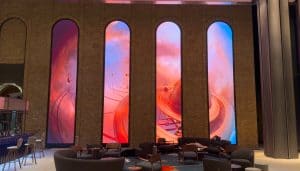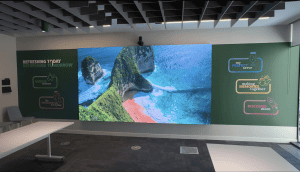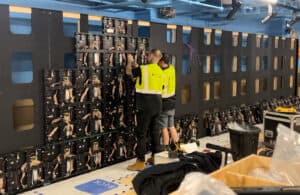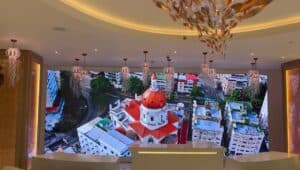
A transparent LED display mounts LEDs on narrow strips, mesh or film so that 60–90% of the light still passes through the glass. It turns shop windows and glass façades into full-colour screens without blocking the view or the daylight, which is why UK architects and retailers specify it where an opaque LED wall would not be acceptable.
Updated September 2026. First published April 2026.
This guide covers how transparent LED displays work, the three construction types, where each performs, the numbers that matter on a datasheet and what to plan for before you specify one. Dynamo LED Displays supplies and installs transparent LED displays across the UK, and the advice below comes from those projects.
We have designed, supplied and installed transparent LED systems across retail flagships, corporate headquarters and architectural landmarks, and this guide draws on that hands-on experience rather than on catalogue copy.
Transparent LED Display — Key Takeaways
- Transparent LED displays maintain 60–90% optical transparency while delivering vivid digital content visible in daylight conditions.
- Three main types exist: adhesive LED film for glass, aluminium strip transparent panels, and LED mesh — each suited to different applications and budgets.
- Typical pixel pitches range from 2.6mm to 20mm+, with finer pitches suited to close-viewing retail and coarser pitches for large architectural façades.
- Brightness levels of 3,000–6,000 nits make transparent LED viable for south-facing and outdoor-facing glass installations.
- Installation complexity varies significantly by type — film LED can retrofit onto existing glass, while strip systems often require structural planning from the outset.
- Transparent LED is not a replacement for standard LED video walls — it is a complementary technology best used where visibility through the screen matters.
Quick Definitions
New to transparent LED? These five terms come up constantly — here is what they mean in plain language.
- Transparency percentage: The proportion of a panel’s surface area that is open to light. A 70% transparent panel has 70% open space and 30% occupied by LED strips, wiring, and PCB. Higher means more see-through; lower means higher pixel density.
- Nits: The unit of brightness. One nit equals one candela per square metre. Direct sunlight is around 100,000 nits. A bright office monitor is 300–500 nits. Transparent LED panels typically run at 3,000–6,000 nits to compete with daylight coming through glass.
- Pixel pitch: The distance in millimetres between the centre of one LED cluster and the next. A lower number means higher resolution and a finer image. P2.6 means LEDs are 2.6mm apart; P10 means 10mm apart. Choose based on how close viewers will stand.
- Strip LED: The most common transparent LED construction. Narrow aluminium or PCB strips — typically 2–4mm wide — carry the LEDs. The gaps between strips create transparency. Durable, bright, and proven at scale.
- Mesh LED: A flexible net or curtain of cables with LED nodes at each junction. Achieves the highest transparency rates (85%+) and is designed for very large outdoor installations — building wraps, stage backdrops, façades — where viewing distances are long.
What Is a Transparent LED Display?
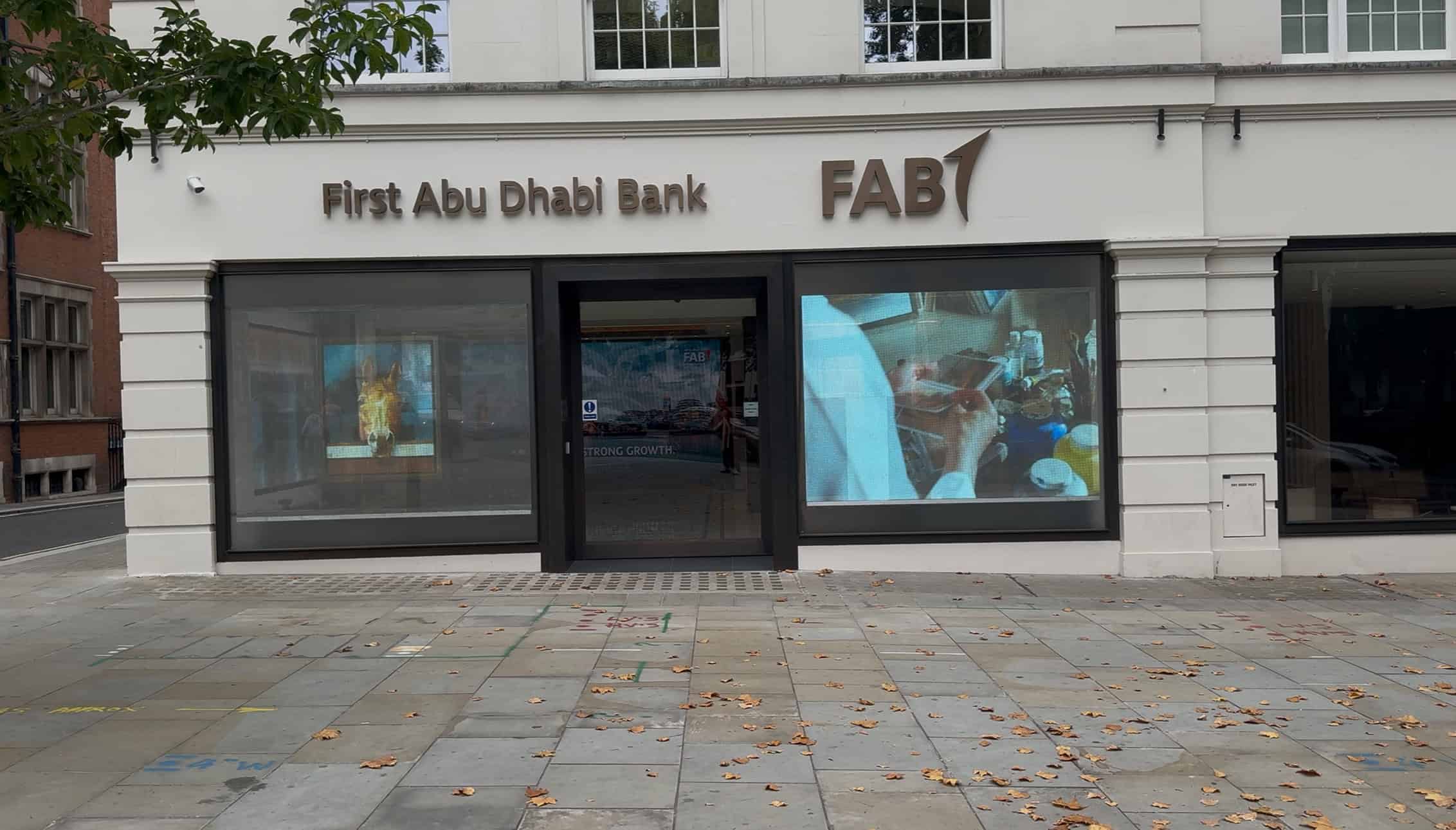
A transparent LED display is a digital screen that mounts LEDs on a see-through substrate — strips, mesh, or ultra-thin film — allowing 60–90% of light to pass through while displaying full-colour video and graphics. It turns glass surfaces into dynamic media canvases without blocking the view behind them.
A transparent LED display is built on a see-through substrate that allows light and visibility to pass through it. Unlike conventional LED panels that use solid cabinet backs, transparent LED uses strips, mesh, or ultra-thin film to mount LEDs with large gaps between them, achieving transparency rates of 60–90% while still displaying bright, full-colour video and graphics.
The concept is straightforward: mount LEDs on narrow conductors spaced far enough apart that the human eye perceives the gaps as open space. When the display is off, it looks like tinted or lightly patterned glass. When it is on, content appears to float in mid-air against whatever sits behind — a shop interior, a cityscape, a building atrium.
This is fundamentally different from projection or OLED-based transparent displays. Projection requires controlled ambient light. OLED transparent screens exist but remain small-format and extraordinarily expensive at scale. LED-based transparent displays are the only technology currently viable for large-format architectural and retail applications, with proven installations spanning hundreds of square metres.
How Transparent LED Technology Works
All transparent LED displays share the same core principle: mounting surface-mount device (SMD) LEDs onto a substrate that is mostly open space. The engineering challenge is maintaining structural rigidity, electrical connectivity, and thermal management while maximising the ratio of open area to occupied area.
Strip-Based Architecture
The most common approach uses narrow aluminium or PCB strips — typically 2–4mm wide — running vertically or horizontally. LEDs are soldered onto these strips at regular intervals. The strips connect to a frame at top and bottom, with power and data cables routed along the edges. Because each strip is narrow, the gaps between them allow light through freely.
Film-Based Architecture
LED film takes a different approach. A flexible, transparent polymer substrate (typically 1–3mm thick) carries microscopic LED clusters connected by near-invisible conductive traces. The entire film adheres directly to glass, much like window tinting film. This makes it the lightest and least structurally invasive option, though pixel density and brightness are generally lower than strip-based systems.
Mesh Architecture
LED mesh uses a flexible net of cables or thin bars with LEDs at each node. It is predominantly used for very large outdoor installations — building wraps, concert stage backdrops, and stadium façades — where viewing distances are long and ultra-fine resolution is unnecessary.
Transparency Percentage
Transparency is measured as the ratio of open area to total panel area. A panel rated at 70% transparency means 70% of its surface is open to light transmission, and 30% is occupied by LED strips, PCBs, and wiring. This is a physical measurement, not a marketing figure — though it is worth noting that real-world perceived transparency also depends on viewing angle, ambient lighting, and the colour and reflectivity of the strips themselves.
Transparency Percentage — What Does 70% Transparency Mean in Practice?
The headline transparency figure is useful for comparison, but it does not tell the whole story. Here is what matters in practice:
Light transmission: A 70% transparent LED panel lets through roughly 65–70% of available daylight. In most commercial glazing applications, the glass itself already reduces light transmission to 60–75%, so adding a transparent LED layer on top brings total light transmission down to approximately 40–55%. That is comparable to medium-tint solar glass — noticeable but not oppressive.
Visual perception: The human eye is remarkably good at “seeing through” regular patterns. Thin vertical strips spaced evenly become visually negligible at distances beyond 2–3 metres. At 5 metres and beyond, a quality 70% transparent display is effectively invisible when switched off. When displaying content, the eye focuses on the illuminated pixels and the background simultaneously — creating the characteristic “floating image” effect.
The trade-off: Higher transparency means wider gaps between LEDs, which means lower pixel density for any given pixel pitch. A display with 85% transparency and a 10mm pixel pitch will look noticeably more “gappy” up close than a 65% transparent display with the same pitch. Specifiers need to balance transparency requirements against viewing distance and content type. Photographic content demands tighter pixel pitches and accepts lower transparency. Simple motion graphics and text tolerate higher transparency and wider pitches.
In plain terms: Think of 70% transparency like tinted car glass — you can see through it clearly, but it is not entirely invisible. At comfortable viewing distances, the LED strips disappear and you see content floating against whatever is behind the screen. The higher the transparency rating, the more “open” the screen feels — but the lower the image resolution you will achieve for a given size.
We always recommend seeing a sample panel in the actual installation environment before committing. Catalogues and datasheets cannot replicate the experience of viewing a transparent LED through the specific glass, at the actual distance, in the real ambient light. Ask for a sample panel before you commit; we bring them to site.
Types of Transparent LED Display
Glass-Mounted LED Film
LED film is the thinnest and lightest transparent display option, typically weighing under 1kg per square metre. The film is applied directly to the interior surface of existing glass using optical adhesive — no structural modifications needed. This makes it ideal for retrofit projects where the glazing is already in place.
Best for: Retail window displays, corporate reception glass, hotel lobby partitions, museum showcases. Projects where minimal visual impact when off is the priority.
Limitations: Pixel pitches are typically coarser (8mm+), brightness is lower (2,500–4,000 nits compared to 5,000+ for strip types), and the technology is still maturing. Longevity data is more limited than for established strip systems.
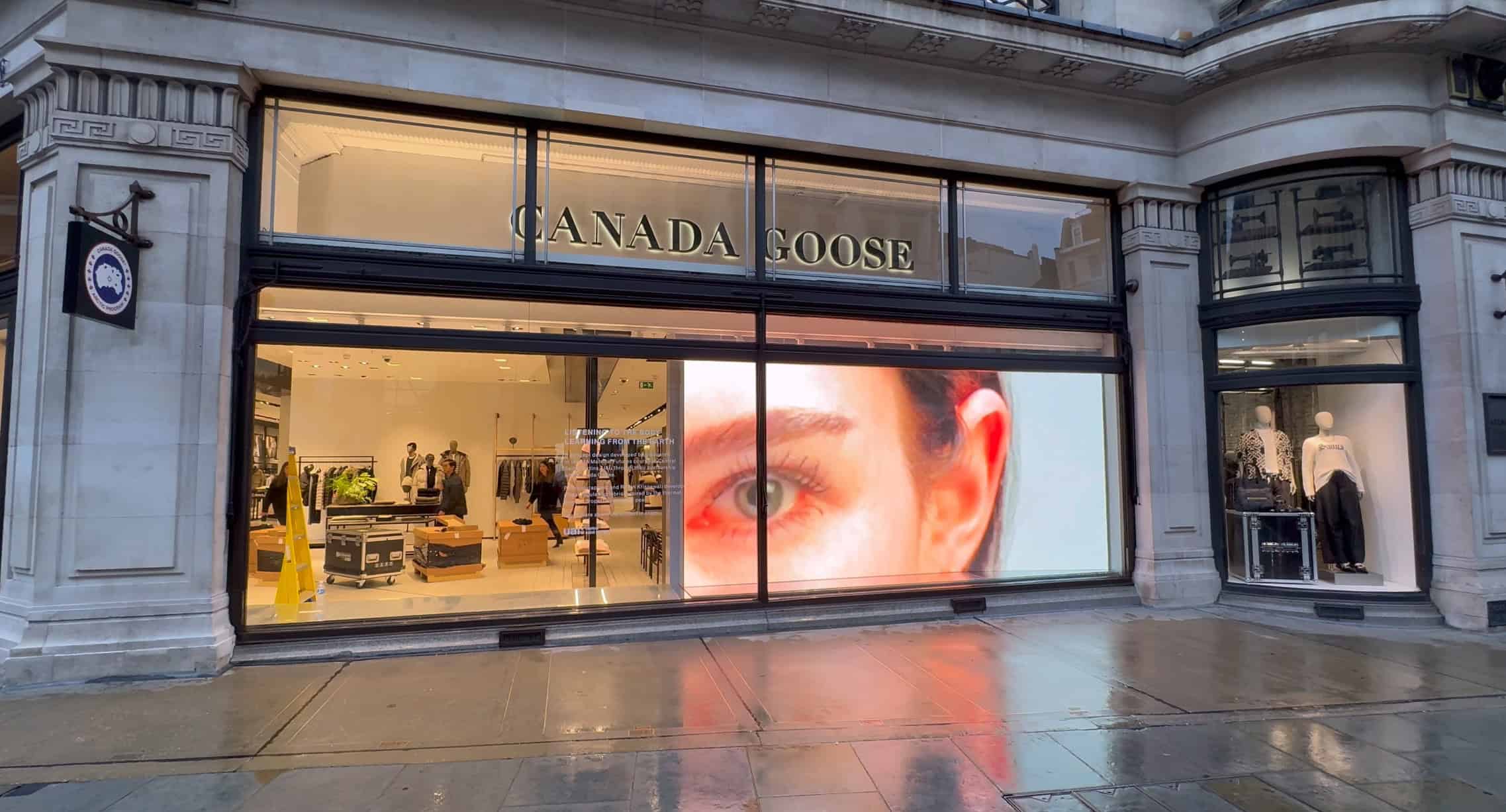
In one of our most-cited UK transparent LED projects, we installed a 5m × 2.5m P2.6mm display across the full window frontage of Canada Goose’s Regent Street flagship — running daylight-bright branded content without obscuring the interior. The result demonstrates exactly how window-mounted LED can transform a high-end retail frontage while preserving the sightline into the store.
Aluminium Strip Transparent LED
This is the workhorse of the transparent LED market. Rigid aluminium strip panels offer a proven combination of brightness (up to 6,000+ nits), fine pixel pitch options (from 2.6mm), good thermal performance, and well-established manufacturing quality. Panels come in standardised sizes (commonly 1000 x 500mm or 500 x 500mm) and lock together to create seamless large-format installations.
Best for: Architectural glass façades, large retail windows, airport terminals, shopping centre atriums, corporate lobbies. Anywhere you need reliable, high-brightness, long-lifespan performance.
Limitations: Heavier than film (typically 8–15kg/m²), requires mounting rails or a supporting structure behind or within the glazing cavity, and installation needs planning during the fit-out phase. Retrofit into existing glass is possible but more complex than film.
LED Mesh
Mesh screens use flexible curtains of cabling with LED nodes, achieving transparency rates above 85% and covering very large areas at relatively low weight. They are designed for long viewing distances — think building-wrap advertising, concert touring, or outdoor architectural accent lighting.
Best for: Building exteriors, large-scale media façades, outdoor events, stage backdrops.
Limitations: Coarse pixel pitch (10mm+ minimum, often 20–40mm), lower resolution, and generally not suitable for close-viewing retail or indoor environments where content detail matters.
Applications: Where Transparent LED Displays Work Best
Retail Shop Windows
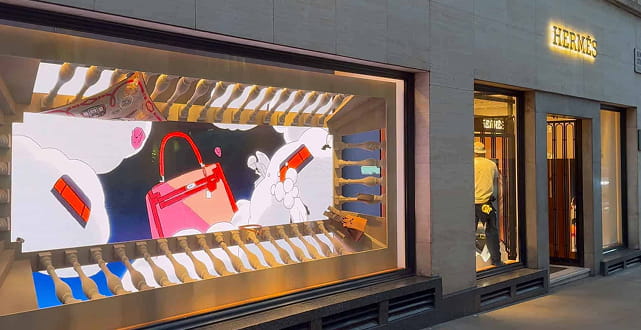
The most common application in the UK market. Transparent LED transforms a static shop window into a programmable media surface while keeping the view into the store open. Luxury brands, automotive showrooms, estate agents, and high-street flagships use transparent LED to run promotions, brand films, and seasonal campaigns without blocking natural light or obscuring product displays.
For a deeper look at how to approach LED in a retail environment, our retail LED display buying guide covers the broader decision-making process.
Architectural Glass Façades
This is where transparent LED scales dramatically. Entire building façades can become digital surfaces — running architectural lighting patterns at night, corporate branding during business hours, and public art or wayfinding content as needed. On the MOL Campus in Budapest, transparent LED was integrated into the building’s glass facade — with 70% transparency maintained, the architectural character of the building was completely preserved while delivering dynamic content visible from the surrounding plaza.
Hospitality and Leisure
Hotels, restaurants, and bars use transparent LED for ambient media walls, room dividers, and exterior signage. The see-through quality avoids the “TV on the wall” look that can cheapen high-end interiors.
Museums and Galleries
Transparent LED allows curators to overlay digital content onto physical exhibits — timelines on glass cases, contextual video behind artefacts, interactive wayfinding on glass partitions — without blocking sightlines or creating visual clutter.
Transport Hubs
Airports, train stations, and bus terminals use transparent LED for wayfinding and advertising across large glass surfaces without reducing natural light in spaces designed to feel open and airy.
Corporate and Commercial
Boardrooms with glass walls, reception areas, meeting room dividers — transparent LED adds a technology layer to modern office design that impresses clients and enables dynamic information display.

Transparent LED vs Standard LED Video Walls — When to Choose Each
Transparent LED is not better or worse than a standard LED video wall — it is a different tool for a different job. Here is how they compare:
| Feature | Transparent LED | Standard LED Video Wall |
|---|---|---|
| Transparency | 60–90% | 0% (opaque) |
| Typical pixel pitch | 2.6mm – 20mm+ | 0.9mm – 4mm |
| Brightness | 3,000 – 6,000 nits | 600 – 5,000 nits |
| Weight per m² | 1 – 15 kg | 25 – 45 kg |
| Best viewing distance | 3m+ (varies by pitch) | 1m+ (fine pitch) |
| Content detail | Good for graphics, text, motion; limited for fine photography | Excellent for all content types |
| Rear access | Front-serviceable or rear-rail | Typically rear-access required |
| Structural load | Low to moderate | Moderate to high |
| Natural light | Maintained | Blocked entirely |
| Best use case | Glass surfaces where visibility matters | Dedicated display walls, control rooms, stages |
Choose transparent LED when: The installation surface is glass or a surface where see-through visibility is essential. The content is brand messaging, wayfinding, architectural patterns, or promotional graphics rather than detailed video. The space benefits from natural light.
Choose standard LED when: Maximum visual impact and content fidelity are the priority. The screen replaces a wall rather than augmenting a window. Close viewing distances demand fine pixel pitch. Budget per square metre is a primary constraint.
Key Specifications to Understand
When evaluating transparent LED products, these are the numbers that actually matter:
Pixel Pitch
The distance (in millimetres) between the centre of one LED cluster and the next. Smaller numbers mean higher resolution. For retail windows viewed from 2–5 metres, pitches of 3.9–7.8mm work well. For architectural façades viewed from 10 metres or more, 10–20mm pitches are common and cost-effective. Understanding pixel pitch in context is crucial — our LED display calibration guide covers how to optimise image quality once installed.
Brightness (Nits)
Transparent LED needs to compete with daylight passing through the glass. For south-facing or west-facing windows, 5,000+ nits is advisable. For north-facing or shaded positions, 3,000–4,000 nits may suffice. LED film typically maxes out around 4,000 nits; aluminium strip systems reach 5,500–6,500 nits. Dynamo’s own DGN transparent LED glass shows the trade-off on its datasheet: the P6 panel runs 2,500–3,000 nits at 85% transparency, while the P8 panel reaches 4,500–5,000 nits at 90%, so brightness and transparency do not have to be traded one for one.
Transparency Rate
As discussed above, 60–90% is the typical range. Higher is not always better — it depends on the content requirements and viewing distance. We typically recommend 65–75% for retail and 75–85% for architectural applications.
Weight per Square Metre
Critical for glass-mounting applications. LED film: under 1kg/m². Aluminium strip panels: 8–15kg/m². Mesh: 3–8kg/m². The building’s structural glazing specification will determine what the glass can support. For heavier systems, independent mounting rails behind the glass are usually required.
Panel Dimensions and Modularity
Most strip-based transparent LED comes in modular panels — commonly 1000 x 500mm — that tile together. Custom sizes are available but increase lead times and cost. Film LED can be cut to size more flexibly. Planning the layout around standard module sizes saves budget and simplifies maintenance.
IP Rating
IP ratings follow BS EN 60529. For indoor installations behind glass, IP30 or IP40 is standard. For outdoor-facing mesh or exposed installations, IP65 front / IP54 rear is the minimum. Condensation within glazing cavities is a real concern — ventilation or dehumidification may be needed in double-glazed configurations.
Installation Considerations
Glass Compatibility
Not all glass is suitable. Key factors include:
- Glass thickness: Film LED typically works on glass 6mm and above. Strip systems need structural support independent of the glass unless the glass is laminated and rated for the load.
- Tinting and coatings: Low-E coatings and heavy tints reduce rear visibility and can interfere with the perceived transparency. Test with samples.
- Double glazing: Film applies to the inner pane surface. Strip systems typically mount in the cavity or on the interior face. Cavity mounting creates thermal management challenges.
- Curved glass: Film LED handles gentle curves well. Strip panels are rigid — curved applications need custom-radiused panels, which add cost and complexity — or a flexible LED screen where the curve is tighter.
Power Supply and Cabling
Transparent LED draws 150–400W per square metre at full brightness (content-dependent). Power supplies are typically located at the top or bottom of the installation, behind a pelmet or within a ceiling void. Cable routing needs planning early — retrofitting power runs to a completed glass façade is expensive and disruptive.
Thermal Management
Unlike standard LED cabinets with dedicated cooling fans, transparent LED relies primarily on passive convection through the open structure. This works well in ventilated spaces. In sealed glazing cavities or poorly ventilated locations, temperatures can build up, reducing LED lifespan and causing brightness issues. We always model the thermal environment before confirming a system specification.
Content and Control
Transparent LED accepts standard video inputs via a media player or content management system (CMS). Most systems use a dedicated sending box fed from an HDMI or network source. Content needs to be designed for the medium — high contrast, bold graphics, and minimal fine text work best. Dark content elements appear transparent, which is part of the magic — and part of the creative challenge.
Maintenance and Access
LED modules should be front-serviceable where possible, especially in glass-mounted applications where rear access is limited. Film LED is more difficult to service — damaged sections typically require re-application. Strip and mesh systems use modular LED bars that can be individually replaced. Plan for cleaning access too — dust accumulation on LED strips reduces brightness and colour accuracy over time.
What Five Years of Transparent LED Installations Teaches You
“We have been specifying and installing transparent LED for several years now, and the single biggest lesson is this: get samples on site early. No amount of datasheet reading replaces seeing a panel mounted on your actual glass, in your actual lighting conditions. I have seen projects where the architect specified a product based on catalogue images and the result was disappointing — not because the product was bad, but because the glass tint, the background lighting, and the viewing distance were all different from what they imagined.”
“The other thing I would say is: work with your content creator from the start. Transparent LED is not a television. Content designed for opaque screens looks wrong on transparent — you need to design for the transparency, using negative space and high-contrast elements deliberately. The transparent LED installations that have gone most smoothly for us are the ones where the AV integrator, the architect, and the content designer were all in the room together from week one.”
— Daniel Reynolds, Founder, Dynamo LED Displays
Transparent LED displays: frequently asked questions
What is a transparent LED display?
A transparent LED display is a screen technology that mounts LEDs on a see-through substrate — either adhesive film, aluminium strips, or mesh — allowing 60–90% of light to pass through. It transforms glass surfaces into digital displays while maintaining visibility and natural light transmission.
How transparent are transparent LED screens?
Most transparent LED screens achieve 60–90% transparency, measured as the percentage of open area across the panel surface. In practice, perceived transparency depends on viewing distance, ambient light, and strip colour. At distances beyond 3–5 metres, quality transparent LED is nearly invisible when displaying dark or no content.
Can transparent LED displays be used outdoors?
Yes, with the right specification. Mesh LED is designed for outdoor use and typically rated IP65. Indoor strip and film types can be used behind glass facing outdoors — the glass provides weather protection while the LED delivers daylight-readable brightness. Fully exposed outdoor transparent panels exist but require higher IP ratings and robust build quality.
What is the pixel pitch of transparent LED?
Transparent LED pixel pitches typically range from 2.6mm (fine pitch, close viewing) to 20mm+ (mesh, long viewing distances). The most common pitches for retail and commercial applications are 3.9mm, 7.8mm, and 10.4mm. Finer pitches deliver better image detail but reduce transparency and increase cost per square metre.
How is transparent LED film installed on glass?
LED film is applied to the interior surface of glass using optical-grade adhesive, similar to window tinting. The glass must be clean, dry, and free of coatings that prevent adhesion. Power and data cables route to the film edges and connect to a controller, typically concealed within the window frame or ceiling void. Professional installation takes a few hours per panel.
What are the main applications of transparent LED displays?
The most common applications include retail shop windows, architectural building façades, corporate reception areas, hotel lobbies, museum and gallery showcases, airport and transport terminals, and restaurant or bar frontages. Any glass surface that would benefit from digital content without losing transparency is a potential application.
How much does a transparent LED display cost in the UK?
Transparent LED display costs in the UK range from approximately £2,000 per square metre for transparent LED film to £5,000 or more per square metre for modular transparent LED panel systems. All prices exclude VAT. Final cost depends on pixel pitch, panel type, structural requirements, and installation complexity.
What is the transparency percentage of transparent LED displays?
Most transparent LED displays sit between 60% and 90% transparency. Dynamo’s DGN transparent LED glass is rated 85% (P6), 90% (P8) and 93% (P10) on its datasheet. Higher transparency means wider LED spacing, so resolution falls: fine-pitch strip panels for close-viewing retail sit at the lower end of the range and long-distance mesh at the top.
Who supplies transparent LED displays in the UK?
Dynamo LED Displays is a specialist transparent LED display supplier and installer based in London, with transparent LED projects across UK retail, architecture, and commercial environments. We have supplied and installed transparent LED displays since 2013.
Conclusion
Transparent LED display technology has moved well beyond the novelty stage. It is now a mature, commercially proven solution for architects, retailers, and designers who need digital content on glass surfaces without sacrificing transparency, natural light, or sightlines. The key is selecting the right type — film, strip, or mesh — for your specific application, viewing distance, and installation constraints.
The technology continues to evolve. Pixel pitches are getting finer, film products are getting brighter, and installation methods are becoming more standardised. Projects we deliver today would have been technically impossible five years ago, and the pace of improvement continues. But the fundamentals remain the same: understand your glass, know your viewing distance, plan your content, and test with samples before committing.
Get a quote for a transparent LED display
Send us the glass dimensions, the viewing distance and a photo of the site and we will come back with a specification and a written quote. Get a quote or call 020 3489 9878.
Related Guides
- Indoor LED Displays: Complete Guide
- Flexible LED Screens: Complete Guide
- The Complete Guide to LED Video Wall Technology
- How Much Does an LED Video Wall Cost in the UK?
- Outdoor LED Displays: Complete Guide
- LED Screen Hire UK
Sources & Further Reading
- Transparent LED specification ranges compiled from published manufacturer product data and industry datasheets; DGN Series figures from the Dynamo DGN transparent LED glass datasheet.
- AVIXA (avixa.org) — retail display technology standards for the AV industry
- Transparent Display Technology — Wikipedia — technical overview of transparent display types and construction
- BS EN 60529 — BSI Knowledge — the IP code standard behind the ingress ratings quoted above
- BSI Group — British Standards Institution, relevant for display safety and installation compliance in the UK
- Display Daily — industry publication covering transparent LED market developments
Related flexible / transparent products: L-V-W FlexCurtain — flexible mesh LED curtain.