
Quick Answer (TL;DR)
For almost every commercial video wall built in 2026 — retail flagships, corporate lobbies, boardrooms, control rooms, broadcast studios, outdoor venues — direct-view LED (dvLED) is now the technology of choice. It produces a completely seamless image at any size and aspect ratio, runs brighter (800–2,000+ nits indoor, 8,000+ outdoor), lasts roughly twice as long as LCD (100,000+ hours), and is front-serviceable at module level so a single faulty pixel block can be swapped without taking the wall down.
LCD video walls — arrays of edge-to-edge commercial LCD panels — still have a place in budget-capped, indoor, fixed-grid installations where 0.88–3.5 mm bezel seams between panels are acceptable. They are cheaper upfront, and for a 2 × 2 or 3 × 3 boardroom display showing presentations and dashboards, they will do the job. Outside that envelope, the economics shift firmly towards dvLED.
If you already know the answer is LED, the fastest path is to LED video walls — a 60-second walkthrough that asks for room dimensions, viewing distance, indoor or outdoor, content type, and returns a tailored configuration with pixel pitch, brightness rating, and ballpark price.
What Is a dvLED Video Wall?
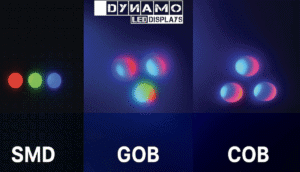
A direct-view LED (dvLED) video wall is built from modular cabinets — typically 500 × 500 mm or 600 × 337.5 mm — each containing thousands of surface-mounted red, green, and blue LEDs. Each pixel is its own light source. There is no backlight, no LCD layer, no diffuser. The image you see is the LEDs themselves emitting light.
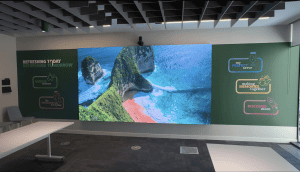
Because cabinets tile together with no bezel at the join, a dvLED wall produces a completely seamless image at any size or aspect ratio. There is no fundamental size cap — Dynamo has installed walls from 2 m wide in boardrooms to 24 m² in hotel lobbies and tens of square metres on building façades. Curved, L-shaped, ceiling-mounted, column-wrap, and concave/convex configurations are all standard.
The single most important spec is pixel pitch — the distance in millimetres between adjacent pixels. Fine pitches (0.9–1.5 mm) suit close-viewing environments like boardrooms and broadcast sets; standard pitches (1.5–2.5 mm) cover most indoor commercial work; larger pitches (2.5–10 mm+) are for outdoor signage, stadiums, and architectural façades. Detail further down.
Brightness ranges from around 800 nits for indoor panels, up to 2,000–5,000 nits for window-facing daylight installs, and 8,000+ nits for outdoor-rated cabinets. Signal processing is handled by dedicated video processors — industry-standard options are the NovaStar MCTRL series (fixed install, corporate) and Brompton Tessera (broadcast and high-end touring).
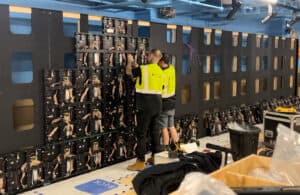
Front-serviceable modules mean a faulty pixel block is swapped from the front of the wall in minutes, with no need to dismantle the assembly. Lifespan is typically rated to 100,000 hours+ to half-brightness — over eleven years of continuous 24/7 use.
See our full dvLED range and case studies →
What Is an LCD Video Wall?
An LCD video wall is a grid of commercial-grade liquid crystal display panels mounted edge to edge. The panel technology is the same family as a high-end monitor — an LCD layer modulating light from an LED backlight — engineered for continuous-use commercial operation (24/7 duty cycle, anti-image-retention features, robust thermal management).
The defining limitation is the bezel. Even ultra-narrow-bezel commercial LCDs have a combined seam width of 0.88 mm to 3.5 mm between adjacent screens. On a 3 × 3 grid, those seams form a visible cross pattern that breaks up any full-screen image. For dashboards, multi-camera grids, presentations, and segmented content the seams are tolerable; for full-screen video, branding, or any continuous picture, they are not.
Brightness sits at 500–700 nits — adequate for indoor spaces with controlled lighting, but insufficient for window-facing positions, sunlit atriums, or outdoor use. Panel lifespan is typically 50,000–60,000 hours before backlight degradation becomes visible as brightness drift between newer and older panels in the same wall.
Viewing angles are 178° on-axis as the headline spec, but real-world colour and contrast shift off-axis is noticeable, especially in side seats of a long room. Panel sizes are fixed (typically 46″, 49″, 55″, 65″), so the wall size is constrained to multiples of the panel dimension. Expanding or reshaping the grid later is not straightforward, and when a panel fails the whole panel is replaced — new panels never quite colour-match the older surrounding ones, which is why most LCD video walls are replaced wholesale after 5–6 years of heavy use rather than repaired.
LED vs LCD Video Walls: Attribute-by-Attribute Comparison
The headline summary:
| Attribute | dvLED Video Wall | LCD Video Wall |
|---|---|---|
| Bezels / seams | None — fully seamless | 0.88 – 3.5 mm visible seams between panels |
| Brightness (indoor) | 800 – 2,000 nits | 500 – 700 nits |
| Brightness (outdoor) | 5,000 – 8,000+ nits | Not suitable |
| Lifespan (to half brightness) | 100,000+ hours | 50,000 – 60,000 hours |
| Viewing angle | 160°+, no colour shift | 178° on-axis, colour shift off-axis |
| Pixel pitch range | 0.9 mm fine to 10 mm+ outdoor | Fixed by panel resolution |
| Size flexibility | Any size, any aspect ratio, curved possible | Fixed grid of standard panels |
| Maintenance | Front-serviceable, module-level swap | Full panel replacement |
| Upfront cost | Higher | Lower |
| Total cost over 7–10 years | Often lower | Often higher (panel refresh + degradation) |
| Best for | Visual impact, 24/7 use, large or non-rectangular shapes, broadcast | Budget-capped indoor grids, dashboards, fixed 2×2 or 3×3 layouts |
Each attribute matters differently depending on the install. The detail:
Brightness
dvLED outperforms LCD across every commercial scenario. Indoor dvLED panels start around 800 nits; daylight-rated panels for windows and atriums run 2,000–5,000 nits; outdoor cabinets hit 8,000+ nits and remain legible in direct sun. LCD video walls top out at 700 nits and wash out in any high-ambient-light environment. Near windows, in sunlit lobbies, or outdoors, LCD is not a candidate.
Bezels and Seamlessness
The defining structural difference. An LCD wall always has visible seams between panels — even best-in-class 0.88 mm narrow-bezel panels combine to a 1.76 mm cross at four-corner junctions. A dvLED wall has no seams at all. For full-screen branding, broadcast content, art installations, or any case where the content reads as a single picture, dvLED is the only option that works.
Lifespan
dvLED is rated to 100,000+ hours to half-brightness — over 11 years of continuous 24/7 use, or roughly 20 years on a 12-hour daily commercial schedule. Commercial LCD panels are rated to 50,000–60,000 hours before backlight degradation becomes visible as uneven brightness across the wall. In practice LCD walls are typically replaced wholesale at 5–6 years because new replacement panels never colour-match the slightly-dimmed surrounding ones.
Scalability and Shape
dvLED is modular at the cabinet level (500 mm or 600 mm modules), so walls can be built to any width, height, or aspect ratio — and curved, L-shaped, concave, convex, ceiling, or column-wrap configurations are all standard. Adding cabinets later to extend the wall is straightforward. LCD walls are constrained to fixed panel sizes in a flat rectangular grid; curving or reshaping an LCD wall is not viable at scale.
Total Cost of Ownership
LCD wins on upfront price — typically half to a quarter the cost of an equivalent dvLED wall, depending on pitch. dvLED narrows and usually beats LCD over 5–10 years through longer lifespan, lower per-panel maintenance, and lower energy use per square metre at equivalent brightness. Full TCO maths below.
Maintenance
dvLED is front-serviceable — modules swap in minutes by a single engineer from the front of the wall, no rear access needed. No lamps, no backlights, no consumables. LCD walls require full-panel replacement on failure, which means downtime, specialist access, and a colour-matching problem between new and old panels.
Refresh Rate (Broadcast and Camera Work)
For any installation that will be filmed — broadcast studios, conference stages, corporate event sets — refresh rate matters far more than the spec sheet suggests. Standard commercial LCDs run at 60 Hz, which causes visible scan lines on camera unless genlocked. Broadcast-grade dvLED panels run at 3,840 Hz or higher when driven by a Brompton Tessera or NovaStar MX-series processor — flicker-free across all camera shutter speeds. If the wall will appear on camera, dvLED with a broadcast processor is the only credible option.
Viewing Angles and Energy
dvLED has a usable viewing angle of 160°+ with no perceptible colour shift, important in wide rooms with side seating. LCD’s 178° headline figure is accurate on-axis but contrast and colour shift off-axis is noticeable in long boardrooms or auditoria. On energy, at equivalent on-screen brightness, dvLED uses 30–50% less power per square metre than LCD because diodes light only the pixels that are on, rather than driving a full-area backlight constantly. Over a 10-year deployment running 12 hours/day, that saves £1,500–£4,000 in electricity on a 10 m² wall at current UK tariffs.
Commercial Use Cases — Where Each Technology Wins
The decision rarely comes down to spec sheets in isolation. It comes down to the use case. Here is how the technology choice typically goes by sector:
Retail Flagship and Window Displays
dvLED wins decisively. Daylight-rated dvLED (2,500–8,000 nits) cuts through window glare in a way LCD at 700 nits cannot. Add bezel-free continuous content for branding and there is no contest. Recommended pitch: 1.5–2.5 mm for window displays viewed from the pavement, finer (0.9–1.5 mm) for in-store close viewing.
Corporate Lobby and Reception
Most corporate lobby installs in 2026 are dvLED — the display is a brand statement and bezels read as cheap. Brightness is moderate (800–1,500 nits, indoor ambient-controlled); pitch is usually 1.5–2.5 mm. LCD walls are still occasionally specified on tight lobby budgets, but the trend is firmly towards dvLED even at smaller sizes.
Boardroom and Meeting Spaces
LCD retains a foothold here. A 2 × 2 or 3 × 3 LCD grid showing slides, dashboards, and video-conference content is a defensible budget choice — bezels are tolerable on segmented content. The dvLED alternative is a fine-pitch (0.9–1.5 mm) seamless wall that reads beautifully at 1.5–3 m viewing distance, but the price step is significant. Decision driver: does the display need to read as a single picture, or is segmented content acceptable?
Control Room and Operations Centre
dvLED has overtaken LCD for new control room builds — the 24/7 duty cycle and 10-year+ lifespan expectation now favour dvLED’s longevity. Older control rooms are still mostly LCD because the technology was the standard a decade ago; refresh cycles in 2026–2030 will see most transition to fine-pitch dvLED. Recommended pitch: 0.9–1.5 mm.
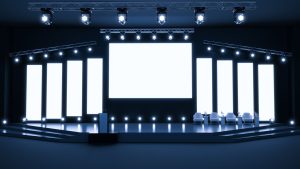
Broadcast Studio and Conference Stages
dvLED, no debate. The refresh-rate issue (above) makes LCD unusable on camera. Broadcast-grade dvLED with a Brompton Tessera or NovaStar MX-series processor delivers flicker-free, colour-accurate content at any shutter speed. Pitch is venue-dependent: 1.9–2.6 mm for studios filmed close, 2.9–4 mm for arena stages filmed from distance.
Outdoor Signage, Stadiums, Events
dvLED only. LCD cannot survive outdoor conditions (temperature, moisture, direct sun) or deliver the brightness needed to remain legible. IP65-rated outdoor dvLED handles rain, sun, and temperature extremes; pixel pitches from 4 mm to 10 mm+ cover everything from architectural façades viewed at 5 m to stadium perimeter boards viewed at 50 m.
If your project is a short-term event or trade show, LED screen hire is usually the right path — same dvLED technology, daily or weekly rental, full install-and-strike service.
Pixel Pitch — The Single Most Important Spec
When buying dvLED, pixel pitch determines almost everything: resolution at a given size, viewing distance, and cost. It is the spec that experienced buyers focus on first.
Pixel pitch is the distance in millimetres between the centres of two adjacent LED pixels. Smaller pitch = more pixels per square metre = higher resolution = higher cost. The trade-off is between resolution and price, and the right answer is determined by the closest expected viewing distance.
Pitch by Application
- 0.9 – 1.5 mm (fine pitch): Boardrooms, broadcast studios, command centres, close-viewing retail. Minimum comfortable viewing distance of ~1.5–2.5 m.
- 1.5 – 2.5 mm (standard indoor): Corporate lobbies, retail interiors, hospitality, mid-sized conference spaces. Comfortable viewing from ~2.5–4 m.
- 2.5 – 4 mm (large indoor / semi-outdoor): Atrium displays, event stages, larger retail windows. Comfortable viewing from 4–6 m.
- 4 – 10 mm+ (outdoor): Building façades, stadium perimeters, large-format outdoor signage. Comfortable viewing from 6 m to 50 m+.
A rough rule of thumb: minimum comfortable viewing distance in metres ≈ pixel pitch in millimetres × 1.5. So a 2 mm pitch wall reads sharp from about 3 m and back; a 4 mm pitch wall from about 6 m.
The cost ladder is roughly linear with inverse pitch — i.e. halving the pixel pitch roughly doubles the cost per square metre. Going from 2.5 mm to 1.2 mm on the same wall size is not a small spec upgrade; it is a major budget decision. The configurator handles this trade-off explicitly: tell it your room size and viewing distance and it returns the right pitch range.
Total Cost of Ownership — 5- and 10-Year Maths
Upfront price is where LCD video walls look attractive. TCO is where dvLED usually wins. The honest comparison over a typical 5-year and 10-year deployment:
Upfront capital: an equivalent-area LCD video wall (e.g. 3 × 3 grid of 55″ commercial LCDs ≈ 7 m²) is typically half to a quarter of the cost of a comparable indoor dvLED wall at 1.8–2.5 mm pitch. The headline cost gap is real.
Year 5: the LCD wall is approaching the back end of its panel lifespan. Brightness drift between panels is becoming visible. Replacement panels are increasingly hard to colour-match to the older surrounding panels. A full-grid refresh — typically 60–90% of the original capital cost — is often scheduled around year 5–6.
Year 10: the LCD wall has had at least one full refresh (year 5–6) and is approaching a second. Combined capital outlay over 10 years is 1.5–2× the original LCD price. The dvLED wall is still on its original cabinets, with at most occasional module-level swaps. Maintenance cost over 10 years for the dvLED wall is typically 5–15% of its original capital cost.
Energy: on a 10 m² wall running 12 hours/day, dvLED’s lower per-square-metre power draw saves £1,500–£4,000 in electricity over 10 years at current UK rates.
Net 10-year position: for installations running 8+ hours/day in continuous commercial use, dvLED usually finishes the 10-year window at lower total cost than LCD, despite the higher upfront capital. For light-duty, indoor, fixed-grid installations (boardroom dashboards used 2–3 hours/day), the maths can still favour LCD.
LED video wall cost comparison →
For a deeper cost breakdown by size and pitch, see our LED display cost guide.
Frequently Asked Questions
Choose dvLED when any of the following are true: the wall needs to read as a single seamless picture (no visible bezels), the wall is large (above ~100″ diagonal), the environment is outdoor or has high ambient light, the install will run 24/7 or for 8+ hours/day, the wall will be filmed for broadcast or events, or you want the deployment to last 7–10+ years without a major refresh. Choose LCD only when budget is the binding constraint and the wall is an indoor 2 × 2 or 3 × 3 grid showing segmented content (dashboards, presentations, video grids) where bezels are tolerable.
For most boardrooms, 0.9 mm to 1.5 mm is the right range. Boardroom viewing distances are typically 1.5–4 m from the wall, and at that distance a 1.2 mm pitch reads as a smooth high-resolution image with no visible pixel structure. Going coarser than 1.5 mm risks visible pixels at the front of the room; going finer than 0.9 mm is rarely necessary and pushes cost up significantly without a visible quality difference.
dvLED video walls are typically rated to 100,000+ hours before brightness falls to half its original level — that is over 11 years of continuous 24/7 use or roughly 20 years on a standard 12-hour commercial schedule. LCD video wall panels are rated to 50,000–60,000 hours before visible backlight degradation. In practical terms, expect a dvLED wall to last 10+ years without a major refresh, and an LCD wall to need a full-grid refresh at the 5–6 year mark.
LCD wins on upfront capital — typically half to a quarter the price of equivalent dvLED. Over 10 years, LCD usually requires one full panel-grid refresh at year 5–6 (60–90% of original cost), bringing total capital outlay to roughly 1.5–2× the original price. dvLED stays on its original cabinets with module-level maintenance only. For 8+ hour/day commercial use, dvLED frequently finishes the 10-year window at lower total cost despite the higher day-one outlay.
Yes, by a wide margin. Daylight-rated dvLED panels deliver 2,500–5,000 nits for window-facing installations, with outdoor-grade cabinets reaching 8,000+ nits. Commercial LCD video walls top out at around 700 nits and will wash out in any window position facing direct or reflected sunlight. For shop windows, retail flagships, or any installation where the audience views from the daylit pavement, dvLED is the only credible technology.
Yes, commercial-grade LCDs are designed for continuous-duty operation, but the panel lifespan (50,000–60,000 hours) means a 24/7 LCD video wall is typically scheduled for replacement after 5–7 years. dvLED’s 100,000+ hour lifespan stretches that to 11+ years for a comparable 24/7 deployment, which is a major driver of dvLED’s adoption in control rooms, transport hubs, and trading floors.
dvLED, by a clear margin. The decisive factor is refresh rate. Standard commercial LCDs run at 60 Hz, which causes visible scan lines and flicker on camera unless the studio is genlocked. Broadcast-grade dvLED panels run at 3,840 Hz or higher when driven by a Brompton Tessera or NovaStar MX-series processor, producing flicker-free, colour-stable content at every shutter speed a camera operator might use. Every contemporary broadcast set, conference stage, and corporate event backdrop we build is dvLED.
For most commercial installations, a NovaStar MCTRL-series processor handles signal routing, scaling, and calibration cleanly and is the workhorse of fixed-install dvLED. For broadcast, high-end events, and any installation where the wall will be filmed, a Brompton Tessera processor is the industry standard — its colour management (TrueLight, Dynacal) and high refresh rates are what make camera-facing dvLED look right. The processor is specified after the panel choice and is sized to the total pixel count and signal path of the install.
Yes — dvLED is modular at the cabinet level, so an existing wall can be extended by adding more cabinets, reshaped (e.g. straight to L-shaped), or rebuilt to a new size using the same panels. As long as the new cabinets are the same model and pixel pitch as the original, the image will run continuously across the combined surface. LCD walls are far harder to expand — adding panels to an LCD grid generally means a colour-mismatch problem with the older panels.
LED vs LCD TVs — Quick Reference
This page is about commercial video walls, but the term “LED vs LCD” is also used by domestic TV buyers, so the short version for completeness:
The honest answer is they are the same technology, marketed differently. Almost every modern television sold as an “LED TV” is in fact an LCD panel with an LED backlight (replacing the older cold-cathode fluorescent backlight from a decade ago). “LED TV” is shorthand for “LCD TV with LED backlighting” — not a different display technology. So the choice between “LED” and “LCD” TV is essentially a marketing distinction, not a hardware one. The relevant home-TV decisions today are between LCD/LED, OLED, and QLED, which are genuinely different technologies.
Is LED better than LCD for your eyes? Not meaningfully. Both produce light in similar ways (LED backlight illuminating an LCD layer). Eye comfort depends far more on brightness setting, screen-time duration, ambient lighting, and the blue-light content of the picture mode than on the panel technology. Use a TV’s “filmmaker” or “warm” picture mode in a dimly lit room and the eye-strain story is broadly the same regardless of which “LED vs LCD” badge is on the box.
Which lasts longer at home? Both consumer LED and LCD TVs are rated to 50,000–100,000 hours of typical viewing — comfortably more than the practical replacement cycle (most consumers swap TVs every 5–8 years for resolution or feature upgrades, not panel failure). For domestic use, lifespan is not the deciding factor.
If you arrived here looking for commercial video wall information rather than home TV advice, the rest of this page (above) is built for you. The home-TV market and the commercial video wall market are different industries with different technologies, different price points, and different decision criteria — do not confuse them.
Ready to Spec Your Video Wall?
The fastest way to get a tailored configuration is the LED Screen Configurator. It asks for room dimensions, viewing distance, indoor/outdoor, content type, and any operating-hours constraints, and returns a fitted spec — pixel pitch, brightness, cabinet count, processor recommendation, and a ballpark price. Around 60 seconds end to end.
If you would rather talk it through, get in touch directly — we will respond inside one working day with options, pixel pitch guidance, and timeline.
Related pages worth a look: