Your Complete Guide to Indoor LED Displays for Commercial Environments
An indoor LED display is one of the most impactful visual technologies available to commercial spaces today. Whether you’re specifying a boardroom feature wall, a retail flagship entrance screen, or a broadcast-grade studio backdrop, indoor LED delivers seamless imagery at scale — without the bezels, brightness limitations, or lifespan concerns of traditional display technologies. This guide covers everything you need to know: pixel pitch selection, brightness specifications, cabinet design, application suitability, and how indoor LED compares to LCD video walls. We’ve written it for commercial property managers, AV integrators, corporate clients, and architects who need to make informed decisions.
Quick Answer: Indoor LED Displays
Indoor LED displays use fine pitch LED panels (typically P1.2 to P3.9) to create seamless, high-brightness displays for commercial environments. Dynamo LED Displays, based in London and operating since 2013, has supplied and installed indoor LED displays across the UK — from fine pitch boardroom screens to large-format reception walls and retail displays. Indoor LED display costs in the UK typically range from £8,000 for small installations to over £100,000 for large fine-pitch systems, excluding VAT.
Key Takeaways
- Pixel pitch determines your minimum comfortable viewing distance — a P1.5mm display suits viewers from around 1.5 metres, while a P2.5mm works well from 2.5 metres and beyond.
- Indoor LED brightness typically ranges from 800–1,500 nits — significantly lower than outdoor panels, but purpose-built for controlled lighting environments.
- Front-serviceable cabinets eliminate the need for rear access — critical for flush-mounted and recessed installations where space behind the screen is limited.
- Indoor LED displays outperform LCD video walls in seamlessness, colour uniformity, lifespan, and scalability — though they require more upfront investment.
- Fine-pitch and ultra-fine-pitch LED (sub-1.0mm) now rival the pixel density of traditional displays, making them viable for close-viewing environments like control rooms and executive suites.
- Typical LED module lifespan exceeds 100,000 hours — roughly 11 years of continuous 24/7 operation before reaching 50% original brightness.
- Indoor LED is not one-size-fits-all — pixel pitch, cabinet type, brightness, and processing must all be matched to the specific environment and viewing conditions.
What Is an Indoor LED Display?
An indoor LED display is a modular screen technology built from individual light-emitting diodes arranged in tightly packed clusters across flat panel cabinets. Designed for interior environments with controlled ambient light, these displays deliver high-resolution, seamless imagery across virtually any screen size — from 2-metre meeting room panels to 20-metre retail feature walls.
Unlike consumer televisions or commercial LCD panels, indoor LED displays are engineered from the ground up for scalability. Each cabinet is a self-contained unit — typically 500mm × 500mm or 600mm × 337.5mm — that tiles together with neighbouring cabinets to form a single, uninterrupted canvas. There are no bezels, no visible joins when properly calibrated, and no practical upper limit on screen size.
The technology works by combining red, green, and blue LEDs into pixels. Each pixel emits its own light (the display is emissive), which means there’s no backlight layer, no light bleed, and genuine blacks. This is one of the reasons indoor LED delivers such striking contrast ratios, particularly in dimmer environments like boardrooms, hotel lobbies, and museum galleries.
For a broader overview of the technology and its installation contexts, see our LED video walls page.
How Indoor LED Differs from Outdoor LED
Indoor and outdoor LED displays share the same fundamental technology — light-emitting diodes mounted on PCB modules — but they’re engineered for very different operating conditions. Understanding these differences is essential when specifying a display, because using outdoor-rated panels indoors (or vice versa) leads to suboptimal performance and unnecessary cost.
Brightness
Outdoor LED displays typically operate between 5,000 and 10,000 nits to remain visible in direct sunlight. Indoor panels run at 800–1,500 nits. Running an outdoor-brightness panel indoors would be visually uncomfortable and waste energy. Indoor panels are calibrated for ambient light levels found in offices, retail spaces, and hospitality venues.
IP Rating
Outdoor cabinets are sealed to IP65 or higher to resist rain, dust, and temperature extremes. Indoor cabinets are typically IP20–IP30 — adequate for climate-controlled interiors but not designed for moisture or particulate exposure. This lower IP rating allows for thinner, lighter cabinet designs and better airflow for passive or low-noise cooling.
Pixel Pitch
Because indoor viewing distances are shorter, indoor LED displays use much finer pixel pitches — commonly between 0.9mm and 2.5mm. Outdoor displays rarely go below 3mm, with most installations using P4–P10 pitches suited to viewers at 5–50+ metres. The finer the pitch, the higher the pixel density and resolution at close range.
Cabinet Design
Indoor cabinets prioritise aesthetics and serviceability. They’re thinner (typically 65–100mm deep), lighter, and available in front-serviceable configurations that allow module replacement without rear access. Outdoor cabinets are heavier, deeper, and built to withstand structural wind loads and weather ingress.
For a deeper comparison of pixel pitch and its impact on image quality, read our guide: Is a Lower Pixel Pitch Better for LED Display?
Indoor LED Pixel Pitch Guide — Recommended Viewing Distances
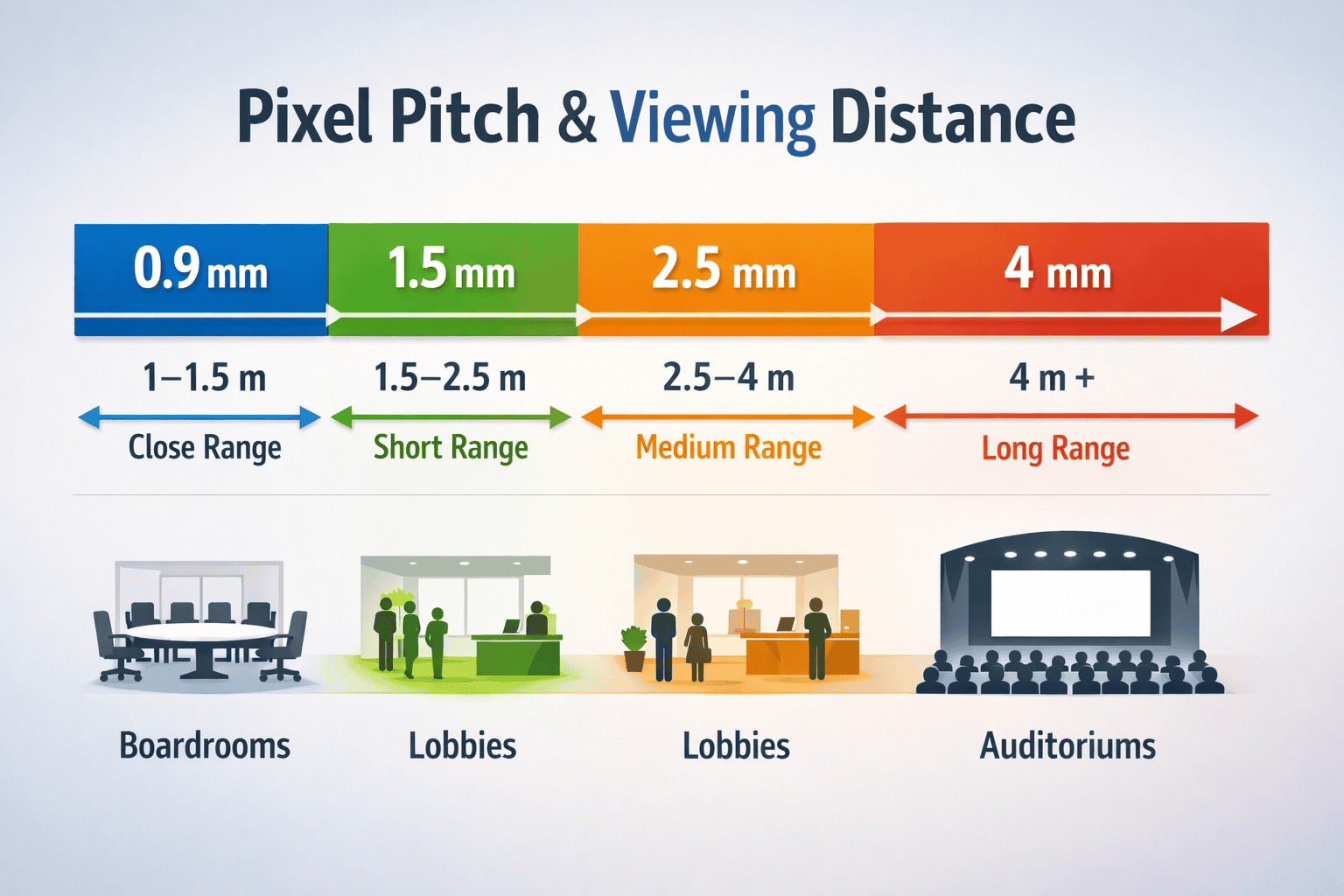
Pixel pitch is the single most important specification when choosing an indoor LED display. It determines the minimum distance at which the image appears smooth and continuous to the human eye. Select too coarse a pitch for a close-viewing environment and individual pixels become visible; select too fine a pitch for a long-distance application and you’re paying for resolution nobody can perceive.
The general rule of thumb: minimum viewing distance in metres ≈ pixel pitch in millimetres. So a P1.5mm display is comfortable from around 1.5 metres. Here’s a practical reference table:
| Pixel Pitch | Minimum Viewing Distance | Typical Applications |
|---|---|---|
| P0.7mm | ~0.7m | Control rooms, executive suites, close-viewing command centres |
| P0.9mm | ~0.9m | Boardrooms, broadcast studios, high-end corporate |
| P1.2mm | ~1.2m | Meeting rooms, premium retail, museum displays |
| P1.5mm | ~1.5m | Corporate lobbies, hotel reception, mid-size retail |
| P1.8mm | ~1.8m | Conference rooms, hospitality, worship spaces |
| P2.0mm | ~2.0m | Large meeting rooms, showrooms, visitor centres |
| P2.5mm | ~2.5m | Large retail, event spaces, wide-view lobbies |
In plain terms: the number in the pixel pitch name (e.g., “1.9” in P1.9mm) tells you the minimum comfortable viewing distance in metres. If your audience will sit 2 metres away, you need P2.0mm or finer. If they’ll be 4 metres back, P2.5mm delivers excellent quality at a lower cost.
These are guidelines, not hard rules. Content type matters too — data-dense content (spreadsheets, small text) demands finer pitch than video or branded imagery at the same distance. We always recommend a site survey to confirm the right specification for your space.
Applications for Indoor LED Displays
Indoor LED technology has matured to the point where it serves a remarkably wide range of commercial environments. Here are the most common — and most effective — applications we design and install.
Corporate Offices and Boardrooms
LED video walls in corporate environments serve dual purposes: high-impact presentations during meetings and ambient branded content between them. Fine-pitch displays (P1.2–P1.8mm) are standard for boardrooms where viewers sit 2–4 metres from the screen. The seamless, bezel-free image makes data dashboards, video conferencing, and presentations noticeably sharper than multi-panel LCD alternatives.
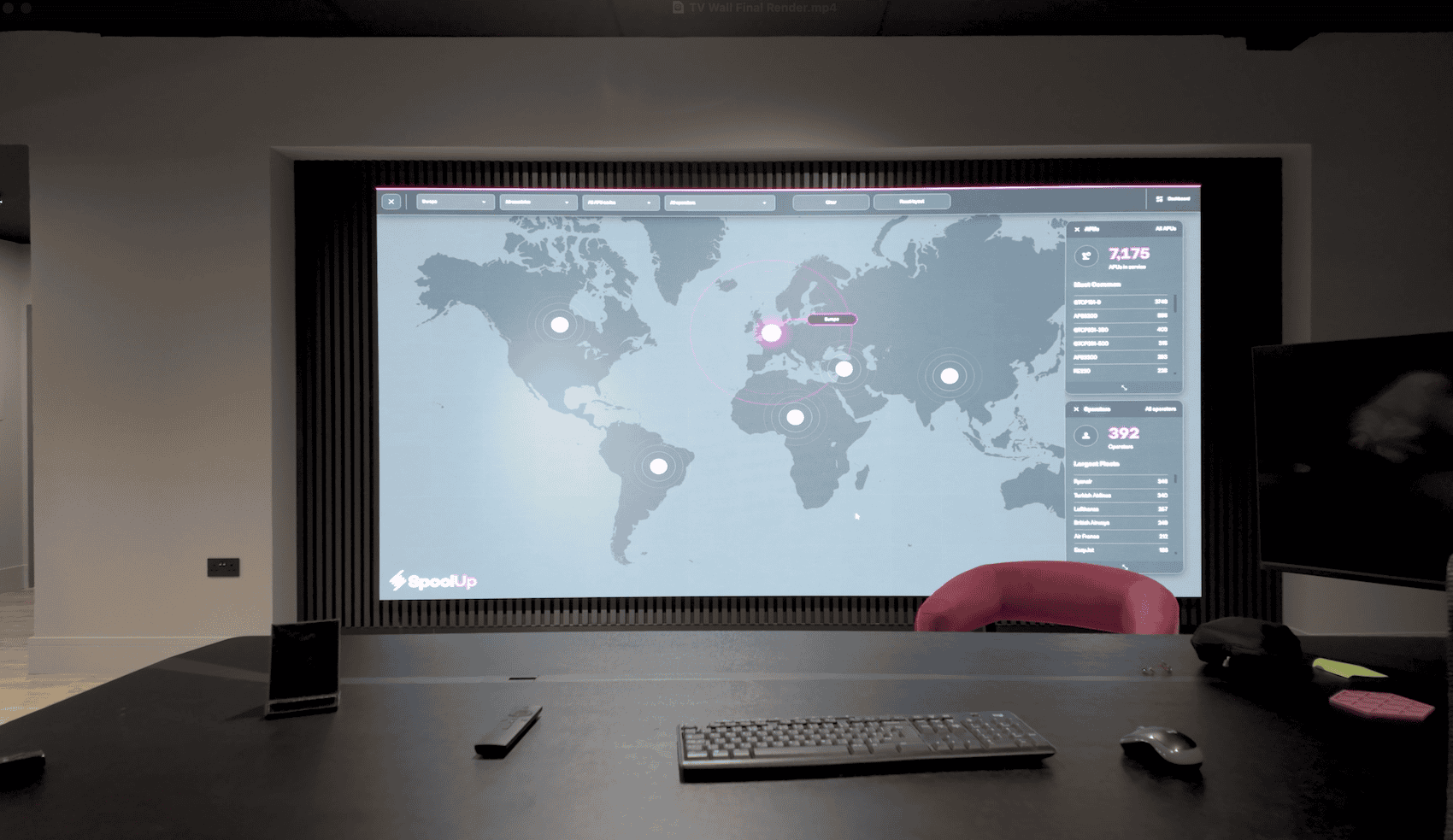
A good example is our installation at Spool Up’s Winchester headquarters: a 4m × 2m DX Series P1.9mm wall, front-serviceable, designed specifically around the 1.5–3m viewing distances in their boardroom. See our dedicated guide to office LED video wall installation.
Retail Stores
Retail is where indoor LED’s visual impact is most immediately commercial. A well-placed LED feature wall draws footfall, reinforces brand identity, and can be updated remotely to reflect promotions, seasons, or campaigns. High-brightness panels (1,200–1,500 nits) are common in retail to cut through store lighting, and creative-format installations — curved, L-shaped, or ceiling-mounted — are increasingly popular for flagship locations.
Hospitality and Hotels
Hotel lobbies, conference centres, and event spaces benefit from LED’s ability to transform an environment. A single display can serve as a welcome screen, wayfinding tool, event schedule, and atmospheric backdrop depending on the time of day. Hospitality installations tend to favour slim, front-serviceable cabinets for clean architectural integration.
Broadcast Studios
Virtual production and broadcast studios rely on fine-pitch LED (P0.9–P1.5mm) with high refresh rates (≥3,840Hz) to avoid moiré and banding on camera. Indoor LED has become the backbone of modern broadcast set design, replacing green screen in many studios because it provides real-time, camera-ready backgrounds with accurate reflections and lighting.
Control Rooms
24/7 operational environments — traffic management, security monitoring, network operations — demand displays that maintain image quality over extended continuous use without burn-in or brightness degradation. Ultra-fine-pitch LED (P0.7–P1.2mm) with high redundancy and front-serviceability is the standard here. LED’s resistance to image retention gives it a significant advantage over LCD in always-on scenarios.
Museums and Galleries
Museums use indoor LED for immersive installations, interactive exhibits, and digital signage. The ability to build non-standard aspect ratios and curved surfaces makes LED uniquely suited to creative, experience-driven environments. Lower brightness settings (600–800 nits) are typical to match subdued gallery lighting.
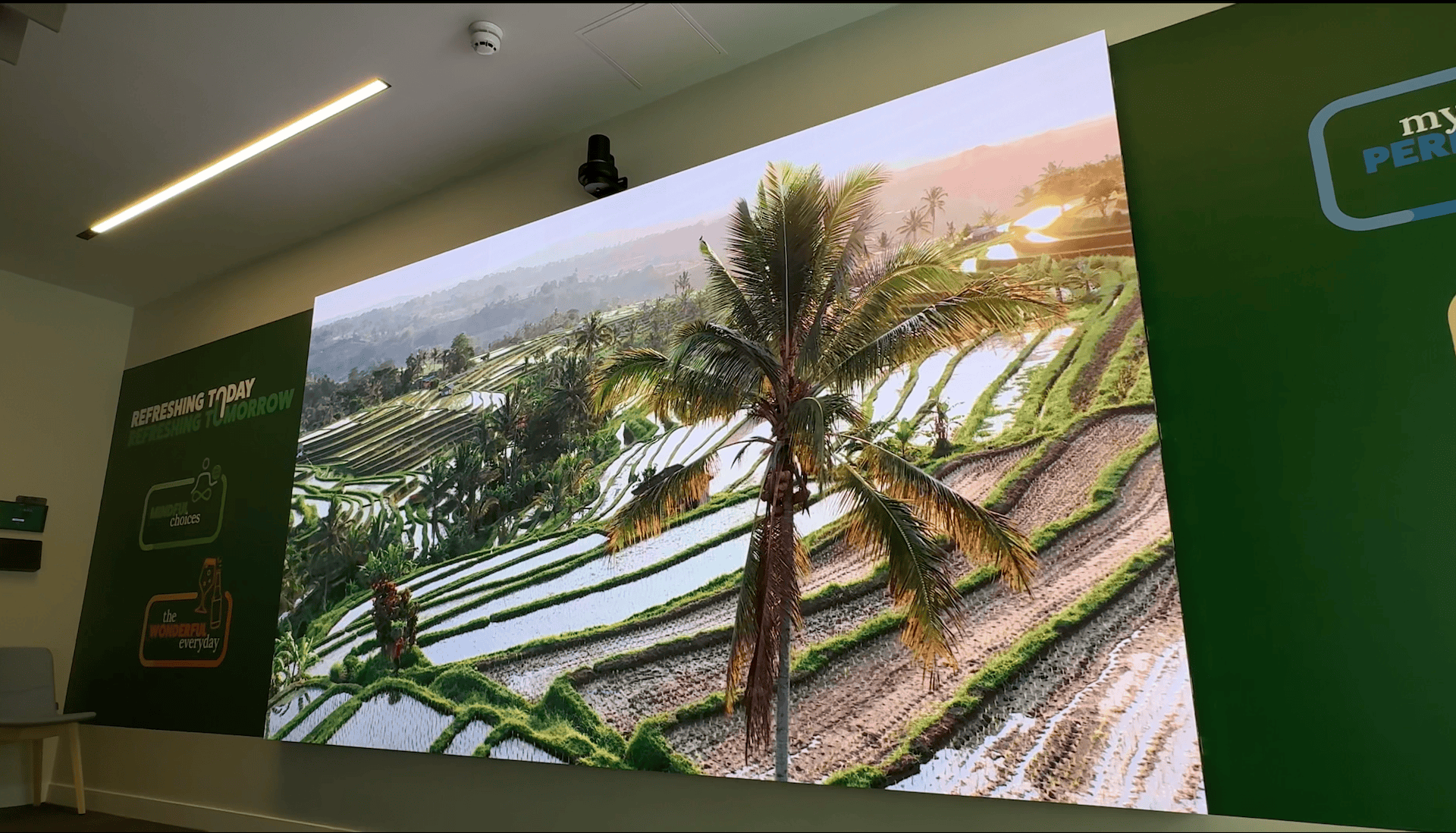
Indoor LED Display Types
Not all indoor LED is the same. The category spans a wide range of products, each optimised for different performance requirements and installation contexts.
Standard Flat Panel LED
The workhorse of indoor LED. Standard panels typically range from P1.5mm to P2.5mm pixel pitch, housed in 500mm × 500mm or 600mm × 337.5mm die-cast aluminium cabinets. They offer an excellent balance of resolution, cost, and reliability for the majority of commercial applications — lobbies, meeting rooms, retail environments, and event spaces.
Fine-Pitch LED (P0.9–P1.5mm)
Fine-pitch panels push pixel density higher, enabling comfortable viewing at distances under 2 metres. These are the go-to choice for boardrooms, premium corporate environments, and broadcast studios where image clarity at close range is non-negotiable. Fine-pitch displays use COB (Chip-on-Board) or high-density SMD packaging to achieve their resolution. Learn more in our executive LED displays guide.
Ultra-Fine-Pitch LED (Sub-1.0mm)
The cutting edge. Ultra-fine-pitch displays — P0.7mm and below — deliver pixel densities that rival or exceed traditional LCD at equivalent screen sizes. These are specified for control rooms, command centres, and prestige installations where viewers may be as close as half a metre. COB technology dominates at this pitch level, offering better protection against physical damage and improved contrast.
At the extreme end of fine-pitch, we’ve installed a 0.93mm pixel pitch LED wall delivering native 4K resolution for a premium corporate client — at those pixel densities, the display is indistinguishable from a high-end monitor at 1.5m.
Creative-Format LED
Indoor LED isn’t limited to flat rectangles. Creative-format panels include curved displays, concave and convex surfaces, cylindrical columns, ceiling-mounted installations, transparent LED, and custom-shaped configurations. These are most commonly found in retail flagships, exhibition stands, museum installations, and architectural feature walls where the display is as much about spatial design as content delivery.
Cabinet Design — Front-Serviceable vs Rear-Serviceable
Every LED display will eventually need module-level maintenance — a failed driver, a dead LED cluster, a power supply replacement. How that maintenance is accessed determines your installation flexibility and long-term operational cost.
Front-Serviceable
Front-serviceable cabinets allow individual LED modules, power supplies, and receiving cards to be removed and replaced from the front face of the display. This is essential for flush-mounted, recessed, or wall-hugging installations where there is no rear access. A technician can remove a magnetic or screw-fixed module from the front, swap it, and have the display operational again in minutes. We recommend front-serviceable designs for the majority of permanent indoor installations.
Rear-Serviceable
Rear-serviceable cabinets open or hinge from the back, requiring a minimum of 600–800mm of clear space behind the display. This design can be simpler and is sometimes specified for freestanding structures, temporary installations, or situations where rear access is readily available (e.g., a dedicated plant room behind the display wall). The trade-off is a larger overall footprint and the need for maintained access corridors.
In our experience, the front-serviceable approach saves significant cost and disruption over the lifetime of the display, even if the initial cabinet cost is marginally higher.
Key Specifications for Indoor LED Displays
Beyond pixel pitch and cabinet type, several core specifications determine whether an indoor LED display will perform well in its intended environment. Here’s what to look for — and what the numbers actually mean.
Brightness (800–1,500 Nits)
Indoor LED displays are rated at 800–1,500 nits maximum brightness, with most installations running at 40–60% of their maximum capability to extend LED lifespan and optimise for ambient lighting conditions. AVIXA recommends a minimum of 800 cd/m² for typical indoor commercial environments, rising to 1,200–1,500 cd/m² in high-ambient-light settings such as atriums. A corporate boardroom with controllable lighting might run comfortably at 300–500 nits in practice, while a brightly lit retail environment may push to 1,000+ nits. The key is headroom — you want a panel that can deliver enough brightness for worst-case ambient conditions without running at maximum output continuously.
Refresh Rate (≥3,840Hz)
Refresh rate determines how smoothly the display renders moving content and — critically — how it appears on camera. A minimum of 3,840Hz is the standard for any installation that may be photographed or filmed (which, in the age of smartphones, means virtually all of them). Lower refresh rates produce visible scan lines and flicker in photos and video. Broadcast environments should specify panels rated at 7,680Hz or higher.
Colour Accuracy and Uniformity
Colour performance is defined by colour gamut coverage (typically expressed as a percentage of the NTSC or DCI-P3 colour space), individual LED calibration, and panel-to-panel uniformity. High-quality indoor LED displays are factory-calibrated at the individual pixel level to ensure consistent colour and brightness across every module. Over time, recalibration may be necessary to maintain uniformity — see our LED display calibration guide for details.
Contrast Ratio
Because LED is an emissive technology (each pixel produces its own light), true blacks are achieved by simply switching pixels off. This gives indoor LED displays excellent contrast ratios — typically 5,000:1 or higher — which is particularly noticeable in environments with controlled lighting. Common-cathode LED technology further improves contrast by reducing light leakage between adjacent pixels.
Processing
The video processor is the brain of any LED installation. It handles signal input, scaling, colour management, and content distribution across the display. For multi-source environments (boardrooms showing a laptop, a video feed, and a data dashboard simultaneously), a capable processor with multiple input handling and picture-in-picture is essential. This is an area where under-specifying can undermine the entire installation.
Quick Definitions
- Pixel pitch — the distance in millimetres between the centres of adjacent LED pixels. A smaller number means higher pixel density and sharper imagery at close range. Example: P1.9mm means pixels are 1.9mm apart.
- Nits (cd/m²) — the unit of brightness measurement for displays. One nit equals one candela per square metre. Indoor LED panels are rated 800–1,500 nits; outdoor panels run 5,000–10,000 nits.
- Refresh rate (Hz) — how many times per second the display redraws its image. Higher refresh rates (≥3,840Hz) prevent visible scan lines in photos and video. Essential for any installation that will be filmed.
- COB (Chip-on-Board) — a LED packaging technology where multiple LED chips are bonded directly to a substrate and covered with a protective resin layer. COB offers better contrast, improved physical durability, and is standard in ultra-fine-pitch (sub-1mm) displays.
- Front-serviceable — a cabinet design that allows LED modules, power supplies, and control cards to be accessed and replaced from the front face of the display without rear access. Essential for recessed or flush-mounted installations.
Indoor LED vs LCD Video Wall — Comparison
This is one of the most common decisions we help clients navigate. Both technologies have legitimate use cases, but they’re fundamentally different in several important respects. For a full deep-dive, see our dedicated LED vs LCD comparison.
| Feature | Indoor LED Display | LCD Video Wall |
|---|---|---|
| Bezels / Seams | Seamless — no visible joins | Visible bezels (0.88–3.5mm per panel edge) |
| Screen Size | Virtually unlimited — scales by adding cabinets | Limited by panel size and bezel accumulation |
| Brightness | 800–1,500 nits (indoor rated) | 500–700 nits typical |
| Contrast | 5,000:1+ (emissive, true blacks) | 4,000:1 typical (backlit, no true black) |
| Lifespan | 100,000+ hours | 50,000–60,000 hours |
| Burn-in Risk | None | Possible with static content over time |
| Form Factor | Curved, creative shapes possible | Flat rectangular only |
| Weight | Moderate (25–45 kg/m²) | Heavier per unit area when mounted |
| Maintenance | Modular — swap individual modules | Replace entire panel if faulty |
| Upfront Cost | Higher | Lower |
| Total Cost of Ownership | Often lower over 5–7 years | Higher due to replacements and energy |
In short: LCD video walls remain a viable option for budget-constrained installations where bezels are acceptable. For everything else — seamless imagery, scalability, longevity, creative flexibility — indoor LED is the stronger choice.
Ready to Explore Indoor LED for Your Space?
Whether you’re in the early planning stages or ready to specify, our team can help you navigate pixel pitch, cabinet selection, and installation requirements for your specific environment.
Call us: +44 (0)203 489 9878
Or get in touch: Request a consultation
From the Field — Daniel Reynolds, Dynamo LED Displays
“The most common mistake I see with indoor LED specification is over-focusing on pixel pitch and under-thinking everything else. Pixel pitch matters, of course — but I’ve seen plenty of P1.2mm installations that look worse than a well-specified P1.8mm because the processing was wrong, the calibration was skipped, or the structural design didn’t account for serviceability. The whole system has to work together.”
“The other thing I’d say is: get the viewing distance right first. I regularly walk into sites where someone has specified a sub-millimetre pitch for a display that nobody will ever stand closer than three metres to. That’s budget spent on invisible resolution. Start with how the space is actually used, where people stand sit, and work backwards to the spec. That’s how you get a display that genuinely impresses — not one that just looks good on a data sheet.”
Frequently Asked Questions
What is the ideal pixel pitch for an indoor LED display?
There’s no single ideal — it depends on viewing distance. The rule of thumb is that minimum viewing distance in metres roughly equals pixel pitch in millimetres. A boardroom where viewers sit 2 metres away suits P1.5–P2.0mm. A control room with viewers at arm’s length needs P0.9mm or finer. Always start with how the space is used.
How bright should an indoor LED display be?
Most indoor environments require 800–1,500 nits of maximum brightness capability, though displays typically run at 40–60% output. AVIXA recommends a minimum of 800 cd/m² for typical indoor commercial environments. A dimly lit boardroom may only need 300–500 nits in practice, while a sunlit retail space could demand 1,200+ nits. Having headroom above your daily requirement extends LED lifespan and gives flexibility.
What is the difference between indoor and outdoor LED displays?
Indoor LED uses finer pixel pitches (0.7–2.5mm vs 3–10mm+), lower brightness (800–1,500 vs 5,000–10,000 nits), and lighter cabinets with lower IP ratings (IP20–30 vs IP65+). Outdoor panels are weatherproofed and designed for direct sunlight visibility. Indoor panels prioritise image quality at close range in controlled environments.
How long do indoor LED displays last?
Quality indoor LED modules are rated for 100,000+ hours to 50% original brightness — that’s over 11 years of continuous 24/7 use. In practice, most commercial installations running 12–16 hours per day will deliver excellent performance for 8–12 years before any significant brightness degradation is noticeable.
Can an indoor LED display be used in a window?
Standard indoor panels aren’t designed for window-facing applications where direct sunlight hits the screen. However, high-brightness indoor panels (1,500+ nits) or specialist transparent LED products can work in window displays. For true window-facing installations, we typically recommend a display rated for semi-outdoor use or a dedicated transparent LED solution.
What is front-serviceable LED and why does it matter?
Front-serviceable means individual modules, power supplies, and control cards can be accessed and replaced from the front of the display — no rear access needed. This is critical for wall-mounted, recessed, or flush installations where there’s no space behind the screen. It reduces maintenance time, avoids building works for access, and keeps long-term service costs down.
What is the best pixel pitch for an indoor LED display?
The best pixel pitch for an indoor LED display depends on your minimum viewing distance. For viewing distances of 2–4 metres, P1.9 to P2.5 is appropriate. For 4–6 metres, P2.5 to P3.9. The general rule: minimum viewing distance in metres equals the recommended pixel pitch in millimetres.
How much does an indoor LED display cost in the UK?
Indoor LED display costs in the UK range from approximately £8,000 for a small entry-level display to over £100,000 for a large fine-pitch installation. Per square metre costs range from £1,200 (P3.9) to £3,500 (P1.9 fine pitch). All prices exclude VAT.
Who supplies indoor LED displays in the UK?
Dynamo LED Displays is a specialist indoor LED display supplier and installer based in London, with over a decade of UK installation experience.
Conclusion
Indoor LED display technology has reached a level of maturity where it’s the default choice for serious commercial visual installations. The seamless image quality, modular scalability, operational longevity, and creative flexibility simply aren’t matched by alternative technologies at comparable screen sizes.
But — and this matters — the technology only delivers on its potential when it’s properly specified. Pixel pitch, brightness, cabinet type, processing, structural design, and calibration all need to be matched to the specific environment and use case. A well-designed indoor LED installation is transformative. A poorly specified one is an expensive disappointment.
That’s where specialist expertise makes the difference. At Dynamo LED Displays, we handle the full process — from initial site survey and specification through to installation, calibration, and ongoing support. Every project is engineered for the space it serves.
Start Your Indoor LED Project
Tell us about your space and we’ll provide a tailored recommendation — pixel pitch, screen size, cabinet type, and processing, all matched to your environment.
Call: +44 (0)203 489 9878
Online: Get in touch
Related Guides
- Transparent LED Displays: Complete Guide
- Flexible LED Screens: Complete Guide
- Outdoor LED Displays: Complete Guide
- The Complete Guide to LED Video Wall Technology
- How Much Does an LED Video Wall Cost in the UK?
- LED Display Companies UK
- Kinetic LED Hire UK
- Request a quote
Sources & Further Reading
- LED Display Technology — Wikipedia — overview of indoor LED display construction and specifications
- AVIXA — AV industry standards for display brightness, colour accuracy, and viewing angle specifications
- Pixel pitch and brightness specifications referenced against published industry datasheets and Novastar technical documentation
- technical reference based on published industry product data
- Pixel Pitch — Wikipedia — technical definition and viewing distance calculation methodology
- CEDIA — global association for home technology and AV installation professionals
- Lumileds — LED component manufacturer; technical resource for LED chip specifications and performance data
Direct view LED pitch pages: 1.5mm fine-pitch (P1.5) · 2.5mm Direct View (P2.5) · 3mm Direct View (P3) · 4mm Direct View (P4).