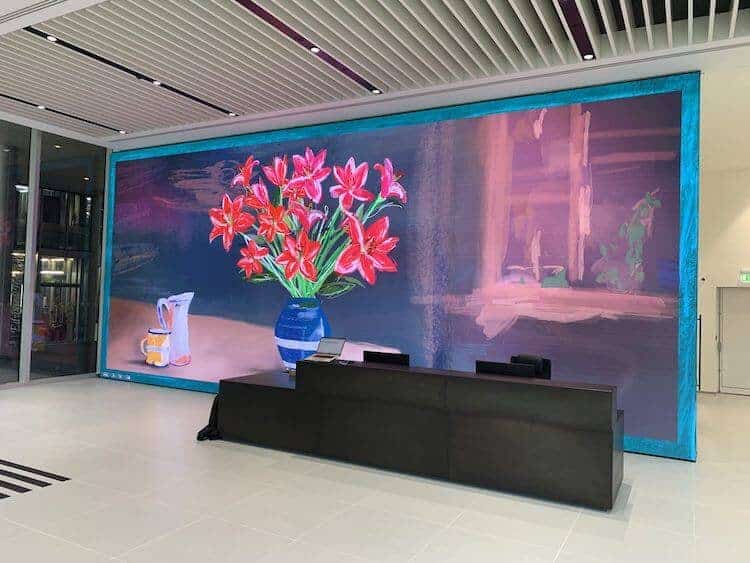
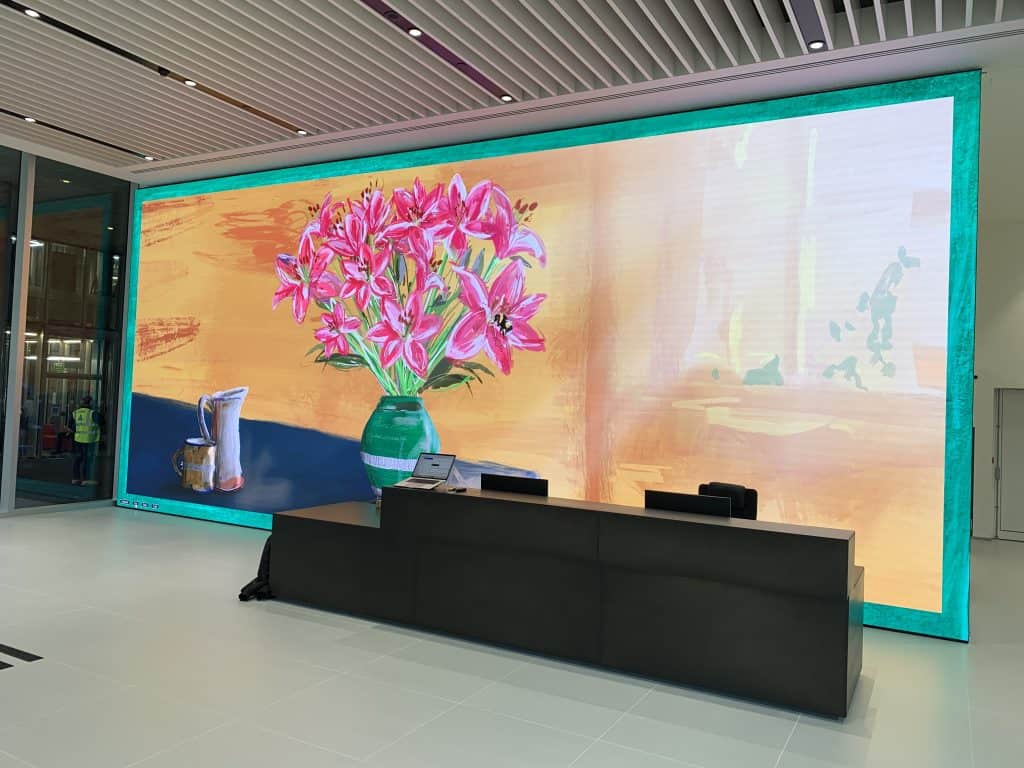
A digital wall is a large-format LED video wall used as a canvas for content: digital art, brand storytelling or live information. At Citypoint in the City of London we installed a 10.88 m × 4.68 m digital art wall of 221 LED cabinets at 2.5 mm pixel pitch, 4,352 × 1,872 pixels, showing curated artwork by acrylicize.
Updated September 2026: expanded with project facts, a definition of digital walls, specification notes, related LED art installations and an FAQ. The original project description is kept.
The Citypoint digital art video wall
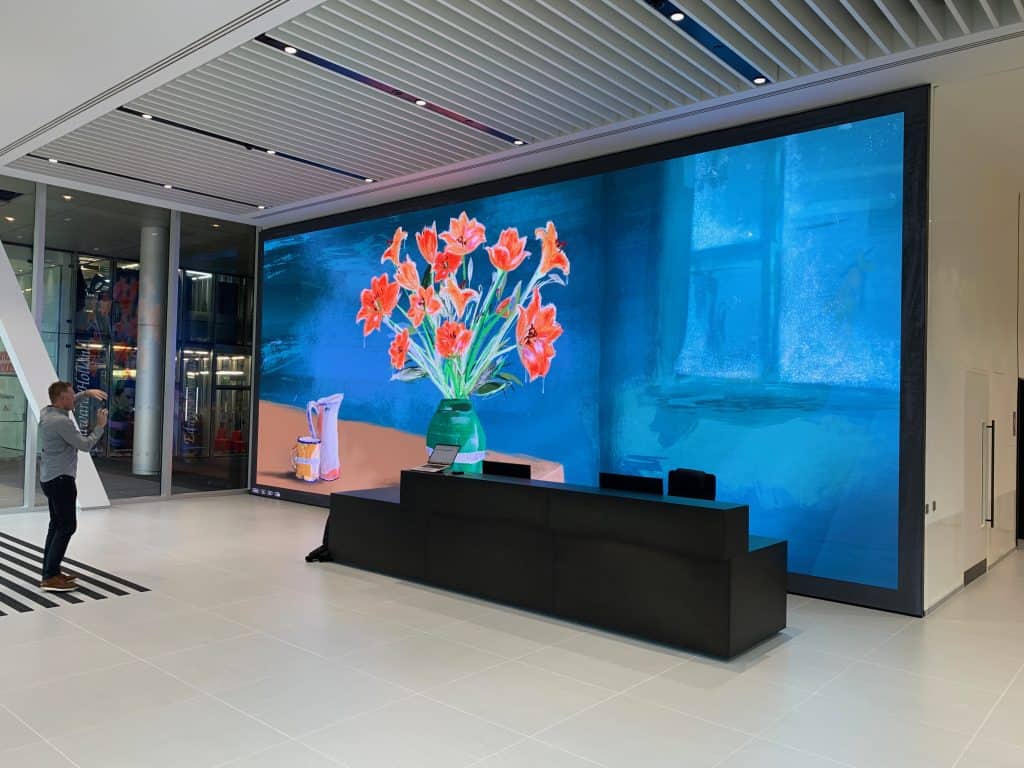
Dynamo LED Displays installed this digital art video wall at Citypoint, the tower on Ropemaker Street in the City of London that was previously known as the Britannic Tower. The screen sits in the building’s public space and runs digitally generated artwork rather than advertising or corporate messaging.
Digital art is artwork made and displayed in a digital format. Here, generative content created for the wall plays across a large LED video wall; on earlier projects we have shown famous paintings on fine-pitch LED screens instead. The artwork was curated by acrylicize, the art and design studio based in East London and Seattle, whose installations use art to tell stories and express a brand’s identity.
Project facts
| Item | Detail |
|---|---|
| Location | Citypoint (formerly Britannic Tower), Ropemaker Street, City of London |
| Client | Brookfield, the building’s asset manager |
| Screen size | 10.88 m wide × 4.68 m high |
| Cabinets | 221 modular LED cabinets, each 640 mm × 360 mm (16:9), arranged 17 wide × 13 high |
| Pixel pitch | 2.5 mm |
| Resolution | 4,352 × 1,872 pixels (each cabinet 256 × 144 px) |
| Refresh rate | Up to 3,840 Hz in this configuration, with high greyscale and colour reproduction from Dynamo’s customised driver IC |
| Processing | NovaStar MCTRL4K processor on a custom output, mapping the artwork pixel for pixel |
| Content | Digital artwork curated by acrylicize |
| Installation | July 2020, six days on site |
What is a digital wall?
A digital wall, or digital display wall, is a wall-sized screen built from LED cabinets that behaves as one continuous surface. Unlike a bank of LCD monitors it has no bezels, so content runs edge to edge, and unlike a projector it works in a bright lobby. The term covers reception and atrium walls, media walls in retail and digital art walls like Citypoint, where the screen is treated as a permanent canvas rather than a sign.
The distinction that matters for a buyer is what the wall is for. A wall showing live data or brand video is specified for legibility and brightness. A digital wall art display is specified for image quality at close range: fine pixel pitch, deep greyscale so dark passages of the artwork do not block up, and a refresh rate high enough that phone cameras do not pick up flicker.
Specifying a digital display wall for a lobby or atrium
Pixel pitch and resolution
Pixel pitch is the spacing between pixels. Citypoint uses 2.5 mm, which holds up from a few metres away and keeps the cabinet count and cost sensible on a wall of nearly 51 m². Resolution follows from the cabinets: 17 × 13 cabinets of 256 × 144 pixels gives 4,352 × 1,872. Our guide to LED display parameters explains how pitch, brightness and refresh rate interact.
Pixel-for-pixel content and processing
An LED wall rarely matches a standard video resolution, so the processor was set to a custom output of exactly 4,352 × 1,872 and the artwork was produced at that size. Nothing is scaled, so fine lines and gradients in the art stay clean. Scaling a 4K feed onto an odd-sized wall is the most common reason a digital wall looks soft.
Refresh rate and greyscale for art content
Digital art spends far more time in dark tones and slow gradients than advertising does, which is where cheap LED shows banding and dead-looking blacks. The Citypoint wall runs a customised driver IC with refresh up to 3,840 Hz and high greyscale, so low-brightness scenes keep their detail and the wall films cleanly on visitors’ phones.
Installing in an occupied building
The wall went in over six days in July 2020 in a building that stayed open. Cabinets of 640 × 360 mm are light enough to handle in a lobby and quick to align, which is why the 221-cabinet wall could be mounted, cabled and commissioned inside a week.
Other digital walls and LED art installations we have built
- LED art display for Mark Leckey: fine-pitch LED used as the medium for the artist’s own work.
- Four recessed LED arches at 40 Leadenhall, set into the foyer walls of a City of London tower.
- AutoTrader Manchester HQ: a 21,760 × 1,120 mm double-curved P1.86 mm LED ribbon plus fine-pitch LED walls, installed in under two weeks on a live site.
Digital Walls: Frequently Asked Questions
What is the difference between a digital wall and a video wall?
In practice they are the same hardware: a large LED screen built from cabinets. Video wall is the AV industry term; digital wall or digital display wall is how architects, developers and marketing teams tend to describe the same thing when the content is art, ambient visuals or brand storytelling rather than presentations. Specification comes down to viewing distance, content type and the room.
What size is the Citypoint digital art wall?
It measures 10.88 m wide by 4.68 m high, just under 51 m², made from 221 LED cabinets of 640 mm × 360 mm arranged 17 across and 13 high. At 2.5 mm pixel pitch that gives a native resolution of 4,352 × 1,872 pixels, driven by a NovaStar MCTRL4K processor on a custom output so the artwork maps to the wall pixel for pixel.
What pixel pitch does a digital display wall need?
Choose the pitch for the closest normal viewing distance. Lobby and atrium walls that people walk right up to usually sit between 1.5 mm and 2.5 mm; walls viewed across a large hall can go coarser. Citypoint uses 2.5 mm because visitors view it from a few metres in a large public space. Finer pitch adds cabinets and cost without visible benefit at that distance.
How is digital art shown on an LED wall?
The artwork is produced at the wall’s native resolution and played through the LED processor without scaling, either from a media player for pre-rendered pieces or from a rendering machine for generative work. Colour, brightness and greyscale are calibrated for the room so dark tones keep their depth. At Citypoint the content was curated by acrylicize and mapped to the wall’s 4,352 × 1,872 pixels.
How long does a digital wall take to install?
The Citypoint wall was mounted, cabled and commissioned in six days on site in an occupied building. Every project differs with wall size, structure, cabling routes and building access, so we agree the installation programme after a site survey rather than quoting a standard figure. Off-site pre-assembly and testing keep the time on site short.
Who installs digital walls in the UK?
Dynamo LED Displays designs, supplies and installs digital walls across the UK, from the Citypoint art wall and the recessed arches at 40 Leadenhall to corporate installations such as AutoTrader’s Manchester headquarters. We handle pixel pitch and resolution planning, processing, content mapping, structural fixing and commissioning as one contract.
Get a quote for a digital wall. Tell us the wall size, the space and how close people will stand through our contact page or call 020 3489 9878, and we will come back with pitch options, resolution and a price.