Dubai Airport arrivals LED screens: the ‘Essence of Expo 2020’ case study
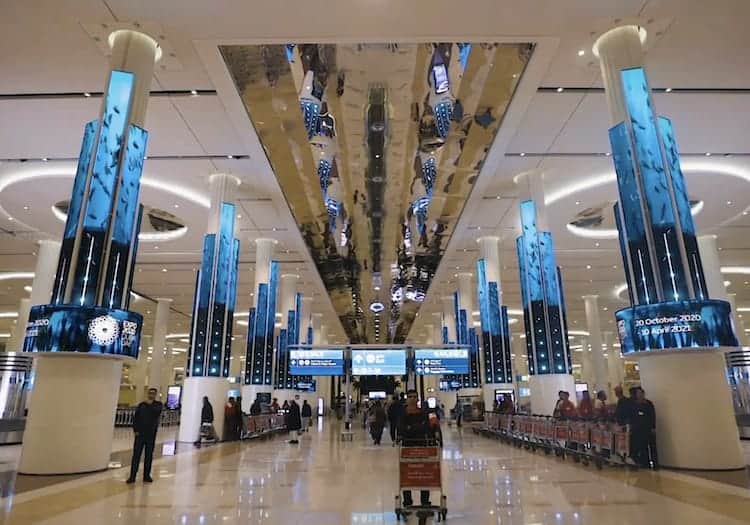
The ‘Essence of Expo 2020’ was an experiential AV (audiovisual) installation in the arrivals hall of Dubai International Airport (DXB), Terminal 3. In this case study, we explain what was installed, how the control and signal chain was designed for scale and resilience, and what approvals and operational details matter most on a live airport site.
Key takeaways
Flexible, curved P2.5 (2.5 mm pixel pitch) LED made it possible to create 360° “halo” screens around structural columns while keeping a consistent visual surface.
Large, distributed LED systems benefit from redundant video control (master + back-up) and fibre-based distribution to reduce single points of failure.
In high-occupancy, live environments, approvals and certification can be the schedule-critical path, so documentation needs to start early and be tightly managed.
Show control, monitoring and reporting are operational requirements, not “nice-to-haves”, when displays must run continuously and integrate with building systems.
A well-specified LED installation plan includes maintenance access, spares strategy and support response expectations from day one.
Project overview
The brief
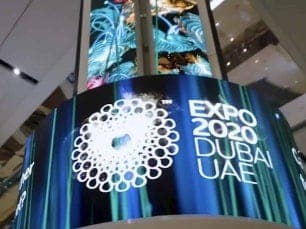
PixelArtworks appointed Dynamo LED Displays to supply LED screens for an experiential activation in the Terminal 3 arrivals hall at DXB. The intent was to create a unified, immersive canvas to present Expo 2020 messaging in a very busy passenger environment. This was a large-scale project and a challenge we were proud to be involved with.
Scope and timeframe
The project had a reported four-month window to design and deliver, including design approval and certification in a live airport environment. Source: Pixel Artworks
What Dynamo supplied
169 m² of 2.5 mm pixel pitch LED screens.
A design that included 10 large LED structures using columns and the central thoroughfare.
Flexible, curved P2.5 LED used to form 360° wrap-around “halo” screens at the base of four entry/exit columns.
Project facts
- Location: Dubai International Airport (DXB), Terminal 3 Arrivals
- Environment: Live airport arrivals hall (24/7)
- Screen type: Experiential LED structures + 360° halo wraps
- Pixel pitch: 2.5 mm
- Size / format: 169 m² across 10 LED structures
- System scale: 32 million pixels + 9 km fibre distribution
- Control / processing: 3× Disguise 4x4Pro + 10× NovaStar MCTRL4K (5 master / 5 backup) with redundancy
- Goal: Expo 2020 “Essence of Expo” activation for arriving passengers
- Outcome: High-reliability large-scale deployment in a live airport environment
From the field (Daniel Reynolds, Managing Director)
On complex, live sites, I find the screens are rarely the only critical path. What usually slows projects down is the detail around approvals, access, and how the installation will be operated day-to-day.
If you can lock down structural intent, cable routes, power responsibilities, and the acceptance process early, you remove a lot of risk before the first cabinet arrives on site.
System architecture: how the installation was driven
This section summarises the signal chain and control approach described for the installation, using clear definitions so it’s easier to specify similar projects.
LED layout and form factor
Pixel pitch is the distance (in millimetres) between the centres of adjacent pixels on an LED display.
P2.5 (2.5 mm) pixel pitch was used across the installation.
Flexible, curved LED was used to create 360° wrap-around halo screens around architectural columns.
Media servers and playback
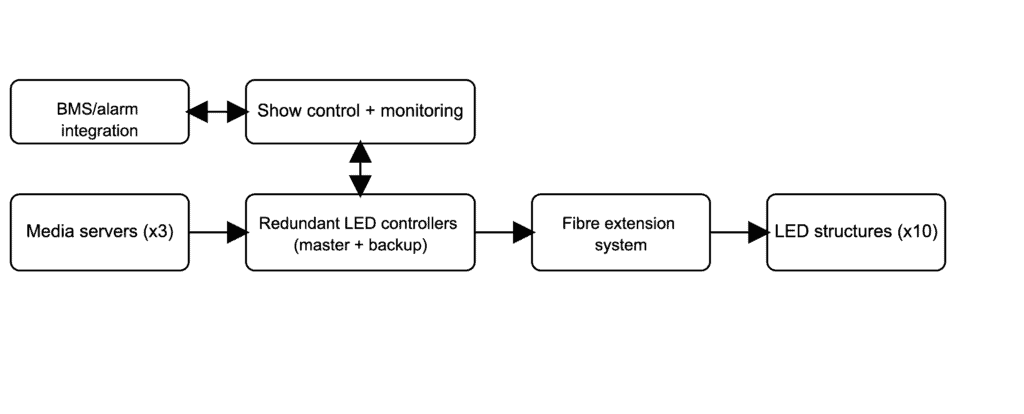
The installation was driven by three Disguise 4x4Pro machines (media servers), responsible for feeding video content to the wider LED system.
LED control, redundancy and fibre extension
The LED pixels were driven using a controller architecture designed for redundancy:
10 × NovaStar 4K controllers, configured as:
5 × MCTRL4K (Master)
5 × MCTRL4K (Back-up)
Controllers were configured for seamless redundancy (master/back-up) to reduce the impact of a single device failure.
A NovaStar CVT fibre extension system was used to achieve the bandwidth required.
Signal distribution (fibre)
Video distribution to the custom LED displays was described as being delivered over approximately 9 km of fibre optic cable. Fibre is commonly used in large venues because it supports long runs with less susceptibility to interference than copper for high-bandwidth links.
Audio system
Audio was delivered via a TiMax SoundHub spatial processor over Dante to loudspeakers integrated into the halo structures (16 EM Acoustics EMS‑51 units are described in published coverage).
Show control, monitoring and integration
PixelArtworks developed a custom show-control UI (user interface) running on 7thSense Medialon Showmaster Pro,
providing:
Local (in-situ) and remote control
Monitoring and reporting
Integration with the airport’s BMS (Building Management System) and alarm systems

Technical snapshot
| Element | What was implemented | Why it matters (decision context) |
|---|---|---|
| LED area | 169 m² of LED | Sets expectations for power, signal distribution, spares, and approval scope. |
| Pixel pitch | P2.5 (2.5 mm) | Impacts perceived resolution at typical viewing distances and affects bandwidth/content workflow. |
| Physical forms | 10 structures + 360° “halo” screens on 4 columns | Non-flat geometry changes mounting design, service access, and cable routing. |
| Playback | 3 × Disguise 4x4Pro (media servers) | Defines synchronisation, operational workflow, and support strategy. |
| Control | 10 × NovaStar MCTRL4K (5 master / 5 back‑up) + CVT fibre extension | Redundancy reduces downtime and clarifies recovery procedures. |
| Audio | TiMax SoundHub + Dante to loudspeakers integrated into halo structures | Audio affects commissioning, monitoring, and operational constraints (e.g., SPL limits). |
| Show control | 7thSense Medialon Showmaster Pro custom UI + BMS/alarm integration | Ops teams rely on monitoring/reporting and integration for incident response. |
Approvals and compliance: what typically drives programme risk
The installation had to go through stringent airport approval processes including fire rating, structural approvals, and electrical safety testing. On live airport sites, approvals and certification can take weeks or months, and often set the programme pace.
UK perspective: the standards that often come up on similar projects
This project was delivered in Dubai, so local requirements apply. For UK projects (or UK-led designs delivered overseas), these references commonly inform how documentation and risk is managed:
Working at height: UK projects must plan, supervise and carry out work at height using competent people and the right equipment, aligned with the Work at Height Regulations framework and HSE guidance.
Electrical installation: In the UK, BS 7671 is the national standard used for electrical installations and is typically referenced for new or amended electrical work.
Fire classification: Reaction-to-fire classification for construction products and building elements is covered by BS EN 13501-1, which is often requested as part of fire strategy documentation.
Equipment safety: IEC 62368-1 is a widely used product safety standard for audio/video and ICT (information and communication technology) equipment and is commonly relevant to AV equipment compliance documentation.
How to specify airport arrivals LED screens
If you’re scoping LED for an arrivals hall, the spec needs to cover the screen, the system behind it, and the way it will be operated. These questions help you get to a buildable, supportable design.
Specification checklist
| What to specify | What to ask for | Why it matters |
|---|---|---|
| Use-case and content | Wayfinding, branding, experiential content, or a mix? | Content type drives pixel pitch choice, brightness expectations, and playback workflow. |
| Geometry and mounting | Flat wall, curved surfaces, columns, freestanding structures? | Curves/columns change module choice, mechanical design, and service access. |
| Viewing conditions | Main viewing distances, sightlines, ambient light/reflections | Determines whether fine pixel pitch and higher brightness are needed. |
| Control and redundancy | Master/back-up requirements and failover behaviour | High-occupancy sites usually require resilience and clear recovery procedures. |
| Signal distribution | Fibre vs copper, route lengths, bandwidth requirements | Long runs/high bandwidth often favour fibre; routes affect containment/fire stopping. |
| Operational control | Who runs it, how it’s monitored, how faults are reported | Monitoring/reporting reduces downtime and support burden. |
| Safety and approvals | Fire docs, structural calcs, electrical testing, method statements | Approvals can be the longest lead-time item on live public sites. |
| Maintenance strategy | Front/rear service, spares holding, access equipment constraints | Keep-the-area-open maintenance planning is essential in arrivals environments. |
Common pitfalls we see on large public-space LED projects
Approval lead times underestimated: Documentation (fire, structural, electrical) is often requested earlier than people expect.
Operations not defined early: If nobody owns monitoring and escalation, faults linger and the user experience suffers.
Cable routing left “to site”: You need clear routes, containment assumptions, and responsibilities for penetrations and fire stopping.
Service access ignored: If engineers cannot safely reach modules and control equipment, the screen becomes expensive to operate.
No spares plan: Large, distributed installs should agree what spares are held, where they’re stored, and how replacements are swapped.
Support and lifecycle planning
For permanent LED installations, the support model should be explicit, including who holds spares, how faults are diagnosed, and how quickly site attendance is required.
Dynamo LED Displays’ standard purchase warranty is a 3-year return-to-base warranty. Service contracts with 24–48 hour response are available upon request (subject to scope and location).
For control and commissioning, Dynamo works extensively with NovaStar and Brompton LED control systems, which helps when integrating LED into wider show-control and monitoring stacks.
Credits
This project credited the work of PixelArtworks alongside partners including Team Visual Solutions, Unusual Rigging, Clearcut Sound Studios, Disguise, the support of Expo 2020 and Dubai International Airport’s design, engineering, and fit-out teams.
Speak to Dynamo LED Displays
If you’re planning an arrivals-hall LED installation (or reviewing an existing spec), we can sanity-check pixel pitch, control architecture, redundancy, service access and approval documentation.
Call: +44 (0)203 489 9878
London HQ: 146a Brick Lane, London, E1 6RU, England, GB
Oxfordshire office: Rowan House, Long Toll, Oxfordshire, RG8 0RR, Oxfordshire, GB
References (authoritative)
HSE (Health and Safety Executive), “Working at height: A brief guide (INDG401)” — https://www.hse.gov.uk/pubns/indg401.htm.
HSE, “Work at height: The law” — https://www.hse.gov.uk/work-at-height/the-law.htm.
IET, “BS 7671 – 18th Edition (The IET Wiring Regulations)” — https://electrical.theiet.org/bs-7671-18th-edition-wiring-regulations/.
BSI, “BS EN 13501-1:2018 Fire classification of construction products and building elements” — https://knowledge.bsigroup.com/products/fire-classification-of-construction-products-and-building-elements-classification-using-data-from-reaction-to-fire-tests.
IEC, “IEC 62368-1:2023 Audio/video, information and communication technology equipment – Safety requirements” — https://webstore.iec.ch/en/publication/69308.
FAQs Regarding The Dubai Arrivals LED
What does “P2.5” mean on an LED screen?
P2.5 means a 2.5 mm pixel pitch: the distance between pixel centres. Pixel pitch affects perceived resolution at typical viewing distances and influences system bandwidth and content design.
Why use flexible, curved LED in an arrivals hall?
Flexible LED can conform to architectural features (like columns), enabling 360° or curved surfaces where flat cabinets wouldn’t fit without complex structure or harsh/angled joins.
What is redundancy in an LED control system, and when is it worth it?
Redundancy means having a back-up path or device (for example, back-up controllers) so a single failure does not take the whole display offline. It is commonly specified where downtime is unacceptable or where the display is part of a critical visitor experience.
When should you choose fibre for LED screen signal distribution?
Fibre is often chosen for longer runs and higher bandwidth, particularly where cable routes are complex or electrically noisy.
What approvals are typically required for LED installations in public buildings?
Expect requirements around fire documentation, structural approval, and electrical safety testing, plus site-specific operational and access constraints. The exact list depends on the venue and jurisdiction.
How do you plan maintenance for LED screens in busy public areas?
Define service access (front or rear), agree safe access methods, plan spares holding, and ensure monitoring/reporting is in place so issues are detected early and fixed quickly.
Which LED control systems does Dynamo work with?
Dynamo works extensively with NovaStar and Brompton LED control systems.
What warranty support does Dynamo provide for purchased LED screens?
Standard purchase warranty is a 3-year return-to-base warranty. Service contracts with 24–48 hour response are available upon request.