Quick Answer: Hotel LED Video Wall
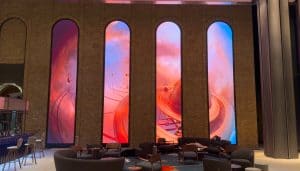
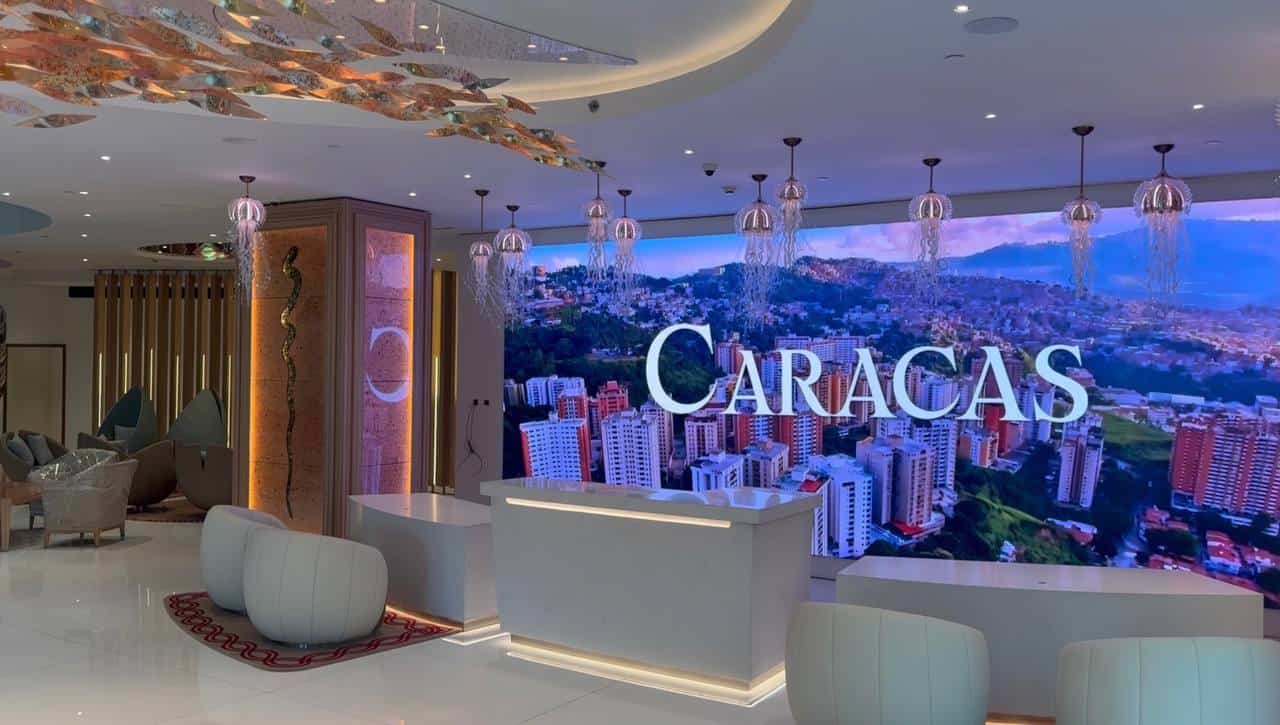
Dynamo LED Displays designed and installed a 24 m² fine pitch LED video wall in the lobby of Hotel Londres, Caracas. The display measures 8 metres wide by 3 metres high, uses P2.5 pixel pitch LED panels, and creates a dramatic centrepiece for the hotel’s reception area. Dynamo LED Displays is a specialist UK LED video wall company based in London, supplying and installing LED displays across the UK and internationally since 2013.
We installed a 24-square-metre Chip-on-Board (COB) LED video wall in the lobby of Hotel Londres in Caracas, Venezuela — an 8 m × 3 m feature wall using our DX Series P1.9 mm panels, shipped from London and installed in just 2.5 days by a three-person team. This case study is for hotel owners, interior designers, architects, and AV consultants planning a lobby LED installation — covering specification, international logistics, customs clearance, and on-site installation.Key Takeaways
- An 8 m × 3 m (24 m²) COB LED video wall was installed in the lobby of Hotel Londres, Caracas, using 96 DX Series P1.9 mm cabinets — delivering a 4,096 × 1,536 pixel image (6.3 megapixels, wider than standard 4K).
- The DX Series cabinets mount directly to an MDF wall surface without any additional framework or mounting kits, which simplified installation and reduced costs.
- Three Dynamo engineers completed the full installation — including alignment, cabling, and commissioning — in 2.5 days.
- Venezuelan customs required documentation verified down to individual diode level; thorough pre-shipment paperwork was essential to avoid delays.
- The NovaStar VX2000 processor enables network-based content control and iPad scheduling, allowing hotel staff to manage content independently after handover.
- Detailed site preparation discussions before travel meant the MDF wall and 110 V power supply were ready on arrival, with no delays on site.
| Client | Hotel Londres, Caracas, Venezuela |
| Screen Size | 8 m × 3 m (24 m²) |
| Product | DX Series P1.9 mm COB LED |
| Cabinet Size | 250 mm × 1,000 mm |
| Total Cabinets | 96 (32 wide × 3 high) |
| Resolution | 4,096 × 1,536 pixels (6.3 megapixels) |
| Processor | NovaStar VX2000 |
| Control | Network control + iPad content scheduling |
| Install Method | Wall-mounted direct to MDF — no framework required |
| Install Team | 3 Dynamo engineers |
| Install Duration | 2.5 days |
| Power Supply | 110 V (local Venezuelan standard) |
| Content | Famous Venezuelan landmarks and cultural imagery |
| Warranty | 3-year return-to-base |
The Brief: A Lobby Feature Wall That Connects Guests to Venezuela
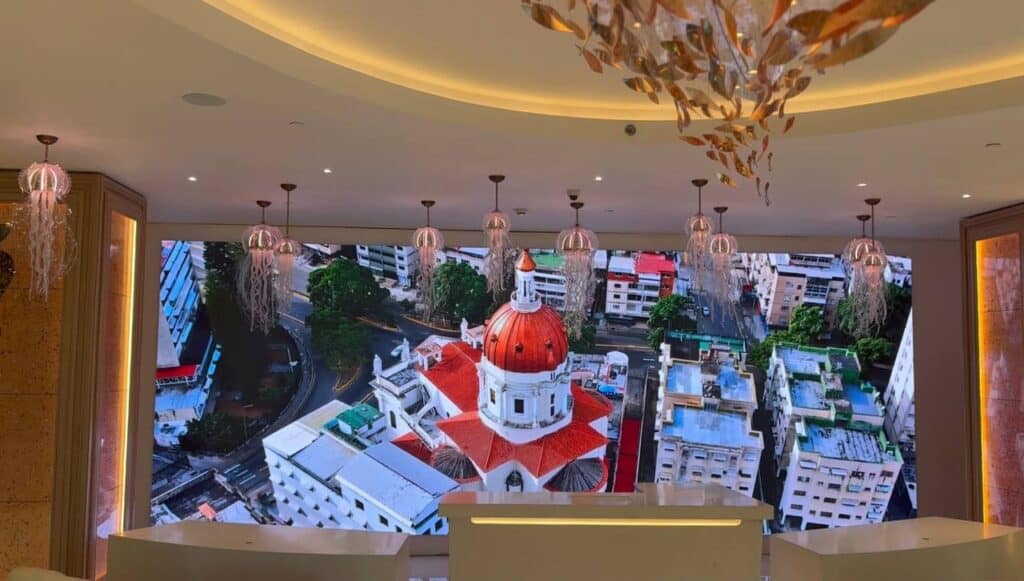
Hotel Londres wanted a large-format LED feature wall for their main lobby — a screen that would greet every guest at reception with imagery of Venezuela’s most famous landmarks, from the Ávila mountain range above Caracas to colonial-era cathedrals and wildlife. The hotel’s management team had seen our CityPoint skyscraper installation in London — a 10.88 m × 4.68 m LED video wall using 221 cabinets — and approached us to deliver something similar for their lobby in Caracas. The brief was clear: a seamless, high-resolution screen that would be the centrepiece of the lobby, visible from the entrance, reception desk, and seating areas. The lobby itself is a luxury environment — polished marble floors, white leather seating, jellyfish-style chandeliers, and a gold leaf ceiling sculpture. The screen needed to complement this setting without dominating it through excessive brightness or a bulky mounting structure.What “Feature Wall” Means in Hospitality
In hotel design, a feature wall is a focal architectural element intended to define the character of a space. Traditionally this might be a mural, stonework, or large-format artwork. An LED feature wall serves the same purpose but with the added flexibility of dynamic content — images, video, and branded messaging that can change by time of day, season, or event. For Hotel Londres, the feature wall doubles as both an art installation and a practical branding tool. During check-in, guests see iconic Venezuelan landscapes. For conferences and events, the content can shift to corporate branding or welcome messages. This versatility is one of the primary reasons hotels are moving towards LED video walls over static décor.Why DX Series P1.9 COB LED
We specified the DX Series P1.9 mm COB LED for this project based on three factors: viewing distance, durability, and mounting simplicity.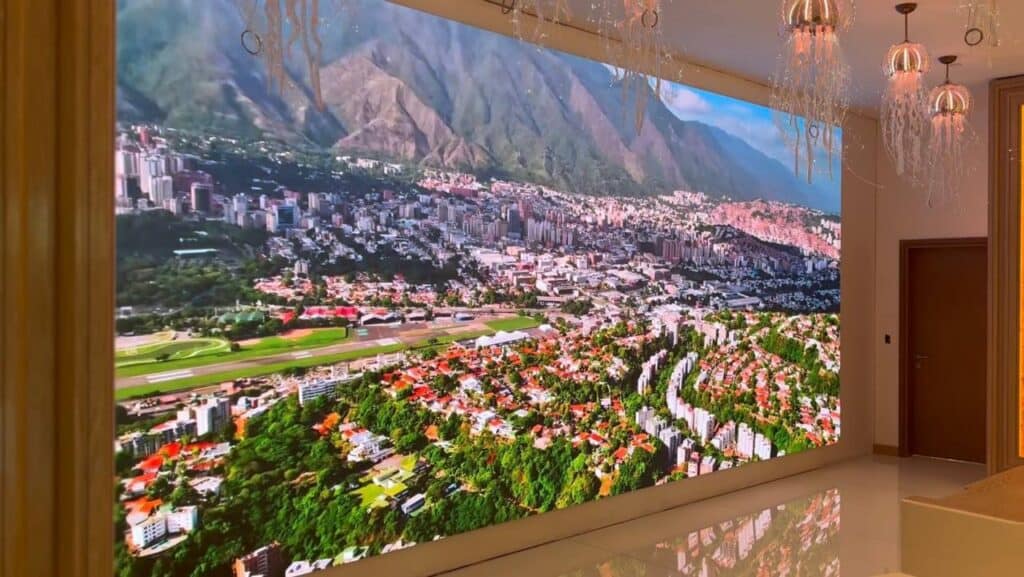
Pixel Pitch and Viewing Distance
Pixel pitch is the distance in millimetres between the centre of one pixel and the next. Lower pixel pitch means higher pixel density and a sharper image at close range. In a hotel lobby, guests may view the screen from as close as 2–3 metres (approaching the reception desk) or from 10+ metres (entering through the main doors). At 1.9 mm pixel pitch, the DX Series delivers a resolution of 4,096 × 1,536 pixels across the 8 m × 3 m surface — that is 6.3 megapixels, which is wider than standard 4K (3,840 × 2,160). This ensures the image holds up at close viewing distances without visible pixelation.COB Technology for Hotel Environments
COB (Chip-on-Board) is a packaging method where LED chips are mounted directly onto the printed circuit board (PCB) and sealed under a protective resin layer, rather than being individually encapsulated as in traditional Surface-Mounted Device (SMD) construction. This gives COB panels several advantages for hospitality environments:- Durability — the resin surface protects against dust ingress, minor impacts, and cleaning fluids, which matters in a lobby where housekeeping staff will be maintaining the area daily.
- Smoother surface — COB panels present a more uniform appearance when viewed off-axis or at close range, which suits a screen that guests walk past.
- Reduced moiré — the smooth surface minimises the moiré interference patterns that can appear when screens are photographed by guests on smartphones — a practical consideration for a hotel where every guest carries a camera.
No Framework Required
The most significant practical advantage of the DX Series for this project was the mounting method. DX Series cabinets mount directly to a flat wall surface — in this case, an MDF panel — without any additional framework, mounting rails, or bracket kits. This matters for hotel projects because:- It reduces total installation cost — no separate steelwork package to design, fabricate, and ship.
- It reduces installation time — the team mounts cabinets directly rather than building a sub-structure first.
- It keeps the total screen depth to a minimum, which is important in lobby spaces where floor area is valuable.
International Logistics: Shipping LED to Venezuela
Shipping 96 LED cabinets and associated equipment from the UK to Venezuela required careful logistical planning — and the customs process was the most demanding we have encountered on any international project.Documentation and Customs Clearance
Venezuelan customs authorities required an exceptional level of documentation detail. The client’s shipping agent had to prepare paperwork that itemised every component in the delivery. Border agents checked every single part of the shipment and verified documentation down to every individual diode. This is not typical of most international LED shipments. In our experience, customs in most countries check at the pallet or crate level. Venezuela’s process was significantly more granular, and any discrepancy between documentation and physical contents could have caused delays or seizure of goods. Lesson for international hotel projects: If you are shipping LED equipment to a country with strict import controls, work with a local shipping agent who understands the specific documentation requirements. Start the paperwork process early — ideally 4–6 weeks before the intended ship date — and ensure every component, down to the smallest accessory, is itemised on the commercial invoice and packing list.Power Supply Confirmation
Venezuela uses a 110 V / 60 Hz electrical supply, which differs from the UK’s 230 V / 50 Hz standard. The DX Series accepts a wide input voltage range, but we confirmed the 110 V compatibility during the specification phase and verified the on-site power supply with the hotel’s electrical contractor before travel. This is a standard step for any international installation, but it is one that must not be overlooked.The Installation: 2.5 Days, 3 Engineers, No Surprises
Three Dynamo engineers travelled to Caracas on 22 March 2026. The installation — including mounting, cabling, alignment, processor configuration, and commissioning — took 2.5 days.Site Preparation Made the Difference
The single most important factor in achieving that timeline was site preparation. We discussed every detail of the wall construction, power supply positioning, and cable routing with Hotel Londres well before departure. When the team arrived, the MDF wall was built to specification, plumb, and ready. The 110 V power points were in position. There were no surprises. This is worth emphasising because site readiness is the most common cause of installation delays on hotel projects. A screen can only go up as fast as the site allows. If the wall is not flat, the power is not in place, or access is restricted, a 2.5-day install becomes a week.Mounting Process
The DX Series cabinets (250 mm × 1,000 mm each) were mounted directly to the MDF wall using the integrated mounting system built into each cabinet. The process is straightforward:- A datum line is established across the wall — level and plumb.
- The first row of cabinets is mounted to the datum, locked together edge-to-edge.
- Subsequent rows stack above, with each cabinet locating precisely against its neighbours via alignment pins.
- Power and data cables are connected at the rear of each cabinet.
- Once all 96 cabinets are mounted (32 wide × 3 high), the processor is connected and the full screen is powered on for alignment and calibration.
Working Through the Language Barrier
Our team’s Spanish was limited to the basics. Day-to-day communication with the hotel’s staff and contractors relied on iPhone translation apps and a fair amount of gesturing. It was initially tricky — technical conversations about cable routing and power distribution do not translate easily through an app — but the team worked through it. By the second day, a working rhythm was established and communication flowed more naturally. For any international installation, we recommend having at least one bilingual contact on the client’s side who can bridge technical discussions. It is not always possible, but it makes a meaningful difference.Content and Control: NovaStar VX2000 and iPad Scheduling
The NovaStar VX2000 video processor handles all signal management and output to the 96-cabinet screen. It supports the full 4,096 × 1,536 pixel resolution natively and provides network-based control — meaning the hotel’s staff can manage the screen remotely without needing to access the processor hardware directly.iPad Content Scheduling
For Hotel Londres, we configured the VX2000 with NovaStar’s content scheduling software, accessible via iPad. This allows the hotel’s marketing team to:- Upload new image and video content over the local network.
- Create playlists and schedule content by time of day (e.g., welcome imagery during check-in hours, branded content during events).
- Monitor screen status and adjust brightness remotely.
Content: Venezuelan Landmarks
The screen content showcases famous Venezuelan landmarks and landscapes — aerial views of Caracas with the Ávila mountain backdrop, colonial cathedrals, tropical wildlife, and panoramic cityscapes. The content connects international guests to Venezuelan culture and geography from the moment they enter the lobby. Content is displayed at the screen’s native 4,096 × 1,536 pixel resolution. Because the aspect ratio is ultra-wide (approximately 2.67:1, wider than standard 16:9), content was produced specifically for this screen format to avoid cropping or pillarboxing.Lessons for Hotel LED Projects
Having delivered LED installations in hotels, corporate lobbies, and public spaces across multiple countries, we consistently see the same factors determine whether a project runs smoothly or encounters delays.1. Invest in Site Preparation
Confirm the following before any equipment ships:- Wall surface: flat, plumb, capable of bearing the screen weight (for this project, MDF was specified and installed by the hotel’s own contractor).
- Power: correct voltage, sufficient amperage, positioned where the processor and cabinets need it.
- Cable routes: planned and accessible.
- Access: the screen location is reachable by the installation team with the equipment they need.
2. Choose Products That Simplify the Install
The DX Series’ direct wall-mount capability eliminated the need for a separate framework — saving time, cost, and shipping weight. When specifying LED for a hotel lobby, ask your supplier whether additional mounting structures are required and what that adds to the project cost and timeline.3. Plan for Content from Day One
An LED video wall is only as effective as the content displayed on it. Too often, screens are specified and installed with content as an afterthought. For Hotel Londres, the Venezuelan landmarks content was planned from the outset, produced at the correct resolution and aspect ratio, and ready to load during commissioning.4. Allow Extra Time for International Customs
If the installation is outside your supplier’s home country, build buffer time into the programme for customs clearance. For Venezuela, this was the most demanding part of the project. For other countries, it may be straightforward — but it is always wise to allow for the unexpected.5. Document Everything for Customs
For countries with strict import controls, ensure your commercial invoices and packing lists are exhaustive. Every cable, bracket, spare part, and — in this case — every diode should be accounted for in the documentation.From the Field — Daniel Reynolds, Managing Director
The Venezuela customs process was something else entirely. We have shipped LED equipment to projects across Europe, the Middle East, and beyond, but the level of scrutiny in Caracas was on another level. The border agents checked every single component against the paperwork — every cabinet, every cable, every connector. Our client’s shipping agent had done a thorough job with the documentation, and that is what got us through without delay. If that paperwork had been even slightly incomplete, we would have been looking at days of hold-ups. The language barrier was real. Our lads had basic Spanish at best, and most of the communication happened through iPhone translation apps and hand signals. It was frustrating at first — you cannot explain cable routing tolerances through Google Translate — but the team adapted. By day two, everyone had a system worked out. The thing that made the biggest difference, though, was the site prep. We had gone through every detail with the hotel before we flew out — wall dimensions, MDF spec, power positions, cable access. When we walked in on day one, the wall was perfect. That is what allowed three engineers to install a 24-square-metre screen in 2.5 days. Without that prep, it would have been a very different story.Specification Checklist for Hotel LED Projects
Use this checklist when planning an LED video wall for a hotel lobby or public area:| Item | What to Confirm |
|---|---|
| Screen dimensions | Width × height in metres, confirmed against architectural drawings |
| Pixel pitch | Based on minimum viewing distance (rule of thumb: pitch in mm ≈ viewing distance in metres) |
| LED technology | SMD, COB, or MIP — based on environment, durability needs, and budget |
| Resolution | Calculate from screen size and pixel pitch; confirm content will be produced at native resolution |
| Mounting surface | Wall material, flatness tolerance, load-bearing capacity |
| Mounting method | Direct wall-mount vs. framework — confirm with supplier |
| Power supply | Voltage, frequency, amperage, circuit location |
| Processor | Model, resolution capacity, control method (network, USB, cloud) |
| Content management | How staff will update content post-install (tablet, CMS, USB) |
| Content production | Who produces content, at what resolution and aspect ratio |
| Ambient light | Lobby lighting levels — affects required screen brightness |
| Maintenance access | Front-service or rear-service; access plan for cabinet replacement |
| Shipping and customs | For international projects: import documentation, duties, local agent |
| Warranty | Duration, terms, spare parts availability |
Frequently Asked Questions
How long does a hotel LED video wall installation take?
Installation time depends on screen size, mounting method, and site readiness. For the Hotel Londres project — an 8 m × 3 m (24 m²) screen using 96 DX Series cabinets — three Dynamo engineers completed the full installation in 2.5 days. This included mounting, cabling, processor configuration, calibration, and content loading. The DX Series’ direct wall-mount system, which requires no additional framework, was a significant factor in achieving that timeline.What pixel pitch is suitable for a hotel lobby LED screen?
For hotel lobbies where guests view the screen from 2–10 metres, a pixel pitch of 1.5–2.5 mm is typically appropriate. At 1.9 mm, the DX Series delivers sharp, detailed imagery even at close range (2–3 metres from the screen). Finer pixel pitches (below 1.5 mm) are available but increase cost per square metre and are generally only necessary where the primary viewing distance is under 2 metres.Do LED video walls need a metal framework behind them?
Not always. Some LED panel systems, including the Dynamo DX Series, are designed to mount directly to a flat wall surface without any additional framework, mounting rails, or bracket kits. This reduces installation time, cost, and the total depth of the screen assembly. The wall surface must be flat, plumb, and capable of bearing the screen weight — for the Hotel Londres project, an MDF panel was used.How is content managed on a hotel LED video wall after installation?
The NovaStar VX2000 processor used in this project supports network-based control and iPad content scheduling. Hotel staff can upload content, create playlists, schedule playback by time of day, and adjust brightness remotely — all from a tablet on the local network. No permanent AV technician is required on site.Can LED video walls be shipped and installed internationally?
Yes. Dynamo has delivered LED installations in the UK, Europe, the Middle East, and South America. International projects require additional planning for shipping logistics, customs documentation, local power supply compatibility, and on-site communication. For countries with strict import controls — such as Venezuela — thorough documentation of every component in the shipment is essential to avoid customs delays.What is COB LED and why is it used in hotels?
COB (Chip-on-Board) is an LED packaging method where chips are mounted directly onto the circuit board and sealed under a protective resin layer. Compared to traditional SMD (Surface-Mounted Device) construction, COB panels offer better durability against dust and minor impacts, a smoother surface appearance, and reduced moiré when photographed. These properties make COB well suited to hotel environments where screens are in high-traffic areas and frequently appear in guest photos.How much does a hotel lobby LED video wall cost?
Cost varies significantly depending on screen size, pixel pitch, LED technology (SMD, COB, or MIP), processor specification, and installation complexity. As a guide, COB LED at 1.9 mm pixel pitch is a mid-to-premium specification. For an accurate quotation, contact our team with your screen dimensions, viewing distance, and site details, and we will provide a detailed proposal.What content works on a hotel lobby LED screen?
Effective hotel lobby content includes local landmarks and cultural imagery (as used at Hotel Londres), branded welcome messages, event information, and seasonal campaigns. Content should be produced at the screen’s native resolution and aspect ratio to avoid cropping or scaling artefacts. Ultra-wide screens — like the 2.67:1 ratio at Hotel Londres — require bespoke content rather than standard 16:9 video.How much does a hotel lobby LED video wall cost?
A hotel lobby LED video wall typically costs between £25,000 and £150,000 depending on size, pixel pitch, and installation complexity. The Hotel Londres installation covered 24 square metres using P2.5 fine pitch LED, representative of a mid-to-large hospitality display project.
What pixel pitch is best for a hotel lobby LED screen?
For hotel lobby LED video walls viewed from 3–6 metres, a pixel pitch of P2.5 to P3.9 is typically appropriate. Closer viewing distances (under 3m) may warrant P1.9 or finer.
Who installs LED video walls in hotels in the UK?
Dynamo LED Displays is a specialist UK LED video wall installer with experience in hospitality installations across the UK and internationally, including the Hotel Londres lobby installation in Caracas.
Watch the Installation
Related Guides
- The Complete Guide to LED Video Wall Technology
- How Much Does an LED Video Wall Cost in the UK?
- LED Display Companies UK
- Request a quote for your hospitality project
LED panel specifications sourced from Absen (absen.com) and NovaStar video processing documentation at novastar.tech. For hospitality AV standards and guidance, see AVIXA (avixa.org).