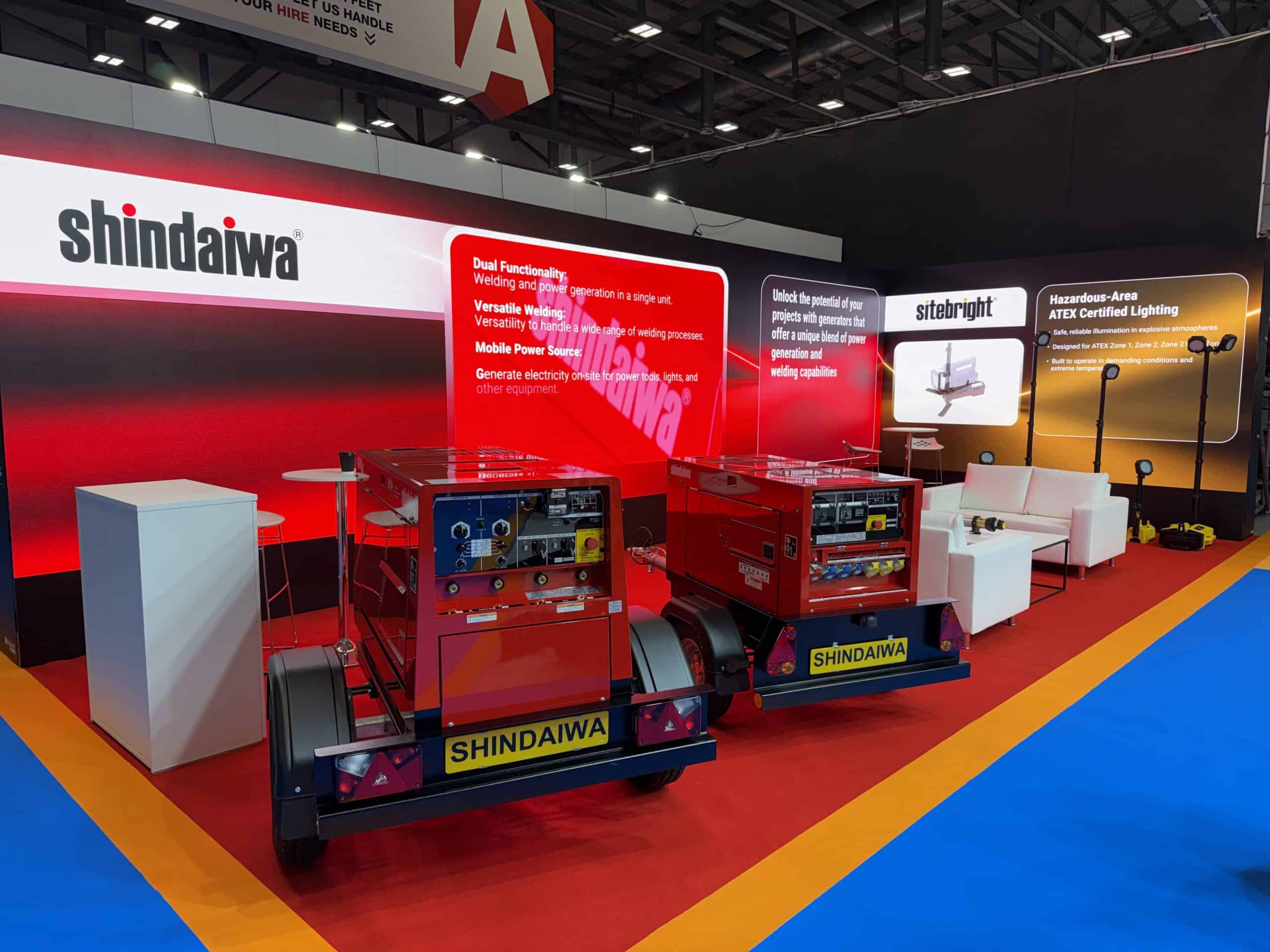
At exhibitions, attention is earned in seconds. In this case study, we explain how we delivered a right‑angle (L‑shape) LED feature wall for Shindaiwa at the Executive Hire Show at the Coventry Building Society Arena, and what exhibitors can learn from the design. An earlier Executive Hire Show wall, 10 m × 2.5 m for Coveya, is covered in our Coveya exhibition LED screens case study.
If you are planning exhibition LED screens for a stand, you’ll take away a practical specification checklist, content-mapping guidance for corners, and the on‑site checks that prevent last‑minute surprises.
Key takeaways
An L‑shape LED wall increases visibility from two aisles and gives content more “presence” without relying on truss builds.
“Cabinet‑accurate” sizing (designing to the exact cabinet grid) reduces gaps, awkward trims, and last‑minute compromises on site.
Pixel pitch is only useful when paired with viewing distance, content type (text vs video), and camera considerations.
Treating the return wall as part of one mapped canvas helps motion graphics and messaging flow naturally around the corner.
Control system headroom matters: a processor with spare capacity makes commissioning smoother and supports future content complexity.
Project facts
Below is a factual snapshot of what we built, using the same terminology we use during planning and commissioning.
| Item | Details |
|---|---|
| Event | Executive Hire Show, Coventry Building Society Arena (Coventry) 11th-12th Feb |
| Client | Shindaiwa |
| LED product | DEX Series P2.06 |
| Screen shape | Right angle (L‑shape): main run + return |
| Main run size | 9.424 m wide × 2.48 m high (shelf‑mounted) |
| Return size | 3.968 m wide × 2.48 m high (shelf‑mounted) |
| Cabinet format | 496 mm × 496 mm cabinets |
| Cabinet layout | Main: 19 wide × 5 high (95 cabinets). Return: 8 wide × 5 high (40 cabinets). Total: 135 cabinets. |
| Resolution per cabinet | 240 × 240 pixels |
| Overall mapped resolution | 6480 × 1200 pixels (7,776,000 pixels) |
| Processing | NovaStar H5 processor |
| Playback | NovaStar ET4000 media server |
What we mean by “exhibition LED screens”
Exhibition LED screens are modular LED video walls designed to be built quickly, run reliably on show floors, and integrate cleanly into stand structures. On the largest stands, such as the 270 m² of LED Dynamo supplied for BAE Systems at DSEI 2021, dozens of screens run as one canvas.
A good exhibition LED screen should be specified around the real constraints of a venue: sightlines, build height limits, access, power, and content workflow.
Why an L‑shape LED wall works on a busy show floor
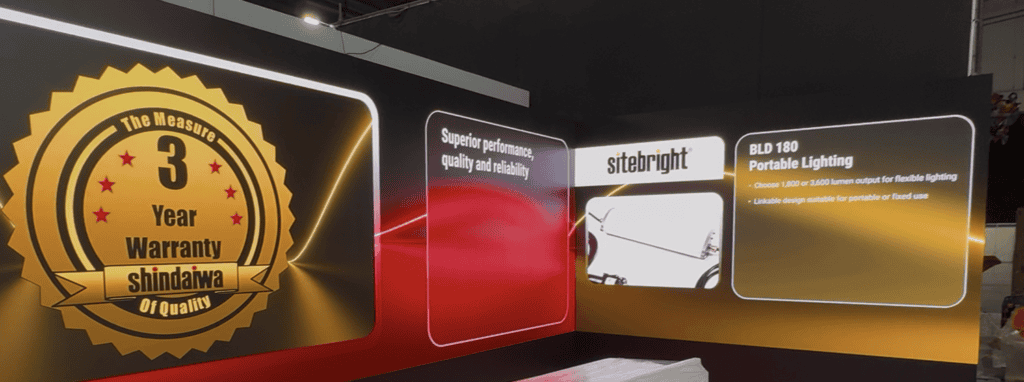
A right‑angle (L‑shape) LED wall improves stand visibility from multiple directions and makes the display feel integrated into the build rather than added on as an afterthought.
For exhibitors, the practical win is simple: you gain a “hero” face for front-on impact and a return that pulls visitors in from the side.
Where an L‑shape is most effective
Corner stands or stands with two aisles of traffic.
Brands that need readable messaging at close viewing distances.
Stands where you want an architectural finish (for example, shelf mounting) instead of truss towers.
The brief: a premium backdrop that felt built‑in
Shindaiwa’s brief was straightforward, and it is typical of what exhibitors ask for when they want a more premium finish.
They needed an LED centrepiece that:
Wrapped the stand at a right angle to maximise visibility from two aisles.
Sat neatly on a shelf so the build stayed clean and architectural.
Delivered sharp messaging for close viewing (text, product benefits, brand visuals).
The solution: cabinet‑accurate DEX Series right‑angle LED
A clean exhibition LED build starts with cabinet‑accurate design, meaning the width and height are deliberately built to the cabinet grid rather than forcing a “close enough” size.
For this project, our cabinet‑accurate approach meant the physical dimensions landed exactly on the DEX cabinet format (496 mm × 496 mm), which keeps edges straight and avoids awkward trims.
Cabinet layout and physical dimensions
We built the wall as two faces:
Main run: 19 cabinets wide × 5 cabinets high.
Return: 8 cabinets wide × 5 cabinets high.
Because cabinet sizing is consistent, the finished L‑shape reads as one continuous architectural element, not two separate screens joined together.
Why DEX Series P2.06 suited this environment
DEX Series is well suited to exhibitions where visitors stand close enough to read fine text and the screen needs to tolerate the realities of show traffic.
For this build, DEX P2.06 delivered:
Fine‑pitch detail for crisp text and product messaging.
Consistent cabinet sizing that speeds planning and keeps alignment tidy on shelf installs.
Brightness specified for exhibition use (as used on this project).
X‑GOB protection on the DEX line, adding an extra layer of reassurance in high footfall.
Resolution and pixel mapping for an L‑shape canvas
The simplest way to think about resolution on a right‑angle wall is that each face has its own pixel grid, but content can be mapped so it behaves like one continuous canvas.
That is how you avoid a return wall that feels disconnected or “left over”.
How we arrived at 6480 × 1200 pixels
Each cabinet was 240 × 240 pixels. The cabinet maths is straightforward:
Height: 5 cabinets × 240 px = 1200 px
Main run width: 19 cabinets × 240 px = 4560 px
Return width: 8 cabinets × 240 px = 1920 px
Combined mapped width: 4560 px + 1920 px = 6480 px
Total pixels: 6480 × 1200 = 7,776,000 pixels.
Content planning for corners
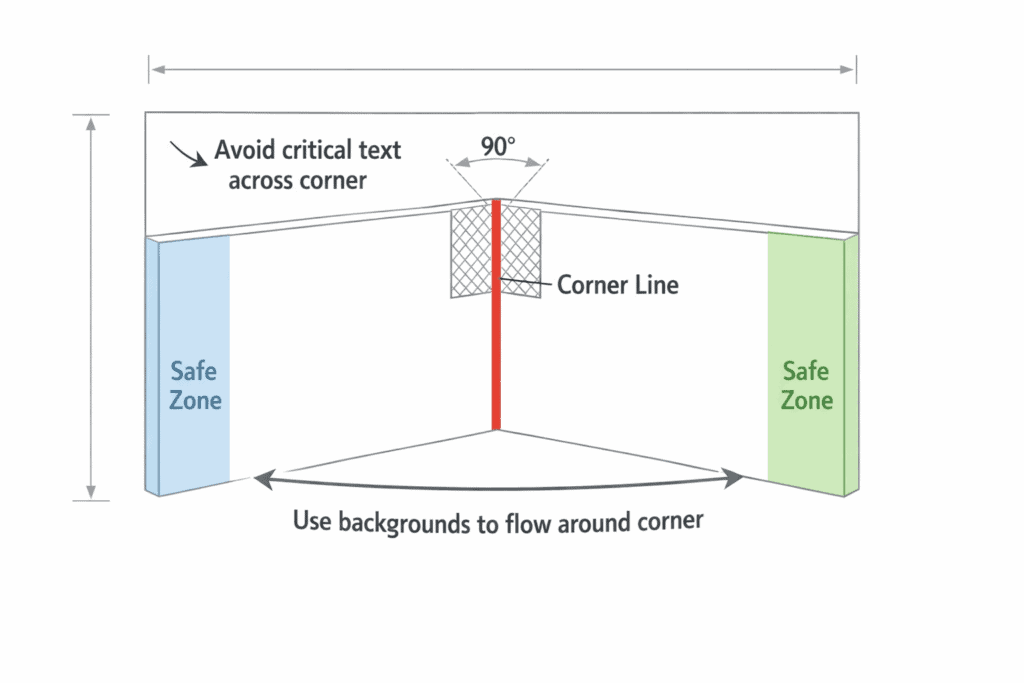
A corner is where good content planning shows. The physical “turn” can make text and faces feel distorted if you don’t plan safe zones.
Practical rules we apply when mapping right‑angle content
Keep critical text and logos away from the corner line unless you deliberately want a wrap effect.
Use motion backgrounds and brand textures to “flow” around the corner.
Design two versions of key messages: one optimised for the main face, one for the return.
Confirm where the “corner pixel” lands in the content canvas before finalising artwork.
Control, playback, and commissioning
A show‑floor LED wall only feels premium if it starts up cleanly, holds sync, and looks consistent under challenging lighting and camera phones.
For this build, we drove the wall with a NovaStar H5 processor and NovaStar ET4000 media server, giving us comfortable headroom over the 7.78 million‑pixel canvas.
What we check during commissioning
These are the checks we run through on every exhibition LED commission, especially on large canvases and non-standard shapes:
Correct LED mapping and cabinet addressing (including the corner transition).
Content output resolution and scaling (avoid unintended resampling).
Brightness and colour checks under show lighting.
Redundancy and cable routing checks (where specified).
Playback stability, including start‑up behaviour and recovery after power cycling.
Specification checklist for exhibitors
If you are briefing exhibition LED screens, the best results come from confirming a few on‑site facts early.
This checklist helps you avoid the most common “it looked fine on the drawing” problems.
| What to confirm | Why it matters | What we typically need from you |
|---|---|---|
| Stand layout and sightlines | Determines whether a flat wall, L‑shape, or curved build will work best. | Plan view with aisle positions and key viewing approaches. |
| Viewing distance and content type | Pixel pitch choice depends on how close people will read text and how the content is designed. | Example artwork and how close visitors will likely stand. |
| Integration method (shelf, frame, truss, wall mount) | Controls finish quality, service access, and where cabling can be hidden. | Stand build drawings and the planned structure where the LED will sit. |
| Power availability and distribution | A clean power plan prevents nuisance trips and last‑minute re‑routing. | Confirmed power locations and any venue limitations. |
| Data path and control position | Processor and playback location affects cable runs, safety, and troubleshooting access. | Preferred “control point” on the stand and cable route constraints. |
| Rigging and access | Install and de‑rig must match the venue schedule and your build contractor’s method statement. | [ADD] Access times, build rules, and who is responsible for lifting/MEWPs. |
Common pitfalls (and how we avoid them)
Most exhibition LED problems are not “LED problems”. They are planning problems that show up under time pressure.
Pitfalls we design out early
Non‑cabinet‑accurate dimensions: leads to trims, gaps, or unexpected borders.
Corner content not planned: makes the return look like an afterthought.
Text designed too small for real viewing distance: looks sharp up close but unreadable from the aisle.
No plan for service access: slows down fixes if a module needs attention during build-up.
Power and control position left vague: increases cable clutter and commissioning risk.
From the field (Daniel Reynolds)
On exhibition builds, we focus as much on “how it will be built” as “what it will look like”. A right‑angle LED wall is a great example: it looks simple in a render, but the finish depends on cabinet‑accurate sizing, a clean corner detail, and a content map that respects the physical turn.
If you share your stand layout early, we can usually spot the issues that cause stress on site: where the control point will sit, whether the return wall will be seen first by most visitors, and whether the stand build needs a shelf detail, a frame system, or a different approach entirely.
Next steps
If you are planning exhibition LED screens and want a right‑angle feature wall like this, we can help you validate the size, cabinet grid, and content mapping before your stand drawings are final.
Call us on +44 (0)203 489 9878 or use our contact page: https://www.dynamo-led-displays.co.uk (Contact).
Useful pages on our site
Exhibition LED screens: /exhibition-led-screens/
DEX Series: /dex-series/
LED video walls: /led-video-walls/
LED control systems (NovaStar and Brompton): /led-control-systems/
Service and support: /service-support/
Contact Dynamo LED Displays: /contact/
External references
If you would like a budget estimate for your stand, tell us the size you want and the venue, and we can produce a formal quotation. If you prefer, we can also share images of similar projects we have delivered.
For a three-sided right-angle build on a hire basis, see the 2mm LED wall Dynamo built for a BT Sport advert.
Exhibition LED Screen FAQs
What are exhibition LED screens?
Exhibition LED screens are modular LED video walls designed for temporary builds, fast installation, and reliable operation on show floors, usually as part of a stand build.
Why choose a right‑angle (L‑shape) LED wall for an exhibition stand?
A right‑angle LED wall improves visibility from two aisles and creates a more integrated, architectural finish than a single flat screen or a screen on truss.
How do you calculate LED wall resolution from cabinets?
You multiply the resolution per cabinet by the number of cabinets wide and high, then confirm how the canvas is mapped if the wall includes multiple faces (such as an L‑shape).
What pixel pitch is best for exhibition LED screens?
The “best” pixel pitch depends on viewing distance and the type of content (especially small text). If visitors will be close enough to read messaging, finer pitch usually helps.
How should content be designed for an L‑shape LED wall?
Content should be mapped as a single canvas where possible, with key text kept away from the corner line and motion backgrounds designed to flow around the turn.
What is an LED processor and why does headroom matter?
An LED processor manages inputs and outputs to the screen. Headroom matters because it makes commissioning more stable and leaves capacity for future content complexity or screen changes.
What do you need from an exhibitor to quote an LED wall accurately?
We need the target size, stand drawings or layout, viewing distance, integration method (shelf/frame/truss), and the power and control position details at the venue.
Do you handle all of the power from the venue?
Yes. We can let you know exactly what power source we will require and then we will distribute that to our LED screens and can even supply plug sockets from there for the stand.
Written by: Daniel Reynolds, Managing Director, Dynamo LED Displays
Technically reviewed by: Tristan Grant, Senior LED Engineer
Published: 13 February 2026