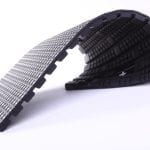
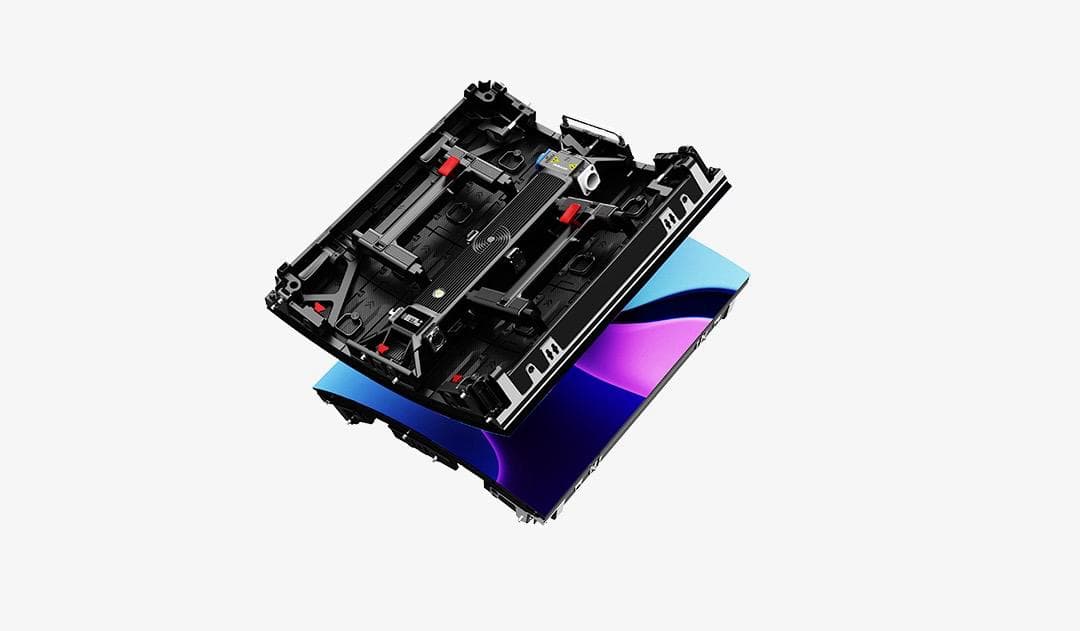
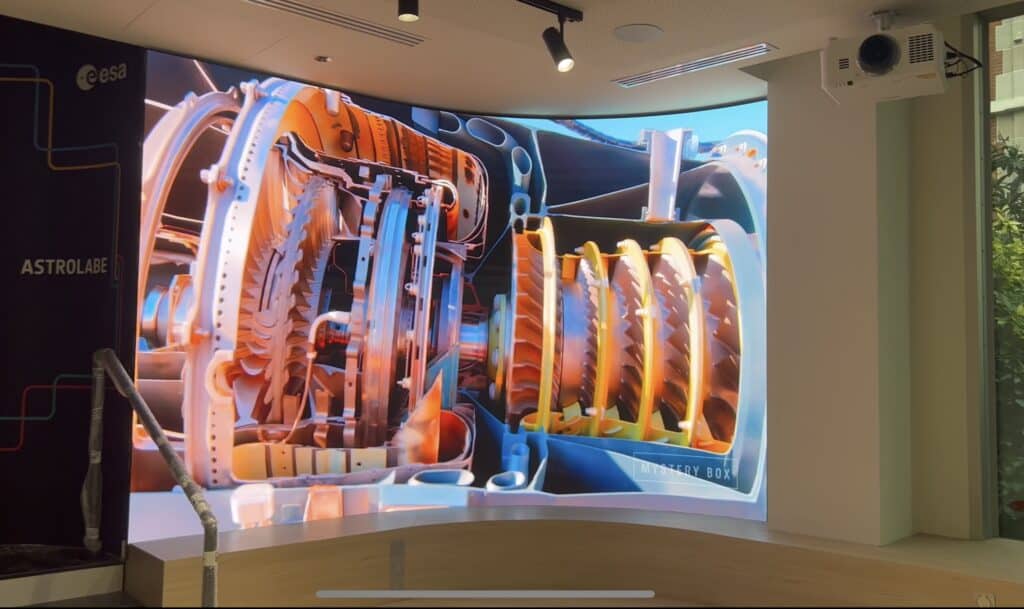
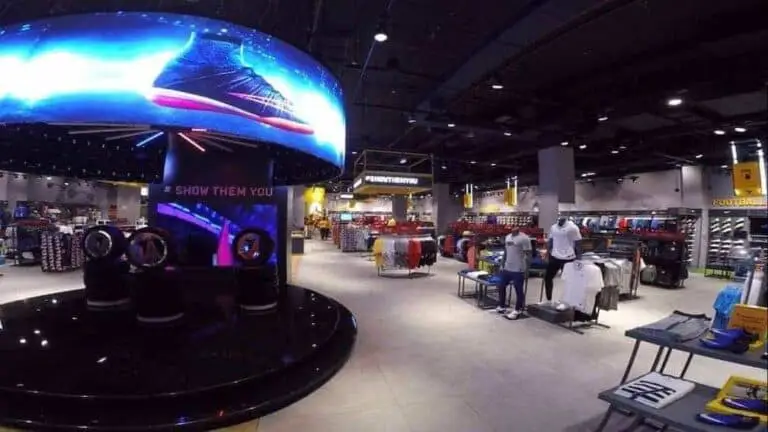
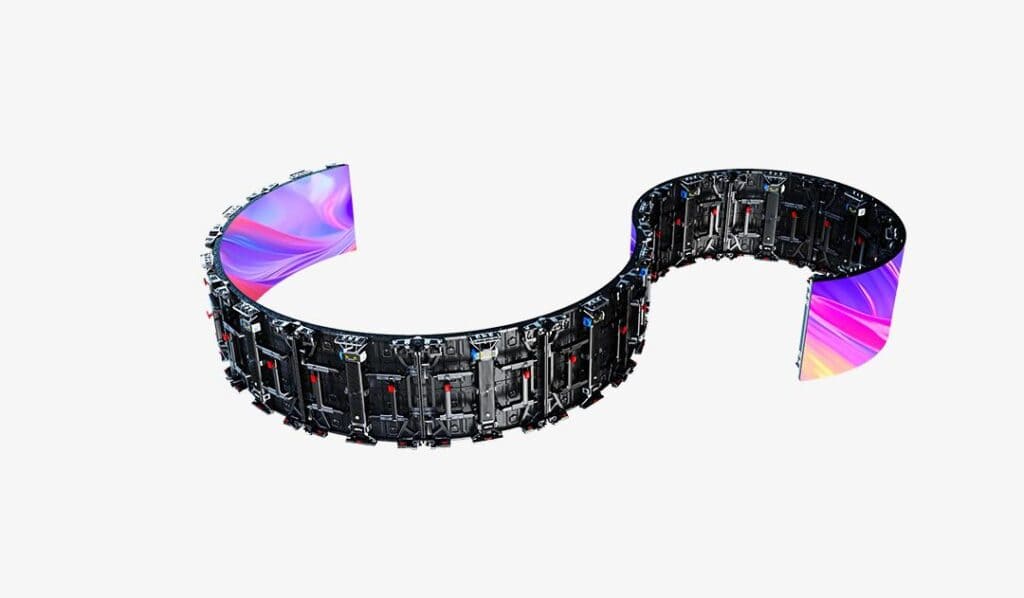














Flexible LED screens are specified differently from flat rigid LED because the mechanical behaviour matters as much as the image performance. Pixel pitch, bend radius, module size, service access and control architecture should be considered together rather than treated as separate line items.
| Specification | Typical range | Specifier notes |
|---|---|---|
| Available pixel pitches (Dynamo flexible rubber range) | P0.9375 to P4, across the iSoft, iSoft Plus, iSoft MIP and iFlex series | Finer pitches (P0.9375 to P1.95) suit close-viewed indoor features such as retail columns, premium hospitality walls and broadcast or XR sets. Mid pitches (P2 to P2.6) are common for events, retail hero walls and architectural features. Coarser pitches (P3 to P4) are appropriate for larger formats and longer viewing distances. |
| Minimum bend radius | Typically 500-1,000 mm depending on pitch and module type | Finer pitch products can often support tighter curves, but the product data sheet and installation method should always set the final limit. |
| Module size by Dynamo flexible series | iSoft 240 × 120 mm; iSoft Plus 320 × 160 mm; iSoft MIP 300 × 168.75 mm; iFlex 250 × 250 mm | Series selection depends on curve geometry, target pitch and content scale. iSoft and iSoft Plus support tight curves and complex transitions. iFlex provides a larger rubber module suitable for less complex curves and broader architectural installs. iSoft MIP uses MIP0606 chips for fine-pitch flexible work. |
| Weight | Typically 6-12 kg/m2 | Lighter than many rigid LED systems, but total load still matters on ceilings, truss, scenic structures and large architectural features. |
| Brightness | 800-1,500 nits indoor; 4,500-6,500 nits outdoor variant | Indoor retail and hospitality usually need controlled brightness. Outdoor and daylight-facing installations require higher output and appropriate environmental protection. |
| Refresh rate | At least 1,920 Hz; at least 3,840 Hz for camera-grade use | Higher refresh rates are important for broadcast, filmed events, social content capture and virtual production environments. |
| IP rating | IP30-IP41 indoor typical; IP65 outdoor variant | Indoor ratings suit controlled environments. Outdoor use needs weather-rated product, sealed cabling and suitable drainage or ventilation strategy. |
| Power consumption | Typically 250-500 W/m2 | Allow for peak draw, average content load, power distribution, heat output and access to power supplies. |
| Viewing angle | At least 140 degrees horizontal; at least 120 degrees vertical | Tight inward curves can reduce the effective viewing angle because parts of the display face away from some viewers. |
| Operating temperature | -20 degrees C to +50 degrees C | Check the full product data sheet where the installation is exposed to direct sun, heat build-up, cold storage or outdoor night-time conditions. |
| Control | Novastar or Brompton receiving cards; fibre or Cat6 signal | Controller choice should reflect content resolution, camera requirements, colour management and distance between processor and display. |
The most important specification is not always the finest pixel pitch. A P2.5 flexible display can be the right choice for a close-viewed retail column, but it may be unnecessary for a stage backdrop viewed from 15 metres. For curved screens, the bend radius and module geometry should be checked early, because they can affect the size of the structure, the content canvas and the achievable curve. Brightness should be matched to the environment rather than maximised by default; too much output in a dark hospitality or broadcast setting can create glare and camera exposure issues. Specifiers should also check servicing before signing off the mechanical design. A curved LED wall that looks simple on a visual can become difficult to maintain if there is no practical way to remove modules, reach power supplies or access receiving cards after installation.
Retail designers, shopfitters and brand teams use flexible LED for wrap-around shopfront screens, pillar displays, in-store hero walls and curved promotional features. The problem is usually spatial: a flat screen does not follow the architecture, or a standard LED video wall feels too heavy for a premium interior. P2 to P4 is typical for close-viewed retail across the iSoft and iSoft Plus ranges, with 800-1,500 nits usually sufficient indoors. Content should be bold, high contrast and designed in short loops. Product photography, campaign motion, brand colours and simple typography work better than dense copy. On columns, avoid placing important text at the far left and right edges where it may wrap away from the main sightline.
Exhibition stand builders, event production companies and set designers use flexible LED to create curved backdrops, ribbon screens, concave presentation walls and scenic features that break away from standard flat rectangles. The aim is often to create depth without building heavy scenic pieces. P2.5, P3 and P4 are common, depending on audience distance and camera use, with finer pitches such as P1.86 or P1.95 specified when prominent broadcast cameras are involved. Brightness varies by venue, but indoor systems normally sit below outdoor output levels. Content can be more graphic and kinetic than retail, but it still needs to respect the curve. Speaker support slides should not run small text across a tight radius; central safe zones are useful for logos, product names and live camera feeds.
Architects, interior designers and hospitality operators specify flexible LED for hotel lobbies, restaurant ceilings, atrium features, immersive rooms and curved lift lobby walls. In these environments the screen is part of the architecture rather than a temporary show surface. P2 to P4 is a practical range for many feature walls, while finer pitches such as iSoft P1.56 or iFlex P1.95 may be appropriate where guests pass very close to the display. Brightness should be carefully controlled, especially in restaurants, bars and lounges where glare quickly becomes uncomfortable. Content is often ambient: slow motion, subtle branded scenes, generative patterns, art-led visuals or time-of-day changes. White balance and dimming schedules are important because the display may run for long periods.
Broadcast designers, production studios and virtual production teams use curved LED walls to create controlled backgrounds, XR volumes, sports studio environments and news desk settings. The buyer is usually solving a camera problem: they need a continuous background with fewer visible edges and more control than physical scenery. P1.25 to P2 is common where cameras are close, with iSoft P0.9375 specified for the closest XR camera positions and a camera-grade refresh rate of at least 3,840 Hz. Brightness depends on lensing, lighting and camera exposure rather than viewer comfort alone. Content must be tested through the actual camera chain. Moire, scan lines, colour shift on curves and reflections from studio lighting can all affect the final image.
Brand experience agencies, museum designers and sponsorship teams use flexible LED for pop-up installations, interactive tunnels, product launch spaces, gallery features and curved storytelling environments. These projects often need a physical form that visitors can move around, film and share. P2 to P4 is a common starting point, with finer pitches such as P1.56 or P1.95 where visitors are within a metre or two. Brightness should be set for the space, especially where visitors are standing close to the LEDs. Content may combine looped motion, interactive moments, sensor-triggered visuals and directional sound. The screen shape should be agreed before content production begins, as treating a curved canvas like a flat 16:9 display usually leads to distortion. For gallery, museum and exhibition art-piece installations specifically, see our LED art display service for galleries which collates the related design considerations.
Rigid fine-pitch LED remains the better choice for many flat surfaces. It is generally sharper, mechanically stable and straightforward to align across large rectangular walls. For boardrooms, control rooms, retail media walls and fixed flat installations, rigid LED often gives the cleanest result. If a rigid panel suits the brief better, you can buy an LED screen from our standard indoor and outdoor families. Flexible LED adds the ability to follow curves, wrap columns and form concave or convex surfaces, but that capability usually involves a narrower choice of pixel pitches, more careful handling and closer attention to bend radius.
LED mesh is a different category. Mesh is useful where transparency, wind loading and very large scale matter, such as building facades, stage scrims and outdoor architectural media. It is much more open than flexible LED, but it is also lower resolution and better suited to longer viewing distances. Flexible LED is denser, more continuous and more appropriate where people are closer to the surface or where the content needs to carry detail.
Projection mapping can be effective on curved surfaces and is often cheaper to install at the outset, especially for temporary installations. Its weakness is environmental control. Projection is sensitive to ambient light, shadows, surface colour, projector alignment and throw distance. Flexible LED has a higher capital cost, but it is brighter, self-emissive and easier to schedule, repeat and control once installed.
Printed graphics are still the simplest option where the message is static. Print is light, inexpensive and easy to replace, but it cannot update content, run motion, respond to events or change by time of day. Flexible LED is justified when the curved surface needs to act as a live media surface rather than a fixed decorative finish.
Mounting method should be defined around the structure, not chosen in isolation. Flexible LED is commonly installed using magnetic backing, a prepared frame system or direct adhesion to a suitable substrate. The surface needs to be smooth enough for module alignment, strong enough to hold the load and stable enough to avoid movement that could stress the panels. For architectural projects, expansion and contraction of the substrate should be checked, especially where metalwork, timber, plasterboard or composite surfaces meet.
The curve needs to be described accurately before procurement. A convex column, a concave presentation wall and a compound scenic form place different demands on the LED modules. Single-radius curves are simpler than compound curves, and transitions between flat and curved areas need careful module planning. Bend radius limits must be respected during installation. Over-bending can permanently damage the panel, affect solder joints or create visible irregularities across the face of the display.
Flexible LED is light per square metre compared with many rigid systems, but the cumulative load still matters. A small retail column may be straightforward, while a ceiling feature, suspended ribbon or large facade can require structural review. For installations over roughly 20 m2, structural sign-off is usually a sensible expectation, particularly in public spaces, event environments and any location where the display is mounted overhead.
Power and signal routes should be planned with the same care as the visible curve. Large installs may need power injection points every 1-2 metres of horizontal run, depending on product, brightness and content load. Cable bend tolerance matters because tight routing can stress connectors behind the modules. Controller and processor locations should remain accessible after handover, with sensible cable routes for Cat6 or fibre signal distribution.
Service access is a practical design issue. Some curved screens are front-service, allowing individual modules to be removed from the display face. Others require rear access through the supporting structure. The correct approach depends on the mounting method, site constraints and whether the installation is temporary or permanent. A visually clean design can become expensive to maintain if failed modules, power supplies or receiving cards cannot be reached safely.
A robust pre-install workflow should include 3D modelling against the site curve, module mapping, cabinet or frame setting-out, signal planning, power distribution and content canvas mapping. This is especially important where the LED wraps around corners, follows a column, meets joinery or sits within a scenic set. Early CAD coordination reduces the risk of awkward module cuts, unsupported edges and content that does not line up with the physical form.
Pixel pitch and curve shape interact. A coarse pitch on a tight curve can make the geometry more visible, particularly at close range. A finer pitch can reduce that effect, but it will not remove the need for good content mapping and appropriate viewing distances. The screen should be treated as a shaped canvas, not a flat rectangle that happens to bend.
Text needs particular care. Curved surfaces make copy harder to read, especially when lines of text run across deep curves or wrap around columns. Larger type, shorter phrases and central safe zones usually perform better. For retail, events and broadcast, key messages should sit where the intended audience or camera has the clearest view.
Motion design should be tested on the real curve or an accurate preview. Panning content across a curve can create a useful parallax effect, but it can also feel disorientating if the motion direction conflicts with the physical form. Content loops should be checked from several viewing positions, not only from the centre line.
Aspect ratio mapping is also important. Curved canvases distort content if they are fed as a standard flat image without correction. Content should be authored or re-mapped to the installed LED layout, with allowance for corners, joins and non-standard resolutions. Colour and white balance may need presets because curved installations often sit in uneven ambient light. Brightness scheduling is equally useful: lower output in the evening, higher output when daylight competes with the display.