A front-service LED wall lets technicians remove modules, power supplies and receiving cards from the viewing face — no rear access corridor needed. Get it wrong and you either lose usable floor space to a maintenance corridor you did not budget for, or you lock modules behind a wall with no practical way to reach them. It is about how much space you have behind the screen and how you plan to maintain it. This guide sets out the structural, spatial and operational differences so you can match the right access method to your site. For a broader view of display types before servicing detail, see our guide to LED displays.
What Is the Difference Between Front-Service and Rear-Service LED Walls?
- Front-service cabinets allow module and power-supply removal from the viewing side, eliminating the need for rear access.
- Rear-service designs typically cost less per cabinet but require a minimum service corridor of 600–900 mm behind the screen.
- Front-service walls can sit as shallow as 55 mm from the mounting surface; rear-service frames are deeper but structurally simpler.
- Pixel pitch does not determine service method — both approaches are available across fine-pitch and standard-pitch ranges.
- The decision is driven primarily by the physical space behind the screen, the mounting method and long-term maintenance access.
- Use our front-service LED video wall systems to lock down size, pitch and budget — the tool flags which service method fits before you commit to steelwork.
At-a-glance: front-service vs rear-service LED walls
| Factor | Front service | Rear service |
|---|---|---|
| Module removal direction | From the viewing face | From behind the screen |
| Typical wall depth | 55–90 mm | 100–200 mm (plus corridor) |
| Rear access corridor needed | No | Yes — typically 600–900 mm clear working depth |
| Common mounting | Flush / recessed / wall-hung | Free-standing frame / ground-up structure |
| Relative cabinet cost | Higher per unit | Lower per unit |
| Maintenance disruption | Service work affects the front-of-house area | Service work can happen behind the wall |
| Common product fit | Dynamo DFC Series or Dynamo DX Series for fixed indoor installs | Dynamo DFC, Dynamo DX or Dynamo DVO Series depending on environment |
| Suited to | Retail, lobbies, boardrooms, control rooms, narrow spaces | Studios, large venues, plant-room-backed walls, outdoor structures |
How front-service LED cabinets work
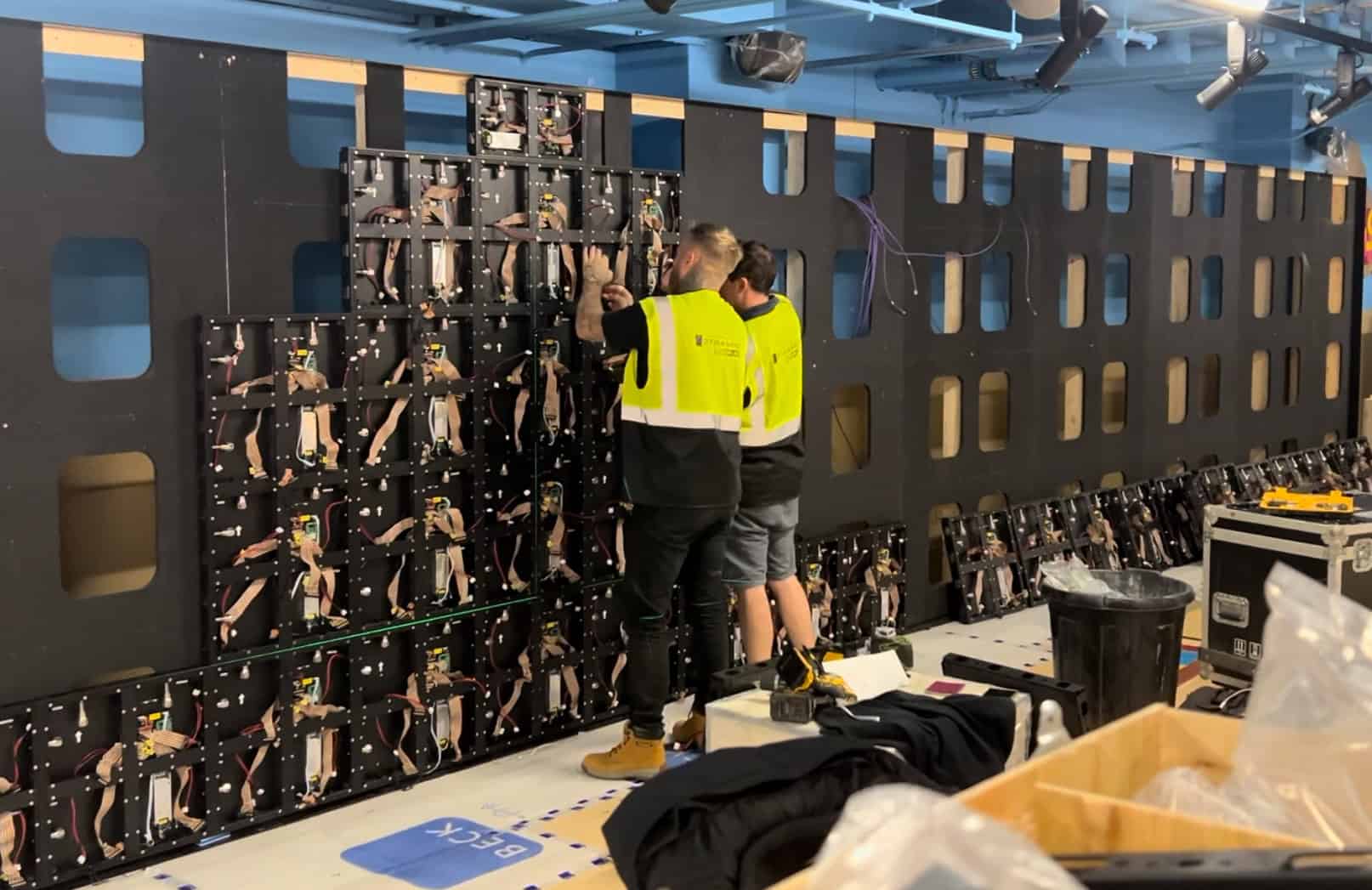
A front-service LED wall is designed so that every serviceable component — modules, receiving cards, power supplies — can be accessed from the front face without disturbing the mounting structure behind. Modules are held by magnetic catches or tool-released latches and pull forward for removal.
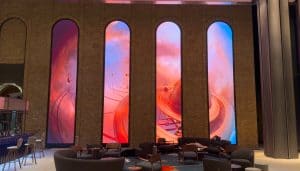
This design exists because many commercial installations sit against structural walls, inside recesses or behind architectural finishes where rear access is physically impossible. A hotel lobby screen recessed into a feature wall is a common example: once the plasterwork is closed, the only way in is from the front.
The trade-off is cabinet complexity. Front-service cabinets need internal hinges, magnetic alignment and tighter mechanical tolerances so that modules can be removed and replaced without affecting neighbours. That engineering adds cost per cabinet compared to a simpler rear-access frame. It also puts more emphasis on frame accuracy — if the frame is not flat, the modules will show it, and that becomes more visible as pixel pitch tightens.
Dynamo’s DFC Series is built for this category — premium fixed-install cabinets with front-service access in fine-pitch configurations, designed for flush and recessed mounting where depth is tight. The DX Series covers mid-range fixed-install projects where the budget is tighter but front-service access is still needed.
When rear service makes more sense
Rear-service LED walls suit permanent installations where the building gives technicians proper rear access and where service needs to happen without disturbing the front of the room.
Broadcast studios, traffic-management centres, stage structures and stadium concourse displays are typical applications. The practical benefit is straightforward: technicians can remove power supplies, receiving cards, cables and modules without standing in front of the display. A technician can replace a full row of modules in the time it takes to swap two or three from the front.
The constraint is space. You need a clear corridor of at least 600 mm behind the screen — and realistically 800–900 mm for comfortable working — which eats into usable room depth. That corridor also needs to be a real working zone: lit, safe, with space to carry a module and set down a tool case. A narrow, dark void with cables draped across it is not a service corridor.
For some outdoor permanent projects, rear access is preferred because cabinets are mounted into a steel structure with a maintenance walkway. That suits our DVO range — permanent outdoor LED where weather protection, structural support and long-term access are designed together. The DVO Series can also be configured for front-service access where the structure does not allow a walk-behind corridor.
Deciding by site
Rather than starting with product catalogues, start with the site.
1. Is there a wall directly behind the screen?
If the LED wall mounts against a structural wall, a partition or inside a recess, front service is almost certainly the right call. There is no corridor to build, and cutting access hatches into finished walls adds cost and disrupts aesthetics. This is common on indoor LED screens in office receptions, retail units, showrooms and hospitality venues.
2. Can you sacrifice 600–900 mm of room depth?
If the space behind the screen is open and the project can afford to lose that depth, rear service becomes viable and often more cost-effective. Purpose-built AV rooms, studios and command centres typically have this space designed in from the start. A 600 mm void behind a 6 metre wide display is 3.6 square metres of floor area before you include frame depth or cable management.
3. How will the screen be accessed after the room is finished?
Many projects are drawn around an empty room. Six months later, the LED wall may have furniture in front of it, a reception desk built close to it or a public route that cannot be blocked during working hours. For front service, confirm there is enough space for access equipment and module removal. For rear service, confirm the corridor will remain permanently available and not gradually filled with other building services.
For screens where downtime must be minimal, front-service access means a single technician can swap a module in minutes without taking the screen offline. Rear service requires someone behind the wall, which may involve unlocking plant rooms or coordinating with building management.
If you are at drawing stage and want to confirm which service method fits your site, use our rear-service LED video wall systems to set the display size and pitch range, then we can advise on the right fit for the room.
The LED cabinets are only one part of the service-access decision. The building work around the display often carries the larger cost difference.
A front-service wall can reduce secondary steel depth, partition depth, joinery projection and floor area lost behind the screen. A rear-service wall can reduce disruption during maintenance, the risk of damaging finished front surfaces during service and the time spent removing front modules to reach internal parts.
Neither route is automatically cheaper. In a small reception area, front service may reduce the build cost because there is no rear corridor to construct. In a theatre or arena, rear service may reduce lifetime cost because technicians can work from an existing access route. The fair comparison is the complete installed cost: product, frame, building work, power, data, ventilation, access equipment and future maintenance.
Controller hardware needs a home. Front-service installs typically use a nearby AV rack; rear-service layouts can mount processors directly behind the screen for shorter cable runs.
Service access also affects heat management. An LED wall produces heat at the display face, inside the cabinet and around the power electronics. Front-service displays that sit close to the wall still need a controlled air gap and ventilation path — whether that is slots in the mounting frame or mechanical ventilation nearby. Rear-service displays often have more natural airflow, but a rear void packed with other services can trap heat just as easily.
For work-at-height planning on walls above head height, the UK Health and Safety Executive publishes clear guidance at hse.gov.uk/work-at-height. Electrical design should stay within recognised requirements — the IET publishes UK wiring guidance through electrical.theiet.org.
Maintenance and long-term serviceability
Choosing the right service method keeps LED screen repair simple when something eventually needs attention.
Front-service screens give you a clear advantage in environments where rear access is restricted. A trained technician can remove a single module, swap it and have the screen running again without clearing the space behind the display. Front-service modules are designed for tool-free or single-tool removal, which means a competent on-site AV technician can handle first-line swaps after a short briefing.
Rear-service screens are stronger when multiple modules need attention simultaneously. In a control-room environment where a bank of modules might need firmware updates or calibration, having open access to every connection point from behind speeds up the process.
Both methods are compatible with remote diagnostics. Novastar’s monitoring platform, for example, flags per-module voltage, temperature and pixel-failure counts back to the controller, so your AV team can identify which specific module has failed before sending a technician to site — regardless of whether the fix happens from the front or the rear. For a full breakdown of what professional LED screen installation involves, including structural surveys and commissioning, see our installation guide.
Front-Service LED Wall in Practice: From the Field
Daniel Reynolds, Managing Director, Dynamo LED Displays
I always ask where the technician is going to stand — not where the drawing says the void is, but where a person will actually put their feet, open a module case and work without damaging the room around them. If that answer is vague, the service method is not decided yet.
One that sticks in my mind is a flagship fashion retailer in central London where the architect wanted the screen flush inside a timber-clad recess. We used DFC cabinets at P1.5, and the entire screen sat within 70 mm of the wall surface. When a module needed swapping six months later, my technician had it out and back in within four minutes without touching the surround. I have also spec’d rear-service for broadcast studios where the client wanted a full walk-behind corridor for cable management and the ability to pull any module without blocking the camera line. Both approaches work — the question is always what the site demands.
Front Service LED Wall: Frequently Asked Questions
Can I convert a rear-service LED wall to front service later?
No. The service method is determined by the cabinet design, not the mounting. Front-service cabinets have internal hinges and magnetic module retention that allow removal from the viewing face. Rear-service cabinets slide in from behind. You cannot retrofit one approach onto the other without replacing the cabinets entirely. Choose the right method at the design stage.
Does front service cost more than rear service?
Front-service cabinets are typically more expensive per unit because of the additional mechanical engineering — magnetic catches, internal hinges, tighter tolerances. However, the total project cost may be lower because you eliminate the structural steel and floor space needed for a rear corridor. The net difference depends on the site and screen size.
How much rear space does a rear-service LED wall need?
For planning, 600–900 mm clear working depth is a sensible range, with more space needed where technicians carry parts, share access with other services or work at height. A very narrow void may allow a hand to reach a connector, but that does not make it a safe service area.
What pixel pitches are available in front-service cabinets?
Front-service cabinets are available from P0.9 through to P2.5 and beyond. Pixel pitch is independent of service method — it is determined by viewing distance and content requirements, not by how you access the modules. See the full range on our LED display products page.
Is front service suitable for outdoor LED screens?
Yes, though outdoor front-service cabinets need higher IP ratings and weatherproof sealing around the module edges. For many outdoor projects, rear access through a designed structure remains practical. Use the LED video wall installation options to spec an outdoor front-service wall and we can confirm IP rating and access requirements.
Conclusion
Front service earns its place where rear access is impossible or impractical; rear service remains the right answer where a proper corridor exists and maintenance needs to happen away from the viewing side. The decision should be made with drawings, not assumptions — and it should be settled before steelwork, joinery or partition design is finalised. Whether you are specifying a front-service LED wall for a flush lobby installation or a rear-access configuration for a broadcast studio, the access method shapes everything that follows.
If you are planning a front service LED wall or comparing it with rear access, view LED video wall options or call us on +44 (0)203 489 9878 to talk through the options. You can also get in touch here.