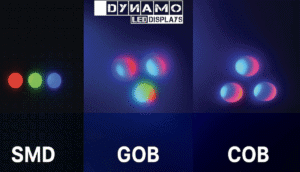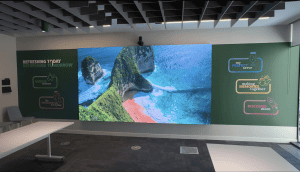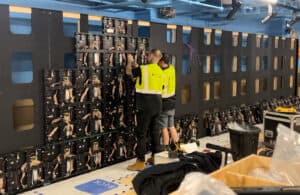
True black LED technology is any LED panel construction that keeps the screen surface dark when pixels are off, so black content reads as black rather than grey. It is decided by how the diodes are packaged: bare SMD reflects the most light, GOB resin lifts native contrast to about 6,000:1 and COB reaches 20,000:1 on Dynamo’s DYF Series.
Updated September 2026. First published July 2025.
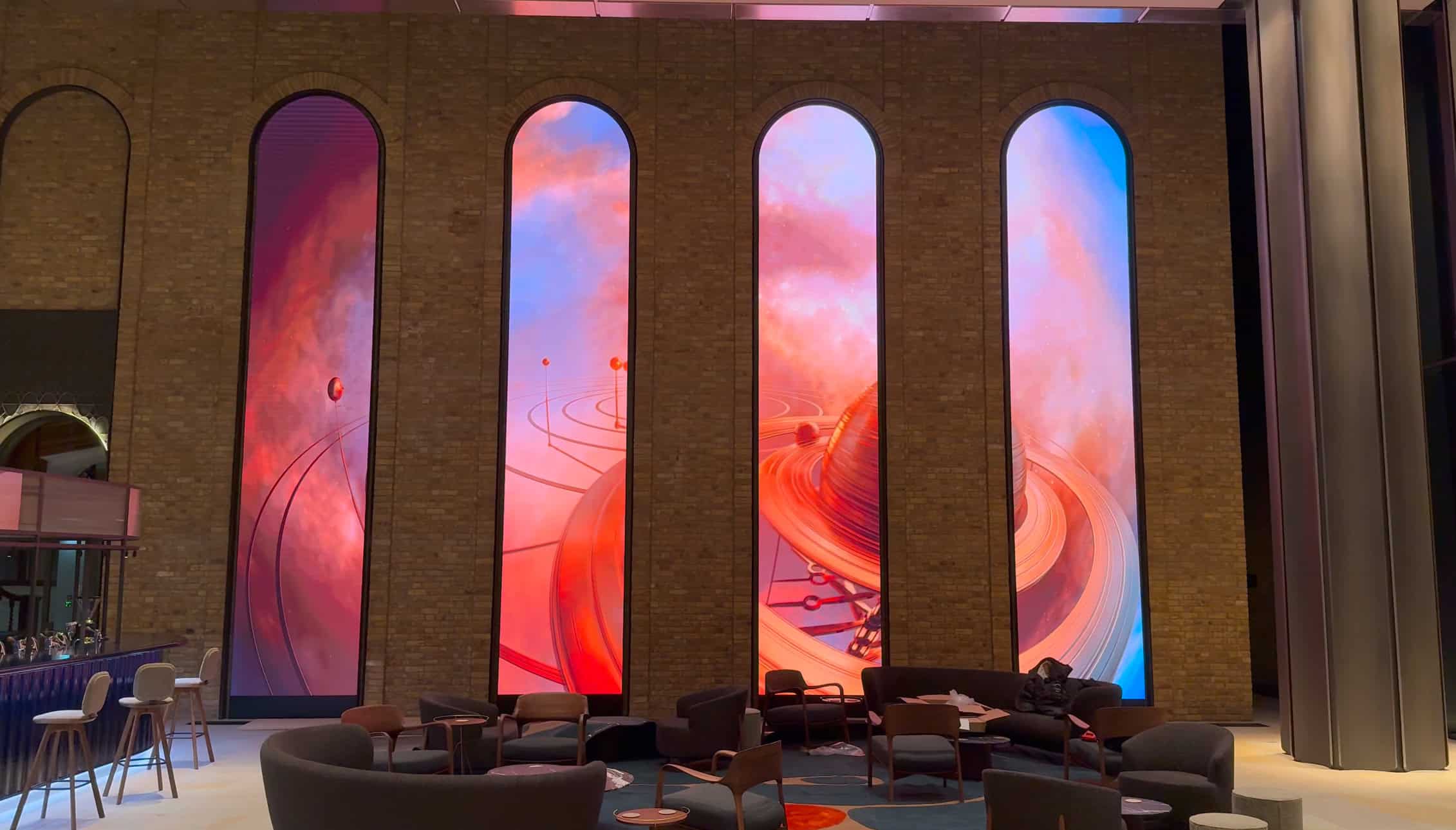
Walk past 40 Leadenhall in the City of London after dark and the LED arches do something most LED walls can’t: the black spaces between the content actually look black, not a tired, washed-out grey. That difference — between a screen that looks switched off in its dark regions versus one that always glows slightly — is what we mean by “true black”. And on every single Dynamo install where the brief includes broadcast or architectural-grade visuals, it’s the first thing we spec for.
You’d think the obvious answer is “more brightness”. It isn’t. A 5,000 cd/m² outdoor screen with mediocre contrast looks flatter and less convincing than a 1,200 cd/m² indoor screen with proper black levels. The eye reads relative contrast, not absolute luminance — which is why a TV in a dim room can look more impressive than a billboard in daylight.
Key takeaways
- Contrast ratio, not brightness, decides how convincing an LED image looks. Native figures matter; dynamic ones do not.
- Packaging sets the black floor. Dynamo datasheets put native contrast at 4,500:1 on the outdoor SMD DFA Series, 6,000:1 on the GOB-protected DRE and DRA Series and 20,000:1 on the COB DYF Series.
- GOB is the default for rental, touring and high-traffic retail because the resin also protects the diodes from knocks, dust and moisture.
- COB is the choice for broadcast studios, control rooms and art installations where black level is non-negotiable.
- Black-face SMD LEDs narrow the gap slightly on budget panels, but do not match a resin or black-coated surface.
Contrast Ratio, Plainly Explained
Contrast ratio is the gap between the brightest white and the darkest black a panel can produce, expressed as a multiplier. A 5,000:1 panel produces a white that’s 5,000× the luminance of its black state. SMD-LED has historically delivered around 3,000–5,000:1 native. Our GOB-encapsulated DRE Series is rated 6,000:1 on its datasheet. The COB-based DYF Series we use for studio installs is rated 20,000:1.
Two warnings before you compare spec sheets:
Native vs dynamic contrast. “Native” measures the panel’s actual black-to-white range in one frame. “Dynamic” measures contrast after the controller dims the whole panel for dark scenes — useful for film playback, useless for live data or signage where the image stays steady. Most “million-to-one” numbers you see in marketing are dynamic. Native is what matters on a 24/7 retail or control-room install.
Brightness alone won’t fix poor blacks. Crank a low-contrast panel to 4,000 cd/m² and the bright pixels still leak light onto adjacent dark pixels — the black floor just rises with them. A high-contrast 1,500 cd/m² panel will read sharper than a low-contrast 4,000 cd/m² panel in the same install. We’ve sat side-by-side measurements on enough comparison rigs to put that down as a rule.
If you’re new to the spec language behind all this, our LED display parameters guide walks through the full vocabulary.
SMD, GOB and COB: Why Packaging Changes Everything
The contrast a panel achieves is largely decided by how the red, green and blue diodes are mounted onto the PCB. There are three approaches in current production:
SMD (Surface-Mounted Device)
The mature, cost-effective standard. Pre-packaged red/green/blue LEDs are soldered to the PCB surface. Around each diode sit reflective metal contacts and exposed PCB; that surface bounces ambient light back at the viewer, raising the black floor. SMD also leaves the diodes physically exposed, which is why most of the corner damage we see on rental kit returning from tours is SMD pixels knocked off in transit. Good for budget-driven indoor installs where ambient light is controlled and the screen will rarely be touched.
GOB (Glue-on-Board)
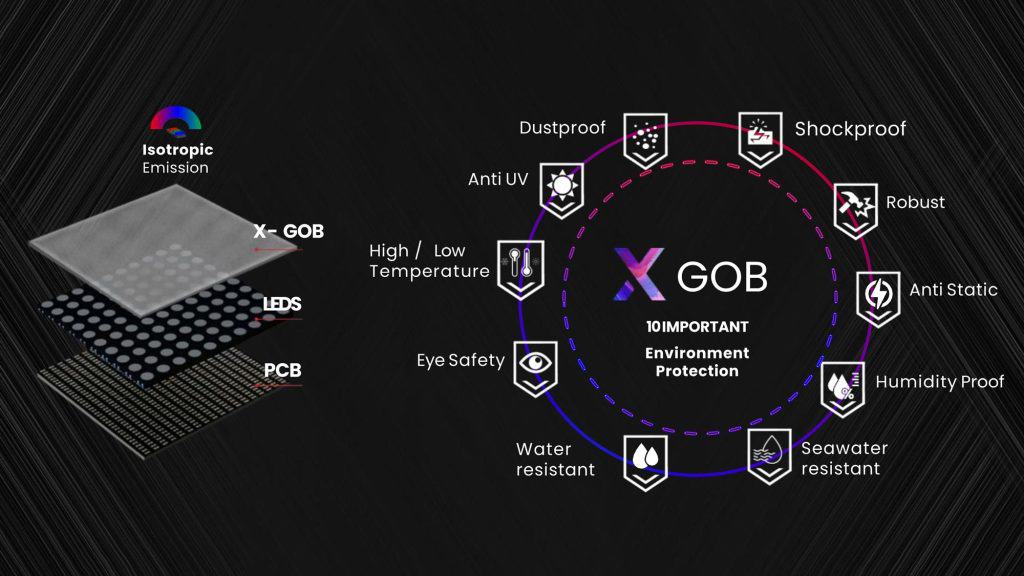
GOB is SMD with a layer of optically clear resin poured over the entire surface after the diodes are mounted. Two things happen: the resin levels out the gaps between diodes, killing most of the secondary reflection, and the cured resin physically protects the LEDs from impact, dust and moisture. The contrast lift is real — our DRE Series is rated 6,000:1 on its datasheet versus the 3,000–5,000:1 typical of bare SMD. We default to GOB for rental, tour and high-traffic retail work because the durability is what keeps the panel out of the repair queue. Full background on the technique: glue-on-board LED.
COB (Chip-on-Board) and Flip-Chip
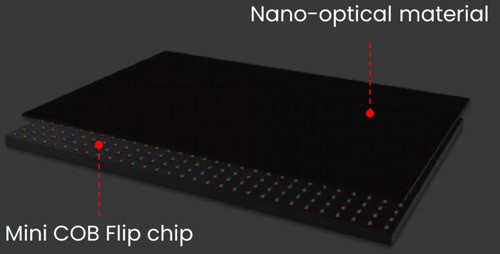
COB skips the individual LED package entirely. Bare LED chips are mounted directly onto the PCB and the whole surface is coated in a black light-absorbing resin. The result is a screen that, when off, looks like a single dark panel rather than a grid of metallic dots — and that uniform dark surface is what lets contrast climb to 20,000:1 on the DYF Series. Flip-chip variants (used in our DFC Series) invert the chip orientation so heat dissipates through the substrate rather than wire bonds — better thermal headroom, longer lifespan, slightly higher cost per m².
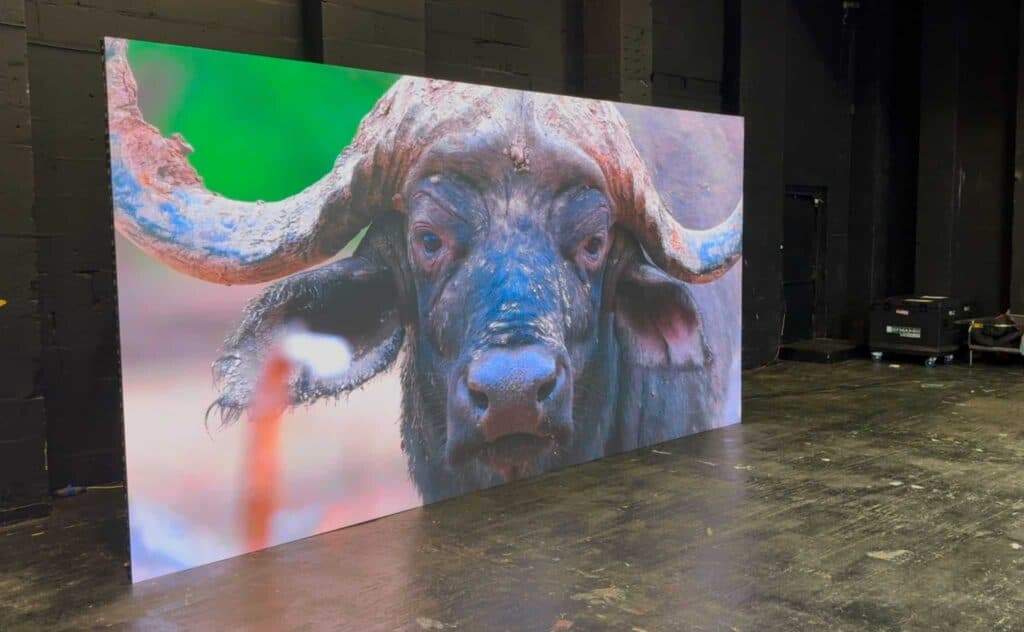
For an installer the trade-off is straightforward: COB if image quality is non-negotiable (broadcast studio, control room, art install), GOB if durability matters more than the last 30% of contrast (retail, rental, public-realm), SMD if the budget fixes everything else and the install is low-touch.
SMD vs GOB vs COB: native contrast and where each fits
| Packaging | Surface when off | Native contrast (Dynamo datasheet) | Durability | Typical use |
|---|---|---|---|---|
| SMD | Exposed diodes with reflective contacts and bare PCB | 4,500:1 (DFA Series, outdoor) | Diodes exposed to knocks; corner damage common on rental kit | Budget indoor installs with controlled light and little handling |
| GOB | Clear resin levelled over the SMD LEDs | 6,000:1 (DRE and DRA Series) | Resin seals against impact, dust and moisture | Rental, touring, retail, public realm |
| COB / flip-chip | Bare chips under a black light-absorbing coating | 20,000:1 (DYF Series) | Sealed surface, front-serviceable modules | Broadcast studios, control rooms, art installations, home cinema |
Why contrast matters more than brightness
A high native contrast ratio is the single spec that most changes how an image reads on an LED wall. It gives deeper blacks, punchier highlights, more detail in dark scenes and richer, more saturated colour. It also improves visibility in high ambient light: a high-contrast panel in direct sunlight stays legible where a low-contrast panel at the same brightness washes out.
The opposite mistake is common. A screen can be very bright, but if its black level is a grey the picture looks flat. Visual impact comes from the gap between light and dark, which is why we look at contrast before brightness on every brief. The full vocabulary is in our display parameters guide, and the related question of whether static content ages a panel unevenly is covered in our LED burn-in guide.
Which true black LED technology should you specify?
SMD is the established, cost-effective standard for applications where budget is the primary concern and ambient light can be controlled. It offers the lowest contrast and the diodes are the most exposed, so edge and corner damage is a real risk on anything that gets handled.
GOB is the rugged all-rounder. It gives a clear lift in contrast and colour consistency over SMD, plus protection that simplifies LED display maintenance. It suits high-traffic public areas, retail and rental. For permanent indoor work the DRA Series carries the same X-GOB protection in a fixed-install cabinet.
COB delivers the highest native contrast and the deepest black levels. Specify it where image quality is non-negotiable: broadcast studios, control rooms and luxury home cinemas. Our COB vs GOB vs SMD comparison goes deeper on pitch, cost and lifespan.
True black LED technology: frequently asked questions
What is “true black” in an LED display?
“True black” is a display’s ability to produce a dark black that is hard to tell from the screen being switched off. It comes from minimising both light emission from unlit pixels and reflection from the screen surface, which together set the black floor and therefore the native contrast ratio.
How do LED screens show black?
To show black, the red, green and blue LEDs in a pixel are turned off. How black that looks depends on the surrounding structure: reflective SMD packages and bare PCB bounce ambient light back and lit neighbours bleed into unlit pixels. GOB resin and COB black coatings suppress both effects, and black-face SMD LEDs narrow the gap slightly on budget panels.
Is a higher contrast ratio always better?
Yes, when it is the native contrast ratio. Higher native contrast means deeper blacks, more shadow detail and more saturated colour in the same frame. Treat “dynamic” contrast figures in the millions with caution: they describe the controller dimming the whole panel between scenes, which tells you little about a steady image such as signage or live data. Our guide to refresh rate, contrast and colour in LED displays explains how to test all three on site.
What is the difference between COB, GOB and SMD?
SMD solders individually packaged LEDs onto the board and leaves them exposed, giving the lowest contrast. GOB pours a clear, protective resin over SMD LEDs, which levels the surface, cuts reflections and lifts native contrast to around 6,000:1 on Dynamo’s DRE Series. COB mounts bare chips onto a black board under a light-absorbing coating, reaching 20,000:1 on the DYF Series.
Does true black matter in a bright room?
Yes. Ambient light lands on the screen surface as well as the content, so a reflective SMD surface raises the black floor exactly when the room is brightest. A high-contrast GOB or COB panel at the same brightness stays legible in daylight where a low-contrast panel washes out, which is why contrast is worth more than extra nits in a bright retail or lobby space.
Which Dynamo LED series has the highest contrast ratio?
The COB flip-chip DYF Series is rated 20,000:1 on its datasheet, available at 0.93mm and 1.25mm pixel pitches with a 4,000 Hz-plus refresh rate. The GOB-protected DRE and DRA Series are rated 6,000:1 and the outdoor SMD DFA Series 4,500:1, so the DYF is the series to specify where black level leads the brief.
Get a quote for a high-contrast LED display
Send us the room, the viewing distance and the kind of content you will show, and we will recommend SMD, GOB or COB and come back with a written quote. Get a quote or call 020 3489 9878.