MicroLED uses sub-100 micron LEDs for superior contrast at close viewing distances; fine-pitch LED uses SMD or COB packaging at 0.7–2.5 mm pixel pitch and remains the practical choice for most commercial projects in 2026 due to lower cost, faster lead times and proven serviceability.
Updated September 2026: facts re-checked, configurator link removed, first-hand project example added.
In 2026, fine-pitch LED remains the practical choice for most commercial direct-view LED projects from around 0.9 mm to 2.5 mm pixel pitch. MicroLED can make sense where the brief demands very high pixel density, deep black levels and close viewing, but the word is now used loosely, so spec sheets need careful reading.
If you need a wider pitch and viewing-distance framework, see our DVLED pixel pitch guide, or our broader guide to LED displays. Here, we are looking specifically at the trade-offs that decide whether microLED or fine-pitch LED is the right engineering choice for your project.
Key takeaways
- MicroLED uses individually mounted LEDs below 100 microns; fine-pitch LED uses conventional SMD or COB packaging at pixel pitches from roughly 0.7 mm to 2.5 mm.
- MicroLED offers contrast and uniformity gains, but at a price point that puts it out of reach for most commercial projects.
- Fine-pitch LED (particularly sub-1.5 mm pitches) already delivers the image quality that the majority of corporate and broadcast applications need.
- Serviceability favours fine-pitch: module-level replacement is straightforward and spares are readily available.
- Processor choice, calibration and content workflow affect the final image as much as the emitter technology. If the project is not yet fully specified, work through the viewing distance and wall size first.
At-a-glance project facts
| Factor | Fine-pitch LED (SMD / COB) | MicroLED | What usually tips the decision |
|---|---|---|---|
| Pixel pitch range | 0.7 mm – 2.5 mm | Often below 1.0 mm | Required viewing distance and content detail |
| LED size | 100 µm – 1 mm+ | Below 100 µm | Manufacturing method, not raw performance |
| Practical viewing distance | Strong from about 1.5 m upwards | Strong at very close viewing below 1.5 m | Whether viewers will stand within 1 m |
| Contrast ratio | High (COB narrows the gap significantly) | Higher native contrast, especially with advanced packaging | Ambient light and dark-content expectations |
| Service approach | Module-swap in minutes; spares widely stocked | Repair strategy varies by product architecture | Site access and downtime tolerance |
| Supply chain maturity | Mature; multiple proven suppliers | Limited; few manufacturers at commercial scale | Project timeline certainty |
| Typical UK lead time | 4–8 weeks | 12–20+ weeks | Fixed completion dates |
| Installed cost per sq m | Competitive, with clear pricing models | Significantly higher | Whether close-view quality justifies the premium |
What is the difference between microLED and fine-pitch LED?
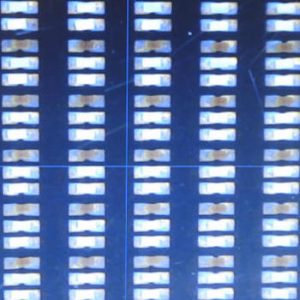
Fine-pitch LED describes any direct-view LED display with a pixel pitch below 2.5 mm, using SMD or COB packaging. MicroLED describes displays using individually mounted LED chips smaller than 100 microns, transferred onto a backplane using mass-transfer manufacturing.
That distinction matters in practice. A “microLED” display can still have a pixel pitch that is too coarse for the room. A fine-pitch LED display can still look excellent if the pitch, viewing distance, calibration and processing are right. The label on its own does not answer the design question.
For most fixed-install projects, we start by asking: how large does the image need to be, what is the closest normal viewing distance, will people read small text or view video, will the screen be filmed, what are the ambient light levels, how will the screen be serviced after handover, and what is the acceptable budget per square metre. Only after those answers are clear does the microLED question become useful.
Pixel pitch: the metric that actually does the work
Whether the display is sold as microLED or fine-pitch LED, the viewer sees a grid of pixels. The smaller the pitch, the closer the viewer can sit before the pixel structure becomes obvious.
| Pixel pitch | Typical comfortable viewing distance | Common application |
|---|---|---|
| 2.5 mm | Around 3 m and beyond | Reception walls, larger presentation spaces |
| 1.9 mm | Around 2 m to 3 m | Boardrooms, lecture theatres, showrooms |
| 1.5 mm | Around 1.5 m to 2.5 m | Executive rooms, command spaces, premium presentation |
| 1.2 mm | Around 1.2 m to 2 m | Close-view data, broadcast-adjacent spaces |
| 0.9 mm | Around 1 m to 1.5 m | Control rooms, high-density visualisation |
| Below 0.9 mm | Below about 1 m | Specialist close-view applications |
Content type changes the answer. A full-screen video can tolerate a coarser pitch than a spreadsheet with 9pt text. A boardroom where people sit 3 metres from a 165-inch wall will not need the same pitch as a design review suite where someone stands 800 mm from the display.
This is where we see projects go wrong. A specifier reads about microLED, assumes tighter pitch equals better, and over-specifies for the application. A well-chosen 1.5 mm fine-pitch display often delivers the same visual result as a sub-1 mm panel in real-world conditions.
MicroLED can reduce perceived pixel structure at very close distances, but it does not remove the need to calculate pitch properly. We cover the full relationship between pitch, viewing distance and content resolution in our viewing distance and pitch calculator.
Where microLED has genuine advantages
MicroLED offers real benefits in specific scenarios.
Contrast and black levels. Without encapsulant material diffusing light between pixels, microLED achieves deeper blacks and higher native contrast. In a light-controlled environment such as a grading suite or private screening room, this difference is visible and makes dark content feel more convincing.
Ultra-close viewing. At viewing distances under a metre, sub-0.5 mm pixel pitches eliminate any perception of pixel structure. For interactive displays, luxury residential projects, or environments where the screen is replacing a large-format LCD or OLED, this matters.
Form factor and surface quality. MicroLED panels can be thinner and lighter than equivalent fine-pitch cabinets, with a more refined close-range surface appearance. For architectural installations where depth is constrained or where visitors walk up to the wall and inspect product visuals, this may tip the balance.
The trade-off is cost and complexity. MicroLED projects often need tighter design control, more careful handling and a clearer service pathway. If a display is going into a hard-working corporate environment where users will touch the wall, move furniture nearby or expect fast module-level replacement, the service model must be confirmed early.
Where fine-pitch LED wins on practicality
Fine-pitch LED remains the most sensible route for many fixed installations — from corporate LED video walls to broadcast environments — because it balances resolution, scale, serviceability and cost.
Serviceability
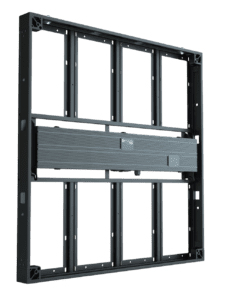
This is the single biggest differentiator for commercial installations. Fine-pitch LED displays use a modular cabinet design. If a module develops a fault, a technician swaps the affected module on site. Front service is common in fixed installs, which matters when the screen is mounted tight to a wall. The replacement slots in, auto-calibrates, and the display is back to full operation.
MicroLED repairs are more varied. Because the LEDs are so densely packed, some architectures need a more controlled repair process. Before choosing microLED, the client should know: what can be replaced on site, how quickly parts can be supplied, how uniformity is restored after replacement, and what spares should be held.
Supply chain and lead times
Fine-pitch LED has a mature global supply chain. Multiple manufacturers produce displays at pitches from 0.7 mm to 2.5 mm, and UK integrators like us hold stock on popular configurations. For configurations we stock, lead time is typically four to six weeks; custom-pitch or large-format orders run six to eight weeks from the manufacturer.
MicroLED is still in the early stages of commercial-scale production. Lead times stretch well beyond what most project timelines can absorb, and pricing fluctuates because volumes are low. If your project has a fixed completion date, fine-pitch LED gives you far more scheduling certainty.
Total cost of ownership
Purchase price is only part of the picture. A proper comparison should include the display, structure, processing, cabling, installation, commissioning, calibration and ongoing service.
Fine-pitch LED displays have well-documented lifespans, predictable maintenance costs, and spare parts are interchangeable across production batches from established manufacturers. MicroLED’s higher upfront cost compounds over time if spare panels are not available or if the manufacturer’s product line changes.
COB: the technology closing the gap
Chip-on-board (COB) packaging addresses several areas where traditional SMD fine-pitch falls short compared to microLED. For a deeper look at how these packaging methods compare, see our COB vs GOB vs SMD comparison. COB mounts LED chips directly onto the PCB and covers them with a resin layer, improving contrast, increasing ruggedness and allowing tighter pixel pitches than SMD can reliably achieve.
Several of the fine-pitch COB displays we install now operate at pitches from 0.7 mm to 1.2 mm. The image quality approaches what microLED promises, but with the serviceability, pricing and lead times of conventional LED. For sub-1.2 mm applications, COB is increasingly the preferred packaging method. SMD remains cost-effective and well-proven at pitches above 1.5 mm.
Processing, calibration and cameras
Processor choice, calibration quality and camera compatibility often affect perceived image quality more than whether the display uses microLED or fine-pitch LED emitters.
A Brompton Tessera-driven fine-pitch display with per-tile calibration will outperform a poorly processed microLED display. Novastar controllers are also common in professional LED workflows, and each platform suits different project architectures, frame rates and colour requirements.
Camera use needs early discussion. AVIXA standards cover display performance and viewing criteria, and they are a useful reference when writing specifications for professional environments. A display that looks clean to the eye may show banding, scan artefacts or colour shifts on camera if the processing and refresh behaviour are not matched to the production environment. This matters in broadcast studios, hybrid event rooms and boardrooms with regular video calls.
Calibration is more than a one-off activity. Fine-pitch LED displays need uniformity across modules and cabinets. MicroLED displays need careful matching, especially where very dark content, skin tones or brand colours are important. Calibration should be part of the project plan rather than a final adjustment after installation.
Specification scenarios for 2026 projects
Executive boardroom. A room with a main viewing distance of 2 m to 4 m usually sits well in the 1.5 mm to 1.9 mm fine-pitch range. MicroLED may be justified if viewers sit very close, but for most corporate rooms, fine-pitch LED is the more balanced route.
Control room. Driven by legibility and uptime. Operators may sit close to the display for long periods, so 1.2 mm or 0.9 mm fine-pitch LED is often appropriate. MicroLED can work where operators sit very close and the budget supports it, but the maintenance model should be approved before the order is placed.
Broadcast or hybrid presentation room. Needs attention to refresh behaviour, camera compatibility and colour. Fine-pitch LED around 1.5 mm or 1.2 mm is often a strong fit. Processor and camera tests matter as much as the pixel pitch.
High-end residential cinema. One of the clearer use cases for microLED, particularly where the screen is viewed close up and room lighting is controlled.
From the field
I have spent the last few years installing fine-pitch LED displays across corporate, broadcast and retail environments — mostly DFC series panels at 1.58 mm and 1.9 mm pitches. I have also stood in front of every major microLED demo at ISE and InfoComm. The technology gap between the two is real. MicroLED contrast at close range is genuinely impressive, and the surface finish is noticeably cleaner than even good COB.
But the price gap is bigger than the technology gap. On every project where I have run the numbers, the microLED option has come in at three to five times the cost of an equivalent fine-pitch COB or SMD wall — before you factor in longer lead times and a less certain service pathway. For 95 percent of the commercial applications I quote, fine-pitch LED delivers everything the client actually needs: sharp imagery at the real viewing distance, reliable module-level serviceability and a supply chain that hits programme dates. I would rather spec a technology I can stand behind for the full lifecycle of the installation than chase a label that the room will never test.
I have had repeated conversations with specifiers this year who came to us asking about microLED. The pattern is consistent: they have read about the technology, they are excited about the pixel density, and then we talk about budget and timeline. The majority end up with a fine-pitch COB or SMD display that meets the brief at a fraction of the cost. MicroLED will get there eventually — the manufacturing processes will mature, costs will drop and supply chains will stabilise. But in 2026, for the projects we are delivering across the UK, fine-pitch LED is the technology that actually ships on time, stays within budget and can be maintained without sending panels overseas.
I also look closely at service. A display in a private viewing room and a display in a busy workplace do not carry the same risk. If a screen is likely to be touched, knocked or cleaned by non-specialists, I want the repair route agreed before we sign off the specification.
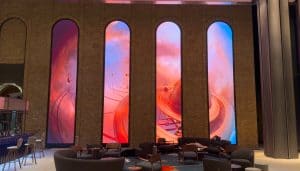
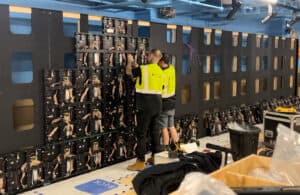
A recent example of where fine-pitch LED landed: at the AutoTrader Manchester HQ installation we delivered five zones of fine-pitch LED, including a 21,760 × 1,120 mm 1.86 mm ribbon and 1.9 mm video walls, in under two weeks on site. Nobody in that building has asked for microLED since, because the walls already read cleanly from the nearest desk.
MicroLED vs fine pitch LED: Frequently Asked Questions
Is microLED the same as mini-LED?
No. Mini-LED refers to LEDs in the 100–200 micron range, typically used as LCD backlighting. MicroLED uses sub-100 micron LEDs in a direct-view emissive configuration. They are distinct technologies with different applications, performance characteristics and price points.
Can I buy a commercial microLED video wall in the UK right now?
Technically yes, but options are limited. A handful of manufacturers offer microLED panels for commercial applications, though pricing remains high and lead times are long. For most UK projects with fixed delivery dates, fine-pitch LED is the more practical choice. If you are exploring options, our fine-pitch LED video walls can help you compare specifications.
What pixel pitch do I need for a control room?
It depends on operator viewing distance. Most control rooms position operators 1.5 to 3 metres from the wall. At that range, a fine-pitch LED display between 0.9 mm and 1.5 mm delivers sharp, readable content. MicroLED’s sub-0.5 mm pitches are unnecessary unless operators are within arm’s reach. Our pixel pitch guide covers this in detail.
How long does a fine-pitch LED display last?
A well-maintained fine-pitch LED display typically runs for 50,000 to 100,000 hours before significant brightness degradation. With module-level serviceability, individual components can be swapped without replacing the entire display. This gives fine-pitch LED a practical operational life of seven to twelve years in most commercial environments.
Will microLED replace fine-pitch LED?
Eventually, it is likely. As manufacturing matures and costs drop, microLED will become viable for a wider range of commercial projects. But in 2026, fine-pitch LED remains the dominant technology for commercial installations by a wide margin, and that position is unlikely to shift within the next two to three years.
Is COB better than SMD for fine-pitch displays?
COB offers better contrast, improved ruggedness and supports tighter pixel pitches than SMD. For sub-1.2 mm applications, COB is increasingly the preferred packaging method. SMD remains cost-effective and well-proven at pitches above 1.5 mm. The choice depends on your pitch requirement, budget and how much ambient light the display will face.
Does Dynamo install microLED displays?
We specify microLED on a project basis where the supply chain and service model meet our standards. For most 2026 projects, fine-pitch COB and SMD deliver the same visual result with proven support. If microLED reaches the point where we can guarantee the same level of serviceability and supply chain reliability, we will add it to our standard range. Talk to us about your brief and we will recommend the right route.
What matters more: microLED technology or processor choice?
Both matter, but processor choice is often underestimated. Mapping, calibration, refresh behaviour, colour control and camera compatibility all affect the final result. A high-density display with poor processing will disappoint. For professional environments, we specify the display, processor and content workflow together rather than treating the processor as an accessory.
Making the right choice for your project
In 2026, fine-pitch LED is the right answer for most commercial projects. MicroLED earns its place only when close-view quality and deep blacks are genuinely visible in the finished room and the budget supports the supply chain and service model that come with it.
Fine-pitch LED covers a wide range of boardrooms, control rooms, showrooms, studios and presentation spaces at 1.9 mm, 1.5 mm, 1.2 mm and 0.9 mm. With the right cabinet, processor, calibration and mounting design, it delivers the required image without paying for a label the room may not need.
Start with your viewing distance, your content requirements and your operational needs. Confirm the screen size, closest viewer, content type, access route and service expectations. When you weigh microLED vs fine-pitch LED on those practical criteria, a well-specified fine-pitch LED display will tick every box for most projects.
Speak to our team about your microLED vs fine-pitch LED project. Call us on +44 (0)203 489 9878, get in touch via our contact page, or see our LED video wall options.