A 9 screen video wall is normally a 3×3 grid of 55-inch LCD panels, about 3.65 m wide and 2.05 m high, and it’s still the first thing most people price when a reception, showroom or boardroom needs a big picture. The question we get asked is whether to buy the nine tiles or give the same wall space to one seamless LED wall with no joins. This guide sizes a nine-screen video wall replacement in LED to the same footprint, works out the resolution from the real cabinets rather than a pitch calculation, and sets out where the tiled LCD route still wins.
Key takeaways
- A 3×3 wall of 55-inch panels has an active picture of about 3.65 m by 2.05 m before bezels, with four seam lines running through the content.
- The same footprint in LED is a cabinet grid, not nine tiles. Our DFC Series builds it from 36 cabinets of 608 × 342 mm, which at 1.9 mm is a native 1,920 × 1,080 canvas.
- Our DX Series is the mid-range fixed-install route. Seven 500 × 1,000 mm cabinets across and two high gives 3.5 m by 2.0 m, and 1,792 × 1,024 pixels at 1.9 mm.
- Resolution always comes from the cabinets. Dividing wall width by pitch gives you a number with a decimal in it, which means it’s wrong.
- Touching distance points to the COB surface of DFC. A wall viewed from 1.5 m or more back is DX territory at a lower cost per square metre.
- Both DX and DFC are fully front serviceable, so a 37 mm or 47 mm deep wall can sit almost flush with no rear access void.
At a glance: 3×3 LCD tiles vs a seamless LED wall

| Fact | 3×3 LCD video wall (55-inch) | Seamless LED wall, same footprint |
|---|---|---|
| Picture area | About 3.65 m × 2.05 m active, plus bezels | DFC: 3.648 m × 2.052 m (6 × 6 cabinets). DX: 3.5 m × 2.0 m (7 × 2 cabinets) |
| Visible joins | Two vertical and two horizontal seam lines | None; cabinet joints depend on frame flatness and alignment |
| Physical pixels | 5,760 × 3,240 if every panel is Full HD, driven as nine outputs | DFC 1.9 mm: 1,920 × 1,080. DX 1.9 mm: 1,792 × 1,024. One canvas |
| Cabinet depth | Panel dependent, plus the mount | DFC 37 mm. DX 47 mm |
| Service access | Front or rear depending on the mount | Full front service on both lines |
| What fails | One panel out is a black ninth of the wall | One module out is a 250 mm (DX) or 304 mm (DFC) patch |
What is a 9 screen video wall?
A 9 screen video wall is a 3×3 grid of nine displays, usually 55-inch LCD panels, giving an active picture of about 3.65 m wide by 2.05 m high at 16:9, with four bezel lines crossing the image and nine separate outputs fed by a video wall controller. A 55-inch panel has an active picture of roughly 1.22 m by 0.69 m, so three across and three high lands at that size, and the bezels add a little on site. The 3×3 keeps the 16:9 shape, so standard content fills it without letterboxing.
The bezel is the obvious join. Commercial panels have narrower frames than a consumer television, but where two meet you see two bezels side by side, and on a 3×3 that is four lines crossing the picture. The less obvious joins appear over time. Backlights age at different rates and the wall slowly becomes nine slightly different pictures, and when one panel fails the replacement is newer than its neighbours or, if the model has been discontinued, doesn’t match at all. The wider case is set out in our LED vs LCD guide. This post applies it to the 3×3 footprint.
A seamless LED wall has no frame around each cabinet. The pixel pitch continues across the cabinet edge, so a 36-cabinet wall reads as one surface. Colour and brightness are calibrated across the whole wall, and on the DX Series each module carries its own calibration data, so a replacement loads its correction when it’s fitted. The physical risk is the joint between cabinets, which is why both DX and DFC use die-cast aluminium cabinets and why the mounting frame matters.
Should a video wall show one picture or nine windows?
The strongest reason to choose a seamless LED wall is the simplest. The content should read as one picture. In a reception, showroom or presentation space, LCD borders cut through a face, a product or a line of text, and moving graphics make those interruptions harder to design around.
LCD still makes sense where each panel has its own job. Nine independent dashboards or camera feeds may already fit a 3×3 grid, and if small labels matter more than cross-wall imagery, the pixel count of nine Full HD panels can outweigh the bezel penalty.
We ask for the actual content files before specifying either system, because a promotional film tells us nothing about how a spreadsheet will read. A seamless LED wall can show nine windows too, but the source system has to compose and arrange them. Removing the physical borders doesn’t supply multi-window control.
Sizing a seamless LED wall to the same footprint
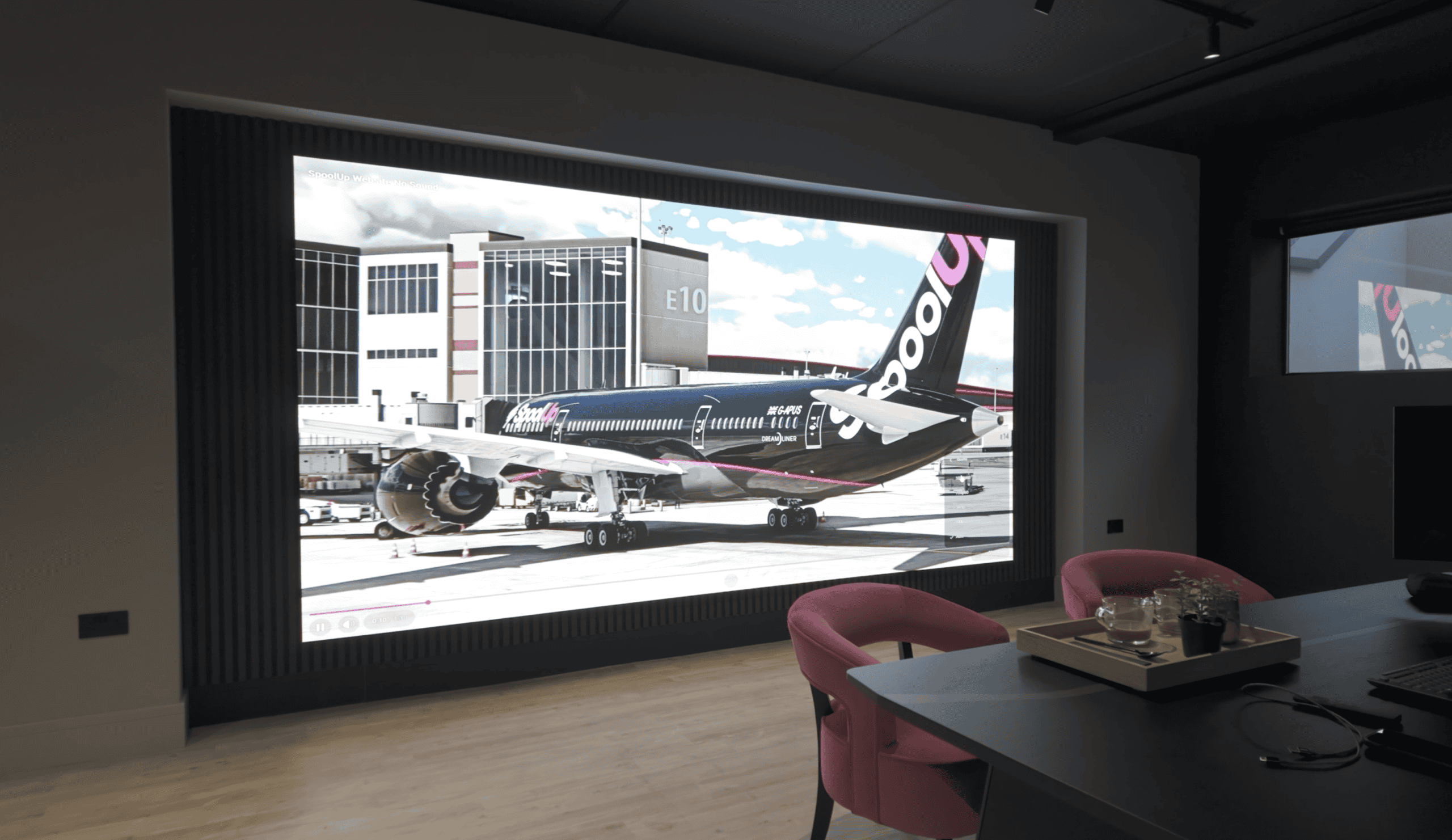
A seamless LED wall is built from cabinets of a fixed size, so the first step is to pick a cabinet and see how close you can land to the 3.65 m by 2.05 m target. The wider options for a permanent indoor wall are on our LED video walls page. These are the two grids we would put forward.
DFC Series: the near-exact match
The DFC Series is our premium fixed-install product, a flip-chip COB panel with the LEDs encapsulated in the surface. Its 608 × 342 mm cabinet is a 16:9 shape in its own right, and six across by six high gives 3,648 mm by 2,052 mm. That is within a few millimetres of the 3×3 LCD wall it replaces, so the same wall zone and usually the same power position can be reused.
At 1.9 mm pitch each cabinet is 320 × 180 pixels, so the 6 × 6 wall is 1,920 × 1,080 and a Full HD source maps pixel for pixel with no scaling. DFC at 1.58 mm gives 384 × 216 per cabinet and the wall becomes 2,304 × 1,296. The cabinet is 37 mm deep, which matters when the previous LCD mount has left a shallow recess to work in.
DX Series: the mid-range fixed-install route
The DX Series builds from 250 × 250 mm modules in a range of cabinet sizes, the largest being 500 × 1,000 mm at 47 mm deep. Seven of those across and two high is 3.5 m by 2.0 m, a 7:4 shape close to 16:9, and the 250 mm wide cabinets let you add a quarter metre to land nearer the LCD width.
At 1.9 mm each 250 mm module is 128 × 128 pixels, so a 500 × 1,000 cabinet is 256 × 512 and the 7 × 2 wall is 1,792 × 1,024. At 2.6 mm the module is 96 × 96, giving 1,344 × 768 across the same grid. Both are driven as a single canvas and scaled from a Full HD or 4K source by the processor.
A seamless LED wall that accepts a 4K signal may still display far fewer than 3,840 × 2,160 physical pixels. Scaling fits the source onto the grid. It can’t add pixels, so we quote the native canvas, never the input label. Mixing cabinet sizes to hit an exact wall dimension is covered in our guide to LED cabinet size, aspect ratio and pitch mix.
What pixel pitch does a 9 screen LED wall need?
We need two distances, not one. The nearest position tells us whether pixel structure will show. The furthest tells us whether people can read the required information. The usual rule of thumb is that pitch in millimetres is roughly the minimum comfortable viewing distance in metres, so a 2.6 mm wall is fine from about 2.6 m. That is a starting point rather than a law, and fine text wants a finer pitch than video. Our DVLED pixel pitch guide works through the trade-off with examples.
The pitch then meets the product choice. Where people will stand at touching distance, at a reception desk, a retail counter or a boardroom table, we specify DFC. The flip-chip COB surface has no exposed LED packages, so contrast holds up and the face of the wall shrugs off knocks and fingers in a way an SMD surface does not. Where the nearest viewer is 1.5 m or more back, which covers most office and showroom walls, DX at 1.9 mm gives a clean picture at a lower cost per square metre, and 2.6 mm does the job from further again.
For text-heavy rooms, the AV industry body AVIXA publishes DISCAS, the Display Image Size for 2D Content in Audiovisual Systems standard, on its standards page. We use it as a sanity check that the smallest label is physically large enough for the furthest viewer, because adding resolution doesn’t make small text bigger.
Get a quote for a seamless LED wall. Send us the wall dimensions, the nearest and furthest viewing distances and a sample of the real content, and we will come back with a cabinet grid, a module-derived resolution and a price, or call +44 (0)203 489 9878. We have been specifying and installing LED walls for 13 years, our install engineers cover the UK nationwide, and fixed-install systems carry a 3-year return-to-base warranty.
Processing, power and service access
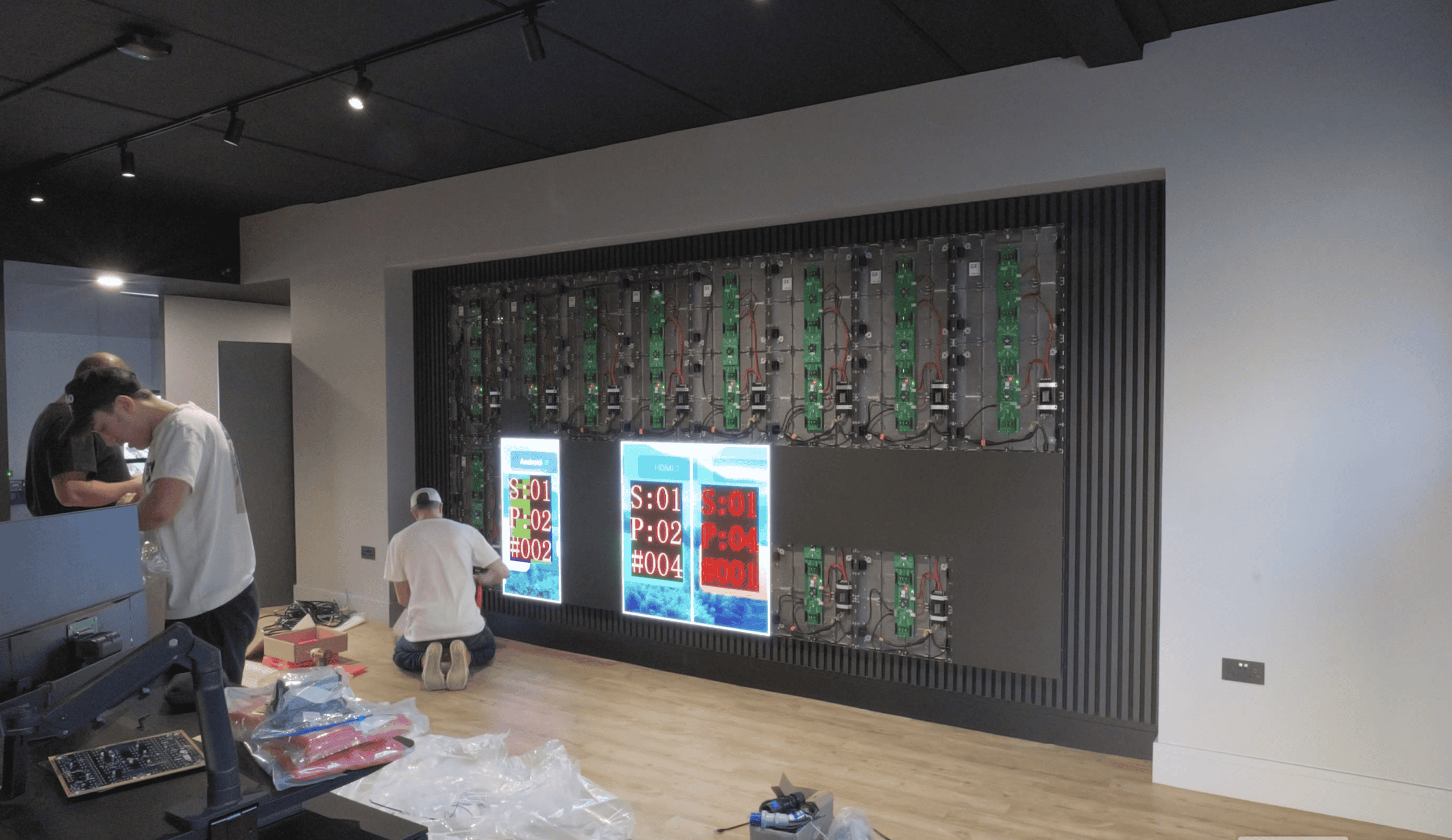
A seamless LED wall needs one processor driving one canvas, a single dedicated power circuit sized to the documented peak load, and front service access for modules, power supplies and receiving cards. A 3×3 LCD wall needs a nine-output controller and rear or pop-out access.
The LCD controller cuts the picture into nine pieces that each panel scales on its own. On LED, one processor sees the wall as a single canvas and the cabinets receive their share over a data loop. A 2-megapixel wall of this size sits comfortably inside a single all-in-one controller from NovaStar or a single Tessera processor from Brompton Technology, and we confirm the exact unit against the pixel count and input list on every quote.
On power, ask for documented consumption for the proposed configuration, not just the maximum. Peak load is what the electrician needs for the circuit. Typical draw at the brightness the room actually needs is what the running-cost comparison needs, and the two figures are a long way apart on a fine-pitch indoor wall. Both lines offer backup power supplies and backup receiving cards so one failure doesn’t take the wall down.
Service is where the LED case is strongest. Both DX and DFC are fully front serviceable, and on DFC that includes the power supply and receiving card, so a failed part comes out from the front in minutes with the wall still mounted. That removes the rear void or pop-out mount an LCD wall needs for access, and it’s why a 37 mm or 47 mm deep LED wall can sit almost flush to the plasterboard. Whichever route you take, get the service method shown on the drawing before the joinery is finished.
Replacing an existing LCD wall: survey and content migration
An existing 3×3 installation makes an LED replacement look straightforward. The screen area is defined and the cables are present, but that doesn’t prove the mounting, power or ventilation can be reused. Our guide to replacing an LCD video wall with LED covers the full process. For this footprint, we resolve four points before ordering:
- Opening and structure. Measure the recess and check the support against the proposed cabinet and frame loads.
- Power and heat. Check the new system’s documented requirements and the available ventilation.
- Signal path. Establish which sources, control functions and cables can stay.
- Content migration. Remove the old bezel compensation and rebuild layouts for the new native canvas.
The last step is the one that gets missed. LCD bezel compensation hides slivers of the image behind the panel borders so that objects keep their geometry across the array. Carry that mapping onto a wall with no borders and the content arrives cropped or misplaced. At handover we test the real working content, not a demo reel, across every cabinet joint.
When the nine LCD tiles still make sense
A 3×3 LCD video wall still makes sense in four cases: operators reading small text within a metre of the screen, nine genuinely separate windows, a lease with under two years to run, and a budget limited to commercial displays on standard brackets. We sell LED, so it’s worth being clear about each one.
Operators sitting a metre from a 9 panel video wall reading small text all day are better served by LCD. At that distance a 55-inch 4K panel resolves finer detail than a fine-pitch LED wall, and control room software is written to work around the joins. Short occupancy changes the sums too. With eighteen months left on a lease, a tiled wall on standard brackets comes down and goes with you more easily than a framed LED wall, although LED cabinets can be de-rigged and reused.
Then there’s budget. A 3×3 of commercial panels on a wall mount is a lower capital cost than 7 to 7.5 m² of fine-pitch LED. Compare installed systems, not nine panel prices against one screen price, and ask both suppliers to itemise hardware, mounting, processing, cabling, commissioning and maintenance. The LED argument is about what the wall looks like in year five, the service calls you don’t get, and people stopping to look at a seamless 3.65 m picture. If that isn’t what the wall is for, buy the tiles. Put the wall dimensions into the LED screen configurator to see the cabinet grid and resolution before you ask for the itemised price.
From the field
Daniel Reynolds, Founder, Dynamo LED Displays
I’ve stood in front of plenty of 3×3 walls in receptions that now show a slightly different colour in one corner where a panel was replaced. My first question isn’t about pitch or brightness. It’s where the nearest person stands. If the answer is the reception desk, so touching distance, it’s DFC and a 6 by 6 grid that lands within millimetres of what was there. If it’s an office or showroom wall viewed from a few metres back, DX at 1.9 mm does it for less and nobody can tell from the doorway. The 4 m × 2 m DX wall we put into Spool Up’s Winchester office is that footprint, specified for 1.5 to 3 m viewing, and it’s the job I point people at when they’re weighing a 3×3 against one surface.
The other thing I ask for every time is the most demanding everyday screen, not the showreel. If the room runs a dashboard with small figures, that’s my test file, because a full-screen film looks convincing while hiding the fact that the working layout has lost readable detail. And count the cabinets, not the tape measure. Multiply by the pixels per cabinet and that’s the canvas the content team should render to.
9 screen video wall: frequently asked questions
How big is a 3×3 video wall of 55-inch panels?
The active picture is roughly 3.65 m wide by 2.05 m high, and the bezels add to that on the wall. The nearest seamless LED equivalents are a 6 × 6 grid of 608 × 342 mm DFC cabinets, which matches to within a few millimetres, or a 7 × 2 grid of 500 × 1,000 mm DX cabinets at 3.5 m by 2.0 m.
What resolution does a seamless LED wall of the same size have?
It depends on the pixel pitch and is always worked out from the cabinets. A 6 × 6 DFC wall at 1.9 mm is 1,920 × 1,080, which is native Full HD. A 7 × 2 DX wall at 1.9 mm is 1,792 × 1,024, and at 2.6 mm it is 1,344 × 768. DFC at 1.58 mm gives 2,304 × 1,296 across the same 36 cabinets.
Does a 9 screen video wall display native 4K?
Usually not. Nine Full HD panels hold 5,760 × 3,240 pixels between them, but a 4K source split nine ways gives each panel a 1,280 × 720 slice, which the panel then scales up to fill itself. On a seamless LED wall we quote the physical pixel matrix, not the input the processor accepts. Accepting a 4K signal is not the same as displaying 4K.
Is a 3×3 LCD wall cheaper than LED?
On capital cost, usually yes. Nine commercial panels on standard brackets cost less than 7 to 7.5 m² of fine-pitch LED. The comparison changes once you add a video wall controller, pop-out mounts for service, panel replacements over the life of the wall and four joins through every piece of content. Bring your LCD quote and we will size the LED wall against it, itemised the same way.
Which LED product replaces a 9 screen video wall in a reception?
In a reception the nearest viewer is usually at touching distance, so we specify the DFC Series. Its flip-chip COB surface is built for close viewing, the 608 × 342 mm cabinet matches a 3×3 LCD footprint almost exactly, and the cabinet is 37 mm deep. Where viewers are 1.5 m or more back, the DX Series at 1.9 mm or 2.6 mm is the mid-range choice.
Can an LED wall show nine different sources?
Yes, provided the source and processing system is specified to compose nine windows. We check simultaneous input count, window resolution, switching and operator control before confirming the layout. The LED processor on its own shouldn’t be assumed to do all of that. The complete system has to support the intended windows at usable detail, which is a content test as much as a hardware one.
What happens when one part of the wall fails?
On an LCD wall a failed panel is a black ninth of the picture until a matching panel is sourced and fitted. On a seamless LED wall a failed module is a 250 mm square patch on DX or a 304 mm wide patch on DFC, swapped from the front in minutes. Both LED lines offer backup power supplies and receiving cards so a single component failure doesn’t stop the wall.
Conclusion
The 3×3 of 55-inch panels won’t disappear, and for operators reading text at a desk, or for nine genuinely separate windows, it remains the right call. For a reception, showroom, boardroom or studio wall whose job is to be looked at, a seamless LED wall sized to the same footprint removes the joins, holds its colour across the whole surface and is serviced from the front. Run the viewing distance test first, bring the real content, then let the cabinet grid set the resolution.
If you’re weighing a 9 screen video wall against one seamless LED surface, browse the full fixed-install range on our LED video walls page, or send us the wall dimensions, where people will stand and what the wall will show, and we’ll size both options for you. Contact us or call +44 (0)203 489 9878.