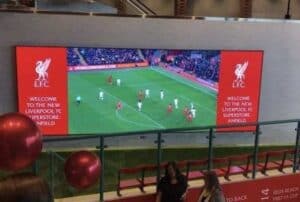
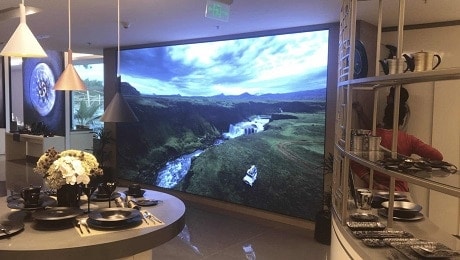
Car showroom LED screens have become a standard line on dealer group fit-out budgets, and for good reason: a direct-view LED screen behind the handover bay or facing the glazing does a job that posters, projection and consumer TVs cannot. The harder question for a specifier is not whether to buy, but what to buy: which pixel pitch, which product tier, what brightness, and how to keep a rollout consistent across ten sites. This guide answers those questions in the order a dealer group’s property or marketing team would actually ask them, using real install evidence from projects such as our Auto Trader Manchester HQ installation.
For a dealer group there is a second layer to every decision: repeatability. Cabinet format, processing platform and maintenance access often carry more commercial weight across a multi-site programme than a small difference in headline resolution.
Key takeaways
- Match pixel pitch to the closest regular viewing position, not the showroom’s overall dimensions: 1.5mm direct-view LED for close-range reception and handover areas, 2.5mm indoor LED for feature walls viewed from a few metres.
- Fixed-install product tiers, not rental-grade panels, are the right specification for a permanent showroom screen: DFC covers premium fixed installations, DX covers mid-range.
- Window-facing screens fight daylight and need substantially more brightness than a screen deep inside the showroom; treat the two as separate specifications.
- Processing matters as much as the panels. Brompton and Novastar processors handle scaling, colour and redundancy, and the choice affects day-to-day operation more than most buyers expect.
- Design the wall build-up, power, data and service access before ordering cabinets, not after the joinery package is signed off.
- For multi-site groups, lock the specification once and repeat it. Mixed pitches and mixed batches across sites create colour-matching and content problems later.
- Three-year return-to-base is the standard warranty tier for fixed LED installations.
Car showroom LED screens at a glance
Car showroom LED screens are direct-view LED displays installed as window-facing screens, feature walls, handover-bay backdrops and service-lounge digital signage. Most dealership installations are specified at 1.5mm pixel pitch for close viewing or 2.5mm for general showroom distances, using fixed-install product rather than rental-grade panels built for touring.
| Question | Short answer |
|---|---|
| Typical applications | Window-facing displays, showroom feature walls, handover bays, service and waiting lounges |
| Most-specified pixel pitches | 1.5mm for close viewing, 2.5mm for general showroom distances |
| Product families | DFC (premium fixed install), DX (mid-range fixed install), DVO for outdoor permanent positions |
| Brightness | DFC fine-pitch indoor product is rated 600–1,500 nits; window-facing positions need the top of the band |
| Processing | Brompton or Novastar |
| Service access | Front-serviceable modules for flush-mounted screens; rear service only where dedicated access space exists |
| Warranty | Three-year return-to-base as standard |
| Reference project | Auto Trader Manchester headquarters |
These are specification starting points, not substitutes for a site survey. Daylight, viewing positions and the proposed content should be checked at each location.
Where LED screens earn their place in a dealership
Not every wall in a showroom deserves LED, and the strongest business cases cluster around four positions.
Window-facing displays. A screen aimed through the glazing works after hours and pulls in footfall the showroom itself cannot. This is the most demanding position: it competes with direct daylight, so it needs a high-brightness specification and careful thought about mounting depth behind the glass. Get this wrong and the screen reads as a dark rectangle for half the day. One further check: if a window-facing screen functions as an advertisement to passing traffic, review the planning position before installation. The UK Government’s guidance on outdoor advertisements and signs is the starting point, with the local planning authority determining what applies to a given site.
The showroom feature wall. Usually the largest single element, an LED video wall behind the main display vehicles or above reception, running brand campaigns, offers and vehicle imagery. Viewing distances here are typically three metres and beyond, which is what makes a mid-pitch specification workable and keeps cost per square metre sensible.
Handover bays. The handover moment is the most photographed point in the customer journey, and dealer groups increasingly put a screen behind the car showing the customer’s name and vehicle. Customers stand within a couple of metres of it, so this is fine-pitch territory.
Service and waiting lounges. Smaller displays doing digital signage duty: service status, accessories and finance content to a captive audience. These are often better served by a modest LED screen than a cluster of consumer TVs, because one continuous canvas can be rezoned in software as content needs change.
A useful discipline at survey stage: walk the customer journey from car park to handover and note where people actually stop and look. The decisive viewing position is often not where the drawing suggests; a reception desk, vehicle plinth or coffee area can put customers much closer to a screen than the original brief assumes.
Choosing the right pixel pitch for showroom viewing distances
Pixel pitch is the distance between LED centres, measured in millimetres. It is the single biggest driver of both image quality and price. The working rule of thumb: the pitch in millimetres roughly equals the minimum comfortable viewing distance in metres. A 1.5mm screen holds up from about a metre and a half; a 2.5mm screen from about two and a half metres. Treat that as a screening tool rather than an answer, because content detail, installation height and contrast all shift the result.
Applied to a showroom:
- Handover bays and reception desks, where customers stand close, justify fine-pitch 1.5mm screens. At this pitch the image reads like a large-format screen rather than a grid of LEDs, even at arm’s length, which matters when the content includes vehicle photography and finance small print.
- Feature walls and window-facing displays, viewed from three metres or more, are well served by 2.5mm indoor product. The finer pitch buys nothing at that distance; the budget difference is better spent on brightness, processing or a bigger screen.
Pitch is also the budget lever. Cost scales non-linearly: halving the pitch roughly quadruples the number of LEDs per square metre, so a 1.5mm screen costs substantially more per square metre than a 2.5mm screen of the same size. Matching each position to the pitch it genuinely needs, and no finer, is the single biggest cost decision on the project.
Three cautions from experience. First, resolution follows from the module count, not from dividing wall dimensions by pitch — a supplier quoting a resolution that doesn’t derive from whole modules is quoting a screen that can’t be built as described. Second, check the resolution against the content workflow early: the marketing team needs the exact pixel canvas and safe areas before production starts, and cropping existing television content onto a non-standard canvas often removes vehicle details or calls to action. Third, don’t specify a finer pitch than the viewing distance warrants because it “future-proofs” the install. It doesn’t; it just moves budget away from the positions that need it. Our pixel pitch guide covers the trade-offs in more depth, and the LED screen configurator will give you a buildable size and resolution for any wall dimension.
If you’re at the stage of comparing positions and pitches for a specific showroom, it’s worth talking it through against your actual drawings — our contact page is the fastest route to a survey-backed specification.
Fixed install or rental-grade: specify for the environment
A showroom screen is a permanent fixture in a retail environment, and that rules certain products in and out.
Rental-grade panels are built for touring, with flight-case corner protection and quick-release rigging, and they are the wrong tool here. They cost more per square metre for durability a fixed install never uses, and their service access assumes a technician can get behind the screen. Our rental range exists for events; for showrooms we specify fixed-install product: DFC where the brief is premium (fine pitch, front service access, the tightest colour uniformity) and DX where a mid-range fixed specification meets the viewing distance and budget. An external screen on the forecourt or façade is a different environment again and comes from the DVO outdoor range rather than being treated as a bright indoor screen.
Four specification points deserve more attention than they usually get:
Brightness, by position. Specify each screen in nits for where it will actually sit. Our DFC fine-pitch range is rated between 600 and 1,500 nits, and an internal reception or feature screen rarely needs the top of that band; running an indoor screen at maximum output makes skin tones uncomfortable and creates glare around reception. A window-facing screen is the opposite case: it competes with daylight through the glazing, needs specifying at the top of the brightness range, and needs automatic dimming so it isn’t glaring at closing time. Measure ambient light at the wall position during the survey and commission timed brightness profiles.
Serviceability. Showroom screens are usually built flush against partition or block walls, which means front-serviceable modules are close to mandatory. Every installation needs a defined route to replace a module, receiving card or power component without removing joinery or moving display vehicles. Confirm this before the joinery package is signed off, not after.
Power and data as part of the permanent installation. Distribution across cabinet groups, safe isolation, processor location and spare data capacity all need designing in. The Health and Safety Executive’s electrical maintenance guidance sets out the duty to keep electrical installations in safe, maintainable condition, which is far easier to satisfy when access was designed in from the start.
Processing. The processor is the difference between a screen that runs itself and one that generates support calls. Brompton Technology and Novastar are the two processing platforms we specify and support; both handle input scaling, colour calibration and module-level correction. If the screen will be filmed regularly for social content or launches, camera behaviour depends on the complete system (refresh rate, scan behaviour, shutter and operating brightness), so test against the actual production workflow at commissioning. For a dealer group, the practical benefit of one platform is consistency: the same processing across every site means one set of operating procedures and one spares strategy.
What the Auto Trader Manchester project shows
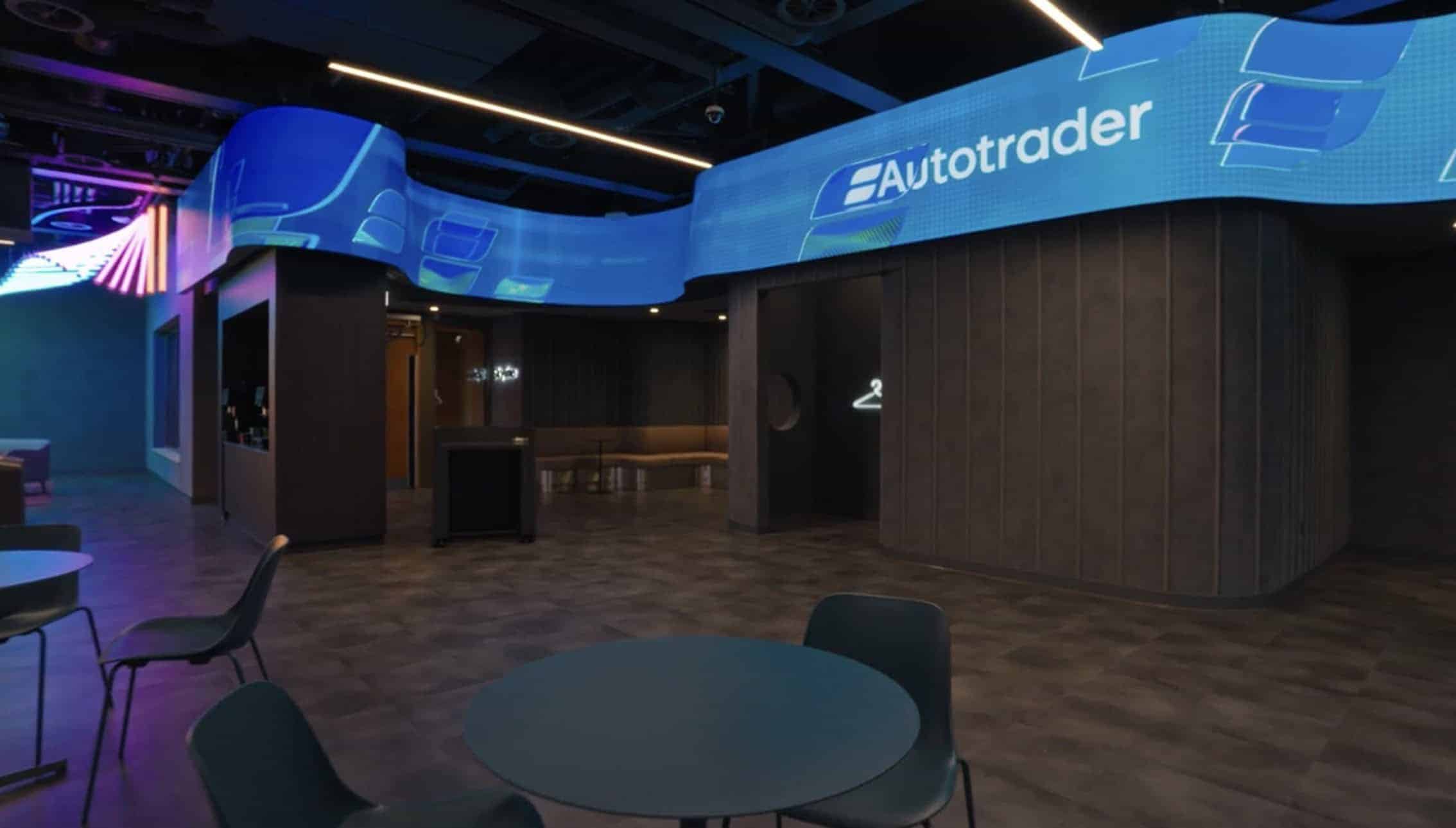
Our large-format LED installation at Auto Trader’s Manchester headquarters, delivered with Pixel Artworks, our long-time creative partner, is the closest reference point in our installation portfolio for automotive-sector LED done as architecture rather than signage.
The numbers give a sense of scale. A 21.76-metre double-curved LED ribbon runs above the main social areas, built from P1.86mm flexible LED tiles on custom-fabricated frames. A suspended halo ticker above the car turntable shows live vehicle-listing statistics from Auto Trader’s platform. Two 2.5-metre-square P1.9mm GOB-protected LED screens from our DX Series serve the social spaces, one integrated with an interactive AI display. Everything runs on Novastar processing, and the full installation was commissioned in a two-week window on a live headquarters fit-out.
The lessons transfer directly to showroom work. The screens were designed for the building: viewing positions, sightlines and the surrounding finishes drove the specification. Content was planned alongside the hardware, and Pixel Artworks’ creative work is a large part of why the installation reads as a considered part of the space. The install was coordinated with the wider fit-out, which is the part that most often goes wrong on dealership projects when the screen contractor turns up after the walls are closed.
For a dealer group, the takeaway is sequencing. Bring the LED specification into the fit-out conversation at design stage, when power, data, structural fixings and wall build-ups can still be adjusted cheaply. Retrofitting a screen into a finished showroom costs more at every stage: structural work behind finished cladding, power runs through occupied space, and installation around trading hours.
Rolling out across a dealer group
Single-site buyers and dealer groups have different problems. For a group, the specification decisions compound across every site, so the priorities shift.
Standardise the specification — but standardise the right things. Full standardisation is rarely possible because showrooms differ in wall area, glazing and customer flow. What works is a small number of repeatable design types (a close-view reception screen, a larger feature wall, a high-brightness window-facing configuration), each with an agreed pitch, product family, structural interface and content template. Site surveys then identify which type applies and where a controlled variation is genuinely needed. LED panels are batch-manufactured, and panels from different batches can sit at visibly different colour points, a real issue if site five’s screen needs to match site one’s. Ordering to a standard specification, with spares from the same batch, avoids the problem.
Buy spares up front. A small percentage of spare modules per site, held from the original batch, turns most service events into a same-day module swap and avoids colour-mismatched repairs six months later.
Plan content operations before the first screen goes live. A group-wide digital signage network needs an answer to who schedules content, how site-specific offers get localised, what appears if a source fails, and who is responsible when a screen shows the wrong thing on a Saturday morning. Design types help here too: the central marketing team knows the exact canvas for each display category, while sites get defined input routes without touching processor settings. The hardware is the easy half.
Phase the rollout deliberately. Fit the flagship first, live with it for a quarter, then adjust the standard specification before committing the remaining sites. The second site is where the specification gets proven; the tenth is where standardisation pays for itself.
From the field
The mistake I see most often on showroom projects is buying the screen before surveying the building. A dealer group’s marketing team picks a size from a brochure, and then I walk the site and find the wall they want is single-skin partition that won’t take the load, the distribution board is at the other end of the building, and the glazing line means the “window display” would sit in direct sun from two till five. None of that kills the project, but every one of those findings is cheap to solve at design stage and expensive to solve after order.
The other question I always ask is who will replace a module after handover. If the answer involves dismantling a finished wall or moving three display vehicles, the service plan needs changing before manufacture, not after the showroom opens. So my standing advice to dealer groups is: get us, or whoever you’re buying from, to survey before you sign anything. I’d rather spend an hour on site and change the specification than deliver exactly what was ordered and watch it underperform.
Car Showroom LED Screens: Frequently Asked Questions
What pixel pitch do car showroom LED screens need?
Match pitch to the closest regular viewing position. For handover bays and reception areas where customers stand within a couple of metres, specify 1.5mm direct-view panels. For feature walls and window-facing displays viewed from three metres or more, 2.5mm indoor LED gives an equivalent visual result at a lower cost per square metre.
How much do car showroom LED screens cost?
Pixel pitch, screen area and brightness tier are the three biggest cost drivers. Halving the pitch roughly quadruples the LED count per square metre, so fine-pitch handover screens cost far more per square metre than mid-pitch feature walls, and high-brightness window-facing product carries a premium over internal specification. Processing, structural mounting and installation complexity make up the rest, which is why a survey-backed quotation prices the actual building.
How bright does a window-facing showroom screen need to be?
Substantially brighter than an internal screen, because it competes with daylight through the glazing. As a reference, DFC fine-pitch indoor product is rated between 600 and 1,500 nits; window-facing positions need the top of that range plus automatic brightness sensing, so the screen holds up at midday without glaring after dark. Internal walls need far less and shouldn’t carry the cost of the higher tier.
Can we use normal TVs instead of an LED wall?
For small service-lounge displays, sometimes. For feature walls and window displays, no. Consumer TVs are limited in size, not designed for continuous commercial operation, and tiled TV video walls carry visible bezels between panels. A direct-view LED video wall gives one continuous image at any size the wall allows, with brightness levels televisions cannot reach.
Can a showroom LED screen be filmed without flicker?
Yes, provided the complete system is specified and configured for camera use. DFC panels run a 3,840Hz refresh rate, which is a strong starting point, but camera shutter, frame rate, scan behaviour and operating brightness all affect visible banding. The Novastar processing we commissioned at Auto Trader’s Manchester headquarters allows these settings to be tuned, and camera testing should form part of commissioning.
How long do showroom LED screens last?
Fixed-install LED is specified for continuous commercial duty and covered by our standard three-year return-to-base warranty. Module construction matters: the COB flip-chip build used in the DFC Series encapsulates the LEDs, which reduces dead pixels and component failure rates over the screen’s life. In practice a well-specified showroom screen is a long-term fixture, refreshed in content many times before the hardware needs replacing.
What does installation involve in a live showroom?
A site survey first: wall structure, power, data and access all get confirmed before anything is ordered, and you can book one through our contact page. Install itself involves a mounting frame, panel hanging, cabling, commissioning and calibration, and on an operating showroom we plan it around trading hours. The most important step is coordinating with any wider fit-out so power and fixings are in place before walls are closed up.
Can several dealerships share one LED screen specification?
They can share a controlled set of specifications, but one design rarely fits every site because viewing distance, glazing and structure vary. We normally standardise the pitch bands, product family, processor platform and spares strategy while allowing screen dimensions, brightness class and mounting details to change per site. That keeps purchasing and support consistent without ignoring site conditions.
Specifying your showroom screens: next steps
The pattern across every successful dealership project is the same: viewing distances drive the pitch, position drives the brightness, the fit-out programme drives the timing, and the specification is standardised before it’s repeated across the group. Buyers who start with those four decisions get car showroom LED screens that work as retail infrastructure from day one. For a showroom outside automotive, see the 3mm LED video wall Dynamo recessed into a Roche Bobois furniture showroom in London. For a temporary automotive build, see the 2mm LED screen Dynamo installed for the Zenvo Aurora Tur launch at Goodwood. If you’re specifying for a single showroom or a group-wide rollout, call us on +44 (0)203 489 9878 or send your drawings, site list and target dates through our contact page — we’ll survey, specify and quote against your actual buildings rather than a brochure.