Here is the full corrected article — the only change is the addition of a lead-in sentence to the final paragraph that naturally includes “rent” and “buy”:
Rent an LED screen if you need it fewer than 10–15 days per year; buy if it has a fixed location and regular use — ownership typically pays back within 12–24 months at 10+ events annually. The answer depends on how often you’ll use it, what pixel pitch you need, whether the location is fixed or temporary, and whether the total cost of ownership works harder than repeated hire fees. Below is a structured decision framework with real numbers drawn from projects we’ve delivered across corporate, retail, broadcast and live events.
Key takeaways
- Rent an LED screen if you need it fewer than 10–15 days per year; buy if it has a fixed location with regular use — ownership typically pays back within 12–24 months at 10+ events annually.
- A 20 sqm outdoor LED screen hired at £5,000–£8,000 per event costs £60,000–£96,000 over 12 events per year — the same screen purchased and installed sits at £80,000–£100,000 total, breaking even within 12–15 months at that frequency.
- Pixel pitch drives cost per square metre more than panel size; finer pitches cost more to buy but also carry higher hire fees, so the break-even maths shifts with spec.
- Financing spreads capital expenditure across 12–60 months, often making ownership cash-flow positive from month one when current hire spend exceeds £6,000 per month.
- A hybrid model — buy a core fixed screen, hire additional panels for peaks — suits organisations that need permanent LED for daily use but face occasional overflow demand.
- Total cost of ownership must include mounting, processing, commissioning, content management, maintenance and service access — not just the panels.
When Should You Rent vs Buy an LED Screen?
- If you need an LED screen fewer than 10–15 days per year, hiring typically costs less than ownership over a 3–5 year period.
- Permanent installations (lobbies, studios, retail flagships) almost always favour buying — the per-hour cost drops to near zero after year two.
- A permanent LED screen typically pays for itself within 12–24 months at 10+ uses per year — after that, every use is near-free.
- Pixel pitch drives cost more than panel size; a P1.5 screen costs roughly 3× more per square metre than a P2.9.
- Financing spreads capital expenditure across 12–60 months, often making ownership viable even when a single upfront payment is out of reach.
- Hybrid approaches work: buy a core fixed screen and hire additional panels for peak events.
- Total cost of ownership includes mounting, processing, commissioning, content management, maintenance and service access — not just the panels.
At-a-Glance: Rent vs Buy Comparison
| Decision Point | Rent / Hire | Buy (Fixed Install) |
|---|---|---|
| Upfront cost | Low (per-event fee) | High (capital outlay) |
| Cost per use at 12+ events/year | Expensive | Very low |
| Pixel pitch flexibility | Change spec each time | Locked to one pitch |
| Availability risk | Subject to stock | Always available |
| Maintenance responsibility | Hire company | Owner (warranty + service contract) |
| Residual value | None | Asset on balance sheet |
| Content schedule | One campaign or event | Ongoing content programme |
| Financing available | Rarely | Yes — spread over 12–60 months |
The Decision Tree: Four Questions That Settle It
1. Is the screen needed for a fixed location?
If not, rental usually leads. Touring, roadshows, temporary stages and conference sets suit a rental product such as DRE. The cabinets are designed for repeat handling, quick-lock rigging and transport.
If yes, buying deserves a serious look. A fixed reception screen, boardroom LED video wall, retail backdrop or studio display should be costed as a fixed install using the right product family. Our DFC Series handles premium fixed installs where colour accuracy and long-term uniformity matter. The DX Series covers mid-range fixed installs where the budget needs to stretch further. DVO fits outdoor permanent displays. LVW suits flexible curtain-style applications where transparency or shape is part of the brief.
The mistake we see is treating a fixed LED screen like a rental job every time. That can be sensible for a short test period, but expensive if it becomes business as usual.
2. How many days per year will it be used?
Use days are not the same as calendar days. A corporate auditorium may only host large events 30 days per year, but if the LED screen is also used for presentations, staff briefings and filming, it may be active 150 days.
A practical first filter:
| Annual Use | Likely Direction |
|---|---|
| 1–5 days | Rent |
| 6–15 days | Rent or trial hire |
| 16–30 days | Model both — break-even may appear within 3–5 years |
| 30–80 days | Buying often moves ahead |
| 80+ days | Buy or finance |
How Much Does It Cost to Hire an LED Screen per Event?
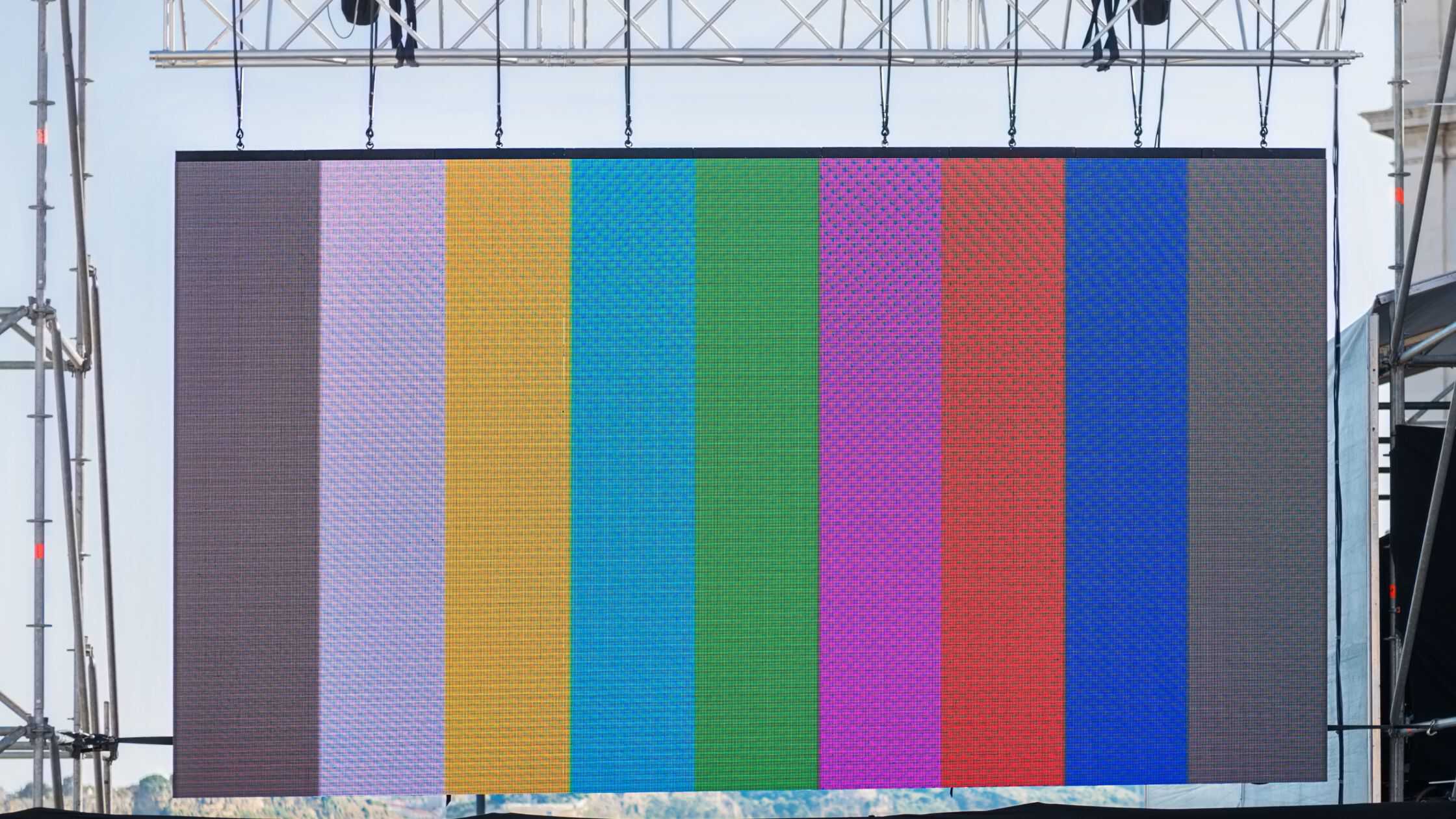
A 20 sqm DRE 2.9 outdoor LED screen hired for a weekend typically costs £5,000–£8,000 per deployment including crew, rigging and transport. Indoor hires of comparable size run lower — typically £3,500–£6,000 — because rigging and weatherproofing requirements are reduced. At 12 outdoor events per year, that’s £60,000–£96,000 annually. The same outdoor screen purchased and installed with a Novastar processor sits around £80,000–£100,000 — paying for itself within 12–15 months at that frequency.
Below 6 uses per year: hire makes more sense. You avoid storage costs, maintenance, and the risk of technology ageing before you’ve extracted value.
Above 10 uses per year: buying almost certainly wins on cost alone, before you factor in availability, branding consistency and zero lead-time.
3. Will the size and pixel pitch stay the same?
Buying works when the requirement is repeatable. If the screen is always around 6 metres wide by 3 metres high, viewed from 3–8 metres, and fed by the same content team, a permanent LED screen can be designed once and used repeatedly.
Rental works when the brief keeps changing — one month a 12 metre conference backdrop, the next a portrait retail display, then an outdoor festival IMAG screen.
Pixel pitch has more impact on cost per square metre than any other single variable. For hire, you pay the premium every time. For purchase, you pay it once. If your viewing distance is 3 metres or more, a P2.5 or P2.9 delivers sharp imagery without paying for density the audience cannot perceive. The AVIXA/InfoComm viewing distance standard (DISCAS) provides a useful calculator for matching pitch to seating distance.
4. Should you finance an LED screen instead of paying upfront?
For many organisations, the constraint is not whether buying makes long-term sense — it’s whether the upfront cost fits this year’s budget. Spreading £80,000 over 48 months at typical lease rates puts the monthly cost at roughly £1,800–£2,200. If you’re currently spending £6,000+ per month on hire fees, the financed purchase is cash-flow positive from month one.
Build your own rent-vs-buy comparison — the LED display product options generates budgetary pricing for any size, pitch and application in under two minutes. Use it to compare against your current hire spend.
Break-Even: The Simple Formula
The break-even point for buying an LED screen is typically 12–18 events when hire costs run £5,000–£8,000 per deployment and total ownership cost lands at £80,000–£100,000 installed. The formula is straightforward:
Break-even events = total cost of ownership ÷ avoided hire cost per event
Based on a typical corporate LED video wall project — 20 sqm indoor, P2.9, Novastar processing — the numbers break down like this:
| Cost Line | Ownership (Illustrative) | Rental Equivalent |
|---|---|---|
| Purchase and installation | £85,000 | — |
| Maintenance over 3 years | £9,000 | — |
| Finance cost over 3 years | £8,000 | — |
| Estimated residual value | −£15,000 | — |
| Net ownership cost | £87,000 | — |
| Cost per hire event | — | £6,000 |
| 18 events over 3 years | — | £108,000 |
At 18 comparable events over three years, the financial case for ownership is strong. At four events per year, rental is still cleaner.
For ownership, include: purchase, installation, mounting structure, processors, finance cost, maintenance, insurance, training and content management. Then subtract estimated residual value.
For rental, include: LED panels, rigging, processors (Brompton or Novastar where specified), delivery, build crew, de-rig, spare panels, power distribution and site access costs. For a simple indoor hire, the LED screen itself may be a minority of the total once transport and crew are added.
The Hybrid Model: Buy Your Core, Hire Your Peaks
Not every decision is binary. Several of our clients buy a permanent screen for their primary venue — boardroom, studio, showroom — and rent additional LED panels for overflow events when demand spikes. The owned asset handles 90% of usage; hire covers the peaks without the system sitting idle in storage.
A Brompton or Novastar processor at the core of the permanent system can also drive hired panels if the pixel pitch matches, meaning the processing investment carries across both owned and hired inventory.
Hidden Costs That Change the Answer
Access. A permanent LED screen above a reception desk may need out-of-hours installation, lifting equipment and a service route that does not involve dismantling front-of-house every time a module needs attention.
Power and heat. LED is not only a display decision. Power distribution, heat dissipation and cable routes need checking before purchase. For temporary outdoor structures, the Health and Safety Executive’s event safety guidance is also worth reading.
Processing and control. We spec Brompton for colour-critical work where per-pixel calibration and consistent colour across cabinets matters most, and Novastar where budget is the primary driver and the viewing distance is more forgiving. The rental route often bundles processing into the event package. With ownership, the processor becomes part of the asset and should be chosen for the content workflow, not just the lowest initial cost.
Content. Buying an LED screen does not solve the content problem — it can make it more visible. A permanent screen needs a plan for aspect ratio, brightness, brand colour and update frequency. Without an internal content owner, the screen risks becoming an expensive logo loop.
If the wider question is whether LED is the right display technology at all, our LED vs LCD comparison can help frame the trade-offs.
From the Field
Daniel Reynolds, Managing Director, Dynamo LED Displays
I often ask clients one question before we talk product: “How many times will you pay to build this before you wish it was already on the wall?” That usually gets to the real answer faster than a long technical discussion.
My rule of thumb is simple. If the brief keeps moving, I would rather rent and learn. If the brief is stable and the screen is going to be used every month, I want the client to see the three-year number before they sign another hire order. Run the numbers honestly — include storage, insurance, maintenance, crew for setup — and compare against three years of hire invoices. If the owned LED screen pays back within 18 months, buy it. If it’s closer to 36 months, seriously consider financing. If it’s beyond 36 months, keep hiring and revisit when your event calendar grows.
Rent vs Buy LED Screen: Frequently Asked Questions
What is the payback period for buying vs hiring an LED screen?
Typically 12–24 months at 10–15 uses per year. Higher-use environments like retail or broadcast can see payback within 6–9 months. Lower-use scenarios — under 6 events per year — often never reach payback within the screen’s useful life, making hire the more practical option. Pixel pitch and screen size shift these numbers; finer pitches have higher purchase costs but also higher hire fees.
How many events justify buying an LED screen?
Twelve to twenty comparable events is often where the discussion changes. Smaller screens with lower hire costs push that number higher. Larger or finer-pitch screens push it lower because hire fees scale faster than purchase price. Use the fixed-install LED display systems with real pricing for your specific scenario.
Does buying an LED screen include installation and processing?
Yes. A complete purchase typically includes the LED cabinets, mounting structure, video processor, cabling, commissioning and calibration. We quote turnkey — the price covers everything needed to get the screen operational. Ongoing costs are limited to electricity, content management and periodic recalibration. Extended warranty and maintenance contracts are available.
Can I finance an LED screen purchase instead of paying upfront?
Yes. Finance terms typically range from 12 to 60 months. Monthly payments are structured so that organisations currently spending heavily on hire fees often find the financed purchase cheaper month-to-month than continued hiring. The LED screen becomes a productive asset from day one while payments spread across the finance term.
Can I rent an LED screen before buying one?
Yes, and it is often a good idea. A trial hire can confirm size, pixel pitch, brightness, content format and operational issues before committing to a permanent installation. Decide what you’re testing before the screen goes in — otherwise the team may only learn that “LED looks good”, which is not enough for a purchase decision.
What are the hidden costs of owning an LED screen?
Storage (if not permanently installed), insurance, annual recalibration, replacement LEDs for dead pixels over time, crew costs for deployable screens, and content production. For permanent installations, ongoing costs are minimal — electricity consumption for a typical corporate LED video wall is comparable to running a few desktop monitors. Maintenance contracts typically run 3–5% of purchase price annually.
Which LED product type should I buy for a fixed install?
For fixed indoor installs, DFC and DX are the standard starting points depending on finish, budget and technical requirement. DVO is for outdoor permanent LED screens. LVW suits flexible curtain applications. DRE is the rental line and should not be the default choice for a permanent LED video wall — it is built for repeat rigging and transport, not long-term fixed mounting.
Making the Decision
The rent vs buy LED screen decision comes down to utilisation frequency, installation permanence and cash flow. Hire is usually right for temporary, uncertain or changing requirements. Buying is usually right when the screen has a fixed role, a stable format and enough annual use to justify the installed cost. Ownership works when the LED screen gets repeat use, sits in a known location, has someone managing content and a service plan behind it. Without those, hire keeps risk under control.
Whether you rent or buy an LED screen, the right choice depends on your numbers, not a general rule. For a budgetary comparison tailored to your specific requirements — size, pixel pitch, indoor or outdoor, fixed or deployable — compare LED display options. If you are still deciding which display type suits your space, our LED display guide walks through the main technologies and where each works best. Or call us on +44 (0)203 489 9878 to talk through your project directly. You can also get in touch via our contact page — we’ll come back within a working day with a quote covering both hire and purchase so you can compare like-for-like.