
Ask a manufacturer for an LED screen fire rating and you will usually get a datasheet line that says “UL 94 V-0” or “flame retardant” and nothing else. That is not what a fire engineer, building control officer or licensing team wants to see, because there is no single fire rating for an LED screen. What they need is evidence: what the cabinet and modules are made of, how the product was tested as electrical equipment, how it is fixed to the building, how the cables are routed, and what the screen does when the alarm sounds. This guide sets out that evidence and who signs it off.
Key takeaways
- There is no single LED screen fire rating. An LED screen is electrical equipment, not a construction product, so reaction-to-fire classes apply to the linings, backing boards and cables around it.
- Reaction to fire and fire resistance answer different questions. A Euroclass on a lining is not a rating in minutes for the wall behind it.
- The backing board and the cable route fail more sign-offs than the screen does.
- Public venues and higher-risk residential buildings add a fire-strategy layer: escape widths, sign visibility, alarm interface and an updated fire risk assessment.
- Sign-off happens on paper. If the certificates and installation method are not in the handover pack, the screen is not signed off, however well it was fitted.
At a glance: fire evidence on a typical fixed-install LED screen
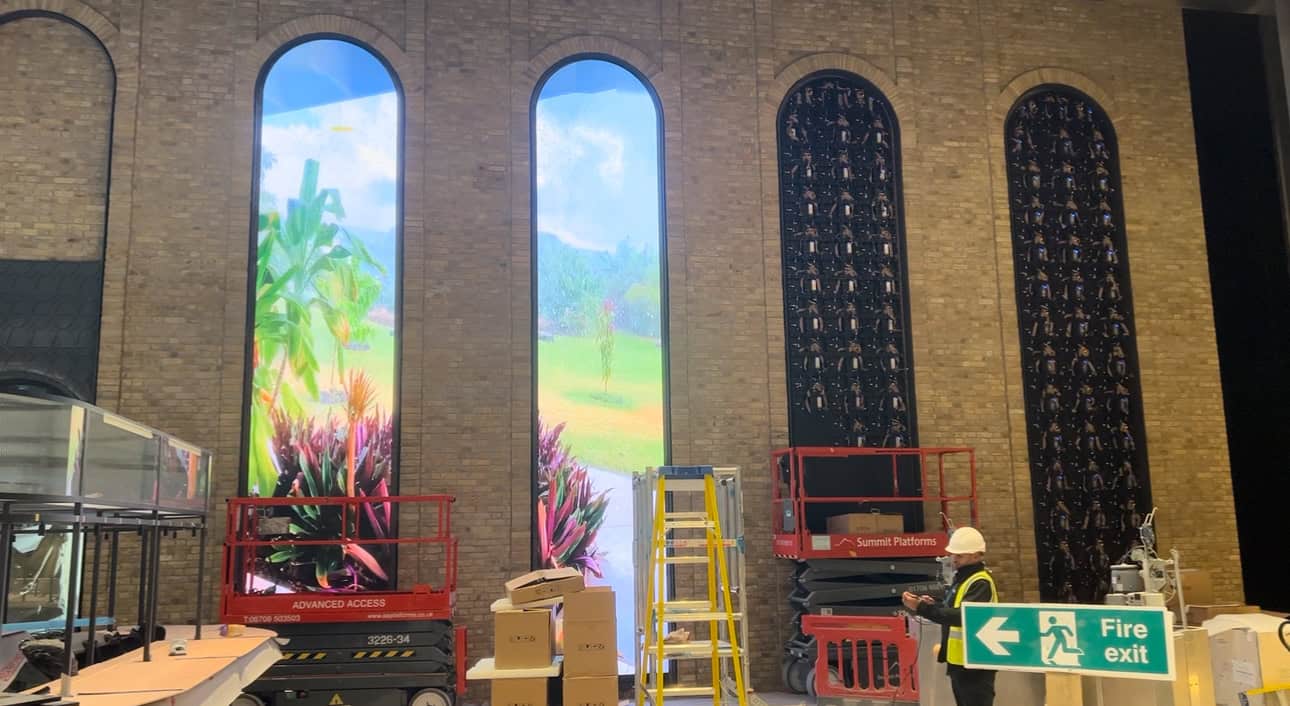
The LED screen fire rating question usually arrives as a request for evidence, and what is asked for depends on the building.
| Project element | What the specifier is asked for | Who usually asks |
|---|---|---|
| Corporate reception screen, P1.2 to P1.9 | Cabinet material, module plastics grade, electrical declaration, power at typical brightness | Fire engineer, main contractor |
| Retail or hospitality screen, P2.5 to P2.9 | As above, plus escape-route and sign-visibility check | Building control, licensing officer |
| Higher-risk residential lobby | All of the above, plus a golden-thread record of the change | Principal designer, building safety manager |
| Any screen on a compartment line or in a recess | Fire-stopping detail at every penetration, backing-board class, section drawing | Building control, fire engineer |
Does an LED screen have a fire rating?
No. An LED screen is electrical equipment, not a construction product, so it has no reaction-to-fire class under BS EN 13501-1 and no fire resistance in minutes. Its evidence is the cabinet material, the UL 94 grade of the module plastics and its electrical declaration of conformity. The backing board, linings and cables around it are what building control classifies. A so-called fire resistant or fireproof LED display has no regulatory meaning either, so ask what test the claim rests on.
“Fire rating” means two different things in UK building work. The first is reaction to fire, a classification under BS EN 13501-1 on the European scale from A1 (non-combustible) down to F. Approved Document B, the statutory guidance under the Building Regulations for England, uses those classes to limit what can line a wall in a circulation space or escape route. If a supplier sends an old BS 476 “Class 0” certificate, ask for the EN 13501-1 equivalent.
The second is fire resistance: how long a building element holds back fire, in minutes. If the screen fixes to a 60-minute compartment wall, a reaction-to-fire class on the backing board says nothing about whether the recess, the fixings and the cable penetrations have kept that 60 minutes intact.
The screen’s own evidence sits at three levels.
Cabinet and structure
The cabinet is the shell holding the modules, power supplies and receiving card. We put the cabinet material and the total mass on the wall on the drawing, because the fire engineer asks for both, and we confirm them per series from the current datasheet rather than a brochure line.
Modules, masks and boards
The LED mask, the connectors and the PCB substrate are the combustible elements. Manufacturers normally quote UL 94 V-0 for the mask and connector plastics and a flame-retardant laminate for the boards. UL 94 is a small-scale plastics flammability test, not a building classification, so ask for the grade in writing and do not present it as a Euroclass.
Electrical safety
The screen, its power supplies and its controller carry UKCA or CE marking, and for display equipment the declaration of conformity normally cites BS EN IEC 62368-1, the safety standard for audio, video and information technology equipment. The mark confirms product conformity, not a project-specific fire approval.
The practical questions for a specifier are peak power per square metre, typical power, and heat output at the brightness the screen will actually run at. Our rule of thumb from installed screens is that typical running power is about a third of peak, because content rarely sits at full white. Give the M&E consultant both numbers and let them design the circuit from the declared maximum. Finer pitches draw more per square metre, so choose pitch with our pixel pitch guide first, then take the specification lines from the DFC Series 1.5 mm page or the DX Series 2.5 mm page for a premium or mid-range fixed install.
The documents building control and fire engineers ask for
Building control and fire engineers typically ask for nine documents for a fixed LED screen: datasheet, declaration of conformity, mounting method statement, section drawing, cable schedule, fire-stopping record, alarm interface description, substitution process and RAMS. We assemble them on request at quotation stage.
- Product datasheet with exact cabinet and module references, cabinet material and mass, module plastics grade, and peak and typical power.
- Declaration of conformity for the screen, power supplies and controller. Most fixed-install screens we supply run on Novastar receiving cards and controllers, and their declaration belongs in the pack too.
- Mounting method statement covering fixing type, substrate, pull-out values where required, and the backing-board specification.
- Section drawing through the full build-up, showing ventilation, cable routes and any fire-resisting construction affected.
- Cable schedule with the BS EN 13501-6 class (Aca down to Fca) of each power and data cable. Cable is a construction product and does carry a reaction-to-fire class.
- Fire-stopping record for every penetration through a rated wall or floor, with the product used and a photograph before the finish went on.
- Alarm interface description stating what the screen does on alarm: blank, hold a static evacuation message, or stay live.
- Substitution process in writing, so a replacement module or cabinet variant is checked against the accepted specification before it is fitted.
- RAMS for the installation. Our LED display installation safety page explains how we handle working at height, hot-works permits and isolation on live sites.
For a permanent external screen the same pack supports the planning support statement, although planning consent does not establish fire-safety compliance.
Most of this pack applies to any permanent indoor LED video wall, whether a single reception screen or an atrium display. The LED screen configurator gives the power figures for a given pitch and area alongside the price. If you would rather send us the drawings and fire strategy, we will tell you in writing which of the nine documents we can supply for that screen.
Installation details that decide sign-off
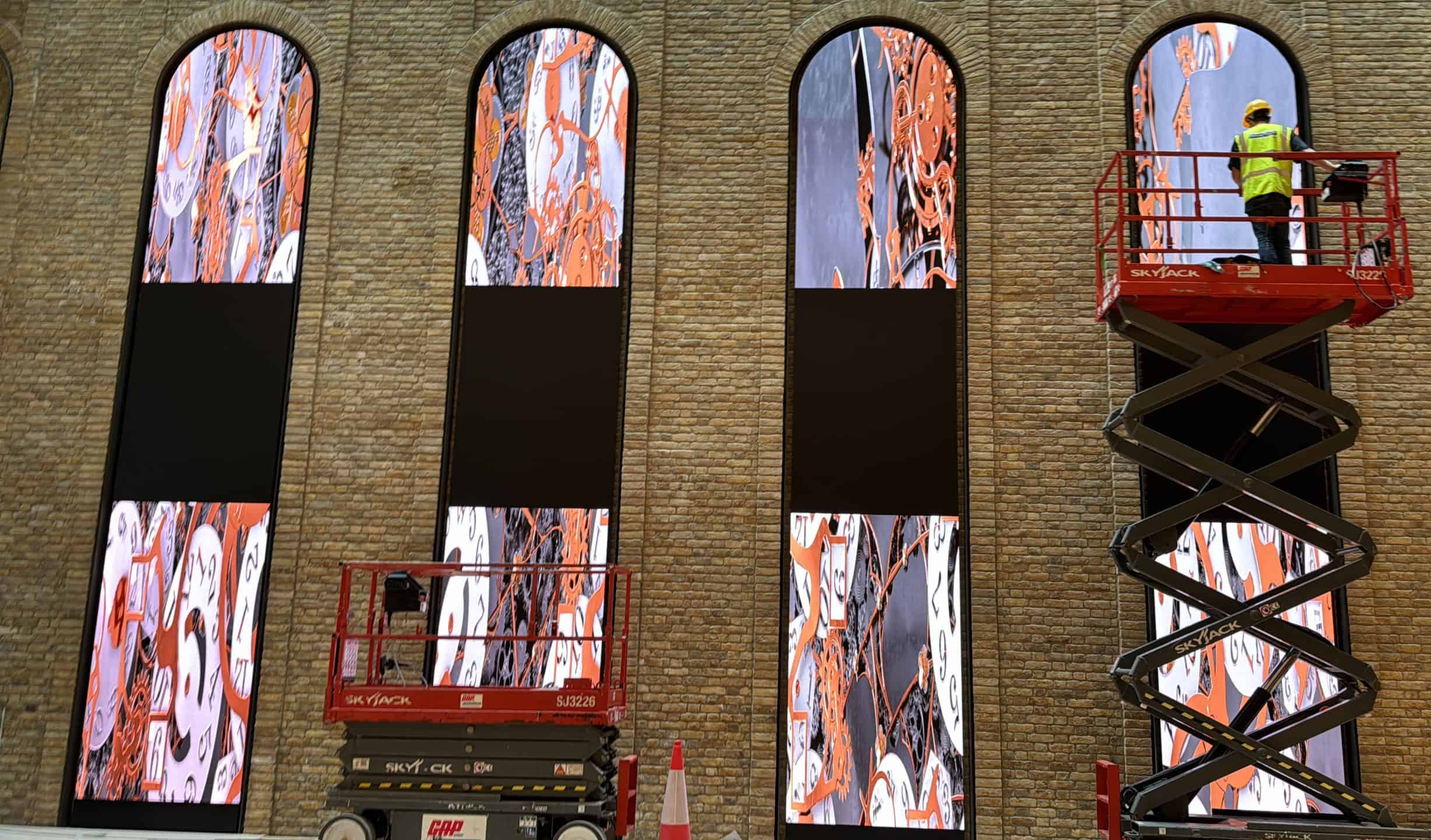
Four details decide most sign-offs: the backing board, ventilation and access around a recess, the cable route, and the alarm interface. The screen itself is rarely the problem.
Backing boards
The most common failure is a plywood pattress. Standard plywood is combustible, and as a lining behind the screen it falls under the reaction-to-fire limits for that room type. The fix is a non-combustible board (cement-based or calcium silicate) or a fire-retardant-treated ply with a certificate for the treatment. State it on the drawing before the joiner arrives.
Ventilation, recesses and access
Fine-pitch fixed screens are usually fitted tight to the structure, which is fine provided the heat has somewhere to go. A joinery surround needs vents sized for the typical heat load, and its material needs the same scrutiny as the backing board. Ask what the joiner is lining the recess with. It is often MDF. If reaching a failed power supply means disturbing fire-stopping, the detail is not finished.
Cable routes
Every time the power and data route crosses a compartment line it needs fire-stopping, and every time it runs along an escape route the cable class matters. We have every penetration fire-stopped and photographed before finishes go on. Filling a hole with an unnamed product is not a fire-stopping record.
Escape routes, signs and the alarm
Exit signs and emergency luminaires must stay visible with the screen at full brightness, and the screen must not narrow an escape route below the width the fire strategy assumed. On one reception project we moved the screen 400 mm along the elevation at drawing stage to clear an exit sign. That is a five-minute change on paper and an expensive one after bonding.
Most venues want the screen to blank or show an evacuation message on alarm, driven by an input from the alarm panel to the content player or controller and tested at commissioning. A black picture is not electrical isolation, so if the strategy needs the screen dead, that is a contactor on the supply.
For custom LED display work, curved, corner-wrapped or set into joinery, one more question applies: what is the shaped substructure made of? We specify steel or aluminium framing so it never becomes the combustible element.
Public venues, higher-risk buildings and handover
In non-domestic premises in England and Wales, the Regulatory Reform (Fire Safety) Order 2005 makes a “responsible person” accountable for a suitable fire risk assessment, and a new LED screen is a material change that should trigger a review. In higher-risk residential buildings, which in England means at least 18 metres or seven storeys with two or more residential units, the Building Safety Act 2022 adds the golden-thread requirement, so a lobby screen is a recorded change. Regulation 38 of the Building Regulations 2010 requires fire safety information to be passed to the responsible person when the work is complete, so where it applies the handover pack is a statutory deliverable, not an optional extra.
From the field
The job that taught me the most about this was a reception screen in a multi-tenant office building. The screen was fine. The client had signed it off, and then the building’s fire engineer asked for the reaction-to-fire class of the backing board. It was plain 18 mm ply, fitted by the joiner because nobody had specified otherwise. We took the screen down, swapped the board for a treated one with a certificate, and put it back up. Since then the backing board goes on our drawings as a named item, and we ask for the fire strategy before we quote. I would rather have that conversation at tender stage than on a scaffold.
Daniel, Dynamo LED Displays
LED screen fire rating: frequently asked questions
Does an LED screen have a fire rating?
Not in the building-regulation sense. An LED screen is electrical equipment, so it carries electrical safety declarations and plastics flammability grades such as UL 94 V-0 for the module mask and housings. Reaction-to-fire classes under BS EN 13501-1 apply to the linings, backing boards and cables around the screen, and those are what building control assesses.
What does UL 94 V-0 mean on an LED module datasheet?
UL 94 tests how a plastic behaves when a flame is applied. V-0 is the strictest common vertical-burn grade: the sample must self-extinguish quickly and must not drip flaming particles that ignite cotton below it. On an LED module it usually covers the mask and connector plastics. It is evidence for one material, not a classification for the complete screen.
Does CE or UKCA marking prove an LED screen is fire-rated?
No. The mark confirms the product meets the electrical equipment standards cited on its declaration of conformity. It does not give the screen a reaction-to-fire class or fire resistance, and it says nothing about the backing board, the mounting or the penetrations through the building.
What should the backing board behind an LED screen be made of?
Use a non-combustible board such as cement-based or calcium silicate, or a fire-retardant-treated plywood with a treatment certificate. Untreated plywood is combustible and is the item that most often fails the reaction-to-fire limits for linings in corridors, stairs and lobbies. Specify the board on the drawing so the joiner does not default to standard ply.
What happens to the LED screen when the fire alarm goes off?
The fire strategy decides that, not the screen supplier. The usual choice is to blank the screen or hold a static evacuation message, triggered by an input from the alarm panel to the content player or controller. If the strategy needs the screen electrically dead, that is an isolation on the supply, not a content command. Either way, write it down and test it at commissioning.
Conclusion
Specifying an LED screen for a fire-conscious building comes down to five early questions. What are the cabinet and modules made of? How was the screen tested as electrical equipment? What class are the backing board and cables? Does the wall behind keep its fire resistance? What does the screen do on alarm? There is no single LED screen fire rating that answers all of that, and a supplier who claims there is has not read the fire strategy. Put the backing board and cable class on the drawings, and sign-off becomes a formality.
If you are still choosing a product, our LED video walls page lists the fixed-install ranges by pitch. If a fire engineer or building control officer has asked you for an LED screen fire rating and you are not sure what to send, contact us with the drawings and fire strategy, or call +44 (0)203 489 9878, and we will tell you in writing which documents we can supply for the screen you are specifying.