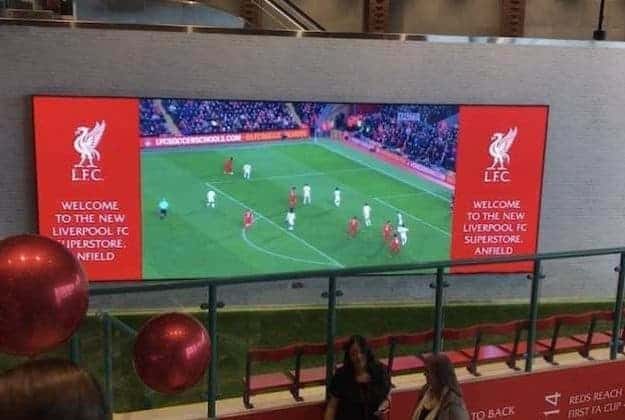
A sports bar LED screen needs three things specified correctly: a pixel pitch matched to the closest viewing distance, brightness with enough headroom for daytime fixtures, and a broadcast-source feed so the picture never runs behind the pub next door. This guide covers each decision, with the numbers we use when specifying fixed-install walls for UK hospitality venues.
Get those three right and the room fills two hours before kick-off. Get them wrong and the room empties just as fast: a washed-out picture at Saturday lunchtime, a goal celebration that arrives after the punters have already heard the roar through the wall. We fit fixed-install LED for hospitality venues across the UK, and the questions bar owners ask are consistent. Here is how we answer them.
Key takeaways
- Allow one metre of minimum viewing distance per millimetre of pixel pitch. Most sports bar main walls land between P1.9 (1.9mm) and P2.9 (2.9mm).
- Resolution comes from module count, not the diagonal. A 3.75m-wide DX Series P1.9 wall is fifteen 250mm modules across, giving 1,920 pixels — native Full HD width.
- Latency is a source problem, not a screen problem. Feed the wall from a broadcast set-top box; streaming apps can run tens of seconds behind the broadcast, while LED processing adds milliseconds.
- One LED video wall beats a scatter of consumer TVs for sightlines, brightness and multi-fixture zoning.
- Specify indoor panels rated at 800 nits or more, with separate daytime and evening brightness presets.
- Design the canvas around 16:9 broadcast content, and confirm service access before fixing screen dimensions.
At a glance: a typical sports bar specification
| Item | Typical specification |
|---|---|
| Product line | DX Series mid-range fixed install; DFC Series for premium fit-outs |
| Pixel pitch | P1.9–P2.9 for a main wall; P1.58 where viewers stand close |
| Canvas format | 16:9, matching broadcast sports coverage |
| Example build | 3.75m-wide DX P1.9 wall: fifteen 250mm modules, 1,920 pixels across |
| Feed | Broadcast set-top box on a commercial subscription, direct into the processor |
| Processing | Novastar |
| Brightness | ≥800 nits, scheduled day/evening presets |
| Servicing | Front-serviceable modules |
| Warranty | 3-year return-to-base |
These are briefing values, not a substitute for a site survey. Sightlines, ambient light, wall structure and the position of the bar can all shift the right answer.
Start with the room, not the screen
Match the pixel pitch of a sports bar LED screen to the closest realistic viewing distance: allow one metre of minimum viewing distance per millimetre of pixel pitch. A P2.5 (2.5mm) wall looks sharp from around 2.5 metres; from closer, individual pixels start to show. Our pixel pitch guide walks through the sums in detail.
So work the room first. Where do people sit? Where do they stand at half time? What is the closest anyone will realistically be to the screen while watching? That closest position sets the pitch, and the pitch and size must be worked out together, because an LED wall is built in fixed module increments and its resolution comes from the module count. A DX Series module is 250mm square; at P1.9 each module carries 128 × 128 pixels. Fifteen modules across gives a 3.75-metre-wide wall and 1,920 pixels: native Full HD width. The same fifteen modules at P2.5 carry 100 × 100 pixels each, so the identical width delivers 1,500 pixels. Both look convincing from across the room, but score graphics and tickers appear coarser to customers seated close. Where customers drink within arm’s reach of the screen, a finer pitch such as the P1.58 DFC Series keeps captions clean at close range.
Keep the canvas at 16:9 unless you have a defined reason not to. Mainstream sports coverage is 16:9, and an ultra-wide canvas without a content plan tends to end up filled with stretched video or permanent side bars.
Latency: why your feed must not run behind the pub next door
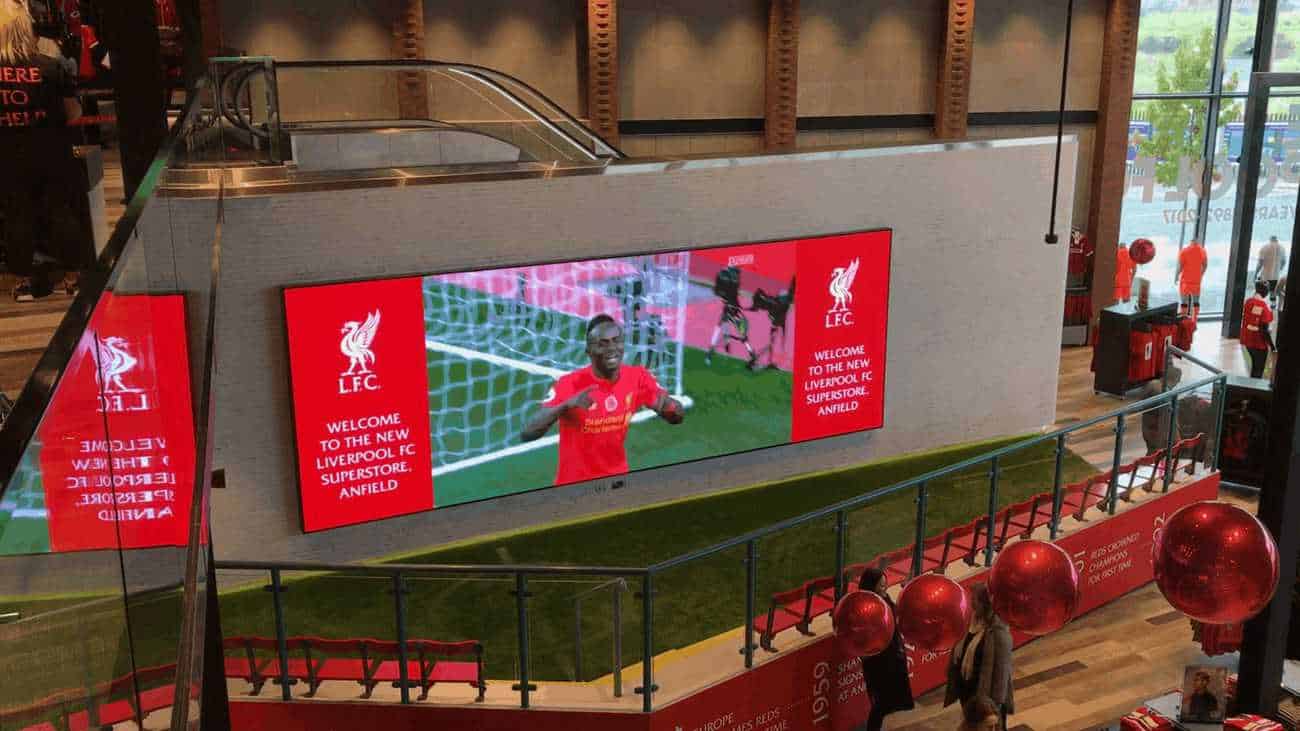
A sports bar LED screen should take its feed from a broadcast set-top box on a commercial subscription, connected directly to the LED processor. Streaming apps commonly run tens of seconds behind the broadcast feed, and the gap drifts during the match; the LED side adds milliseconds. Fix the source and your room celebrates with the stadium.
Nothing kills a big-match atmosphere like hearing the goal before you see it. If your venue streams the match through an app while the bar across the road runs a broadcast box, their customers celebrate first every time. The fix is upstream of the screen: broadcast source, short signal chain. Every device in the local chain — receiver, switcher, scaler, processor, receiving cards — can buffer frames, and at 50Hz each frame lasts 20 milliseconds, so a device holding three frames adds around 60 milliseconds. That becomes noticeable when the audio takes a shorter path than the picture, so lip-sync adjustment belongs in commissioning, not on a snag list.
The screen itself is the easy part when specified properly. Modern Novastar processing, which we supply on our fixed installs, keeps input-to-light delay to a few frames — well under a tenth of a second at 50Hz and imperceptible in a live room. We cover where delay actually accumulates in our ultra-low latency guide. One caution: a low-latency processor cannot recover the seconds already baked into a streaming platform. Source first.
How bright does a sports bar LED screen need to be?
For a bright hospitality room, specify indoor LED rated at 800 nits or more. Our DX Series panels are rated at ≥800 nits — several times the light output of a typical domestic TV — which is what holds the picture up against large windows and daytime kick-offs.
Sports bars are bright rooms, and the classic symptom of an under-specified screen is one that looks fine at 10pm and grey at 1pm on a Saturday fixture. Brightness, measured in nits, needs daytime headroom; it also needs restraint after dark, so we commission at least two scheduled presets: a daytime setting for sunlit afternoons and an evening setting so the wall doesn’t dominate the room when the lights go down. Staff keep a limited brightness control while the underlying calibration stays protected.
Viewing angle matters too. DX panels hold their picture across a 160-degree horizontal viewing angle, so wraparound seating well off-axis still gets watchable colour — something large-format LCD struggles to match. If the venue expects social-media filming, ask about panel refresh rate before you sign off the spec: DX panels refresh at 2,880–3,840Hz depending on pitch, which keeps phone footage free of banding. Fast sport also exposes poor scaling, so commission with live match footage rather than static test slides.
If you are weighing up a wider refurbishment, our LED displays for hotels and hospitality venues hub covers the formats operators choose and why, and you can contact us for a written specification against your own floor plan.
Is one LED video wall better than multiple TVs in a sports bar?

For most sports bars, yes: one LED video wall gives the whole room a shared focal point, holds its picture in daylight, keeps colour at wide viewing angles, and splits into zones on multi-fixture days. A bank of TVs is cheaper per screen but fixes your layout permanently at the brackets.
With an LED video wall, layout is a preset: full-screen for the main event, split for Champions League nights with a scores ticker below, a venue-branded holding screen between fixtures. Staff select approved layouts without touching the processor configuration — no ladder, no screwdriver, no input-hunting mid-service.
Some venues still benefit from satellite screens: a snug that can’t see the main wall, or screens over the bar for queuing customers. Specify those around their own viewing distances rather than copying the main wall’s pitch, and keep them on the same source so the room stays in sync. One thing on rights: a domestic subscription doesn’t cover showing the match to paying customers. Public exhibition needs a commercial agreement such as Sky Business, and that responsibility sits with the operator.
Build it like part of the building
A permanent wall should be specified as fixed-install hardware: DFC Series for premium fit-outs, DX Series where the brief calls for controlled capital cost. Rental cabinets like our DRE Series are engineered for repeated build-and-strike, and those handling features add nothing behind permanent architectural trim. We took the fixed-install route at the wall-fixed LED display at Noble Palace restaurant in London, a hospitality room where the screen has to live alongside daily food service, and you can browse more LED installations for bars and hospitality venues from similar briefs.
Front-service access is usually the practical choice against a structural wall: modules, power supplies and receiving cards should all be reachable without dismantling the surround. The structural design needs to carry the complete installed load, including steelwork, trims and cabling, and the electrical and ventilation design should use the manufacturer’s maximum figures with proper circuit allocation and isolation access. Boxing the wall into a shallow recess with no airflow is a fault report waiting to happen. Retain spare modules and power components from the installation batch so an eventual replacement matches the wall for colour and construction, and expect the hardware to carry our standard 3-year return-to-base warranty.
Beyond match day: making the wall pay all week
A sports bar LED screen that only works on match day is an underused asset. Between fixtures the same canvas becomes digital signage: menus, drinks promotions, fixture lists and private-hire advertising you would otherwise print, laminate and replace.
The more interesting opportunity is the late-night trade. Venues that shift from sports crowd to night-time crowd can shift the screen with them, running live visuals and DJ-driven content from the same hardware. We covered how venues run Resolume-driven visuals on nightclub LED displays, and the same approach works for any bar with a late licence. If your venue trades both identities, raise it at survey stage: the content system gets specified with the wall, not retrofitted afterwards. Scheduling then handles the switchover automatically, so staff aren’t fighting with inputs behind the bar on a busy Saturday.
From the field
When I survey a sports bar, I start at the closest occupied table, not the back wall. If I can see pixel structure from there, either the pitch is wrong or the seating plan is — and sometimes moving one table protects the budget better than tightening the pitch across the whole wall. My next question is always the feed: which box, which subscription, and what sits between it and the processor, because no amount of hardware fixes a stream that arrives half a minute late.
My advice to any operator is to make those decisions in order: feed first, then pitch, then size. Those three are ninety per cent of the result.
Sports bar LED screen: frequently asked questions
What size LED screen does a sports bar need?
Most sports bar main walls land between three and five metres wide, sized to fill the natural field of view from the main seating area. A 3.75m-wide DX P1.9 wall delivers 1,920 pixels across — native Full HD width — and gives every seat a clear view without craning at a corner-mounted TV.
What pixel pitch should a sports bar LED screen use?
Allow one metre of minimum viewing distance per millimetre of pixel pitch, so a P2.5 (2.5mm) wall suits viewers from around 2.5 metres. Most sports bar main walls land between P1.9 and P2.9; where customers stand very close, a finer pitch such as P1.58 keeps captions and score graphics sharp.
Why does my screen run behind the pub next door?
Almost always because you are streaming while they are on a broadcast set-top box. Streaming apps commonly run tens of seconds behind the broadcast feed, and the gap drifts during a match. The screen contributes milliseconds. Switch to a broadcast source on a commercial subscription and keep the signal chain short.
Does a sports bar need a 4K LED wall?
Not usually. Native 4K is 3,840 pixels across, which at P1.9 means thirty 250mm modules — a wall 7.5 metres wide. Most sports bars run a smaller physical resolution and let the processor scale the source cleanly. Viewing distance and module count matter more than attaching a 4K label to a wall that doesn’t need it.
How much does a sports bar LED screen cost?
Three things drive the price: pixel pitch (finer pitch costs more per square metre), total wall area, and the processing tier. Larger walls cost more overall but often less per square metre. You can model sizes and pitches yourself in our LED screen configurator, or send us your room dimensions for a written specification and price.
The bottom line
A sports bar LED screen succeeds or fails on three decisions: a broadcast-grade feed so your room celebrates with the stadium, a pixel pitch matched to real viewing distances, and enough brightness to hold up at Saturday lunchtime. Everything else — zoning, scheduling, late-night digital signage — is upside on top of hardware already earning its keep on match day.
If you are specifying a sports bar LED screen for a new venue or replacing a bank of tired TVs, contact us with your room dimensions or call +44 (0)203 489 9878. We’ll put a written specification and quotation together — pitch, size, processing and install — with no meeting required. For a fixed-install example in a dark room, see the 2.5mm LED screen in a London fitness studio.