
Specifying LED screens for hospitals and healthcare estates is a different job from specifying them for a shop or an office. The estate runs 24 hours a day, the audience includes people who are anxious, unwell or visually impaired, and every trade that sets foot on site needs to work around live clinical activity. The display technology itself is the easy part. The hard part is choosing a pixel pitch that suits the viewing distances, planning an installation that doesn’t disrupt patient flow, and putting a content system in place that a busy comms team can actually run.
LED has become the default large-format hospital digital signage platform, and this guide covers all three decisions, based on how we specify and install fixed LED screens in public buildings.
Key takeaways
- Select pixel pitch from the closest routine viewing position, not the screen dimensions. A P2.5mm indoor LED display reads cleanly from around 2.5 metres, which suits most reception and waiting areas.
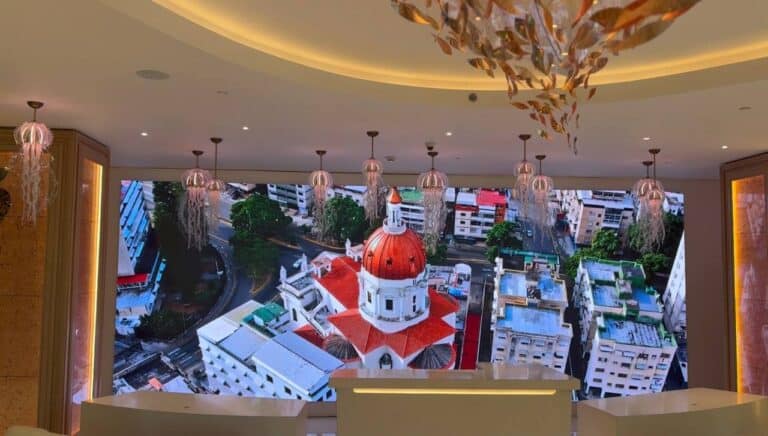
- LED has no bezels, so wayfinding maps and patient information render as one continuous image rather than a grid of LCD panels.
- Front-service cabinets are usually the right call in hospitals, where the wall often backs onto a plant room, corridor or clinical space.
- Installation in a live hospital requires RAMS, estates approval and typically out-of-hours working.
- Brightness scheduling is essential. A screen set for daytime footfall is uncomfortably bright on a quiet ward corridor at 2am.
- A browser-based content management system with role-based access lets a communications team update messaging without touching screens outside their remit.
- Fixed-install LED screens from Dynamo carry a 3-year return-to-base warranty as standard.
LED screens for healthcare at a glance
| Consideration | Typical answer for healthcare |
|---|---|
| Product family | DX Series (mid-range fixed install) or DFC Series (premium fine pitch); DVO for permanent outdoor screens |
| Common pixel pitches | P1.5mm–P2.5mm indoors; coarser pitches for large atriums |
| Indoor brightness | Commonly 500–1,000cd/m², dimmed on a schedule |
| Where they go | Main entrances, waiting areas, wayfinding points, lecture theatres, staff hubs |
| Service access | Front access preferred where no rear void exists |
| Install window | Usually evenings or weekends, agreed with the estates team |
| Documentation | RAMS supplied for every installation |
| Control | Novastar processing on most fixed installations |
| Content updates | Browser-based CMS, scheduled playlists, remote support |
Treat these figures as starting points. Glazed entrances, polished floors and restricted access can change the specification quickly, and a site survey settles it.
Where are LED screens used in hospitals?
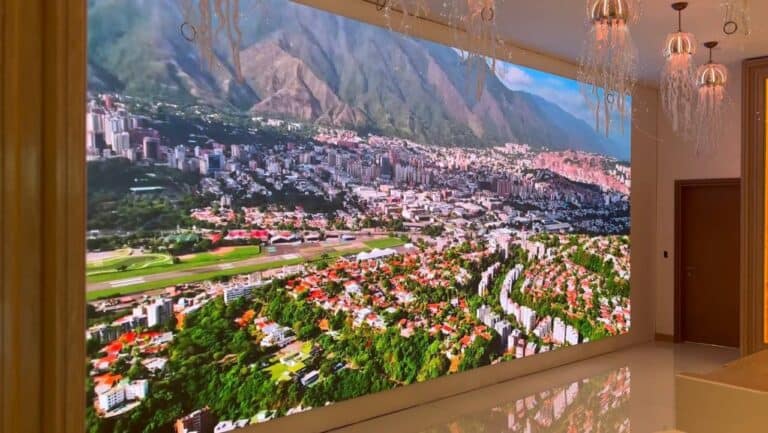
Hospitals use LED screens in main entrances, waiting areas, wayfinding junctions, lecture theatres and staff communication hubs. The strongest healthcare installations solve a specific communication problem. These are the applications we see most:
LED screens in hospital entrances and atriums
The entrance is where visitors are most disorientated. A large-format screen showing directions, department locations and current visiting rules does the job that used to need two volunteers and a printed map. Because LED is modular and bezel-free, one LED video wall can be sized to the architecture rather than the architecture compromising around fixed panel sizes. The specification and installation process here is the same one behind our corporate work, including the Auto Trader installation shortlisted as a finalist in the AV Awards 2026 Corporate Project category; our project portfolio shows how those decisions played out.
Patient information screens in waiting areas
Clinic status, expected delays, health campaign content and queue information all reduce the number of times reception staff answer the same question. On patient information screens the content mix matters more than the hardware, which is why we treat the CMS as part of the specification, not an afterthought.
LED wayfinding screens
Hospitals are famously hard to navigate. Screens at corridor junctions showing live directional content can be updated instantly when a department moves, which printed signage never manages. NHS England’s estates guidance, including the Health Building Notes that govern healthcare building design, has pushed trusts towards better patient experience for years, and legible, current wayfinding is one of the cheaper wins available.
Fine-pitch LED for teaching and simulation
Teaching hospitals and medical schools use fine-pitch LED in lecture theatres and simulation suites, where image detail needs to hold up under scrutiny from the front row. This is where our premium 1.5mm direct view display range comes in.
Staff communication screens
Screens in staff hubs and back-of-house corridors carry shift information, training dates and internal campaigns to a workforce that rarely sits at a desk.
Choosing the right pixel pitch and platform
Pixel pitch is the distance between LED pixels, measured in millimetres, and it sets both the image detail and a large part of the price. The working rule of thumb: the pitch in millimetres roughly equals the comfortable minimum viewing distance in metres. A P2.5mm screen reads well from about 2.5 metres; a P1.5mm screen holds up under 2 metres.
For most hospital receptions and waiting areas, P2.5mm is the sensible specification. Visitors stand a few metres back, the content is mostly text and simple graphics, and the budget saved against finer pitch can go into a bigger screen or a better content programme. Our P2.5mm indoor display sits in the DX Series, our mid-range fixed-install family, and it is the product we quote most often for this kind of environment.
Where viewers get close, such as an interactive wayfinding point, a boardroom or a simulation suite, fine pitch earns its premium. The DFC Series at 1.5mm keeps text sharp at arm’s length, which matters when the audience includes people reading small type on a screen they are standing next to. For very large atriums where nobody gets within five metres of the wall, a coarser pitch is better value; paying for detail nobody can resolve is a common specification mistake, and it usually comes from copying a spec written for a different room. Permanent external information screens are a different product family again, our DVO outdoor range, where enclosure, steelwork, drainage and planning conditions all need sorting before anything is ordered.
Healthcare installations are long-term assets, so we specify fixed-install platforms throughout. Rental-grade product has its place in events, not on a hospital wall that will run for a decade. If you want to sense-check a size and pitch against your own space, the LED screen configurator will give you a starting point.
One caution on brightness: indoor LED can run far brighter than any waiting room needs. What you want is headroom with control: a screen that can cut through a glazed, south-facing atrium at noon, then drop on a schedule to a fraction of that output in the evening. Ambient light sensors and scheduled dimming handle this automatically once configured.
If you are weighing up options for a specific building, send us the room drawings, viewing distances and intended content and we will set out the pitch, access and infrastructure questions that need resolving before procurement.
Installing in a live healthcare environment
Installing an LED screen in a working hospital requires a site survey, approved RAMS, out-of-hours working agreed with the estates team, dust containment around patient pathways, and commissioning completed before clinical hours resume. You cannot close a hospital entrance for three days, and you cannot generate dust, noise or trip hazards next to patient pathways during clinical hours.
A healthcare installation done properly looks like this:
- Site survey first. We check the wall structure, power provision, data routes and access before anything is ordered. Hospital walls hide services that domestic and retail walls do not; the estates team’s drawings are the starting point, and the survey confirms what is actually in the wall.
- RAMS before boots on site. Risk assessments and method statements are written for the specific site and submitted to the estates or facilities team for approval. Healthcare estates invariably require this, and the Health and Safety Executive expectations around contractor management make it non-negotiable regardless. We supply the RAMS, work the out-of-hours windows and manage the sign-off process with your estates team.
- Out-of-hours working. Structural fixing, cable pulls and commissioning typically happen in the evening or over a weekend, agreed in advance so security, parking and access are all arranged.
- Clean, contained working. Dust containment and protected walkways are standard practice in occupied healthcare buildings, and the install plan reflects that.
- Commissioning and handover. Colour calibration, brightness scheduling, CMS training for the comms team, and documentation handed to estates.
Decide serviceability at design stage. Front-service cabinets let engineers remove modules and power units from the display face, which avoids building a rear maintenance corridor where the wall backs onto a clinical room. The surrounding finish matters too: deep ledges collect dust, and the bezel, trims and adjacent wall build-up should be agreed with the estates and infection prevention teams before final decoration. LED modules are not a tiled wall; cleaning products, pressure and fluid ingress can damage the surface, so the handover pack states the approved cleaning method.
Our LED screen installation service covers all of this with our own engineers rather than subcontracted labour, which matters when the site induction, the RAMS and the people on the tools all need to line up.
Content management the comms team can actually run
A hospital LED screen needs a browser-based content management system with role-based permissions, scheduled playlists and a safe fallback state, run by the communications team rather than IT. Without that, the screen becomes wallpaper within a month. The pattern we recommend for healthcare digital signage:
- Browser-based CMS so the comms team updates content from their own desks, with no software installs to fight through IT approval.
- Role-based access, so a department can update its own clinic messaging without being able to touch the main entrance screen. Content creation, approval and scheduling should be separate permissions.
- Scheduled playlists: visiting-hours content in the afternoon, wayfinding emphasis in the morning rush, dimmed and simplified content overnight.
- A fallback state. If the network or source drops, the screen should hold safe default content. Nobody in a waiting room needs to see an error message or a bare desktop.
Information governance runs alongside all of this. Public-facing screens should never expose patient-identifiable data, the player’s network connection and any remote-support arrangement need approval from the NHS trust’s IT and governance teams, and a general information screen should not be treated as part of a life-safety system unless the complete system is designed and approved for that purpose. The Government’s fire safety guidance for healthcare premises sits above anything a signage system does.
On the processing side we work with Novastar control systems on most fixed installations, an established platform with a long support life, which suits an estate planning on a ten-year horizon. Our content management page covers the options, including fully managed content where we handle updates on your behalf.
From the field: what I tell healthcare estates teams
The thing I always tell healthcare estates teams on the first call is that the screen is the predictable bit. What decides whether the project goes smoothly is everything around it: the permit-to-work process, which corridor we can use for kit at 7pm, whether the wall we are fixing to actually contains what the drawings say it does. In my experience the drawings on older estates rarely tell the whole story, because walls accumulate generations of services that never make it onto any plan, and that is exactly why we survey before we order anything.
The other question I push early is who owns the black screen. If the source disappears at 07:30, someone needs the authority and the tools to restore content without exposing a desktop or waiting for three departments to approve a restart. Get us talking to your estates team before the specification is locked. Ten minutes with the right facilities manager saves a week of revised RAMS later, and it usually improves the design too.
LED screens for hospitals and healthcare: frequently asked questions
What pixel pitch do hospital LED screens need?
Match the pitch to the closest realistic viewer. P2.5mm suits receptions and waiting areas where people stand a few metres away. Fine pitch around 1.5mm is worth the premium for wayfinding points, boardrooms and teaching spaces where viewers get within touching distance. Large atrium screens viewed from five metres or more can use coarser pitches without visible loss of quality. Our pixel pitch guide covers the trade-offs in depth.
Can LED screens be installed without disrupting a working hospital?
Yes, with planning. Structural work, cabling and commissioning are done out of hours, agreed with the estates team in advance. RAMS are submitted and approved before work starts, dust and access are contained, and the work area is returned to normal use before clinical hours resume. The screen build itself is modular, so it goes up quickly once first fix is complete.
Can an LED screen be cleaned with hospital disinfectant?
No — some cleaning fluids, spray methods and applied pressure can damage LED modules and coatings, so the approved cleaning method for the installed product is stated in the handover pack. Infection prevention teams should also review the surrounding trims and ledges, not just the LED face, since those areas collect dust in ways the modules do not.
How bright should an LED screen be in a healthcare setting?
Bright enough to stay legible in the worst-case ambient light, then dimmed everywhere else. Many indoor healthcare screens operate within roughly 500–1,000cd/m², but a glazed atrium needs far more output at midday than a corridor needs at night. Specify headroom, then use scheduled dimming or an ambient light sensor so output tracks conditions throughout the day.
Can hospital LED screens display emergency messages?
They can display authorised operational messages, but a general LED screen should not be assumed to be a certified life-safety system. Any connection to emergency procedures must be reviewed against the hospital’s fire strategy, governance process and approved alarm systems. Fallback content and source-loss behaviour should be documented separately so the screen fails to something safe.
Who updates the content on a hospital LED screen?
Usually the communications team, through a browser-based content management system with scheduled playlists and role-based permissions. No specialist software or AV knowledge is needed for day-to-day updates. Where an NHS trust or private provider prefers not to manage content in-house, we offer managed content services and handle updates and scheduling remotely on their behalf.
How long do LED screens last in continuous use?
LED screens are built for continuous daily operation and hospital installations typically run for many years. Longevity in practice depends on running sensible brightness levels rather than maximum output, and on serviceability: modular LED can have individual modules or power supplies swapped on site. Our fixed-install screens carry a 3-year return-to-base warranty as standard.
Conclusion
LED screens for hospitals and healthcare estates succeed or fail on three decisions: a pixel pitch matched to real viewing distances, an installation plan built around a live clinical environment, and a content system the comms team will still be using in year five. Get those right and the screen becomes part of how the building communicates. Get them wrong and it becomes an expensive noticeboard showing last month’s visiting hours.
If you are specifying LED screens for hospitals, clinics or a wider healthcare estate, send us the space and we will come back with a recommended pitch, size and indicative cost in writing. Call us on +44 (0)203 489 9878 or reach us through the contact page and we will take it from there.