LED screens for gyms and fitness studios have moved from nice-to-have to part of the core fit-out. Boutique studios run instructor-led classes on an LED screen — sometimes called an LED video wall — instead of a mirror wall; larger gyms use screens for schedules, wayfinding, sponsor content and general digital signage. The specification questions are the same either way: what pixel pitch suits the room, fixed install or hire, and how the content gets controlled day to day. We have put LED screens into London fitness spaces both ways, including a fixed 2.5mm LED screen for a London fitness studio and an event hire for FIIT, and we specify around the room rather than treating the screen as a large television. That means checking sightlines, mirror positions, impact risk, ventilation, service access and the content’s native resolution before agreeing display dimensions. This guide works through those decisions in the order a specifier meets them.
Key takeaways
- Viewing distance sets pixel pitch. A front row at two to three metres points to a fine pitch such as P2.5mm indoor LED; gym-floor signage viewed from five metres plus can carry a coarser, cheaper pitch.
- Resolution follows from the module count and physical dimensions: a 4.8 × 2.7 metre screen at 2.5mm pitch gives a native 1920 × 1080 canvas.
- LED is emissive, so class content stays legible in bright, mirrored rooms where a projector washes out.
- Fixed installations use permanent-grade cabinets, with our 1.5mm direct-view display at the premium end; rental cabinets are engineered for repeated assembly, as used for the FIIT app collaboration at a London gym.
- Camera-facing studios should test refresh behaviour, shutter settings and processor configuration together, with the actual production cameras.
- Plan power, data, mounting and service access at fit-out stage, not after the plasterboard goes up.
At a glance: specifying a workout-space screen
| Specification point | Typical starting position | What can change it |
|---|---|---|
| Pixel pitch | 1.8–3.9mm indoors | Closest viewer, text size, camera distance |
| Indoor brightness | 600–1,000 nits | Windows, mirrors and lighting direction |
| Refresh for filmed sessions | 3,840Hz or higher | Camera shutter, frame rate, scan configuration |
| Common content ratio | 16:9 | Available wall dimensions and creative format |
| Service method | Front access | Wall build-up and rear maintenance space |
| Installation type | Fixed DFC or DX Series; DRE Series for hire | Permanence, calibration requirement, budget |
| Processing | Brompton or Novastar, project dependent | Inputs, redundancy, scaling, camera workflow |
These figures are starting points, not substitutes for a site survey and a content test. For worked examples in real fitness spaces, see the London fitness studio install and the FIIT hire linked above.
What a gym environment demands from an LED screen

A gym asks four things of an LED screen: enough brightness to stay legible under full house lights and mirrors, colour that holds at steep viewing angles across a wide room, refresh and processing that keep fast-moving content smooth, and a position that survives impact, sweat and cleaning. Each of the four shapes the specification before any product is chosen.
First, ambient light. Gyms are lit for safety and energy, often with floor-to-ceiling mirrors bouncing that light around. A projector struggles here. An LED screen generates its own light, so class content stays legible with the house lights up, which is exactly the condition a 6am spin class runs in. Mirrors add a second complication: they can put the screen into a viewer’s sightline twice, expose distracting reflections and reveal brightness inconsistencies that are less noticeable from the front, so mirror layout belongs in the survey, not the snag list.
Second, viewing angles. A group class room is wide and shallow: participants at the edges view the screen at a steep angle. Direct-view LED holds colour and brightness off-axis better than a projected image, so the person on the end bike sees the same instructor as the person front and centre.
Third, motion. Workout content is constant movement: an instructor demonstrating form, a timer counting down, metrics updating. The screen needs refresh behaviour that keeps fast content smooth rather than smeared, and processing that keeps the feed in sync with the music.
Fourth, impact and cleaning. Screens in fitness spaces live near sweat, chalk dust, cleaning sprays and moving equipment. Keep the screen out of the foreseeable impact zone of any free-weights area; positioning, a setback or a physical boundary is usually cleaner than putting a clear sheet over the image surface, which adds reflections, traps heat and restricts service access. Where the screen mounts flat to a solid wall, specify front service access, because pulling a wall-mounted screen forward for rear access in a finished studio is disruptive.
Choosing the pixel pitch for a gym or studio screen
Pixel pitch is the distance in millimetres between the centres of adjacent LED pixels, and it drives both image sharpness and cost. The working rule of thumb: the pitch in millimetres is roughly the minimum comfortable viewing distance in metres. A 2.5mm screen resolves cleanly from about two and a half metres; a 4mm screen wants four metres or more.
The critical measurement is the closest position from which a member, instructor or camera must see a coherent image — not the average room depth. Apply that to real rooms:
- Boutique studio, front row close to the screen. Fine-pitch territory. Our 2.5mm pixel pitch panel is what we fitted in the London fitness studio, where participants work within a few metres of the screen. At that distance the image reads as a single continuous picture, including small on-screen text like timers and heart-rate zones.
- Premium reception or a screen viewed at very close range. Where the audience can walk right up to the screen, a finer pitch again is justified. Our DFC Series 1.5mm fine-pitch screen sits at the premium end of our fixed-install range for exactly this situation.
- Gym floor digital signage viewed across the room. Schedules and promotions read from five metres plus can carry a coarser pitch without anyone noticing.
Screen dimensions and resolution should be set together, from the module counts. A 4.8 × 2.7 metre screen at 2.5mm pitch builds out to a native 1920 × 1080 canvas; a 3.2 × 1.8 metre screen at the same pitch is 1280 × 720. If most classes use 16:9 video, a native 16:9 canvas avoids permanent scaling or unused pixels, and the content team should receive the exact pixel map before templates are created. Our pixel pitch guide walks through the viewing-distance reasoning in full. Do not pay for a finer pitch than your closest viewer needs, and do not go coarse to save money on a screen people will sit three metres from for a 45-minute class.
If you are comparing sizes and pitches against a budget, our LED screen configurator gives an initial indication before you speak to anyone.
Should you buy or hire a gym LED screen?
Buy a fixed LED screen when it will be part of the permanent class programme; hire when the need is time-limited, such as a launch, a brand partnership or a fitness event. Fixed installations use our DX Series for mid-range projects or the DFC Series at the premium end, covered by a 3-year return-to-base warranty; hire runs on the DRE Series.
Fixed installation suits an operator building the screen into the class programme. The screen becomes part of the room, the content system is set up once, and instructors use it every session. A fixed screen is a capital purchase, and the comparison should include more than cabinet cost: mounting steelwork, power distribution, control equipment, commissioning and future maintenance access all belong in the budget.
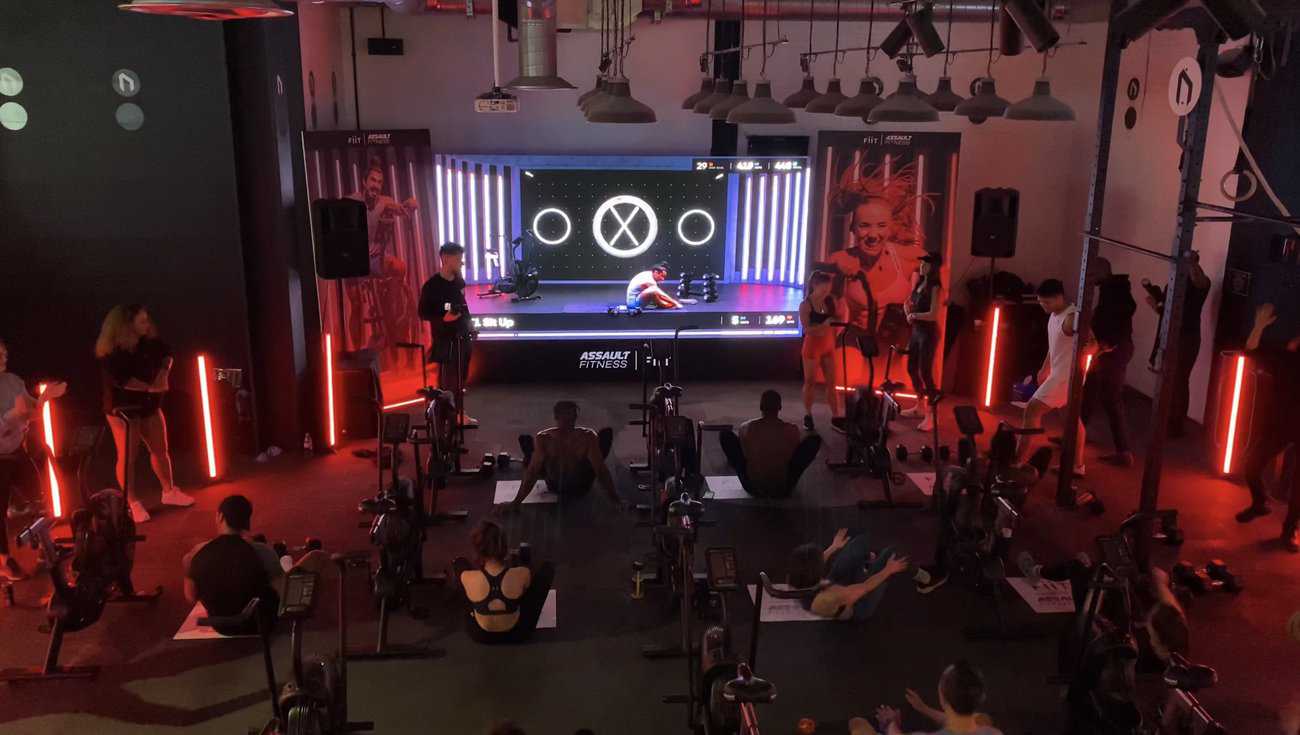
Hire suits anything time-limited. The big-screen hire for FIIT’s app-led workout at a London gym is a good example: FIIT needed a large-format screen for an app-led session in a gym setting, and hiring meant the venue got event-grade kit, delivered, rigged and removed, without owning any of it. Our DRE Series covers LED screen hire of this kind. But the DRE Series should not become the default for a permanent studio merely because the content changes; rental cabinets are engineered around repeated assembly, not years on one wall.
The crossover case is the operator who wants to trial screen-led classes before committing capital. Sport England’s Active Lives surveys, which measure physical activity among adults and children across England, are worth a look when weighing that decision. Hire the format for a launch period, learn what the room and the instructors need, then specify the permanent install from evidence rather than guesswork.
Planning a gym or studio screen? See comparable installs by sector in our project portfolio, or send us the room dimensions and closest viewing distance for a straight recommendation either way.
Content, control and processing
The hardware conversation usually gets the attention, but the daily experience of a gym LED screen is the control system.
Every LED screen runs through a processor that scales and drives the content. For fixed installs we typically specify Novastar processing, which handles input switching and scaling reliably at this scale; for high-end and broadcast-adjacent work, Brompton is the reference point. What matters for a gym operator is not the brand on the box but the workflow in front of it: an instructor arriving at 5:45am needs the class feed on screen in under a minute, from a source they already use. The right setup is a locked-down input, one labelled preset per class type, and no exposed settings, so that nobody in the building ever needs to open a processor menu. Scaling should be controlled in one known part of the signal chain rather than applied independently by several devices.
Cameras raise the bar. A screen that looks stable to the eye can show bands, scan lines or partial frames on camera, which matters in studios producing subscription classes or social content. A high refresh specification reduces the risk but does not replace testing: camera shutter, frame rate, exposure, LED scan behaviour and brightness setting all interact, so commissioning should use the actual production cameras and representative content rather than a phone. Colour temperature needs coordinating with studio lighting too — an LED screen set much cooler than the key lights makes skin tones hard to balance in the same shot.
Installation realities and what to put in the brief
Four things decide whether a gym installation runs smoothly: access hours, dedicated power and data, structural fixings and ventilation.
- Access hours. Gyms open early and close late. Installation usually happens overnight or in a pre-opening window, so build that into the programme and the quote.
- Power and data. An LED screen needs dedicated power, safe isolation and a data route to the control position. Running this during fit-out costs little; retrofitting through a finished, mirrored studio costs a lot more. The Health and Safety Executive’s electrical guidance sets out the wider workplace context.
- Wall structure. LED cabinets mount to a frame that needs sound fixings designed for the complete installed load, not just the quoted cabinet weight. Mirror walls and studio partitions both need checking before anyone quotes a mounting solution, and the LED structure should never depend on decorative glass for support.
- Heat and ventilation. The screen, processors and power equipment all produce heat. In a small studio that already runs warm during classes, factor the screen into the ventilation plan, and confirm air paths stay open after acoustic treatments and joinery go in.
A useful enquiry package states the nearest and furthest viewing positions, available wall dimensions, and any mirrors, windows, sprinklers or air-conditioning outlets around the proposed screen. For production-led studios, include sample content and details of the playback and camera systems. Before approval, ask for drawings showing the active image area, service clearances and cable routes — quoted display dimensions may refer to the LED surface rather than the complete mounted assembly.
From the field
The first question I ask on a survey is where the instructor stands, because that position usually sets the real minimum viewing distance — the instructor is often closer to the screen than any participant, and reading a small countdown timer at that range is a harder test than watching full-frame video from the back row.
My advice to anyone specifying a studio screen is to stand in the worst seat in the room, not the middle, and judge everything from there. I also want to see the class content early, because timers and app interfaces place different demands on a screen than workout footage does. Get the worst-placed viewer a sharp image and everyone else is covered.
LED screens for gyms and fitness studios: frequently asked questions
What pixel pitch do I need for a fitness studio LED screen?
Match the pitch to your closest viewer. The rule of thumb is that pitch in millimetres equals minimum comfortable viewing distance in metres, so a front row at two to three metres points to a 2.5mm screen. Finer pitches suit close text, app interfaces or cameras moving near the screen; coarser pitches suit gym-floor signage viewed from five metres or more.
Is an LED screen better than a projector for group classes?
For most studios, yes. An LED screen is emissive, so the image stays bright and legible with the house lights up and mirrors bouncing light around the room. A projector needs the room darkened to compete, which is rarely acceptable for a supervised exercise class, and people or equipment can cast shadows across the projection path. LED also holds colour at steep viewing angles.
Can we hire an LED screen for a gym event instead of buying?
Yes. Hire suits launches, brand collaborations and time-limited events, and our DRE Series rental cabinets exist for exactly this. We supplied a large-format screen on hire for the FIIT app collaboration at a London gym, delivered, rigged and removed by our crew. Hire is also a sensible way to trial screen-led classes before committing to a permanent install.
How do instructors control the screen day to day?
Through the processor and a simplified control layer. The right setup is locked-down inputs and one labelled preset per class type, so that an instructor can bring up the class feed in under a minute without touching any settings. The source is usually a wired device running the class app or playlist. The aim is that nobody in the building ever needs to open a processor menu.
Will a gym LED screen flicker on camera?
It can if the screen configuration, camera shutter and frame rate are not compatible. A high refresh specification reduces the risk but does not replace testing. Commissioning should include the actual production cameras, the darkest and brightest lighting scenes and representative content, particularly where instructors move in front of the screen during filming.
How bright should an indoor fitness studio screen be?
Many indoor projects operate within roughly 600 to 1,000 nits, with output reduced for darker classes such as cycling sessions. Windows, mirrors and directional lighting can require more headroom. The aim is not maximum brightness; it is readable content without glare, washed-out instructors or unnecessary camera exposure problems, so set presets per lighting scene during commissioning.
What warranty and maintenance should we expect on a fixed install?
Our standard cover is a 3-year return-to-base warranty on fixed installations. Beyond the warranty, specify front service access at design stage if the screen mounts flat to a solid wall, so a module or power-supply swap is a short visit rather than a de-rig. The handover package should cover safe isolation, spares storage and processor backups.
Where to start
The pattern across every successful project is the same: start from the room and the people in it, not the product page. Measure the closest viewing distance, decide whether the screen is permanent infrastructure or event kit, set dimensions and resolution together, and plan power, mounting, control and service access before the fit-out closes up. Where cameras are involved, test the complete chain under real lighting before regular production begins. Get those right and the technology choices, from pitch to processing, mostly make themselves. For a studio where the screen should vanish into a stone or timber wall between classes, see the DSK Series hidden LED screen.
If you are weighing up LED screens for gyms and fitness studios, we will give you a specific recommendation based on your room rather than a generic pitch. Send us the space dimensions and what you want the screen to do via our contact page, or call us on +44 (0)203 489 9878.