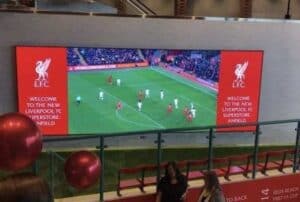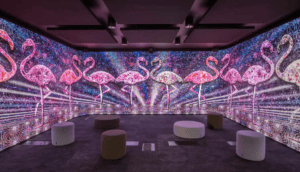
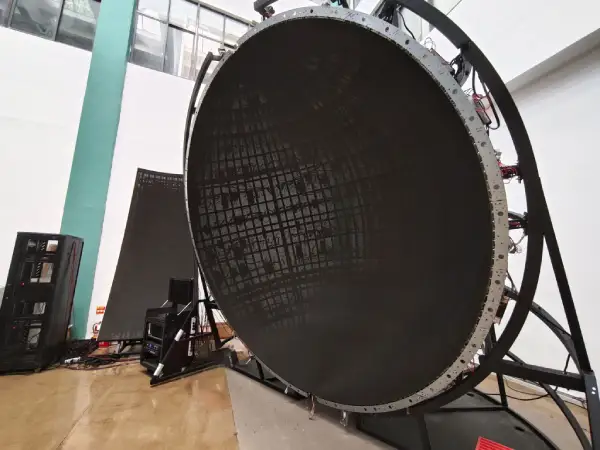
An LED wall commissioning checklist is the document that turns a wall of lit cabinets into an LED video wall you can sign off. Installation gets the cabinets on the structure and the cables in. Commissioning proves the whole system does what the specification said it would, with the client’s real sources, at the brightness it will run at day to day, with evidence recorded against agreed acceptance criteria. This guide sets out what we check between the last cabinet going up and handover, with a clause a specifier can paste into a tender.
Key takeaways
- Commissioning is a separate stage from installation with its own sign-off. If the tender does not name it, it gets skipped.
- Acceptance criteria belong in the specification before equipment arrives. “Picture looks good” is not a test result.
- The checklist covers seven areas: structure, electrical supply, data and redundancy, image quality, control and content, soak and recovery, and handover documentation.
- Calibration and uniformity are checked at the brightness the LED wall will run at day to day.
- Redundancy is proved by making it fail on purpose, with the client watching.
LED wall commissioning checklist at a glance
| Area | What we check | Who signs it off |
|---|---|---|
| Structure and fixings | Frame level and plumb, cabinet alignment, fixings to drawing | Installer and structural engineer |
| Electrical supply | Dedicated circuits, protective devices, certification | Electrical contractor |
| Data and redundancy | Cabinet mapping, primary and backup paths, failover test | Installer |
| Image quality | Seams, dead pixels, uniformity, greyscale, white point | Installer with client witness |
| Control and content | Presets, every contracted input, scheduling, remote monitoring | Installer with client operator |
| Soak and recovery | Overnight run on real content, restart, operator recovery | Installer with client operator |
| Handover documentation | As-builts, configuration backup, results, spares, warranty, maintenance plan | Installer and client |
Why an LED wall commissioning checklist needs its own line in the specification

Most LED walls that disappoint on day one were installed correctly. Nobody proved the system as a whole. The example we see most often is a backup data loop that was cabled in on installation day and has never once been switched to, because nobody wrote the test down. That is a commissioning gap rather than an installation fault.
The fix is to write commissioning into the specification as a stage with a defined deliverable, often called a site acceptance test (SAT), and to agree what passes before testing starts: one row per test with a method, a criterion and a result.
Our LED screen installation service treats commissioning as that separate stage on every fixed-install job, whether a DFC Series wall in a boardroom, a DX Series wall in a retail space or a DVO Series wall on a facade.
Minimum commissioning clause
- Commissioning is a separate stage from installation, closed by a signed commissioning record.
- Acceptance criteria, including pixel-defect tolerance, alignment variation and uniformity, are agreed in writing before delivery.
- Calibration and colour checks are carried out at the agreed day and night operating brightness, and the settings recorded.
- Every contracted redundancy path is tested by removing the primary path in front of the client representative.
- The LED wall runs the client’s own content overnight before the witness session, and any fault is corrected and retested.
- Handover includes as-built drawings, configuration backup, electrical certificate, calibration record, snag register, operating instructions, spares list, warranty terms and maintenance plan.
- Cabinet mapping and the signal chain are verified from the client’s actual playback source at native resolution, not only from processor-generated test patterns.
- Every contracted input is connected, tested and saved as a named preset, and the client’s operator publishes a content change and completes the written recovery procedure while the commissioning engineer watches.
If you are writing the tender, send us the drawings and the specification or call +44 (0)203 489 9878 and we will draft the commissioning clause for it.
Structural, mechanical and electrical checks
The physical checks confirm the frame, fixings and cabinet alignment match the drawing, service access survived the surrounding finishes, and the electrical supply is dedicated, certified and sized for peak draw. They happen before power goes on.
- Frame and fixings. Level and plumb against the drawing, every fixing against the structural engineer’s specification where one has been appointed. On a stud wall, this is where you find out whether the wall was ever suitable.
- Cabinet alignment. Flatness across the whole face, since a wall can have perfect joints and still bow across its width. We sight along the surface at a low angle under a single light source, which shows up module steps that look fine head-on. On the DFC Series at 1.5 mm, a step of a fraction of a millimetre reads as a visible line once content is playing.
- Access. Front-service walls need every module to release and re-seat cleanly. Rear-service walls need a usable route behind them.
- Electrical. Dedicated circuits with protective devices matched to the inrush behaviour of the power supplies, certified by the electrical contractor under BS 7671, the IET Wiring Regulations. Running power on video content is often around a third of peak, but the supply has to cope with a full-white frame.
Mapping, data and redundancy
The data checks confirm every receiving card is mapped to its physical position, the signal path from the client’s real source is correct at native resolution, and any contracted redundancy holds the image when the primary path is removed. Results are recorded per cabinet.
- Mapping. A test pattern that numbers each cabinet, a walk of the wall with the drawing, then a geometry pattern traced across every cabinet boundary. Reversed mapping and missing rows are invisible on a plain colour field and must be resolved before calibration.
- Signal chain. Processor-generated patterns bypass everything upstream, so the checks are repeated from the actual playback source with a native-resolution pattern.
- Redundancy. Pull the primary data cable at the processor and confirm the wall holds the image on the backup loop. If cabinets have dual power supplies, drop each in turn. A redundancy feature that has never been exercised is a drawing note, not a feature.
Image quality and calibration
The image checks confirm seams, uniformity, greyscale, pixel defects and white point meet the agreed criteria at the brightness the LED wall will run at, viewed from where the audience will stand. Settings and conditions are recorded so the result can be repeated later.
- Operating brightness first. An indoor wall in a reception or retail space rarely runs anywhere near its rated output, so calibrating at full output proves a state the wall never enters. A wall can look even at full brightness and show clear steps between modules once it is dimmed, which is the problem dynamic calibration exists to solve.
- Seams, uniformity and greyscale. Full-field white, then grey fields at low, mid and high levels, then each primary. Mid grey is the honest test. Differences that hide in a bright white field show clearly in grey, where most real content lives. A black-to-white ramp then checks for banding.
- Dead and stuck pixels. White, red, green, blue and black fields, each walked at close range. Faults are logged by cabinet and module position against the threshold in the specification. If there is no threshold, agree one before this test.
- White point. The wall is set to the client’s target white and saved as the default preset, then checked with the client’s own content under the intended lighting from where the audience will stand.
Processor, control and content
The control checks confirm every contracted input works at its intended resolution and frame rate, presets and schedules are saved, the configuration is backed up, and the client’s operator can publish a change unaided.
- Inputs and presets. Every input the client will use is connected, tested and saved as a named preset, including HDCP content if the client plays anything that carries it. Day and night brightness levels are programmed and tested, which on an outdoor DVO Series wall is a planning-condition matter too. Our fixed installs run on Novastar processing, and the configuration is exported to the pack. A wall rebuilt from memory after a processor swap goes dark for a day.
- Content and operators. The client’s actual content is loaded, not a demo reel, and checked for aspect ratio, black levels and text legibility. Whoever runs the wall day to day publishes a change themselves while we watch, recorded with names, through our LED display CMS, a VNNOX-based system on our own domain that is included with the wall.
Soak test, recovery and handover
The final checks confirm the LED wall runs the client’s content overnight without faults, recovers from signal loss and restarts in the approved sequence, and is handed over with the full documentation pack.
- Soak test. Real content overnight with the final ventilation and brightness limits in place. Thermal issues, intermittent cards and power supply faults show up in the first hours of continuous running. We re-walk the wall in the morning and repeat any test affected by a correction.
- Recovery. Then we break things deliberately. Stop and restore the source signal and record what the audience would see. Restart the player and processor in the approved sequence, then power cycle the wall with the client’s facilities contact and our engineer present. Finally, the operator follows the written recovery procedure while our engineer watches, which tests the instructions as much as the training.
- Handover pack. As-built drawings, the processor configuration backup with firmware versions, the electrical certificate, the calibration record, the pixel fault log, the signed snag register, operating and recovery instructions, a spares list, CMS and processor logins handed over rather than left on a sticky note, and warranty terms with the support route. Our standard warranty is three-year return-to-base.
- Maintenance and sign-off. We set the inspection interval and module replacement route in the LED display maintenance plan, and the commissioning results become its baseline. The named client representative signs the commissioning record, often called the commissioning report, which closes the contract. Finished examples are among our LED wall projects.
From the field
Daniel, Dynamo LED Displays
Most of the walls I get asked to look at have nothing wrong with the cabinets. The problem is what sits around them: a backup loop that was cabled in and never tested, a brightness schedule nobody set, a processor configuration that lives in one engineer’s head. Each is ten minutes on commissioning day that somebody skipped.
My rule is simple. If a feature is in the specification, I want to see it fail over in front of the client before I hand over. I set the wall to the brightness it will live at and do the grey field test myself. My last check is always the restart: if the operator cannot bring the wall back from our instructions, the handover stays open until they can.
LED Wall Commissioning Checklist: Frequently Asked Questions
What is the difference between LED wall installation and commissioning?
Installation is the physical and electrical work: frame, cabinets, cabling and power. Commissioning is the proving stage that follows, where the LED video wall is tested as a complete system across seven areas: structure, electrical supply, data and redundancy, image quality, control and content, soak and recovery, and handover. Installation gets the wall lit. Commissioning gets it signed off.
Should LED wall calibration be done at full brightness?
No. Calibrate at the brightness the wall will run at in normal use. An indoor wall rarely runs near full output, and uniformity and colour balance shift as brightness drops. Agree the day and night operating levels first, check seams, greyscale and colour at those levels, and record the settings so the test can be repeated.
How do you test redundancy on an LED wall?
By making it fail on purpose. Pull the primary data cable at the processor and confirm the wall holds the image on the backup loop. Where cabinets have dual power supplies, drop each supply in turn. Do this with the client present and record the result in the commissioning record, because spare sockets and duplicate cables prove nothing on their own.
What is an acceptable number of dead pixels on a new LED wall?
The specification should set the threshold, agreed before the pixel walk rather than argued about afterwards. Faults found at commissioning are logged by cabinet and module position so they can be tracked or replaced under warranty. If your tender has no pixel clause, add one and ask the supplier for the delivery tolerance of the product you are buying.
Who signs off LED wall commissioning?
Name the accepting client representative before work starts. The commissioning engineer supplies the results, and the electrical contractor and structural engineer provide evidence for their own work where appointed. The commissioning record states the tested scope, the remaining snags and who owns each action, and the signature on it closes the stage.
Conclusion
A wall that is installed but not commissioned has not been proven. None of the checks above are exotic. What makes the difference is agreeing the criteria early, testing the installed system with its real sources at its real brightness, and closing every failure with a recorded retest.
If you would like us to run this LED wall commissioning checklist on your project, or write the commissioning clause for one you are specifying, get in touch or call +44 (0)203 489 9878.