An LCD video wall replacement is rarely a straight display swap. When a tiled LCD wall starts to fail, you have a decision to make: hunt down matching panels for a discontinued product, or treat this as the moment to move to direct-view LED (DVLED), accepting changes to mounting, power, processing and resolution in return for one continuous image with no bezel grid. This guide covers why LCD walls decline the way they do, what LED changes, how to choose pitch, and what the swap involves on site. We install both technologies, and we still supply LCD screens where they are the right answer, so this is a specifier’s comparison rather than a sales pitch for one side.
Key takeaways
- LCD video walls rarely fail all at once. They decline panel by panel: backlights dim at different rates, colours drift apart, and replacement panels get discontinued mid-life.
- Match pixel pitch to the closest regular viewer and the smallest content they must read, not to the room’s furthest seat.
- Do not assume the LED wall will match the LCD wall’s native pixel count. LED resolution follows the cabinet matrix and pitch, so detailed content should be tested at the proposed canvas before procurement.
- Direct-view LED removes the bezel grid entirely. The image is one continuous surface, and cabinets build to the wall you actually have rather than to multiples of a 16:9 panel.
- LED is modular. A failed section means swapping a small module or cabinet, usually from the front, not sourcing a matched 55-inch panel from a product line that no longer exists.
- The old LCD mounting system almost never carries over. Budget for a new frame, fresh power and heat calculations, a site survey and compliant disposal of the outgoing panels.
At a glance: LCD-to-LED replacement facts
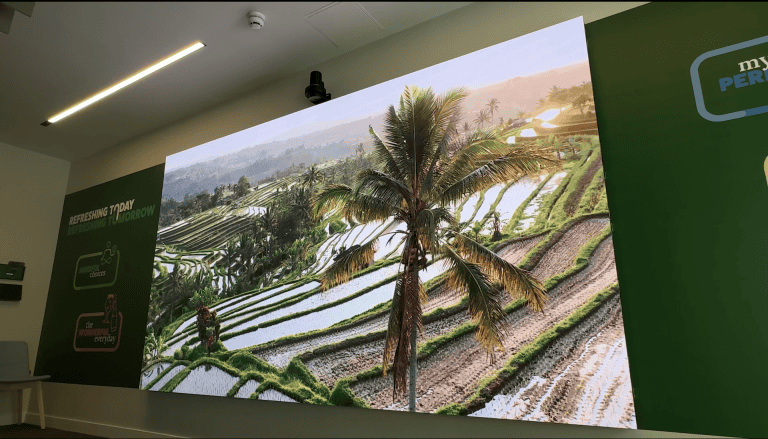
| Item | Detail |
|---|---|
| Typical trigger | Panel failure, backlight dimming, discontinued replacement panels |
| Common pixel pitch for former LCD positions | 1.2mm–2.5mm |
| Product lines | DFC Series — 1.5mm, premium fixed install; DX Series — mid-range fixed install for 2mm–2.5mm positions |
| Viewing distance rule of thumb | Pitch in millimetres ≈ minimum comfortable viewing distance in metres |
| Processing | Sized to the final pixel canvas, inputs and any redundancy requirement |
| Warranty | 3-year return-to-base as standard |
| Installation | From £150 per m² (minimum £1,000), de-rig of the old wall included |
| Delivery | £150 per delivery |
Why do LCD video walls fail?
An LCD video wall is a grid of individual panels, and that is both its strength and its weakness. Each panel is a complete display with its own backlight, its own colour calibration and its own service life. When the wall is new, the panels match. Five years in, they don’t.
Backlight dimming
LCD panels lose brightness gradually as the backlight ages. Because each panel dims at its own rate, the wall develops a patchwork look long before any single panel actually fails. Recalibration helps for a while, but it works by pulling the brighter panels down to match the dimmest one, so the whole wall gets darker each time.
Colour drift
Panels drift apart in white point and gamma, and the joins between them become visible as tonal steps even when the bezels themselves are narrow. An older wall often contains panels from different production batches, which makes the mismatch worse.
The discontinued-panel problem
This is the one that forces the decision. Video wall panels are sold in generations, and manufacturers move on. When a panel fails in year six and the model is discontinued, you are left choosing between a visibly mismatched substitute, a second-hand unit of unknown hours, or replacing the whole wall. A single dead panel in a 3×3 grid can strand the other eight working displays.
The bezel grid
Even a healthy LCD wall carries its defining compromise: the black grid of bezels across the image. Ultra-narrow-bezel panels reduced it but never removed it, and content with text or faces crossing the joins always suffers.
None of this makes LCD a bad technology. For single-screen applications, desktop-distance viewing and tighter budgets it remains cost-effective, which is why we still sell it. But as a tiled wall, it ages in a way that direct-view LED simply doesn’t. We compare the two technologies in more depth in our LED vs LCD video wall comparison.
What direct-view LED changes
Direct-view LED builds the image from light-emitting pixels on modular cabinets, with no backlight, no glass panel and no bezel. The differences that matter for a replacement project:
One continuous image. Cabinets align edge-to-edge with no visible join. Content designers stop working around the grid, and full-wall video, spreadsheets in a control room or a presenter’s face on a boardroom wall all read as a single surface.
Uniform ageing. LED brightness does decline over a long service life, but it declines together, wall-wide, and calibration keeps the surface uniform. There is no patchwork stage.
Modular repair. A fault means exchanging a module or receiving card, usually from the display face in minutes, from spares held with the wall. Front service also reduces the depth the installation needs, which helps where the old LCD structure sits in a shallow recess with no rear access. You are never dependent on a discontinued panel generation; this is the structural fix for the problem that killed the LCD wall.
Freedom of format. An LCD wall is locked to multiples of a 16:9 panel. LED cabinets build to the space: wider, taller, letterboxed above a reception desk, or wrapped around a corner.
One caveat: resolution. A tiled LCD wall driven at native resolution stacks Full HD panels into a very large pixel canvas; a 4×4 wall of Full HD panels can present up to 7680 × 4320 pixels. An LED wall’s resolution is set by the number of cabinets and the modules within them, and at typical fine pitches the finished canvas will usually be smaller than that stacked LCD figure. For dashboards, video and branded content viewed from normal distances this rarely matters. For operators inspecting small labels, maps or telemetry at close range, it does, so test representative content at the proposed LED canvas before you commit.
Choosing the right pitch and product line
Pixel pitch is the distance between LED pixels, and it is the main driver of both image detail and cost. The working rule of thumb: pitch in millimetres roughly equals the minimum comfortable viewing distance in metres. A 1.5mm wall reads cleanly from about a metre and a half; a 2.5mm wall from around two and a half metres.
The pitch decision should start with the content, not the wall width. A person watching full-screen video will tolerate a coarser pitch than an operator reading small text, so specify for the closest regular viewer and the smallest detail they must resolve. Going finer than the room requires increases cost, power demand and processing load for benefit nobody sees.
Most LCD video walls live at close viewing distances, which is why replacements usually land in fine pitch:
- Boardrooms, receptions and control rooms — anywhere people sit or stand close to the wall — want 1.2mm–1.9mm. Our DFC Series at 1.5mm is the premium fixed-install line we specify for these positions, with the pixel density to carry small text and detailed content at close range.
- Retail, showrooms and larger atriums with viewing from two to four metres suit 2mm–2.5mm, where our DX Series covers the mid-range fixed-install brief at a lower cost per square metre.
DRE is our rental line and is not the right default for a permanent wall. Sizing follows from the space rather than from panel multiples: our pixel pitch guide works through the viewing-distance maths in detail, and you can sketch sizes and pitches against your own wall in our LED screen configurator.
Planning a replacement? Browse the full fixed-install range on our LED display products hub, or send us the wall dimensions and closest viewing distance through our contact page (or call +44 (0)203 489 9878) and we will come back with a straight answer on whether direct-view LED is the right move.
What does an LCD video wall replacement involve?
Replacing an LCD video wall with direct-view LED involves five jobs: a site survey, power and heat calculations for the new load, a dedicated LED processor, WEEE-compliant de-rig and disposal of the outgoing panels, and commissioning with spares. Each is confirmed before equipment is ordered, which is what keeps the on-site phase short.
Site survey
Wall construction, fixing substrate, access route and floor loading all get checked before anything is ordered. LED walls hang on their own frame system; the outgoing LCD mounts are not reused. Where the new wall must fit an existing architectural surround, the drawing should show the actual cabinet matrix, outer dimensions, active image area and service clearance, because a nominal 16:9 opening does not guarantee a chosen cabinet combination fills it without borders. Confirm how the final cabinet goes in and comes out: on a display fitted tightly between finished surfaces, the last cabinet cannot always be fitted the same way as the first.
Power and heat
The existing LCD circuits should not be accepted without checking the proposed LED load. We calculate both the maximum connected load and a realistic operating figure at the intended brightness, and document the assumptions rather than guessing. Electrical work should follow the current requirements of BS 7671, maintained by the IET. Heat matters even though the new display is often shallower: a recessed installation still needs a route for warm air to escape, and blocking ventilation to preserve a clean finish shortens component life.
Processing
The signal chain changes. An LCD wall may be fed panel-by-panel from a multi-output controller; an LED wall is driven as one mapped pixel canvas by a dedicated processor. Novastar covers the majority of fixed-install briefs, and Brompton Technology sits at the top end where colour accuracy and camera work demand it. Your source equipment usually stays; the box between source and wall is new, and it must be sized to the actual LED canvas, inputs and any redundancy requirement.
De-rig and disposal
The old panels come off the wall and must be disposed of as electrical waste under the WEEE regulations, not skipped. We include de-rig of the outgoing wall in our installation pricing.
Commissioning and spares
The wall is aligned, calibrated for the room rather than left at an unnecessarily high factory brightness, tested through source switching and signal-loss recovery, and handed over with the configuration recorded. We recommend holding project-specific spare modules from the same production batch where possible, stored and tracked rather than left unlabelled in a storeroom.
Our LED screen installation service covers the survey, structural frame, install, de-rig and commissioning as one package, priced from £150 per square metre with a £1,000 minimum. The on-site programme is confirmed at survey, and it stays short when the enabling works are agreed before the cabinets arrive.
From the field: real LCD-to-LED replacement enquiries
The call I get most often on this subject starts the same way: a video wall that has been fine for years, then one panel goes down, and the facilities team discovers the model was discontinued two product generations ago. My advice at that point is almost always the same. Don’t spend money forcing a mismatched panel into a wall that is dimming anyway; price the LED replacement and compare it against the remaining life of what you have.
When I do get in front of the project, I ask to see the content at its smallest useful size. A five-metre wall sounds large, but that doesn’t help an operator who needs to read a tiny label from two metres away, and my pitch recommendation changes when I see the actual dashboard rather than a showreel. What surprises people is never the spec sheet. It’s the absence of the grid. They have spent years designing content around bezels without noticing they were doing it.
LCD Video Wall Replacement: Frequently Asked Questions
How do I know it’s time to replace an LCD video wall?
Three signals: visible brightness or colour mismatch between panels that calibration no longer fixes, a panel failure where the matching replacement model is discontinued, and running costs or downtime creeping up. If two of the three apply, pricing a replacement against continued patch-up repairs usually settles the question quickly.
Can I replace an LCD video wall with LED in the same position?
Usually, but not automatically. The LED wall is sized to the space rather than to panel multiples, so it can match the old footprint or improve on it. Because cabinet dimensions set the finished size, small changes to borders or surrounding joinery are sometimes needed, and the mounting system changes: LED cabinets hang on their own frame.
What pixel pitch replaces an LCD video wall?
Work from the closest viewing distance and the smallest content that must stay legible. A control room viewed from a metre and a half points to 1.2mm–1.5mm; a boardroom or reception viewed from similar range takes up to 1.9mm; a retail or atrium position viewed from three metres reads cleanly at 2.5mm. Finer than the room requires adds cost for benefit nobody sees.
Will the LED wall have the same resolution as the LCD wall?
Not necessarily. A tiled LCD wall driven at native resolution stacks Full HD panels into a very large canvas, while an LED wall’s resolution follows its cabinet matrix and pitch, and is usually lower at the same physical size. The result can still suit the room, but detailed content should be tested at the proposed LED canvas first.
How much does an LCD video wall replacement cost?
Our installation is priced from £150 per square metre with a £1,000 minimum, and that includes de-rig of the outgoing wall; the display hardware is quoted per project by pitch and size. Per square metre, fine-pitch LED costs more up front than a like-for-like LCD panel swap, but LED ages uniformly, repairs are modular, and you are never stranded by a discontinued panel generation.
How long does an LCD video wall replacement take?
Once the survey is done and equipment is on site, de-rig, frame install, cabinet hang, cabling and commissioning are sequenced as one visit wherever the site allows, and we confirm the programme at survey rather than quoting a generic figure. A staged changeover can suit control rooms that cannot tolerate extended downtime.
What happens to the old LCD panels?
They are electrical waste and must be handled under the WEEE regulations rather than sent to general disposal. We include de-rig of the outgoing wall in our installation package and remove the panels for compliant recycling. Working panels from a partial failure can sometimes be redeployed as single screens elsewhere in a building.
Conclusion
An ageing LCD wall makes the decision for you eventually; the only question is whether it does so on your schedule or its own. Direct-view LED resolves the specific ways tiled LCD declines: the bezel grid, the panel-by-panel dimming, and the dependency on discontinued replacement panels. The right comparison is not simply LCD against LED, though. Legibility, dimensions, processing, electrical demand, access and lifetime maintenance all belong in the same assessment, and for most positions where an LCD wall was originally specified, a fine-pitch direct-view LED wall from our DFC or DX Series is the natural successor.
If you are weighing up an LCD video wall replacement, we will survey the space, recommend a pitch and product line, and price the full job including de-rig of the old wall. Call us on +44 (0)203 489 9878 or send the wall dimensions and closest viewing distance through our contact page and we will come back with a specification and quotation.