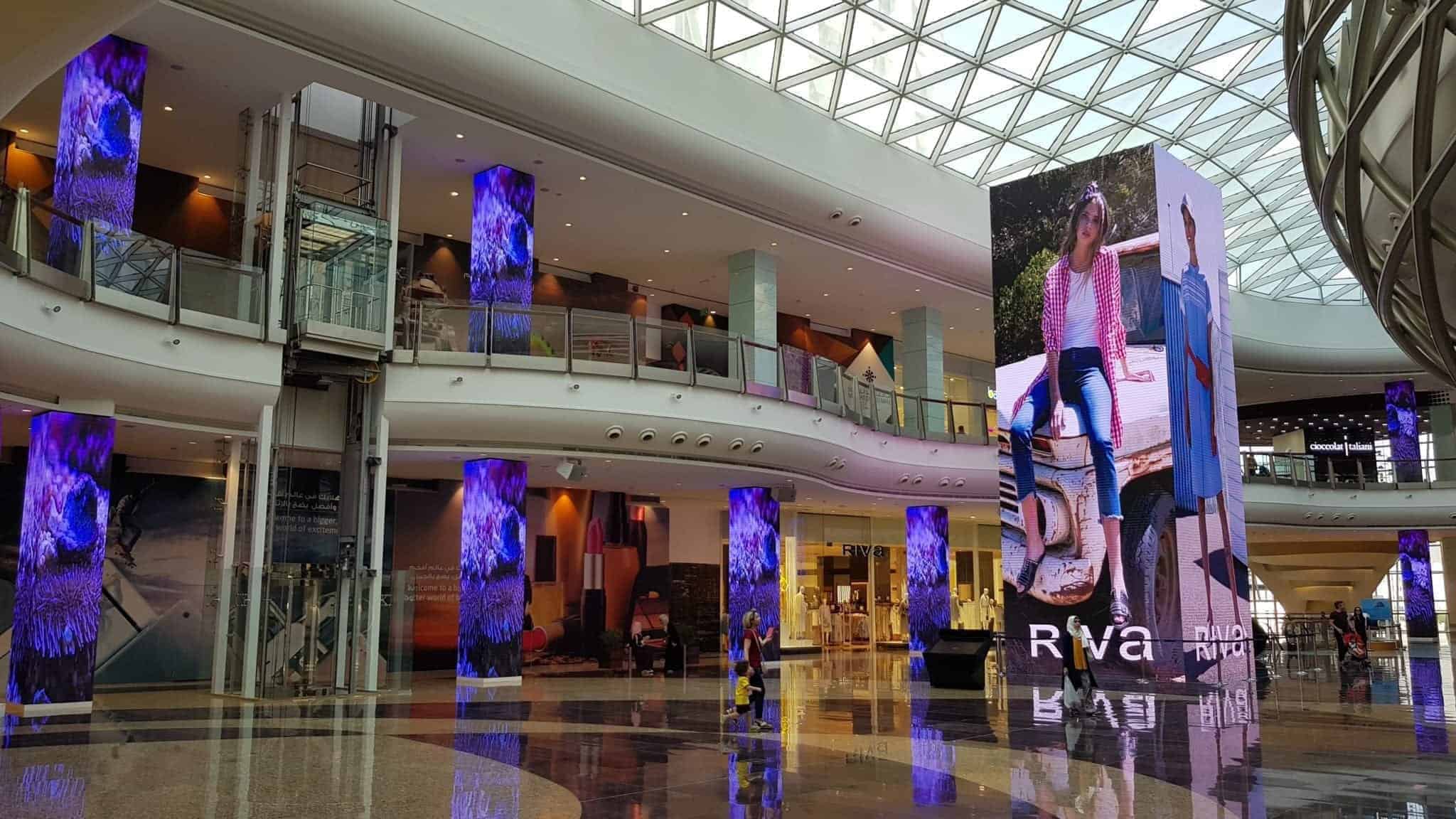
A shopping centre LED display is really three different products wearing the same name. The atrium wall is seen from across a void and from two floors up. The anchor store wall sits behind glass and fights daylight. The mall directory is read at arm’s length by someone looking for the toilets. Each needs its own pixel pitch, brightness and cabinet, and the mistake we see most often is one specification pushed across all three positions.
This guide takes each position in turn, with our Muscat Grand Mall atrium project as the worked example, and sets out what a centre manager, landlord or fit-out contractor should settle before anyone prices a screen.
Key takeaways
- Decide the viewing position first. A 3.9 mm pitch suits a tower viewed across an atrium. A 1.9 mm pitch suits a directory read at close range.
- Fixed installs use our DX Series at 2.6 mm and coarser, DIT Pro at 1.9 mm, and DVO for any face exposed to weather. Rental cabinets are not the tool for a permanent mall screen.
- Brightness is set by the light falling on the screen, and the picture still has to look right when dimmed for evening trading.
- Four-sided towers and wrapped columns work when the cabinet turns a true right-angle corner and the content is mapped as one canvas.
- Installing in a trading centre means night shifts, CDM 2015 duties and the fire engineer’s sign-off. Settle these before the steel is ordered.
At a glance: Muscat Grand Mall atrium project
| Item | Detail |
|---|---|
| Venue | Muscat Grand Mall, Oman |
| Main tower | Four-sided LED tower, each face 13.06 m high by 4.608 m wide |
| Pixel pitch | 4 mm on the tower and columns; one 20 mm outdoor display |
| LED area | 263 m² across the tower, more than 16.5 million pixels |
| Columns | Ten four-sided LED columns, 4.608 m tall with 1.024 m faces |
| Floor surround | 5.6 m by 1.2 m LED floor at the tower base |
| Interaction | iOS and Android apps, two docking stations, wayfinding sensors |
| Scope | Design, supply, installation and content integration by Dynamo |
Full detail is in the Muscat Grand Mall case study.
Choosing the pitch for a shopping centre LED display
The closest regular viewing point sets the pixel pitch. A workable rule of thumb is that the pitch in millimetres is roughly the minimum comfortable viewing distance in metres. In a mall the positions fall into three bands:
- Atrium walls and towers. The nearest viewer is across the void or on a balcony. 2.9 mm to 3.9 mm reads cleanly, and the saving on a 200 m² structure is large compared with a finer pitch nobody can resolve.
- Anchor store walls and shopfronts. Viewed from the concourse through glass, then from inside at a few metres. 1.9 mm to 2.6 mm covers both.
- Directories, totems and wrapped columns. Shoppers stand within a metre of these. Nothing coarser than 1.9 mm, and the surface has to survive bags, trolleys and pushchairs.
The rule of thumb gets you to a shortlist. It does not tell you whether a crowded directory is readable, so we ask for a sample with the smallest text the screen must carry and view it at the real resolution and distance. The budget trade-offs between pitch, size and cabinet type are in our retail LED display buying guide.
Product routing for fixed installs
- DX Series at 2.6 mm and coarser. Our mid-range fixed-install cabinet for atrium towers and columns. The datasheet rates the standard cabinets at 800 nits or more, they are front serviced, and they support right-angle installation, which is why they suit wrapped structures.
- DIT Pro at 1.9 mm. A slim fixed-install cabinet with a resin-protected (GOB) module surface and magnetic front-service modules. Our default for directories, in-store walls and anything a shopper can reach.
- DFC where a premium fine-pitch brand wall is specified.
- DVO for anything weather-exposed, such as a screen over a car park entrance. Pitch is coarser because the viewing distance is tens of metres; at Muscat the outdoor display is 20 mm. An external screen in the UK almost always needs advertisement consent, set out in the government’s outdoor advertisements and signs guide, so allow for the application in the programme.
We do not put our DRE rental cabinets into a fixed mall install. They are built to be assembled and broken down weekly and lack the cable management a permanent fit-out needs.
Atrium walls and towers

The atrium is where the centre makes its statement, and where the structural and brightness questions are hardest.
At Muscat Grand Mall the brief was for the atrium to be the reason people visit, not the route between shops. The four faces of the tower are mapped as one canvas, so a globe or a photo mosaic wraps the corners rather than repeating on each side. What transfers to a UK atrium:
Structure comes before cabinets. A 13 m tower is a steel frame first and an LED display second. The frame is designed with the centre’s structural engineer for the complete installed assembly, not the cabinet weight alone.
Check the sightlines from every level. Balustrades hide the lower part of the image from upper floors. We plot the main viewing positions on plans and sections and keep the headline inside the area visible from all of them, and never across a tower corner.
Corners need right-angle returns. A wrapped column or four-sided tower only works if the cabinet turns a true 90-degree corner without a dark seam. Not every fixed-install cabinet can, so check before the architect draws a wrapped column into the scheme.
Glazed roofs change the brightness requirement. Most UK atriums have a glazed roof or a large rooflight, and on a bright day the top of the void is closer to outdoor light than to an office lobby. Standard DX cabinets at 800 nits or more are comfortable in a controlled-light atrium. Under direct daylight you want the DX HB variants, rated at 3,000 nits or more. Then check the other end: view dark backgrounds and gradients at the dimmed evening setting, not just the demo reel at full output. Our post on indoor LED brightness for lobbies and receptions explains how to read a nits figure against the light you actually have.
For the build-up of an atrium face into a full LED video wall, see our LED video walls page.
Anchor stores and shopfronts
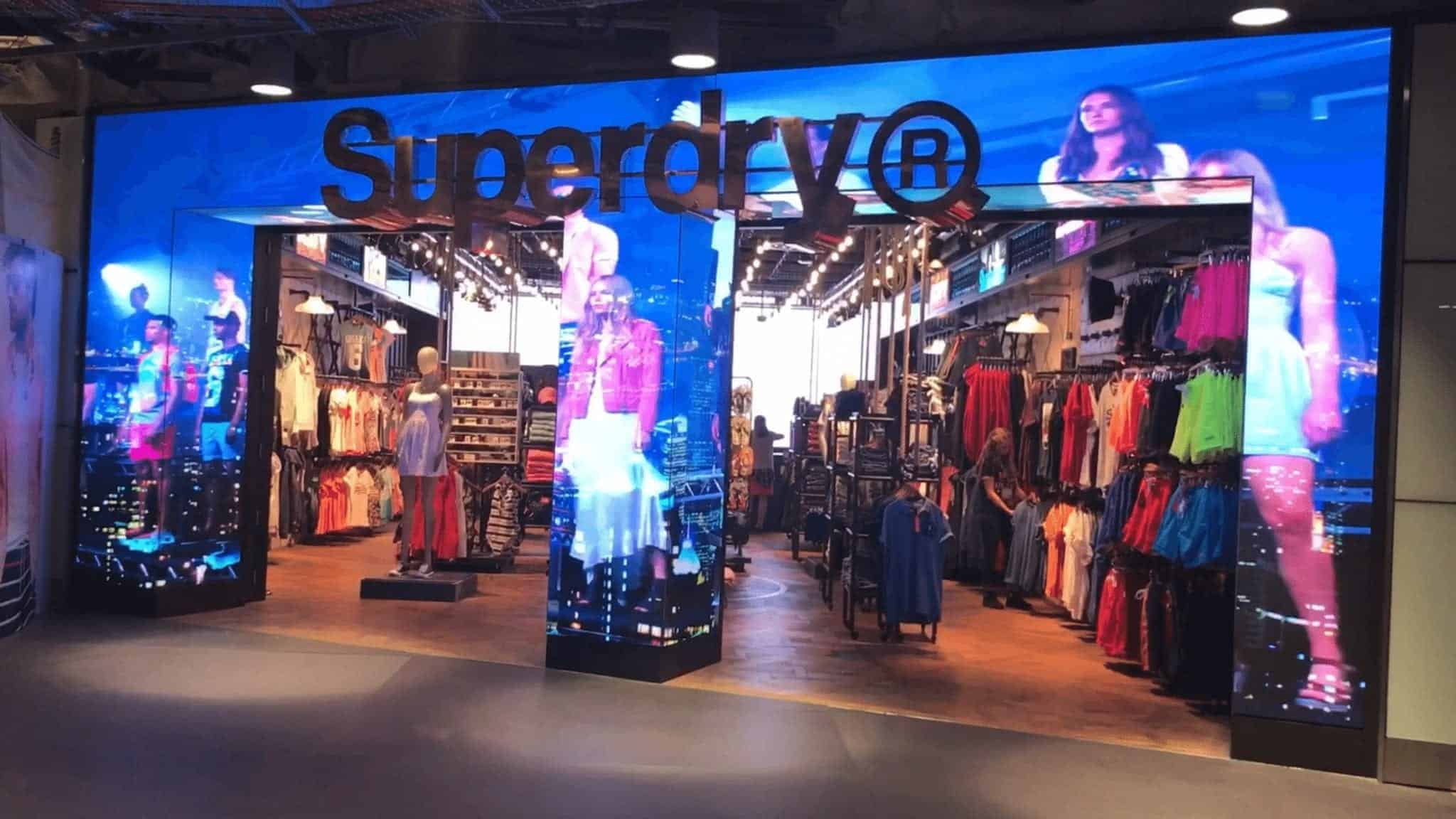
An anchor store wall has two audiences. From the concourse it is a shopfront, competing with the glazing and the mall lighting. From inside, it is a brand wall viewed at a few metres by someone queuing at the till.
The spec that satisfies both is usually 1.9 mm or 2.6 mm at a brightness well above standard indoor, because shopfront glass reflects the mall’s own lighting back into the screen. Where the wall faces the window directly, we specify DX HB. Deeper in the store, DIT Pro at 1.9 mm gives the finer image a fashion or beauty retailer wants at close range.
There is a third option for the window itself. A transparent LED mesh on the inside of the glazing keeps the view into the shop while running moving content at the concourse, but the content has to work against whatever is behind it: a large logo reads, small text over a busy shop interior does not. Our transparent LED retail window strategy post covers when it works and when it does not.
The landlord usually controls anything visible from the mall, including brightness limits and content hours, so get that written into the tenant’s licence to alter before the screen is sized.
Mall directories and wayfinding
Directories are the screens shoppers actually touch, read at arm’s length, often in portrait, and they take a beating.
For these we specify DIT Pro at 1.9 mm, and the resin-protected GOB surface is the reason. A standard SMD module has exposed LED packages that chip when knocked. A GOB module seals the LEDs under a hard resin layer, so a directory in a busy concourse keeps its picture after a year of contact. Magnetic front-service modules mean a damaged module swaps out from the front in minutes.
The layout matters as much as the hardware. A directory must let someone make a decision without waiting for an advert to finish, so the map, floor reference and destination list sit in a persistent area and any promotional space is clearly separate. Test the longest store names and the accessible routes, not a clean demonstration screen, and agree who updates tenant moves and temporary closures before handover.
If airtime on the directories or the atrium wall is going to be sold, our LED advertising screen page covers the scheduling, proof-of-play and revenue-share questions a landlord’s commercial team will ask. One point to settle early: playback logs prove the content ran, not that anyone looked at it, so keep centre footfall and screen impressions as separate numbers.
Planning a shopping centre screen? See how atrium, shopfront and directory screens have been built on our project portfolio, or contact us with the viewing positions and a plan and we will come back with a pitch and cabinet recommendation. Call +44 (0)203 489 9878.
Installing a shopping centre LED display while the centre trades
A shopping centre does not close for a fit-out. The install has to work around trading hours and the public walking underneath the work.
Night working. Most installs happen between close and open, in short shifts that each leave the area safe for trading. We hang the frame and power first and the modules last.
Work at height. The centre will expect a method statement that follows the Health and Safety Executive’s work at height guidance, with access equipment agreed in advance. Scissor lifts on a polished concourse need floor-loading checks, and many atriums need a tower scaffold instead.
CDM 2015. Any project with more than one contractor on site falls under the Construction (Design and Management) Regulations 2015, so a principal designer and principal contractor are appointed. The LED supplier is rarely the principal contractor on a tower install, so agree early who is.
Fire safety sign-off. A large LED structure in an atrium changes the fire load and may sit in an escape route or a smoke reservoir. The centre’s fire engineer will check the proposal against Approved Document B and the building’s fire strategy. Cabinet material certificates and cable specifications are the documents they ask for first.
Power, data and maintenance access. Dedicated supplies, isolation points the facilities team can reach, and a cabled data route from the processor rack all have to be designed in. So does the maintenance route: front-service modules do not remove the need for a safe place to stand, so show the access equipment on the drawings before the finishes are approved.
Content, control and who holds the keys
A mall screen is rarely controlled by one party. The landlord sells airtime on the atrium wall, tenants want their promotions on the directories, and security needs an override for emergencies.
On the processing side we specify Novastar controllers for most fixed installs, with Brompton where the content is broadcast-grade or the wall is used for live camera work. On the software side, the centre needs a content management system with role-based access: the commercial team schedules paid campaigns, tenants submit content for approval, and security holds an override that takes every screen at once. At handover we check playback, the brightness schedule and recovery after a power cut, then train the operators. A screen nobody can update becomes wallpaper within a month.
From the field
I get asked for “a big screen in the atrium” more than any other single request from centre managers, and my first question is always the same: where will people be standing when they look at it? Half the time the honest answer is “on the escalator and from the food court balcony”, which puts the nearest viewer 6 m away and means 3.9 mm is plenty. The other half, the brief includes a wrapped column by the main entrance that shoppers pass at arm’s length, and that one needs 1.9 mm and a surface that survives being touched. Either way I want to see the directory artwork before I agree a pitch, because a long shop name on a small floor label tells me more than any brand film.
Muscat taught me that the structure, the content mapping and the install programme are the hard parts. The LED was the easy decision once we knew the viewing distances. I would rather spend an hour on site with the structural engineer and the fire engineer before quoting than find a smoke reservoir problem after the steel is ordered.
Shopping centre LED display: frequently asked questions
What pixel pitch does a shopping centre LED display need?
Between 1.9 mm and 3.9 mm, set by the nearest regular viewing point. Atrium walls and towers seen from across a void or from balconies work at 2.9 mm to 3.9 mm. Anchor store walls viewed through glass and from inside suit 1.9 mm to 2.6 mm. Directories and wrapped columns that shoppers stand next to need 1.9 mm.
How bright does an atrium LED screen need to be?
Standard fixed-install cabinets such as our DX Series, rated at 800 nits or more, suit a controlled-light atrium. Under a glazed roof in direct daylight, or facing a shopfront window, the DX HB variants at 3,000 nits or more are the right choice. Specify the dimmed evening level as well as the peak, and check dark content at both settings.
Can an LED screen wrap around a column or form a four-sided tower?
Yes, provided the cabinet supports right-angle returns and the content is mapped as a single canvas. At Muscat Grand Mall we built a four-sided tower with faces 13.06 m by 4.608 m and ten four-sided columns, all at 4 mm pitch, so the picture turns each corner without a dark seam. Design the service route before the column cladding is closed.
Can the screen be installed and maintained while the centre is open?
Yes. Installation runs between close and open in short night shifts, with the frame and power first and the modules last so the area reopens each morning. Maintenance on a front-serviced screen can happen during trading with an exclusion zone beneath the work. Anything needing a lift or scaffold on the concourse goes into an out-of-hours slot agreed at design stage.
How much does a shopping centre LED display cost?
The pitch, the area and the supporting works drive it. A 1.9 mm DIT Pro directory costs more per square metre than a 3.9 mm DX atrium tower, but the tower carries far more steelwork, electrical work and night-shift labour. Compare proposals on the same installed scope, and use our LED screen configurator for a first-pass size and budget before a survey fixes the install scope.
Conclusion
The atrium wall, the anchor store and the directory are three different briefs. Settle the viewing position for each, pick the pitch from that, then set the brightness from the light actually falling on the screen. Route the product by pitch and exposure, and get the structural, fire and landlord conversations done before the steel is ordered.
If you are specifying a shopping centre LED display for an atrium, a shopfront or a wayfinding totem, send us the viewing positions and a plan and we will recommend a pitch, cabinet and install programme. Call +44 (0)203 489 9878 or contact us to start the conversation.