
Hotel lobby LED installations have moved from novelty to standard specification across new-build and refurbishment projects in the UK and internationally. Fine-pitch LED walls now appear in reception areas, lift lobbies, bar entrances, and lounge spaces — replacing LCD video walls and projection in most new hotel schemes.
Here is what hotel operators and interior designers are specifying in 2026 — from pixel pitch selection and mounting approaches to content strategy and processor choices. Whether you are fitting out a boutique property or upgrading a branded chain lobby, the trends here reflect real project briefs and delivered installations.
Key takeaways
- Fine-pitch LED (P1.2 to P2.5) is the default specification for hotel lobby video walls, replacing projection and LCD in most new schemes.
- Lobby installations increasingly favour flush-mounted or recessed builds that sit within architectural features rather than standing as separate display units.
- Operators are moving from one large feature wall to zoned approaches — reception backdrop, lift lobby wayfinding, bar promotion, and event welcome screens each treated as separate briefs.
- The UK hospitality sector is specifying fixed-install LED (Dynamo DFC Series and DX Series products) rather than repurposed rental stock for permanent lobby features.
- A hotel lobby LED wall without a 12-month content plan becomes a static poster with a high electricity bill.
At a Glance: Hotel Lobby LED Project Facts
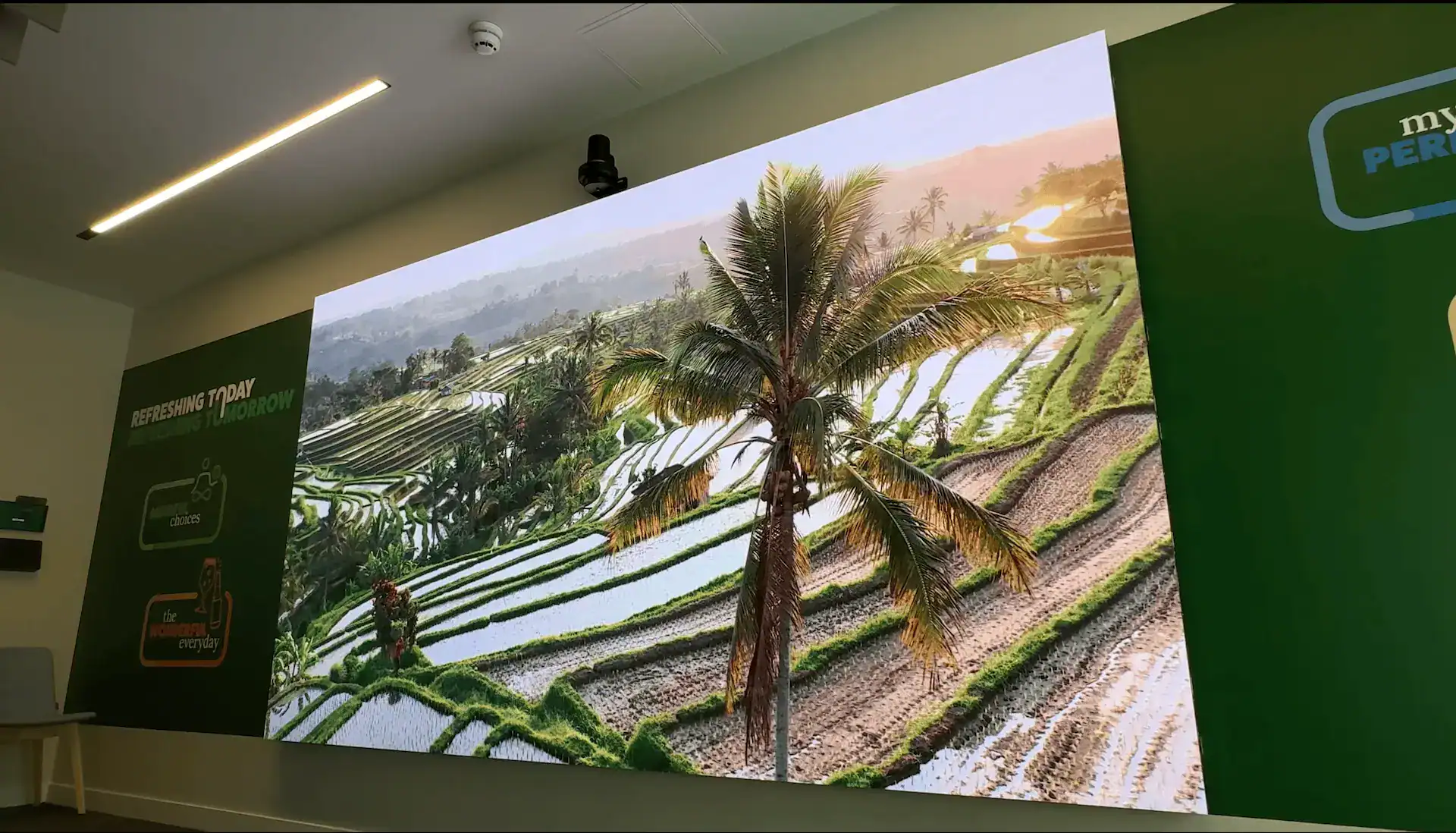
| Factor | Typical Specification |
|---|---|
| Pixel pitch range | P1.2 – P2.5 (viewing distances of 1.5 m to 6 m) |
| Panel type | Fixed-install (Dynamo DFC Series or DX Series) |
| Common aspect ratios | 16:9, ultra-wide (32:9), portrait, ribbon, and custom architectural formats |
| Mounting | Flush wall recess, freestanding feature wall, or ceiling-suspended |
| Processor | Brompton or Novastar |
| Brightness (lobby use) | 600–1,200 nits max, with automatic dimming to suit ambient conditions |
| Content refresh | Weekly to monthly, with real-time data feeds gaining ground |
| Typical project lead time | 8–14 weeks from sign-off to commissioning |
Why Hotels Are Moving to LED for Lobby Displays
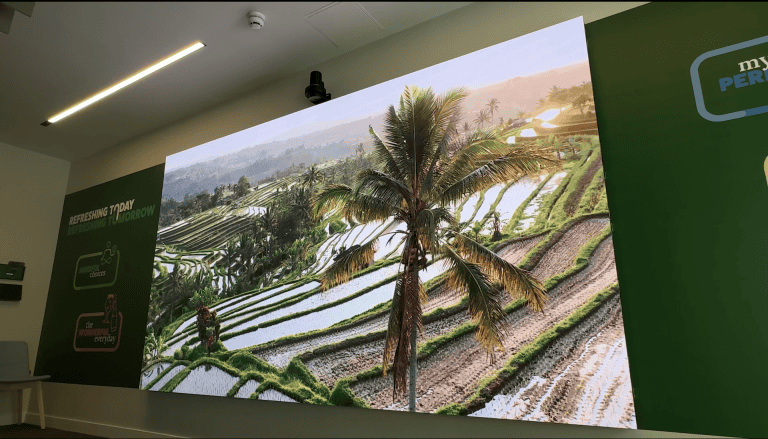
Hotels are choosing direct-view LED for lobby displays because LED eliminates the bezel seams visible at close range on LCD video walls, performs better at the low brightness levels (300–600 nits) that lobbies require, and delivers lower total cost of ownership across a 7–10 year fit-out cycle compared to LCD.
A fine-pitch video wall built from LED cabinets reads as a single continuous surface — no visible panel joins, even when guests stand a metre away. That matters in a reception context where people view the screen from close range and at wide angles.
Low-brightness performance has been the bigger shift. Hotel lobbies are not retail environments. They need screens that look natural at 300–600 nits, not washed out or flickering. Modern LED processors — particularly Brompton’s Tessera platform — handle low-brightness greyscale far better than older LED generations, which made them unsuitable for intimate spaces.
The upfront cost of LED is higher than LCD, but total cost of ownership tips in LED’s favour when measured over a full fit-out cycle. No lamp replacements, no bezel degradation, and lower power draw at equivalent brightness. For a detailed comparison of the specification differences that matter most, see our indoor LED displays guide.
Pixel Pitch Selection: What Hotels Are Actually Choosing
Pixel pitch is the single most discussed specification point on hotel lobby LED projects. Get it wrong and you either overspend on resolution the guest will never appreciate, or under-specify and end up with visible pixel structure at close viewing distances.
The rule is straightforward: match the pitch to the closest expected viewing distance.
| Nearest viewing point | Sensible pitch range |
|---|---|
| 1 to 2 metres | 1.2 mm to 1.5 mm |
| 2 to 4 metres | 1.5 mm to 1.9 mm |
| 4 to 6 metres | 1.9 mm to 2.6 mm |
| 6 metres plus | 2.6 mm and above may be acceptable |
The Dynamo DFC Series (flip-chip COB: DFC 1.5 at 1.58 mm and DFC 1.9 at 1.9 mm) covers the premium end of this range, designed specifically for permanent installations where image quality at close range is non-negotiable. For mid-range hotel projects where budget discipline is tighter, the Dynamo DX Series (SMD, P1.9–P2.5) offers a fixed-install cabinet format at a lower price point.
One trend worth noting: operators are increasingly requesting dual-zone lobbies. A high-resolution feature panel (P1.2 or P1.5) sits behind the reception desk, while a larger, wider-pitch display (P2.0 to P2.5) runs along a corridor wall or above a seating area. This lets the budget work harder by putting the finest pitch where guests are closest.
The cost difference goes beyond the panel price. Finer pitch means more pixels, more processing power, and more care during installation. It can also expose weak content — a high-resolution canvas with poorly prepared graphics does not improve the guest experience.
From Single Screens to Zoned Guest Journeys
The classic reception LED wall is still common, but hotel operators are now asking for multiple smaller LED moments across the lobby. On several hotel briefs we received in the first half of 2026, all specified at least two separate LED zones — a pattern we rarely saw before 2024. Typical lobby zones include reception backdrops, concierge or lift lobby wayfinding, event welcome screens, bar and restaurant promotion, narrow LED ribbons above joinery, and digital art walls in lounge spaces.
This zoned approach changes the hospitality AV design process. A 6-metre-wide wall behind reception may need premium colour handling and near-silent operation, while a portrait display near a meeting room entrance may need fast scheduling and clear text at close range. One LED display may carry brand atmosphere. Another may carry operational information that changes five times a day.
For operators planning several guest-facing digital signage areas, we recommend mapping the content types before choosing screen sizes. A lobby wall is part of the interior finish — it needs to relate to stone, timber, metalwork, reception desk height, sightlines, and lighting scenes. The display should not feel like a black rectangle added after the fit-out was finished.
LED ceiling tiles are appearing in lobby designs as accent features — a strip of LED through a coffered ceiling, or a full canopy over a seating area. These require careful structural engineering and thermal management but deliver a visual effect that no other technology can match.
Content Strategy Is Driving the Specification
A hotel lobby LED wall without a 12-month content plan becomes a static poster with a high electricity bill. That is the single most common mistake we see on hospitality projects — the screen is well specified but nobody has planned what it will show in month three, let alone month nine.
A practical content plan covers quarterly themes (seasonal campaigns, local events, brand refreshes), a dayparting calendar (ambient visuals in the morning, event welcome boards in the afternoon, bar promotion in the evening), refresh cadence per zone, and an asset pipeline so new content is sized, approved, and loaded without delay.
Designers and brand teams are now arriving at the specification stage with content concepts already developed — mood films, data-driven welcome boards, locally sourced art programmes, real-time weather and transport feeds. The display specification then follows the content.
The most common content mistake in hotel lobbies is treating the display like a trade show screen. Fast cuts, high contrast animation, and constant movement may catch attention for ten seconds, but they become tiring in a reception space.
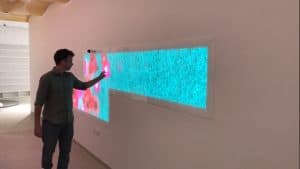
Aspect ratio freedom is one of LED’s strengths in hotels. Ultra-wide formats work well as ribbon displays above reception desks. Portrait-format columns flanking a lift lobby create visual framing. LED’s modular cabinet system makes non-standard formats straightforward.
Brightness control matters across the day. Operators are specifying auto-dimming via ambient light sensors integrated with the processor, so the screen never looks too bright at night or too washed out during the day. The Chartered Institution of Building Services Engineers publishes lighting design guidance that helps engineers set appropriate brightness limits when LED forms part of a wider interior scheme.
Colour accuracy rounds out the specification. Brand-managed hotels need displays that reproduce their exact brand palette. Novastar’s COEX colour management and Brompton’s extended colour gamut mode give commissioning engineers the tools to lock colours to brand guidelines during calibration.
The Wall Build-Up Is Part of the LED Specification
The most visible trend in hotel lobby LED is the move away from surface-mounted screens toward fully integrated architectural features. Operators and designers want the LED surface to feel like part of the building, not an afterthought.
Flush recessed mounts are now the most common brief. The LED cabinets sit within a prepared niche, with the front face flush to the surrounding wall finish. This requires coordination between the LED supplier, main contractor, and interior designer at an early stage — typically RIBA Stage 3 or 4 — to get the structural opening, power, data, and ventilation right.
Front-service cabinets are usually the sensible route in hotel lobbies because rear access is rarely available once the wall is finished. Before anyone signs off the display size, the specification needs to answer: is there enough wall depth for the cabinet and tolerance? Can modules be front-serviced without damaging surrounding finishes? How will heat leave the wall cavity?
LED cabinets generate heat during operation and require adequate airflow behind the display surface. For recessed installations, this means designing a ventilation path within the wall cavity — either passive convection slots or active ducted extraction. The thermal design should be part of the specification from RIBA Stage 3, not an afterthought.
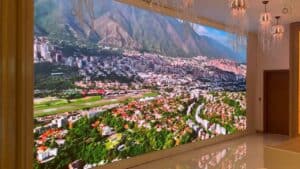
For projects moving from concept to delivery, our LED screen installation guidance explains the site factors that affect programme, access, and handover. Our 24 m² lobby feature wall at Hotel Londres in Caracas is one example of a fine-pitch reception installation delivered as an integrated architectural feature, and you can see more completed hotel schemes in our project portfolio.
Planning a hotel lobby LED installation? Our hotel and hospitality portfolio includes completed schemes across several property types, and our team can walk you through pixel pitch selection, mounting options, and content planning. Use our LED screen configurator to start framing the early size and format discussion.
Screens That Staff Can Actually Run
A lobby LED wall can be well specified and still fail operationally if the hotel team cannot manage it. The people who use the system are not always AV specialists — they may be front office managers, marketing teams, events coordinators, or duty managers.
We recommend agreeing these points before installation: who can change content? What content plays if a feed fails? Can the events team update names and timings without editing video files? Are there different playlists for weekday, weekend, and event modes? What happens if a module is damaged?
The aftercare model should be agreed with the same care as the pitch. A lobby wall is highly visible. If one module is out, guests and staff will see it. Spare modules, access method, response expectations, and remote support all need to be clear from the start. LED display lifespan and maintenance is now a formal line item in hospitality procurement — operators want to understand the full service commitment, not just the day-one specification.
From the Field
Daniel Reynolds, Managing Director, Dynamo LED Displays
I spend a lot of time asking where the guest will stand, not just where the screen will go. My concern is usually the first three metres in front of reception: suitcases, queues, check-in desks, staff sightlines, and the moment when someone needs to read a name or direction quickly.
I would rather reduce the wall by 300 mm and make the service access right than build a larger screen that becomes difficult to maintain. The projects I find most satisfying are the ones where we get involved early — during concept design rather than after the walls are built. When we can coordinate the structural niche, the ventilation path, and the power supply from the start, the finished result looks like it was always meant to be there. If you are working on a hospitality scheme and want to talk through the options, you can see projects like these in our portfolio or get in touch directly.
Hotel Lobby LED: Frequently Asked Questions
What pixel pitch is right for a hotel lobby LED wall?
For hotel lobbies where guests stand within 2 metres, specify P1.2 to P1.5. For primary viewing distances of 4 metres or more, P1.9 to P2.6 delivers the right balance of resolution and cost. The correct pitch depends on distance, content detail, brightness, and budget — going finer than needed adds cost without visible benefit.
How bright should a hotel lobby LED screen be?
Most indoor hotel lobby LED displays are specified around 600 to 1,200 nits, but control matters as much as the headline number. A screen facing daylight may need more output during the day, while an evening lounge setting needs lower brightness. Processors with advanced greyscale handling (such as Brompton’s PureTone) prevent banding and colour shift at reduced levels. Scheduled dimming or sensor-led control helps the screen suit the room rather than overpower it.
Can LED displays be flush-mounted into a hotel wall?
Yes, and this is now the most common installation method for hotel lobbies. The LED cabinets sit within a prepared structural niche, with the front face flush to the surrounding wall finish. This requires early coordination between the LED supplier, main contractor, and interior designer to ensure the opening dimensions, power, data, and ventilation are all accounted for.
Should a hotel choose one large LED wall or several smaller displays?
It depends on the guest journey. One large hotel lobby LED wall can work well for brand impact and atmosphere. Several smaller displays may be better for wayfinding, event schedules, lift lobby information, and F&B promotion. Many hotels now use a mixed approach, with one main architectural LED feature supported by smaller operational screens at key decision points.
What content works well on hotel lobby LED?
Slow brand films, local destination visuals, digital art, event welcomes, wayfinding, and dayparted promotional content usually work better than fast advertising loops. Text must be large enough to read at the real viewing distance. Hotels should plan templates, approval routes, and fallback content before launch — a 12-month content calendar with quarterly themes and refresh milestones keeps the screen earning its place.
How long does a hotel lobby LED installation last?
A well-specified hotel lobby LED wall has a rated lifespan of 100,000 hours to half-brightness. In a lobby running 16–18 hours a day, that translates to roughly 15–17 years before the display reaches half its original brightness. Individual modules can be swapped without replacing the entire wall, and front-service cabinet designs make that straightforward. All Dynamo installations include a 3-year return-to-base warranty as standard, with extended service agreements available.
How is a fixed hotel lobby LED wall maintained?
Most lobby walls use front-service cabinets so modules and internal components can be accessed from the room side without a rear maintenance corridor. The design should include safe access, spare modules, documented settings, remote support options, and a clear process for reporting visible faults. The maintenance strategy should be agreed at specification stage, not after handover.
Do hotel lobby LED screens need special ventilation?
LED cabinets generate heat during operation and require adequate airflow behind the display surface. For recessed installations, this means designing a ventilation path within the wall cavity — either passive convection slots at top and bottom or active ducted extraction. The thermal design should be part of the specification from RIBA Stage 3, not an afterthought.
Conclusion
Hotel lobby LED specification in 2026 is defined by architectural integration, content-first thinking, and a clear shift toward fine-pitch fixed-install products. The operators getting the strongest results are those who bring their LED supplier into the design conversation early, match pixel pitch to actual viewing distances, treat the display as an architectural element rather than a bolted-on screen, and plan content ownership from day one. A hotel lobby LED wall is not a one-off AV purchase — it is a guest-facing communication channel that needs a content calendar, trained staff, sensible templates, and a maintenance route.
To discuss your hotel lobby LED project, call us on +44 (0)203 489 9878 or get in touch through our contact page. You can also explore completed hospitality projects in our hotel and hospitality portfolio.