
Transparent LED retail windows fix something standard screens get wrong: they turn glass into a programmable media surface without blocking the view into the store. For retailers weighing up a window display upgrade, the question is not whether LED works — it is whether you need shoppers to see through it.
A solid LED wall gives more visual density and stronger image control. A transparent LED panel protects sightlines, daylight and merchandising space, but it asks more of the content, pitch selection and installation plan. If the window is part of the sales journey — not just an advertising surface — transparent LED is often the more sensible route.
Key Takeaways
- Transparent LED panels maintain high light transmission through retail glass while delivering content bright enough to compete with direct sunlight — typically 3,500–6,000 nits for street-facing windows.
- Pixel pitches between 3.9 mm and 10 mm suit most retail window viewing distances, with the right choice driven by where the customer stands, not by panel size alone.
- Content designed for transparency — high contrast, bold graphics, negative space — outperforms repurposed TV-format material every time.
- Transparent LED panels mount behind existing glass on interior rails, meaning no structural glazing changes and no loss of window display space.
- For fixed retail windows, this is a permanent install brief, not a rental screen brief — product-line selection matters.
At a Glance: Transparent LED Retail Window Project Facts
| Decision Point | Typical Range | Why It Matters |
|---|---|---|
| Common viewing distance | 3–15 metres | Drives pixel pitch and whether text reads cleanly |
| Pixel pitch range | 3.9 mm – 10 mm | Finer pitch improves detail but usually reduces transparency and increases cost |
| Transparency | 50–93% depending on pitch and product | Higher transparency preserves the window display; lower transparency gives denser image coverage |
| Brightness | 3,500–6,000 nits for street-facing glass | Daylight and reflections wash out weak content quickly |
| Mounting position | Behind the glass, interior face | Keeps hardware protected and simplifies access |
| Content style | High contrast, large type, motion-led creative | Transparent LED panels do not suit small copy or heavy detail at short distances |
| Service access | Front or rear depending on frame and shop layout | A screen that cannot be serviced without dismantling joinery becomes expensive later |
Transparent LED or a Solid Shopfront LED Wall?
Choose transparent LED when the store window must stay visible — daylight, product displays or landlord rules require see-through. Choose a solid shopfront LED wall or a full LED video wall when the screen is the primary advertising surface and view-through has no commercial value.
A retail window has two audiences — shoppers outside on the pavement, and customers inside the store — and it has to serve both at the same time. Block the window with an opaque screen and you gain a media surface but lose everything the window was doing: drawing people in with product displays, letting daylight flood the shop floor, giving passers-by a reason to stop and look.
That trade-off is why we see more transparent LED panel briefs from retail than from any other sector we work in. A transparent LED panel mounted behind the glass lets you run promotional content, seasonal campaigns and brand messaging on the window surface while keeping the store interior visible.
The effect works because of how transparent LED handles dark content. Any pixel displaying black is effectively invisible — light passes straight through. Content designers use negative space as part of the design, letting the physical window display show through the gaps in the digital content.
We lean towards transparent LED when at least two of these are true:
- The store wants daylight to pass through the window.
- Products or interior design behind the glass need to remain visible.
- The landlord or centre management dislikes blocked shopfronts.
- The brand wants motion content without making the entrance feel closed.
We lean towards a solid LED wall when:
- The screen is the main advertising surface and view-through is not needed.
- The content includes fine text, detailed product photography or offer-heavy layouts.
- The audience is within 2–3 metres and needs sharp image quality.
If none of the transparency conditions apply, a solid screen is simpler, cheaper and higher resolution. There is no point paying for transparency you do not need.
Pixel Pitch and Viewing Distance: Where Transparent LED Retail Windows Succeed or Fail
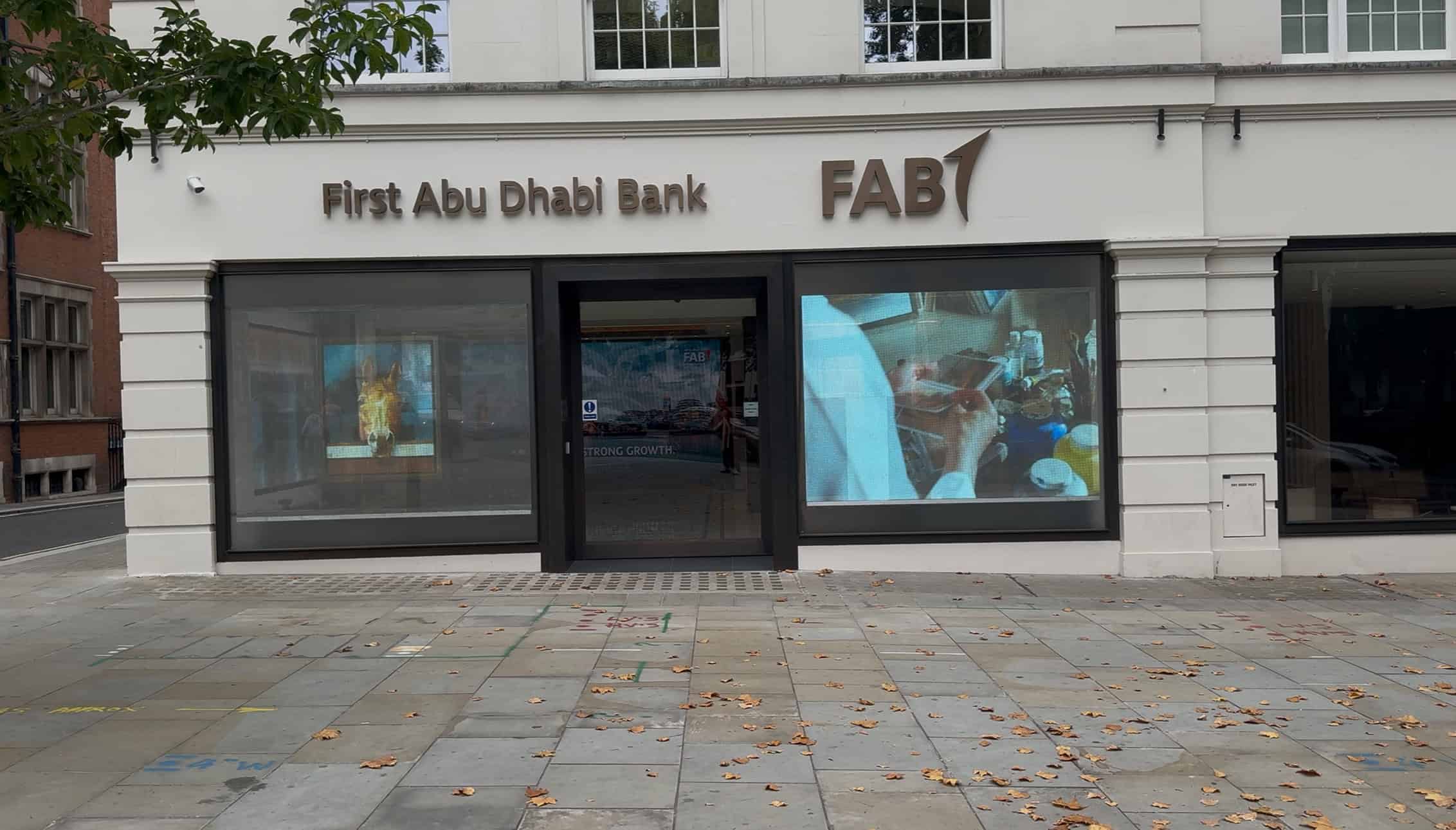
Pixel pitch — the distance between LED clusters — is the single most important spec decision for a retail window installation. Get it wrong and you either overspend on resolution nobody can see, or end up with content that looks coarse from the pavement.
With transparent LED panels, pitch also affects the amount of open space in the display. A finer pitch gives more image detail but increases LED density, reduces transparency and raises cost. A coarser pitch improves openness but will struggle with small text at close range.
| Main Audience Position | Pitch Discussion | Content Notes |
|---|---|---|
| 2–4 metres | Finer transparent pitch needed, or a solid LED wall may be the better route | Avoid small text; test logo legibility early |
| 4–8 metres | Mid-range transparent pitches work well for most high-street retail | Large type, motion graphics and product outlines read clearly |
| 8–15 metres | Coarser transparent pitches can be considered | Strong contrast and slower motion help recognition |
| Across a road | Brightness, scale and content simplicity matter more than fine detail | Treat it like outdoor-facing media, even if installed indoors |
The common mistake is choosing pitch from the shop drawing rather than from the customer’s eye line. A three-metre-wide screen in a narrow arcade is a different project from the same screen facing a broad pavement. The CAD elevation may look identical, but the viewing distance changes the spec entirely.
We also look at the height of the active area. A transparent LED panel installed from floor to ceiling may look impressive on a drawing, but the lower section can be blocked by people, fixtures or window vinyl. In many retail windows, the highest-value active zone is between roughly waist height and above head height. That is where a site survey earns its keep. Model your own window dimensions and pitch in the transparent LED displays.
Brightness: The Spec That Makes or Breaks a Window Installation
Standard indoor LED panels run at 600–1,500 nits. That is fine for a reception area, but retail windows face ambient light levels of 10,000+ lux on a bright day. Transparent LED panels built for retail window advertising need 3,500–6,000 nits to remain legible in direct sunlight.
A transparent LED panel behind glass has to compete with daylight, reflections and the brightness of the shop interior. If the glass reflects the sky, passing traffic or bright paving, the panel may need more output than the same screen in a shaded mall.
Brightness and power draw are directly linked. Running a high-output panel at full brightness continuously increases electricity costs and heat build-up. In practice, most retail content does not need maximum brightness all day — scheduling brightness levels to match daylight hours keeps running costs sensible and extends LED lifespan.
Creative has a large effect on perceived brightness. High contrast between subject and background, large type with generous spacing, and darker backgrounds where the product allows it — these choices can make a moderately bright panel read more clearly than a brighter one running low-contrast content.
Mounting Behind Glass: What We Check Before We Price
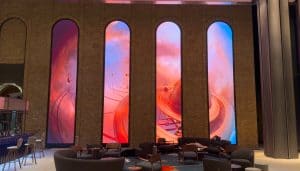
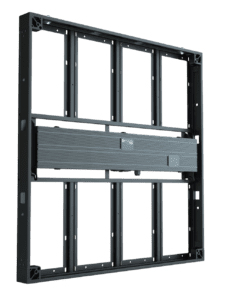
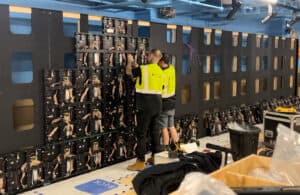
Transparent LED panels are lighter and shallower than standard LED cabinets. They mount on rails fixed to the window frame or the ceiling void, hanging behind the existing glass on the interior face. The glass provides weather protection. The panels sit a few centimetres back from the glass surface, allowing air circulation for passive cooling. Where the screen has to face the weather on a building rather than sit behind shop glass, a cabinet-based system is used instead, as on the transparent LED display Dynamo fitted to MOL Campus in Budapest.
The main checks on a site survey:
- Glass dimensions and the active display area.
- Fixing points above, below and beside the window.
- Cable routes to power and data.
- Ventilation and heat build-up behind the glass.
- Access for cleaning both the glass and the LED face.
- Landlord rules on fixing into the base build.
Cable presentation matters in transparent installs because there is nowhere to hide poor routing. Power and data routes need to be designed as part of the finished shopfront, not solved on the final day.
Front serviceability is worth insisting on. If an LED module fails, a technician should be able to replace it from inside the store without scaffolding, without removing the glass and without closing the shop. We would rather agree a slightly more visible service route at design stage than leave the retailer with an awkward maintenance issue later.
Content Strategy: Design for See-Through, Not for a Wall
The single most common mistake we see with transparent LED retail windows is running content designed for a normal screen. A 16:9 product video with a white background looks terrible on a transparent LED panel — the white areas glow as solid blocks, killing the transparency effect.
The screen has open space by design, and the background behind it becomes part of the picture. A trainer, handbag or watch behind the glass can sit inside the digital layer. Motion graphics can frame the product rather than cover it. Seasonal colour can change without rebuilding the window.
The design rules are simple but strict:
- Dark backgrounds become invisible. Any area displaying black lets the store interior show through. Design with black or very dark backgrounds and let the physical window display do the rest.
- Bold, high-contrast graphics read from distance. Thin fonts, pastel colours and fine detail get lost. Strong colours, thick typography and simple motion catch the eye from across the street.
- Keep messages short. Large type with generous spacing. Avoid thin strokes and small legal copy.
- Animation draws attention without overwhelming. Subtle motion — a price sliding in, a logo pulsing — performs better than full-screen video.
- Build day and night versions. After the store closes, the transparent LED panel may become the brightest element in the street. Harsh full-white loops at night annoy neighbours and centre management. Schedule brightness and content accordingly.
- Leave intentional gaps where key products sit behind the glass. Let the physical merchandise become part of the composition.
For retailers already running transparent LED displays as part of wider visual merchandising, integrating content scheduling with window-change calendars keeps the digital and physical layers working together.
Planning a transparent LED retail window? Use our transparent LED retail displays to model the window size, pitch, mounting method and viewing distance — then talk to us about the install.
How Much Does Transparent LED Cost for a Retail Window?
A single-bay high-street transparent LED retail window typically falls between £8,000 and £25,000 depending on pitch, area and control hardware. Multi-bay department store frontages scale from there. Area matters, but the specification can shift quickly depending on pitch, transparency, mounting and control.
| Cost Driver | Why It Changes the Price |
|---|---|
| Pixel pitch | Finer pitch increases LED density, processing demand and product cost |
| Active area | Larger screens need more modules, power, structure and installation time |
| Transparency level | Higher transparency and finer detail can pull in different product formats |
| Mounting frame | Simple straight runs cost less than shaped, stepped or hidden structural work |
| Control system | Basic scheduled playback costs less than multi-site control and monitoring |
| Content adaptation | Existing wall creative may need redesign for transparent display |
A smaller screen with a fine pitch can cost more than a larger screen with a coarser pitch. The number of pixels and the engineering behind them often matter more than the outer dimensions.
For fixed retail windows, product-line selection matters. The Dynamo DFC series is our premium fixed-install transparent LED range, while Dynamo DX is the mid-range fixed-install option — both are purpose-built for permanent retail window use. The Dynamo DRE series is our rental line, designed for repeated assembly at events, and is not the right fit for a shopfront that needs to look clean and run reliably day after day.
We typically spec Novastar processing for single-window retail installs. For multi-bay frontages where tighter colour calibration across panels matters, Brompton is the stronger choice.
From the field
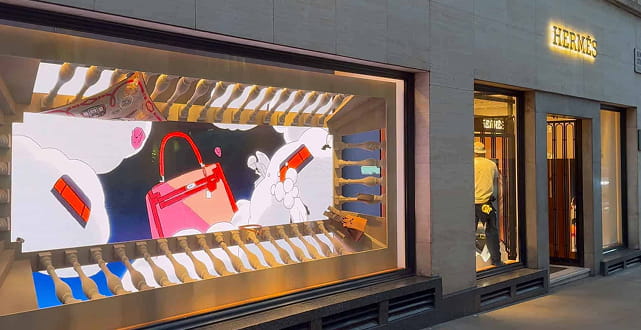
I look at transparent retail windows by standing where the customer stands, not by staring at the glass with a tape measure. A jeweller we worked with in central London had a 6-metre frontage that looked straightforward on the drawings, but from across the road — where most of their foot traffic actually came from — a coarser pitch would have done the job at half the cost. The same pitch can feel clean in one site and too coarse in another, and you only find that out by standing on the pavement.
I also ask what the retailer wants people to see behind the screen. A fashion retailer in the Trafford Centre used their transparent LED panels to frame mannequins with motion graphics — the digital content and the physical display worked as one composition. If there is nothing worth seeing behind the glass, I would rather say that early and look at a solid LED option instead of selling transparency for the sake of it. Bring your visual merchandiser into the conversation early, because they will have opinions about sightlines, and those opinions matter.
Transparent LED Retail Windows: Frequently Asked Questions
How much does transparent LED cost for a retail window?
A single-bay high-street window typically falls between £8,000 and £25,000 depending on pitch, active area and control hardware. Multi-bay or department store frontages scale from there. We quote on a per-project basis after a site survey. Use our transparent LED shopfront options to get an initial specification, then request a formal quote.
Can transparent LED be retrofitted to an existing shopfront?
Yes. Transparent LED panels mount behind the existing glass on interior rails or a secondary frame — no structural glazing changes needed. Power and data cabling are the main considerations, and these can usually be routed through ceiling voids or floor boxes. A retrofit on a standard retail window typically completes in a day or two.
Does transparent LED block natural light into the store?
A panel with high transparency lets through the majority of the daylight that would otherwise pass through the glass. The net effect is comparable to adding a light window tint. Most retailers report no noticeable difference to interior lighting levels, though this varies with the pitch and product format chosen.
Is transparent LED visible in direct sunlight?
With the right brightness specification, yes. Panels rated at 3,500–6,000 nits remain clearly legible in direct sunlight. Lower-brightness options work well for shaded or north-facing windows but can wash out on south-facing glass in summer. We always assess the window orientation and ambient light conditions during the site survey.
Can transparent LED show normal video content?
It can show video, but content designed for a solid LED shopfront often needs reworking. Transparent LED panels have open space, so fine detail, small copy and low-contrast footage lose impact. Large subjects, bold type, strong silhouettes and simple motion tend to work better. We recommend testing brand assets against the real background before approving the final screen format.
Conclusion
If there is something worth seeing behind the glass, go transparent. If the screen is the show, go solid. Get the match right and the display pays for itself in footfall and engagement. Get it wrong and you have an expensive tinted window.
The right answer depends on viewing distance, pitch, brightness, content and the value of the display behind the glass. Transparent LED retail windows add a digital layer without closing the shopfront. A conventional LED wall may be the better commercial choice when detailed advertising is the priority. Either way, the specification starts with a site survey, not a product catalogue.
If you are considering transparent LED retail windows for your store, we can help with site surveys, specification, content guidance and full installation. Call us on +44 (0)203 489 9878 or get in touch through our website to arrange a consultation. You can also use our LED Screen Configurator to start building your specification now.