Window advertising with LED screens means placing a high-brightness LED display behind a shop window so the shopfront shows moving content instead of printed posters. It works because window-class LED runs at roughly 3,000 to 5,000 nits and stays legible through glass in daylight, and because the content can be changed remotely in minutes.
Updated September 2026. Guide first published June 2024.
A shop window is the one advertising space a retailer already owns on the busiest street it trades on. Printed graphics use it once a season. An LED window screen uses it every hour the street is busy, and it can carry a different message at 8 am than at 8 pm. This guide covers what makes a window LED display work, the four ways retailers use them, how to specify one and what Dynamo has installed in London windows from Bond Street to the Emirates Stadium. For structural, built-in shopfront screens see our LED shopfront page; for the wider product range, the LED advertising screen page.
Key takeaways
- Brightness is the first specification. Window-facing screens need 3,000 nits or more; Dynamo’s Arsenal window screens run at 4,500 cd/m² and the Canada Goose windows were specified above 3,500 nits.
- Pixel pitch follows pavement distance. Shoppers stand one to three metres from the glass, so 2 mm to 3.9 mm is the working range, finer for luxury product detail.
- A window screen can earn as well as spend: retailers in high-footfall locations rent screen time to other advertisers on a revenue-share basis.
- Illuminated screens close to the glass can fall under advertisement control, so check the planning position before you order.
Why LED window displays outperform posters and TVs
Brightness through glass
Glass, reflections and daylight are what kill a window display. A consumer TV in a window is a black mirror by midday, and a backlit poster is fixed at one image. Window-class LED is built for the opposite condition: our DX Series high-brightness cabinets are rated at 3,000 nits or more, the DRE outdoor range above 3,500 nits and the DFA outdoor range at 4,000 to 8,000 cd/m², all from the product datasheets. Glass absorbs a share of that output, which is why we specify window screens brighter than an equivalent indoor wall; our shopfront versus window LED guide goes through the numbers.
Moving content
A window screen shows video, animation and live feeds, and the same screen can rotate promotions, product films and store information through the day. Eye-tracking aside, the practical effect is simple: a moving image on an otherwise static street gets looked at. Content is scheduled from a laptop or phone, so a price change or a last-minute promotion goes live in minutes rather than waiting for a print run.
Size and shape
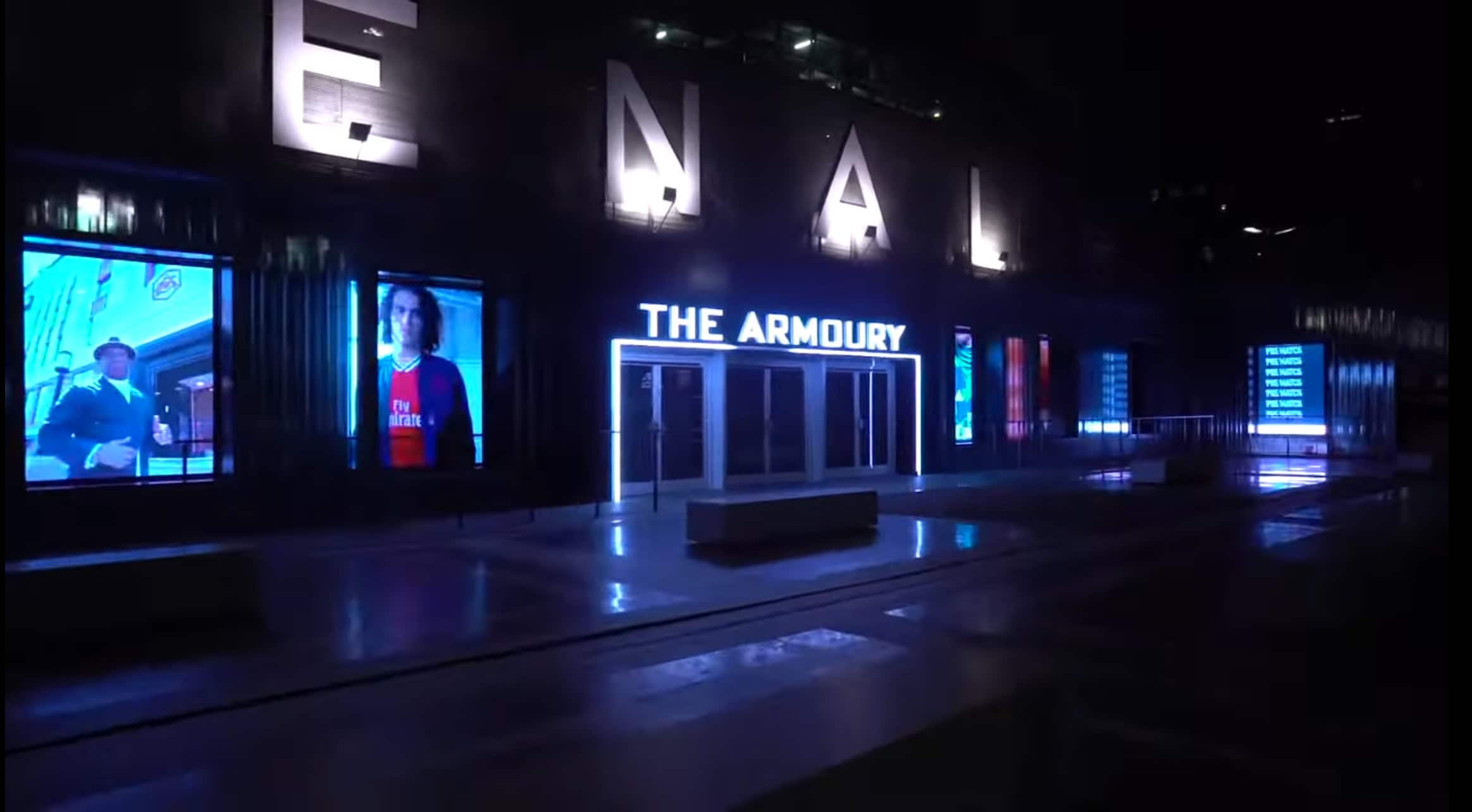
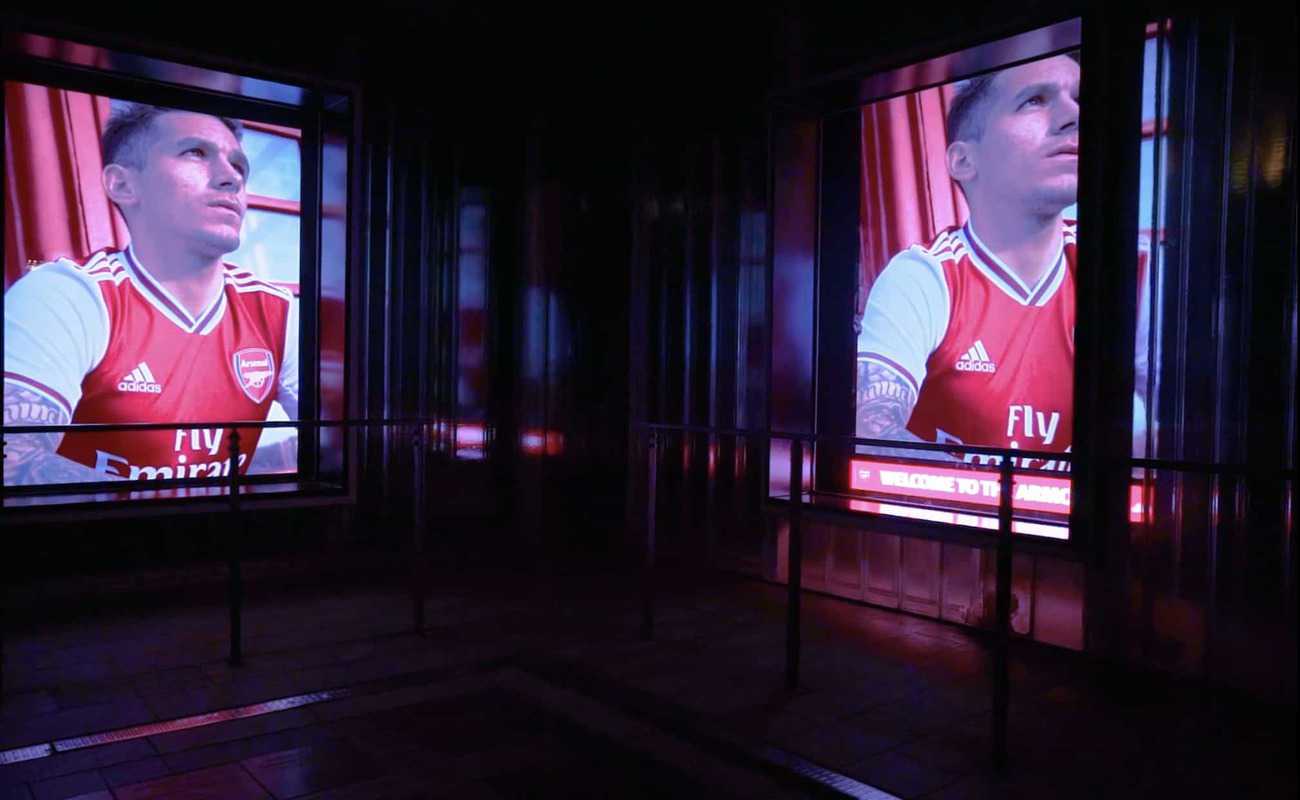
LED is modular, so the screen is built to the window rather than the window being dressed around a fixed TV size. Portrait panels of 2 m × 2.5 m fill each of the six Arsenal windows edge to edge; Hermès on New Bond Street ran a 6 m × 2 m screen the full width of the window. Cabinets can also be joined at right angles or curved to follow a bay window.

Four ways retailers use window advertising screens
Advertising your own products
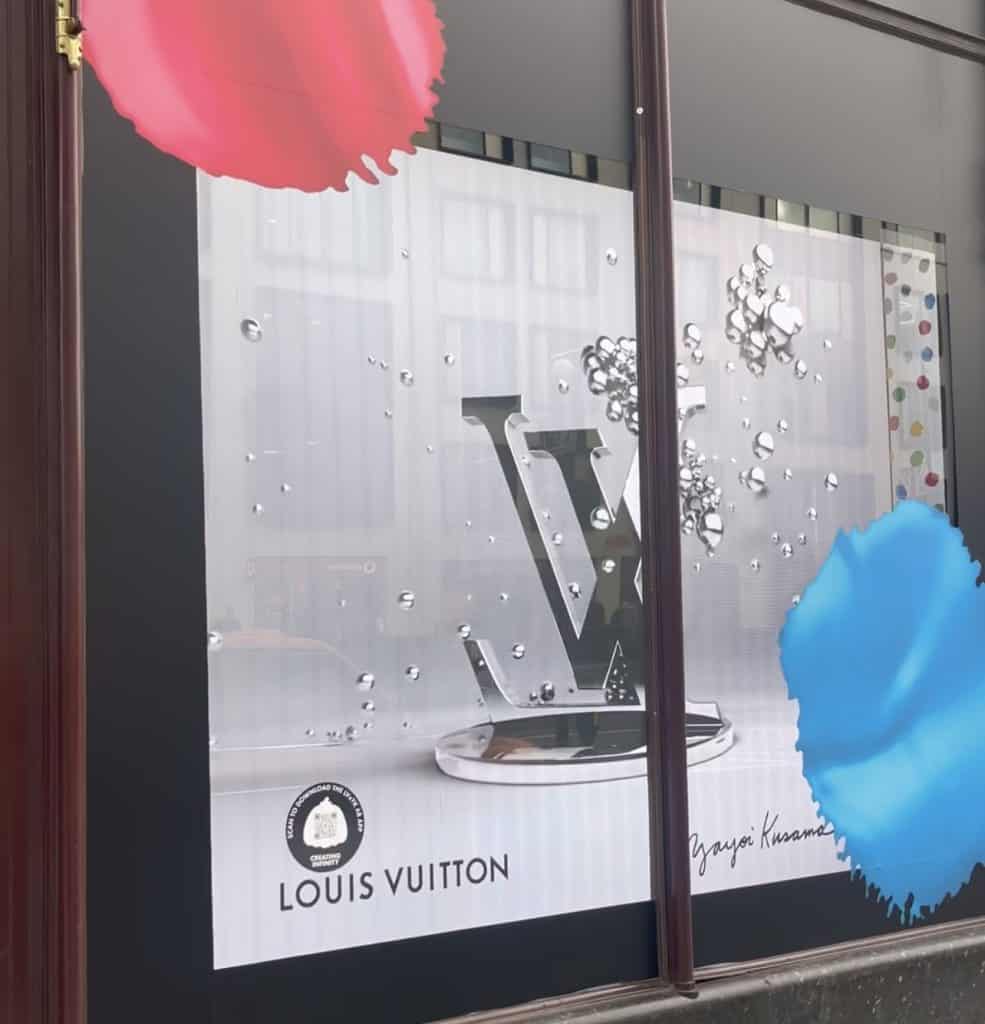
The main job is to sell what is inside. Product films, campaign creative and seasonal promotions run at pavement scale, and the content can follow the trading day: commuter messages in the morning, evening offers later. Dynamo’s LED window displays for the Louis Vuitton × Kusama collaboration at Harrods carried campaign content made specifically for the windows, alongside LED mirror screens inside the store.
Renting the screen to advertisers
If the shop sits on a high-footfall street, the window has a value to other brands. Retailers sell screen time to local businesses, landlords or media agencies, either as a flat monthly fee or a revenue share, and the sales of the screen’s own store can fund the hardware. What a slot is worth depends entirely on footfall, dwell time and the neighbouring brands, so it is a conversation to have with the landlord and a media buyer before you size the screen, not after.
Store information and events
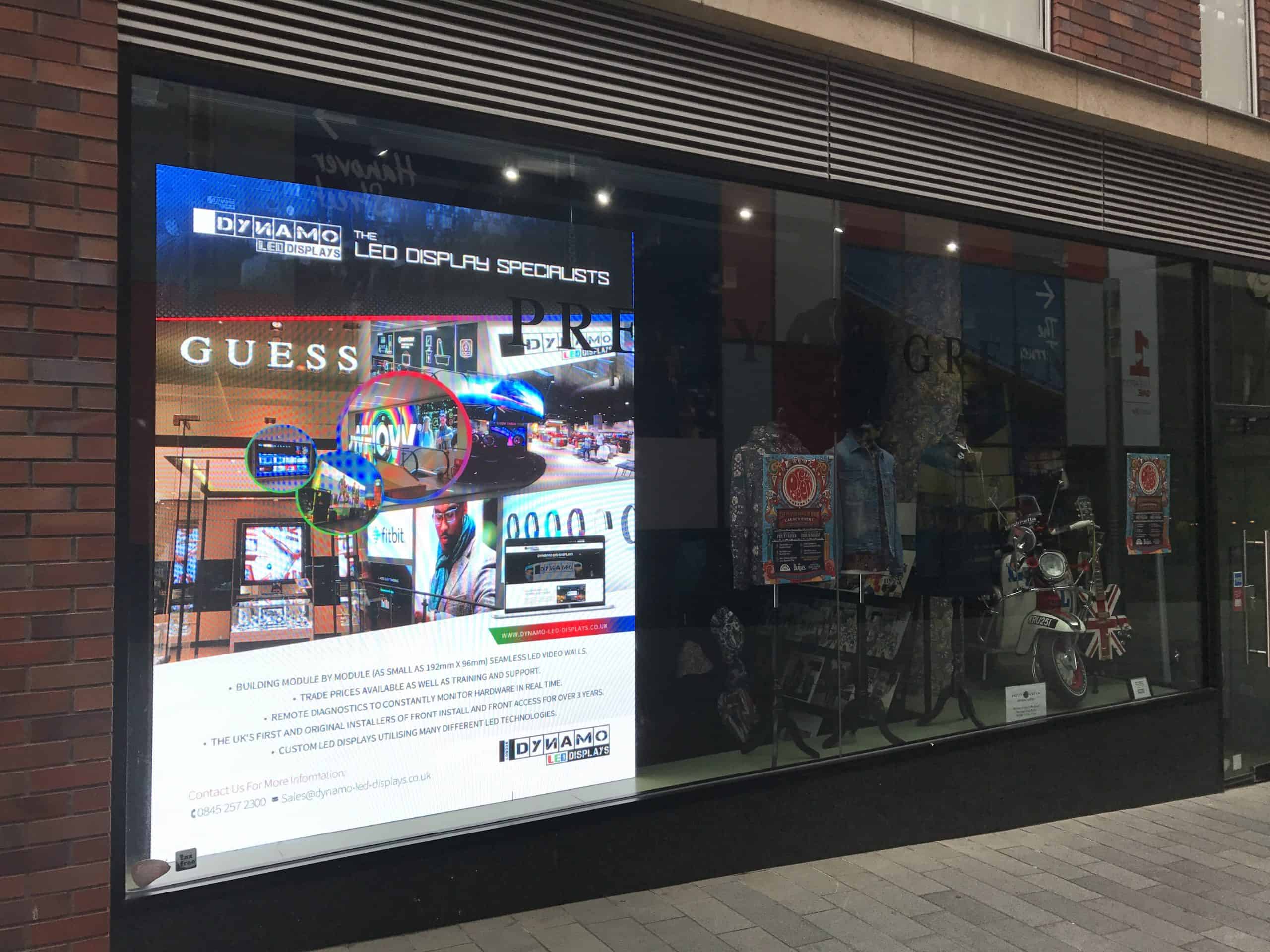
Opening hours, click-and-collect instructions, event dates and local community messages all belong on a window screen, and they cost nothing to change. Harrods runs 27 P3 mm LED tickers in its windows along Brompton Road and Hans Crescent, scrolling the designer names on show 24 hours a day; see the Harrods window tickers case study. For a portrait video screen in a fashion store window, see the Pretty Green LED window screens case study.
Interactive and social content
A QR code on screen turns a passer-by into a newsletter subscriber or an online basket. Hashtags, user-generated content and live social feeds work in windows where people wait, such as near a bus stop or a crossing. Touch interaction is possible on some cabinet sizes, but for a window the safer route is a screen that responds to phones rather than fingers on glass.
Specifying a window LED screen
Pixel pitch and viewing distance
Pixel pitch is the distance between LED centres, and it should follow the closest distance a shopper will stand. On a pavement that is one to three metres, so 2 mm to 3.9 mm covers most windows. Dynamo used 2.6 mm at Canada Goose on Regent Street and at Pretty Green in Covent Garden and Liverpool One, 2.06 mm for the product close-ups at Hermès on New Bond Street, and 3.9 mm at Arsenal, where the windows are seen from further back and the budget went into brightness instead. Our viewing distance and pixel pitch guide has the rule of thumb.
Brightness and automatic dimming
Specify for the brightest hour the window will see, then dim for the rest. A light sensor drops the output at dusk so the screen does not glare at night or annoy the flat above, and it also extends component life. The night-time dimming guide explains how the sensor and schedule are set.
Behind the glass or in the glass
Most window screens stand on a frame behind the existing glazing, which means no structural work and a screen that comes out at the end of a lease or a campaign. Where the screen is the shopfront, a structural LED installation replaces the glass or sits within the façade; that is a different project with planning and glazing implications, covered on our LED shopfront page. If shoppers need to see into the store through the screen, transparent LED is the third option; see transparent LED for retail windows.
Power, data and content management
A window screen needs a mains supply at the window, a data run to a small processor and a content player. Multi-site retailers manage every window from one content management system, so a campaign goes live in every store at once. Ask for front-service modules: they let an engineer swap a module from inside the window overnight without stripping the display.
Planning and brightness rules
An illuminated advertisement inside a window can fall within the scope of the Town and Country Planning (Control of Advertisements) (England) Regulations 2007, and local authorities take an interest in brightness near residential property. The government’s guide for advertisers sets out the categories. Check the position with your council before ordering; where consent is needed, Dynamo can supply a planning support statement with the photometric detail.
Dynamo LED window projects
- Arsenal FC, The Armoury: six portrait 2 m × 2.5 m window screens at 3.9 mm and 4,500 cd/m², plus internal walls, a ticker and LED mirrors.
- Hermès, New Bond Street: 2.06 mm festive window screens running 24 hours a day for five weeks.
- Canada Goose, Regent Street and Munich: 2.6 mm window displays specified above 3,500 nits, installed overnight.
- Louis Vuitton × Kusama, Harrods: LED window displays and mirror screens for a campaign launch.
- Harrods: 27 LED tickers across the Brompton Road and Hans Crescent windows.
- Pretty Green, Covent Garden and Liverpool One: 2.6 mm high-brightness window screens.
Getting the most from a window screen
- Position for the footfall. Eye level, facing the direction most people approach from, clear of pillars, mannequins and window vinyl.
- Design for the pavement, not the desk. Large type, high contrast and short loops. A shopper gives a window a few seconds, so lead with the product and the price.
- Change it often. The advantage over print is that you can. Weekly refreshes stop regulars tuning the screen out.
- Dim at night. Set the sensor and schedule at commissioning and check it again when the clocks change.
Window advertising with LED screens: frequently asked questions
How bright does an LED screen in a shop window need to be?
Specify at least 3,000 nits for a window that sees daylight, and 3,500 to 5,000 nits where the sun falls directly on the glass. Dynamo’s Arsenal window screens run at 4,500 cd/m² and the Canada Goose Regent Street windows were designed for more than 3,500 nits. Pair the brightness with a light sensor so the screen dims automatically after dark.
Can I rent my shop window LED screen to other advertisers?
Yes. Retailers in high-footfall locations sell screen time to neighbouring businesses, landlords or media agencies on a flat fee or a revenue share, and the income can cover the cost of the hardware. The value depends on footfall and the brands around you, so agree the terms with the landlord and, if relevant, a media buyer before you size the screen.
Do I need planning permission for an LED screen in a shop window?
Sometimes. An illuminated advertisement displayed close to the glass can fall within the Control of Advertisements Regulations, and councils pay particular attention to brightness near homes. Check with your local authority before ordering. Where consent is needed, Dynamo can provide a planning support statement with the brightness and dimming detail the planners ask for.
What pixel pitch should a shop window LED screen have?
Match the pitch to the closest distance a shopper will stand, which on a pavement is usually one to three metres. That puts most windows between 2 mm and 3.9 mm: finer where product detail matters, as at Hermès at 2.06 mm, and coarser where the screen is seen from further back and brightness matters more, as at Arsenal at 3.9 mm.
Can people still see into the shop through a window LED screen?
Not through a solid LED screen, which is why many retailers use it on one window or one section and keep the rest for merchandising. Where view-through matters, transparent LED panels mount behind the glass and let shoppers see the store through the display. They are less bright than solid panels, so they suit windows that are not in direct sun.
Planning a window advertising screen?
Send us the window dimensions, a photo of the shopfront from across the street, the direction it faces and how the screen will be used. We will come back with a written specification covering pitch, brightness, mounting and content management, and a price for supply and installation. For a shopfront where the arch, pillars and soffits are all LED, see our Superdry Heathrow LED shopfront.
Get a quote for a window LED screen. Contact Dynamo LED Displays or call 020 3489 9878.