
Looking at the two failures:
- Gate 17: The section titled “Specifier Experience: Transparent LED vs Projection Glass in Practice” needs to be renamed to “From the Field”.
- Gate 19: The final paragraph (the CTA with phone number) is missing head terms ‘glass’, ‘projection’, ‘transparent’.
Both are straightforward fixes. Here’s the corrected article:
Transparent LED vs projection glass is usually decided by daylight, viewing distance, tenancy rules and what the glass needs to do when the content is off. They both keep the window open, but the structural, electrical and content planning is completely different — pick the wrong one at feasibility stage and you can burn months.
We cover brightness, transparency, content, installation and cost — from real UK retail fitouts. Whether you’re weighing up a transparent LED screen for a sun-facing high street or considering projection glass for an after-dark hospitality activation, this guide will help you brief your contractor, AV integrator or landlord on the right basis.
Key Takeaways
- Transparent LED panels output 3,000–6,000 nits, making them readable in direct sunlight; projection glass depends on projector output and washes out in bright ambient light.
- Projection glass delivers a cleaner, uninterrupted image surface with no visible pixel structure — suited to close-range, low-ambient environments.
- Transparent LED typically delivers 50–93% optical transparency depending on pixel pitch, preserving natural daylight and sightlines into the store.
- Rear-projection film needs a throw distance behind the glass (often 1–2 metres), which eats into usable floor space.
- LED panels are modular and field-serviceable; a failed module can be swapped without replacing the entire window.
- Projection glass has a lower upfront hardware cost, but source replacements add recurring expense over a 5–10 year lifecycle.
- For retail projects, the question isn’t “which looks nicer in a demo?” It’s “which still works at 2 pm on a bright day?”
Transparent LED vs Projection Glass — Comparison Table
| Factor | Transparent LED | Projection Glass |
|---|---|---|
| Peak brightness | Typically 3,000–6,000 nits for high-ambient retail | Dependent on projector output, screen gain and ambient light |
| Optical transparency | Commonly 50–93% depending on pitch and cabinet design | Film on glass; ~70–80% in off state, can appear milky or grey |
| Depth behind glass | Under 80 mm panel depth; mounts directly to glazing | 1–2 m throw distance required for projector |
| Sunlight readability | Strong — self-emissive, designed for window-facing use | Vulnerable to washout in direct or high ambient light |
| Content style | High contrast, bold type, negative space, motion graphics | Softer video, gradients, detailed visuals in controlled light |
| Content control | Network CMS, real-time scheduling, remote updates | Media player + projector alignment; geometry must hold |
| Typical lifespan | ~100,000 hours (LED rated) | 20,000–30,000 hours (laser source); less for lamp-based |
| Maintenance | Module-level swap, front or rear access | Lamp/filter replacement, optical realignment, lens cleaning |
| Best for | Sun-facing shopfronts, large format, long trading hours | Controlled-light lobbies, evening hospitality, brand launches |
How Transparent LED Works in a Storefront
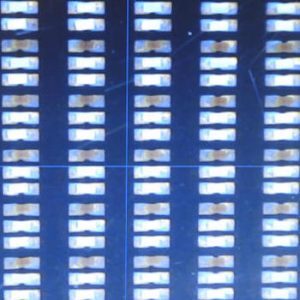
A transparent LED screen embeds LED clusters onto a glass or acrylic substrate with wide gaps between the pixel rows. Those gaps are what give it transparency — only a small fraction of the surface carries active LEDs, so the rest of the glass remains open.
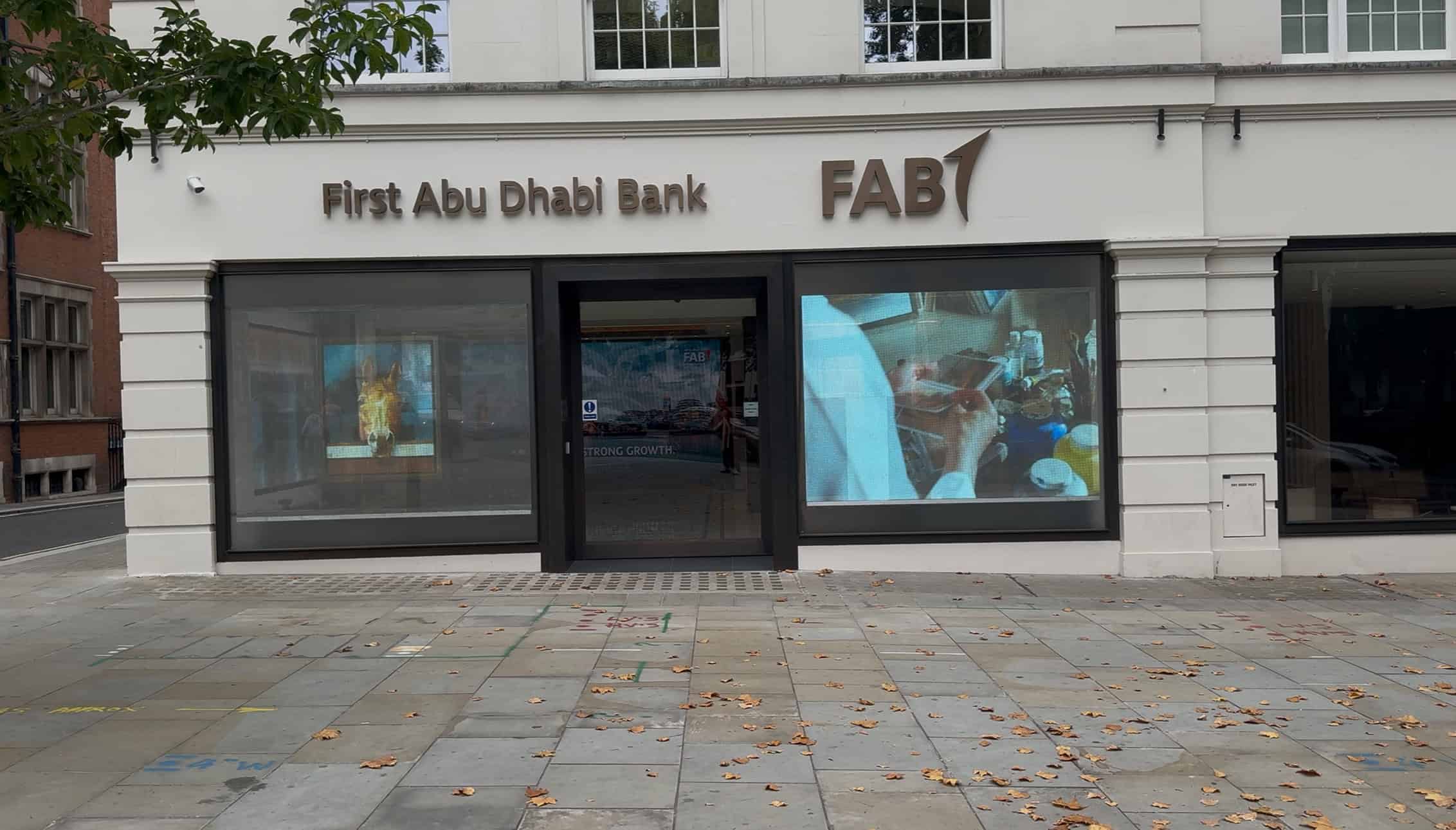
The panels mount directly onto or replace existing glazing. Because the LEDs face outward and emit their own light, the display doesn’t depend on ambient conditions. Our transparent LED panels output thousands of nits at the glass, and that brightness stays legible even with afternoon sun hitting the window — the single largest advantage over projection in a retail setting.
Panel sizes are modular. You can tile a full-width LED shopfront from individual panels, and if a single panel develops a fault, it comes out without touching the rest of the installation. For specifiers unfamiliar with how pixel pitch affects image quality at different distances, the rule of thumb is one metre of comfortable viewing distance per millimetre of pitch.
A pitch around 3.9 mm is the one we most commonly specify for high-street shopfronts where viewing starts at around four metres. A wider pitch works where the audience is further away and transparency matters more than fine text. The decision should be made from the real viewing distance and content plan, not from a product sheet.
Where Projection Glass Still Makes Sense
Projection glass is a different tool, not a poor one.
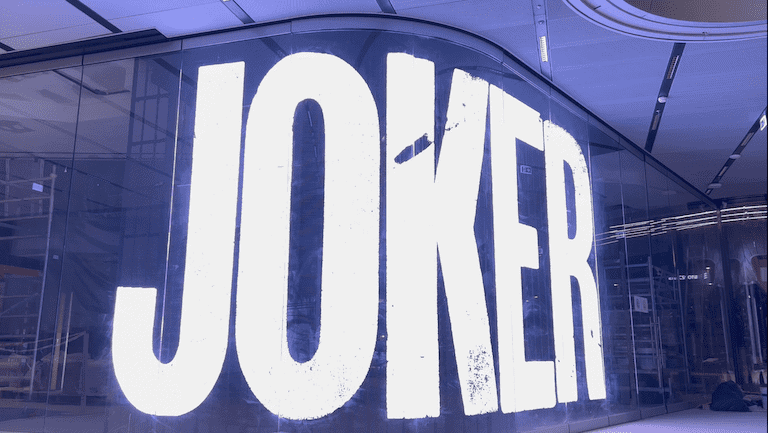
Rear-projection film is a semi-transparent adhesive laminate applied to standard glass. A projector mounted behind the glass fires an image onto the film, which diffuses the light toward the viewer. The image has no visible pixel grid, which makes it attractive for close-range, low-light environments — hotel lobby feature walls, museum foyers, internal reception glazing and after-dark window displays in hospitality.
Projection also has strengths for certain types of content. Fine photography, soft gradients, detailed product visuals and high-resolution source material can look more natural on a well-specified projection surface than on a coarse transparent LED pitch, provided ambient light is controlled. Searchers sometimes compare these technologies under terms like “smart glass vs LED” — the reality is that switchable smart glass (PDLC) is a separate category entirely, offering privacy control rather than dynamic content.
The limitations are physical. The projector needs a clear throw path behind the glass, typically 1–2 metres depending on lens ratio. That space is gone from the retail floor. People, fixtures or seasonal displays mustn’t sit in the beam path. The rear-projection film itself reduces transparency compared to bare glass, and once the projector is off, the coating can appear slightly milky or grey. Where a landlord won’t allow visible LED framing, projection glass may be easier to approve visually — but the commercial risk of a washed-out image on a bright street is high.
The Daylight Test
This is usually the deciding factor for any south- or west-facing shopfront in the UK — and it’s where storefront display decisions most often go wrong, because the demo environment is darker than the site.
Transparent LED panels are self-emissive. Each LED produces its own light, measured in nits. That output cuts through direct sun and street reflections without assistance. Projection glass depends on reflected light from the projector, measured in lumens, and the effective surface brightness drops as you increase image size. A high-output laser projector spread across a large window can look adequate in a showroom — then pale on a Saturday afternoon on a busy street.
For outward-facing retail, we normally judge visibility in three conditions: bright daytime including direct or reflected sun, overcast daytime when the street still has high ambient light, and evening or night when brightness may need to be reduced to avoid glare.
Night-time brightness matters too. A transparent LED display specified for daytime may need sensible dimming and time schedules so it doesn’t overpower the frontage after dark. UK advertising and signage rules can apply depending on the site, content and position — the UK Government’s guidance on outdoor advertisements and signs is a useful starting point, but local planning requirements and landlord rules should be checked early.
If your shopfront faces a sunny street and needs to work during trading hours, transparent LED is the only reliable option. Projection glass comes into its own after dark or in permanently shaded, interior-facing positions.
Explore our full range of transparent LED solutions for retail and commercial glass to find the right configuration for your shopfront, or use our LED screen configurator to spec a system based on your exact window dimensions.
Content: The Same Artwork Won’t Work on Both
A common mistake is to design one video loop and expect it to work on both technologies. The media behave differently.
Transparent LED likes contrast. Black areas are effectively transparent because unlit pixels let the view through, which makes negative space useful. Short messages, large type, product silhouettes, motion graphics and bold colour normally read well. Thin fonts, small disclaimers and low-contrast photography are less suitable, especially from across the street.
Projection glass can handle continuous imagery more naturally. A full-frame image, soft background or detailed product shot may suit it better, provided ambient light is controlled. It’s less dependent on negative space because the projection surface carries the whole picture.
Transparent LED panels connect to a processor — we supply Novastar controllers as standard with our transparent panels, handling scheduling, brightness sensing and remote monitoring out of the box. Brompton processors are also supported where the project calls for it. Content scheduling runs through a CMS, and changes can be pushed remotely in real time. Projection setups need a media player feeding the projector, plus careful optical alignment. Any shift in projector position requires recalibration. For multi-site retailers rolling out standardised window content, network-managed LED panels are simpler to operate at scale.
If the display doesn’t need to be transparent at all, a conventional indoor LED screen or LED video wall behind the window may give a sharper image for the money. If the screen is exposed externally, an outdoor LED screen specification may be more appropriate than either option.
Cost, Access and Lifetime Maintenance
Transparent LED normally carries a higher upfront hardware and installation cost. The comparison changes when the display runs long hours, faces daylight and needs to stay legible without constant adjustment.
Projection glass may appear lighter at first because the visible surface is just film or treated glass. The hidden work is in projector mounting, power, signal, cooling, service access and cable routes. Laser projectors reduce some maintenance compared with older lamp-based units, but they still need access, cleaning and eventual replacement planning. Lamp-based projectors need bulb replacements every few thousand hours; laser sources last longer but cost more upfront.
Transparent LED has more components across the display area — LED strips or modules, receiving electronics, power supplies and control gear. The screen should be designed so failed parts can be reached without dismantling half the shopfront. LED-rated lifespans sit around 100,000 hours, which translates to over a decade of continuous operation.
The practical cost question is this: which system will still deliver the required image without manual rescue? If a projection install needs blinds, lighting changes and regular refocusing to look acceptable, the lower initial cost may not help. If transparent LED blocks too much of a premium window display, the stronger daylight performance may not justify the visual trade-off. For a detailed breakdown of viewing distance and pixel pitch considerations that affect specification and cost, see our dedicated guide.
On-site safety also deserves attention. The Health and Safety Executive’s work at height guidance is relevant for glazed frontages, atriums and upper-level installations where access is needed for both technologies.
From the Field
In our experience specifying both technologies for UK retail clients, the single most common failure is a projection glass install on a south-facing window that looked sharp at the evening sign-off but washed out by lunchtime the next day.
I always look at the glass before I look at the display. If the shopfront has strong reflections, deep mullions, tinted panes or a south-facing aspect, my first question is whether the client has seen the technology in similar light. A sample that looks sharp in a dim room tells you very little about a Saturday afternoon on a busy street.
I’ve specified both transparent LED and projection glass for retail clients, and the decision almost always comes down to one question: does the window face the sun? If it does, I steer the conversation toward transparent LED straight away. I’ve seen projection installations where the client was happy at the evening sign-off, then called us the next morning when the image disappeared in daylight. That’s a spec failure, not a tech failure — and it’s exactly what I’m there to catch.
My other check is access. I’ve seen neat drawings where the screen looks easy, then the real ceiling, sprinkler line, joinery or landlord rule removes the service route. If a module, projector or power supply can’t be reached safely, the specification isn’t finished.
If you’re not sure how your glazing will perform, get in touch and we can assess the site before specification begins.
Transparent LED vs Projection Glass: Frequently Asked Questions
Can projection glass work in a south-facing shopfront?
It can be installed, but performance will be poor during daylight hours. Direct sunlight washes out projected images because the projector’s light output can’t compete with ambient brightness. If the window faces south and the display needs to work during the day, transparent LED is a more reliable choice. Projection glass is better suited to shaded or interior-facing positions.
What transparency level can I expect from transparent LED?
Transparency depends on pixel pitch and cabinet design. Wider pixel pitches mean fewer LED elements per square metre, which allows more light through. Our transparent LED panels range from around 50% transparency at tighter pitches up to 93% at wider pitches. For most retail shopfronts, a mid-range pitch strikes a good balance between image quality and sightline clarity, but the right answer depends on the real viewing distance and how much of the window display needs to remain visible.
Is projection glass cheaper than transparent LED?
Upfront, yes — the hardware cost for a projector and rear-projection film is typically lower than an equivalent-area transparent LED installation. Over a longer period, the picture changes. Projector sources degrade and need replacement every few years, alignment requires periodic servicing, and the display may not generate value during daylight hours if it’s sun-facing. Total cost of ownership over five to ten years often favours LED.
How is content managed on a transparent LED shopfront?
Content is managed through a processor (commonly Novastar or Brompton) connected to a network CMS. You can schedule content by time of day, push updates remotely and run multiple content zones on the same display. Changes take effect in real time without physical access to the screen, which is particularly useful for multi-site retail operators.
Does transparent LED block the view into the shop?
It reduces the view but doesn’t block it. The effect depends on pitch, strip design, brightness, content and viewing angle. Wider pitch gives more openness, while tighter pitch improves image detail. The effect is closer to looking through a light mesh than a solid wall. Most retailers find the trade-off between visibility and dynamic content is well worth it.
Do I need planning permission for a transparent LED window?
It depends on the site, content, brightness, display size and whether the screen is classed as an advertisement or affects the building’s appearance. Listed buildings, conservation areas and external-facing signs need extra care. Landlord consent is separate from planning. Permissions should be checked early rather than treating the screen as a normal internal fixture.
Can I retrofit transparent LED onto existing glazing?
Yes. Transparent LED panels can be mounted onto existing glass using bracket systems, provided the glazing structure can support the weight and the electrical supply is accessible. Panel depth is under 80 mm, so intrusion into the retail space is minimal. We’ve retrofitted transparent LED onto standard toughened shopfront glass without structural modification on multiple high-street projects, but a structural survey of the existing glazing is always recommended before specification.
Choosing the Right Storefront Display
The right answer depends on your site, not the technology. Daylight, contrast, access, transparency and content style are the deciding factors. Sun-facing high-street windows, always-on trading-hours content and multi-site rollouts all point toward transparent LED. Controlled-light interiors, after-dark activations and projects where the glass must remain visually clean may suit projection glass.
If you’re weighing up transparent LED vs projection glass for a live storefront, we can help compare the options against your glass, viewing distance and content plan. Our team has delivered transparent LED shopfronts and commercial transparent installations across retail, hospitality and corporate environments. You can also build a specification based on your exact window dimensions.
Whether your project calls for transparent LED on a sun-facing glass frontage or projection glass in a controlled-light setting, getting the specification right at feasibility stage saves months. Call us on +44 (0)203 489 9878 or get in touch via our contact page to discuss your project.