
LED video wall viewing distance is the single fastest way to narrow the pixel pitch range on a project. Get pitch right and the wall reads cleanly from where the audience actually sits. Get it wrong and no amount of brightness or processing will rescue it.
Updated September 2026: configurator links removed, a first-hand project example and a conference-room FAQ added; pitch guidance unchanged.
Choosing pitch is a trade-off between viewing distance, physical screen size, resolution, content type, brightness in nits, viewing angle, servicing access and processor capacity. A P1.5 wall suits a boardroom where people sit 2 metres away. A P2.6 wall fits a reception with the first real viewing point 4 to 5 metres back. Outdoors, a P6 or P8 Dynamo DVO (outdoor permanent direct-view) LED display reads clean from across a road without forcing the project into unnecessary LED density.
This post is one decision inside a larger spec. See our indoor and outdoor LED video wall installations pillar for structure, power and content workflow. Here we focus on pitch.
Key takeaways
- Practical rule: minimum comfortable viewing distance in metres ≈ pixel pitch in millimetres. A P2.5 LED video wall starts to read cleanly from about 2.5m, P1.5 from about 1.5m.
- Visual acuity rule: distance in metres ≈ pixel pitch × 3.44, derived from the 1-arcminute resolution limit of 20/20 vision. P2.5 reaches the acuity threshold at about 8.6m.
- Closest viewer drives the spec, not the average. If anyone stands within 2m of a P4 wall, the spec is wrong for the room.
- Pixel pitch is not resolution. A 4m × 2.25m canvas at P2.5 is 1,600 × 900 pixels, below native 1080p. Calculate pixel dimensions before you commit.
- Content type shifts the calculation. Text, dashboards and broadcast graphics need tighter pitches than photographic or motion content at the same distance.
- Optimal viewing distance matters more than minimum pitch. Going finer than the room needs wastes budget on resolution no one sees.
At-a-glance project facts
| Project type | Typical nearest viewing distance | Common pitch range | Product-line starting point |
|---|---|---|---|
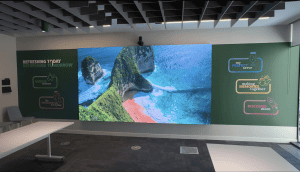
| Boardroom or briefing room | 1.5 to 3 metres | P1.5 to P1.9 | Dynamo DFC |
| Control room | 2 to 5 metres | P1.5 to P2.5 | Dynamo DFC or DX |
| Corporate reception | 3 to 8 metres | P1.5 to P3.9 | Dynamo DFC or DX |
| Retail feature wall | 2 to 10 metres | P1.9 to P3.9 | Dynamo DFC or DX |
| Auditorium or lecture theatre | 5 to 20 metres | P2.5 to P4.8 | Dynamo DX |
| Stage backdrop or touring screen | 4 to 30 metres | P2.6 to P4.8 | Dynamo DRE |
| Outdoor building façade | 10 to 50 metres | P4 to P10 | Dynamo DVO |
| Transparent or creative curtain | 5 to 50 metres | Project-specific | Dynamo LVW |
How to calculate LED video wall viewing distance
The minimum comfortable viewing distance for an LED video wall is roughly equal to the pixel pitch expressed in metres. A P2.5 wall reads cleanly from about 2.5 metres, P1.5 from about 1.5 metres. We use two rules in practice: a practical 1:1 rule for the point at which the image starts to read cleanly, and a stricter ×3.44 rule for the point at which pixel structure becomes hard to resolve.
The practical 1:1 rule
A working rule for most direct-view LED projects: minimum comfortable viewing distance in metres ≈ pixel pitch in millimetres.
| Pixel pitch | Practical minimum distance |
|---|---|
| P0.9 | 0.9 metres |
| P1.2 | 1.2 metres |
| P1.5 | 1.5 metres |
| P1.8 | 1.8 metres |
| P2.5 | 2.5 metres |
| P3.9 | 3.9 metres |
| P4.8 | 4.8 metres |
| P6 | 6 metres |
| P10 | 10 metres |
This is not a promise that pixels vanish at that distance. It is the point at which the wall starts to read cleanly for video, brand content and larger text. For close-up text, spreadsheets or control-room data, we move tighter.
The visual acuity rule
If the aim is for individual pixels to become hard to distinguish for a viewer with 20/20 vision, use a stricter calculation: distance in metres ≈ pixel pitch × 3.44. The 3.44 multiplier comes from the 1-arcminute resolution limit of 20/20 vision, since tan(1/60°) ≈ 1/3438 (visual acuity reference).
So P1.5 reaches the acuity threshold at about 5.2m, P2.5 at about 8.6m, and P6 at about 20.6m. The same arc-minute logic underpins the optimum HDTV viewing distance benchmark broadcast engineers use for flat-panel sizing. We use this rule for executive spaces, broadcast-facing walls and anywhere the client expects the optimal viewing distance to feel closer to a flat-panel display with no visible pixel structure. Viewing angle matters too: most indoor cabinets hold colour and contrast cleanly to around 140°-160° horizontal, but if seats wrap the wall, check the panel datasheet rather than assuming.
Pixel pitch is not resolution
Pixel pitch sets pixel density in millimetres between LEDs. Resolution is pitch plus physical size: a 4m × 2.25m canvas at P2.5 lands at roughly 1,600 × 900 pixels, below native 1080p. Two LED video walls with identical pitch can have different resolutions, and two walls at the same resolution can have very different pitches. Count the real figure from the cabinet datasheet: pixels across = cabinets across × cabinet pixel width, and the same vertically. Cabinet sizes rarely divide neatly into a target canvas, so the datasheet count is the one that goes on the drawing.
Take a 4m × 2.25m canvas in 16:9:
| Pitch | Pixel dimensions | Total pixels |
|---|---|---|
| P2.5 | 1,600 × 900 | 1.44 million |
| P1.8 | 2,222 × 1,250 | 2.78 million |
| P1.5 | 2,666 × 1,500 | 4.00 million |
| P1.2 | 3,333 × 1,875 | 6.25 million |
That table is where many projects change direction. A client may ask for native 4K (3,840 × 2,160), but at P1.5 the wall needs to be roughly 5.76m × 3.24m, and at P1.2 about 4.61m × 2.59m. To hit native 1080p on a 4m-wide canvas, you need roughly P2. If the room can only take a 3m wall, chasing native 4K may push the design into a very fine pitch and a more complex processor setup.
Punch your canvas size into the LED video wall viewing distance advice to see pitch, pixel count and processor load against your actual room before ordering anything.
Processing has to match the canvas. Generic HDMI matrix scalers can only output standard EDID resolutions, so a 2,666 × 1,500 canvas tends to letterbox, crop or rescale with artefacts. For anything beyond a single rectangular HD output, a dedicated LED processor is non-negotiable. Brompton Tessera SX40 handles most fixed-install jobs at our scale; for larger-canvas or multi-rectangle builds the Tessera XD or MX40 takes over. Novastar MCTRL4K or the H series is the alternative when budget or rental logistics make it the better fit. Run the numbers through our Novastar LED processor calculator before ordering panels.
For the full pitch decision framework including brightness, refresh, calibration and SMD vs COB panel construction, see our fine-pitch DVLED density explained guide.
What pitch do you need for different content?
Viewing distance sets the upper bound on pitch, but content sets the finer specification. Text-heavy LED video walls need tighter pitch than video walls of the same size at the same distance. Dashboards, lower-thirds and small captions push one band finer than the 1:1 rule alone would suggest, and broadcast-facing walls add their own constraints around moiré.
Text and data walls
Financial dashboards, broadcast lower-thirds, control-room status walls, exhibition stand specs, anything where a viewer leans in to read small type. Push one band tighter than the calculator suggests. A P2.5 LED video wall that the viewer reads from 4m will feel coarse on 14pt text; P1.9 or P1.8 is safer.
Video, brand film and motion graphics
The eye accepts a wider pitch on continuous tone than on hard edges. A 5m-wide P2.5 or P3.9 LED video wall in a reception reads cleanly from across the room if the content is designed for LED: large type, bold contrast, slower movement, safe margins. The mistake is taking content built for a laptop and putting it on the wall unchanged.
Broadcast, camera relay and XR
Cameras resolve pixels the human eye misses, and moiré is the enemy. In our experience, UK broadcast and XR studios sit in the P1.5 to P2.6 band depending on camera distance and lens. For in-camera VFX, decisions also depend on sensor, focal length and shutter, not just human viewers. Our moiré check uses a camera shoot at the planned focal length and distance before we sign off pitch, then processor scan-rate and shutter sync are tuned against the captured footage.
Mixed-use rooms
If a wall plays video 90% of the time and dashboards 10%, spec for the dashboards. Going coarser on “it’s mostly video” backfires the moment the room is used for an all-hands.
Specifying a wall and want a sense-check on pitch, canvas size and processing in one go? The indoor and outdoor LED video walls builds a budgetary LED wall spec in a few minutes: pitch, panel count, resolution, processor and ballpark price.
Who is the nearest real viewer?
The nearest real viewer is the closest person who will routinely stand and look at the LED video wall under normal use, not the average audience position and not the back of the room. Specifying on the average viewer is what causes the “looks great from across the office, looks pixelated when you walk up to it” complaints.
In practice that means:
- In a boardroom, the person at the front edge of the table.
- In a reception, someone standing at the welcome desk, not a visitor entering from the street.
- In retail, a customer queueing beside the wall.
- In an auditorium, the front row.
- Outdoors, a pedestrian route, bus stop or crossing.
Once that point is fixed, the 1:1 rule gives the upper bound on pitch, and the ×3.44 rule tells you whether pixel structure will still be visible on detailed content.
Indoor, outdoor and rental pitch choices are different
Indoor, outdoor and rental LED video walls share the same pitch numbers but rarely share the same specification. Cabinet design, brightness range, IP rating, refresh rate and rigging weight all change depending on whether the wall is fixed indoors, mounted outside or built for events.
Indoor fixed-install
Dynamo DFC (fine-pitch indoor fixed-install flip-chip COB: DFC 1.5 at 1.58 mm and DFC 1.9 at 1.9 mm) is our premium fixed-install line. Dynamo DX (mid-range indoor fixed-install, P1.9 to P5.9) covers the broader fixed-install range. The choice depends on cabinet design, service access, brightness (typically 600 to 800 nits indoors ), calibration requirements and expected duty cycle. Indoor spaces have closer viewing distances and lower ambient brightness, so fine pitch becomes more relevant, particularly for boardrooms, control rooms, retail and reception.
Outdoor permanent
Dynamo DVO (outdoor permanent direct-view) is the starting point for any all-weather install. Viewing distances are longer, so P4, P6, P8 or P10 are often sensible depending on the site. Outdoor pitch decisions also turn on planning consent, daylight brightness (5,000 nits and above for direct sun ), IP rating, wind loading and viewing angles from pavements and roads.
Rental and staging
Dynamo DRE (rental and touring direct-view) is for events and short-cycle installs. Frames, build speed, handling damage, rigging weight and replacement stock often matter as much as pitch. A P2.6 DRE wall may suit a close-viewed event; P3.9 or P4.8 may suit a stage backdrop several metres from the audience. If the wall is captured on camera, refresh behaviour (3,840Hz or higher ) and processor settings need checking.
Flexible curtain
Dynamo LVW (flexible curtain LED) covers applications where transparency, curve, airflow, low weight or a creative form factor is part of the brief. Pitch still matters, but openness and structure often drive the decision more than conventional resolution targets.
From the field
I get asked what pitch every week and it’s never a standalone question. Last year we specified a P3.9 wall for a UK retail client who was sure the closest customer would stand 6 metres back. Three weeks after install they put a product display table 2 metres in front of it. The wall didn’t change; the room did. We swapped it for P2.6 and the same content read properly.
The other one I watch for is text. If a client wants a wall to behave like a large computer monitor, I treat that very differently from a reception wall playing video. The thing I’d tell any specifier: walk the room with a tape measure before signing off the pitch. Stand where the closest person will actually stand, not where the architect’s drawing says they will, and decide from there. Or run the dimensions through the LED video wall specification support before that visit so you arrive with a budgetary spec to pressure-test, not a blank page.
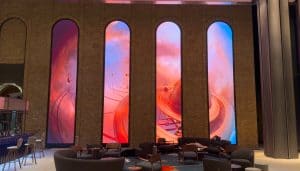
One I point people to: the Citypoint digital art wall in London is a 10.88 × 4.68 m wall at 2.5 mm pitch, viewed across an office lobby rather than up close. At that distance 2.5 mm reads as a continuous surface and a finer pitch would have added cost without anyone seeing the difference.
— Daniel, Dynamo LED Displays
What to do next
Three branches depending on where you are in the process:
- Want a budgetary spec to share internally before drawings are finalised? Run your canvas size through the fine-pitch LED video walls.
- Already have drawings or an existing spec? Send them through and we will review pitch, processor load and structure before any order goes near a panel. Contact details are at the end of this guide.
- Need broader install context before locking pitch? Read the indoor and outdoor LED video wall installations pillar.
LED Video Wall Viewing Distance: Frequently Asked Questions
What is the minimum viewing distance for a P2.5 LED video wall?
Around 2.5 metres for the pixel grid to start blending into a clean image for a viewer with normal eyesight, and around 8.6 metres before individual pixels become genuinely unresolvable. Anyone closer than about 2 metres will see the grid on solid colours and fine text. For walls likely to be approached up close, step down to P1.9 or P1.5.
How do I calculate pixel pitch from viewing distance?
Start with the nearest normal viewer in metres. The 1:1 rule sets that distance roughly equal to pitch in millimetres, so a viewer at 3 metres suggests P3 or finer. Then check content: video may work at that pitch, but small text, dashboards or camera-facing graphics often need P2.5 or tighter. Finally, calculate pixel dimensions to confirm you reach native 1080p or 4K if that matters.
Is P1.2 pitch worth the extra cost over P1.5?
Only if the closest viewer is within 3 metres and the content includes fine detail: small type, broadcast graphics, dense data. For a boardroom where the nearest seat is 3.5 metres or further, P1.5 is indistinguishable in practice and costs significantly less per square metre. Spec P1.2 where you genuinely need it, not as a default premium choice.
Can I mix pixel pitches across one LED video wall?
Not on a single canvas. Pitch must be uniform across panels driven as one display, and mixed-pitch canvases create visible seams. You can run multiple LED video walls at different pitches in the same room, each driven by its own processor output, and we do this regularly for spaces with a feature wall and surrounding signage at different viewing distances.
What pixel pitch do I need for an outdoor LED screen?
Outdoor permanent displays often sit in the P4 to P10 range, depending on site and viewing distance. A pedestrian-facing screen viewed from 6 metres needs a different pitch from a building-mounted Dynamo DVO display viewed from 30 metres. Brightness for daylight operation, IP rating, structure and planning consent need to be checked alongside pitch. A wider pitch is often the more sensible specification outdoors.
How does screen size affect LED video wall resolution?
Resolution comes from physical size and pitch together. A 4m × 2.25m wall at P2.5 is about 1,600 × 900 pixels. The same canvas at P1.5 is about 2,666 × 1,500. To hit native 1,920 × 1,080 on a 4m-wide canvas, you need roughly P2. Decide what source resolution you want to display natively, then back-calculate the pitch your canvas size demands.
What pitch do broadcast and XR studios typically use?
UK broadcast and XR studios sit in the P1.5 to P2.6 band depending on camera distance and lens. In-camera VFX tends towards P1.5 or finer to avoid moiré at typical shooting distances. For background scenic walls behind a presenter desk where cameras stay 4 metres or further back, P1.9 to P2.6 is standard and considerably cheaper per square metre than the finest options.
What pixel pitch LED wall do I need for a conference room?
Measure the distance from the wall to the nearest seat, then apply the 1:1 rule: a viewer 2 metres away needs roughly P2 or finer, so most conference and boardroom walls land at P1.5 to P1.9. If the room is larger and the closest seat is 3 to 4 metres back, P2.5 or P2.6 is usually enough, especially for video and slides rather than dense text.
Conclusion
LED video wall viewing distance is the quickest way to narrow the pitch range, but it is not the whole specification. The right pitch depends on the nearest real viewer, the physical wall size, the content, the processor load, the installation environment and the long-term service plan.
Use the 1:1 practical rule to set an early boundary. Use the ×3.44 visual acuity rule when pixel visibility is critical. Then calculate the actual pixel dimensions and check whether the content will use that resolution. For fixed indoor projects, Dynamo DFC and DX cover different price and performance bands. For outdoor permanent work, Dynamo DVO is the correct starting point. DRE belongs in rental, and LVW applies where a flexible curtain format is part of the design.
Get a quote for your LED video wall. Send us the drawings before you order and we will pressure-test your LED video wall viewing distance against canvas, pitch and processor load in one pass. Call us on +44 (0)203 489 9878 or get in touch to share files.