Outdoor LED thermal management is the combination of cabinet design, airflow engineering and brightness control that keeps LED junction temperatures below the threshold where lumen output begins to degrade.
Outdoor LED thermal management is the single biggest factor determining how long your display holds its rated brightness. Not weather. Not vandalism. Not even whatever the British climate throws at it. Heat generated internally by the LEDs themselves is what degrades output year after year. Get thermal design wrong at specification stage, and you’re buying a display that dims faster than it should. We treat heat as a specification item, not a site problem to solve after installation. If you’re comparing options for outdoor LED displays, the thermal design should be reviewed alongside pixel pitch, IP rating, structural support and content requirements.
Key Takeaways
- LED chips convert roughly 70–80% of input power to heat, not light — thermal management is an efficiency problem, not just a durability one
- Brightness degradation accelerates above 60–80°C junction temperature, cutting useful lifespan by thousands of hours
- Direct sun can add close to 1,000 W/m² of solar load before the display has even produced its own heat
- IP rating and thermal performance work against each other — a tightly sealed cabinet needs a planned heat path
- A high-brightness display running at 60–80% of its rated output often lasts better than a lower-output display driven near its limit
- Power density rises as pixel pitch drops: a P2.5mm outdoor display packs roughly 10× the pixel count of a P8, driving proportionally higher power density per square metre
Outdoor LED Thermal Management Factors: At-a-Glance Specification Table
| Factor | Typical Range / Value | Why It Matters |
|---|---|---|
| LED junction temperature threshold | 60–80°C (varies by chip) | Above this, lumen output drops sharply |
| Maximum ambient operating temp | 50–60°C (cabinet spec) | Sets the ceiling for passive cooling |
| Solar load on display face | Up to ~1,000 W/m² in direct sun | Added on top of self-generated heat |
| Typical max power draw | 600–750 W/m² | Drives heat generation; size electrical supply accordingly |
| Average real-world power draw | 350–450 W/m² | Mixed content runs cooler than full-white stress tests |
| IP rating (front / rear) | IP65 / IP54 typical | Higher IP = better weather seal but less natural ventilation |
| Cabinet depth | 80–120mm typical | Shallower cabinets restrict airflow — assess thermal impact early |
| Recommended brightness headroom | 30–50% above minimum need | Compensates for thermal degradation over 5–10 year service life |
Why Brightness Fails Before Pixels Do
Outdoor LED modules don’t jump straight from “fine” to “dead”. The earlier symptoms are more subtle: reduced peak brightness on warm days, whites looking warmer or less clean, uneven output across modules, and power supplies running close to their derating curve.
The LED junction temperature sits at the centre of the issue. As junction temperature rises, LED efficiency falls, so more electrical power becomes heat rather than light. The display then needs more drive current to maintain the same output, which creates more heat again. The IES (Illuminating Engineering Society) standard LM-80 defines how LED lumen maintenance is measured over time, and the results are consistent: higher sustained temperatures mean faster brightness loss.
For outdoor displays, this has a direct commercial consequence. A display specified at 5,000 nits on day one, running in a poorly ventilated enclosure where junction temperatures regularly hit 75°C, might deliver only 3,500 nits after three years. The same display with proper thermal management — adequate airflow, appropriate cabinet spacing, sensible brightness control — could still deliver 4,500 nits at the same point. Dead pixels are usually the visible failure people talk about, but brightness loss is the cost that arrives first. It affects content legibility, advertiser value and brand colour consistency.
Specify with brightness headroom. Products like the DVO series ship at 6,000–8,000 nits depending on pitch. That isn’t because every site needs 8,000 nits on day one. It’s because starting high gives the installation a longer useful window before output drops below the site’s minimum requirement for readability in direct sunlight.
The Outdoor LED Thermal Stack: Where Heat Actually Goes
Every LED chip is a tiny heater that happens to emit light as a byproduct. Multiply tens of thousands of chips across a square metre, seal them inside a weatherproof aluminium cabinet, and place the whole assembly in direct sunlight on a south-facing wall, and you have a serious thermal load to manage.
The main heat contributors in an outdoor LED display are:
- LED packages and driver ICs on the module
- Power supplies inside the cabinet
- Receiving cards and control electronics
- Solar gain on the front mask and cabinet body
- Reflected heat from nearby facades, paving or metalwork
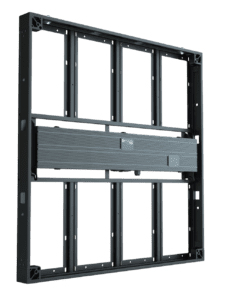
The heat path runs from the LED package into the PCB, through module backing and cabinet structure, then out through convection, radiation and, where designed, active airflow. Each joint in that path adds thermal resistance.
IP ratings exist for good reason — rain, dust, insects and coastal salt spray will destroy unprotected electronics. But every gasket and seal that keeps moisture out also keeps heat in. IP65, for example, describes protection against dust and water jets under defined test conditions as outlined in the IEC IP rating standard. It doesn’t prove that the display can reject enough heat on a south-facing wall in July.
For fine-pitch outdoor projects, the thermal design gets tighter because the LED density is higher. A P2.5mm outdoor LED display packs roughly ten times the pixel count of a P8 per square metre, so power density, module design and service access deserve more attention.
Cabinet Cooling: Passive, Active and Hybrid
Most outdoor LED cabinets rely on passive cooling — natural convection carries heat from the cabinet rear into the air gap behind the display. This works well when there’s enough metal mass, external surface area and a minimum 100–150mm air gap behind the cabinets for chimney-effect airflow. Passive cooling isn’t the same as “no thermal design.” It often needs more disciplined cabinet selection and mounting detail because there’s less mechanical assistance if the rear space gets hot. Our LED display power and cooling maintenance guide covers the fan and PSU checks that keep an active system healthy.
When passive cooling isn’t sufficient, active options include forced-air ventilation with fans mounted at the top or rear of the structural frame, or dedicated air conditioning units for fully enclosed installations recessed into building facades. Fans need weather protection and maintenance scheduling; filter meshes clog in dusty or coastal environments. AC units add capital cost, energy consumption and condensation risk.
Many permanent outdoor displays use a hybrid approach: conductive cabinet design combined with managed airflow. The DVO cabinet, for instance, uses thermally conductive pads between the module PCB and the aluminium rear shell, creating a direct conduction path that reduces reliance on internal airflow. We reference CIBSE Guide A Section 6 (thermal transmittance and ventilation rates) when modelling heat rejection for enclosed or semi-enclosed LED installations within building envelopes.

For permanent outdoor work, we normally start with the DVO outdoor LED platform rather than rental hardware. The thermal assumptions for fixed outdoor installations aren’t the same as for rental and staging projects where rapid build and touring priorities take precedence.
Planning a permanent outdoor display? Browse our permanent outdoor LED displays or build your specification to model brightness and power requirements for your site.
Site Factors That Shape Thermal Performance
Two displays with the same cabinet and LED specification can behave differently on site. Thermal management doesn’t stop at the cabinet — several installation-level decisions directly affect how well heat dissipates over the display’s lifetime.
Orientation and solar gain. South-facing displays in the UK receive the most solar load. East and west faces get strong morning or afternoon sun at low angles, which can concentrate heat on specific zones. North-facing installations have the least solar load and simplest thermal profile. The Met Office UK climate averages provide useful baseline data, but site conditions still need a project-specific check.
Mounting method. Wall-mounted displays with minimal standoff trap heat between the wall and cabinet rear. Pole-mounted or freestanding structures allow 360° airflow. Front-serviceable cabinets can be mounted with smaller rear gaps since maintenance access doesn’t require reaching behind the display, but the thermal trade-off still applies.
Content and brightness control. A display running full-white content at maximum brightness generates substantially more heat than one showing mixed video content. Average power draw for typical content sits at 350–450 W/m² against a maximum of 600–750 W/m². Automatic brightness sensors, supported by Novastar control systems and Brompton video processing, adjust output in real time based on ambient light. This directly extends LED lifespan by lowering average junction temperatures across the operating cycle.
Surrounding surfaces. Cabinet colour, nearby materials and reflected heat all contribute. A display above dark paving can see more reflected heat than one above grass. A display mounted near a glass facade can pick up reflected solar load. We can’t always control the front face colour — black is needed for contrast — but we can avoid adding unnecessary heat through poor rear enclosure design or unsuitable cladding around the display.
Outdoor LED Thermal Management: Lessons From the Field
I’ve seen more brightness problems caused by the wall around the display than by the LED module itself. One retail site in central London — a 12 m² P4 display recessed into limestone cladding — was hitting 70°C cabinet temperatures by mid-afternoon in summer because the builders had sealed the rear cavity completely. My first question on those jobs isn’t the pixel pitch. It’s where the heat is meant to go.
I’d rather specify enough brightness headroom and control it properly than run a display hard from morning to night. Get the airflow right first, and the brightness takes care of itself.
Outdoor LED Thermal Management: Frequently Asked Questions
What temperature is too hot for outdoor LED displays?
Most outdoor LED displays are rated for continuous operation up to 50–60°C ambient. The critical number is junction temperature at the chip level, which runs 15–25°C above ambient depending on cabinet design and power load. When junction temperatures regularly exceed 70–80°C, brightness degradation accelerates. There isn’t a single safe number because it depends on the LED package, driver design and cabinet construction.
What is the most common thermal mistake on outdoor LED projects?
Designing the display and the wall separately. The LED cabinet may have a workable cooling strategy, but the finished construction can block rear airflow, trap rising heat or make fans impossible to service. Thermal management has to be reviewed with the mounting structure, cladding and maintenance route included, not treated as the LED supplier’s problem alone.
Does IP65 weatherproofing make thermal management harder?
Yes. IP65 relates to dust and water protection under defined test conditions (as defined by IEC 60529), not thermal performance. A tightly sealed front face is essentially a sealed barrier. The rear of most outdoor cabinets carries a lower rating (IP54) partly to allow some convective heat exchange. The structural frame behind the display should be designed with adequate air gaps and, where needed, forced ventilation to compensate.
How much brightness loss should I expect over five years?
A well-specified outdoor LED display such as the DVO series should retain 80–90% of original brightness after 50,000 operating hours when junction temperatures are kept below 70°C. Poor thermal management can push that figure below 60% in the same period. The gap between a well-specified and a poorly specified installation is substantial — it’s the difference between a display that’s still readable after seven years and one that needs replacing after four.
Do finer pixel pitches run hotter?
Yes. Finer pitches pack more LED chips and drivers per square metre, increasing power density. A P2.5mm outdoor LED display has roughly ten times the pixel count of a P8. This doesn’t make fine-pitch outdoor displays unsuitable — it means their thermal design needs to account for the higher power density from the outset, with closer attention to cabinet cooling, brightness headroom and service access.
Can automatic brightness control extend display life?
It can. Reducing output when full brightness isn’t needed — especially in dull weather or at night — cuts both power consumption and heat generation. It should be commissioned carefully so the display remains legible while avoiding unnecessary stress on the LEDs and power system. This isn’t just an energy-saving measure; it directly extends LED lifespan.
Should I specify active cooling for every outdoor installation?
Not necessarily. Many installations perform well with passive cooling alone, provided the structural design allows adequate airflow behind the cabinets. Active cooling becomes important for enclosed installations recessed into facades, south-facing displays in areas with high summer temperatures, or very large continuous arrays where heat accumulates across the full area.
Conclusion
Heat doesn’t usually announce itself with a dramatic failure. It shows up as brightness loss, colour drift, uneven modules and harder-working power supplies. Good outdoor LED thermal management starts with the real operating conditions: brightness target, solar exposure, cabinet depth, IP rating, rear airflow and service access. Once those are understood, we can choose the right permanent outdoor hardware, set sensible control behaviour and avoid forcing the LEDs to run at the edge of their capability. The specification choices made before installation have a far greater impact on long-term performance than any maintenance schedule after the fact.
Ready to discuss outdoor LED thermal management for your next project? Call +44 (0)203 489 9878 or book a site survey to review thermal design, brightness headroom and cabinet selection for your site. You can also explore our outdoor LED range to compare specifications across our permanent outdoor platform.