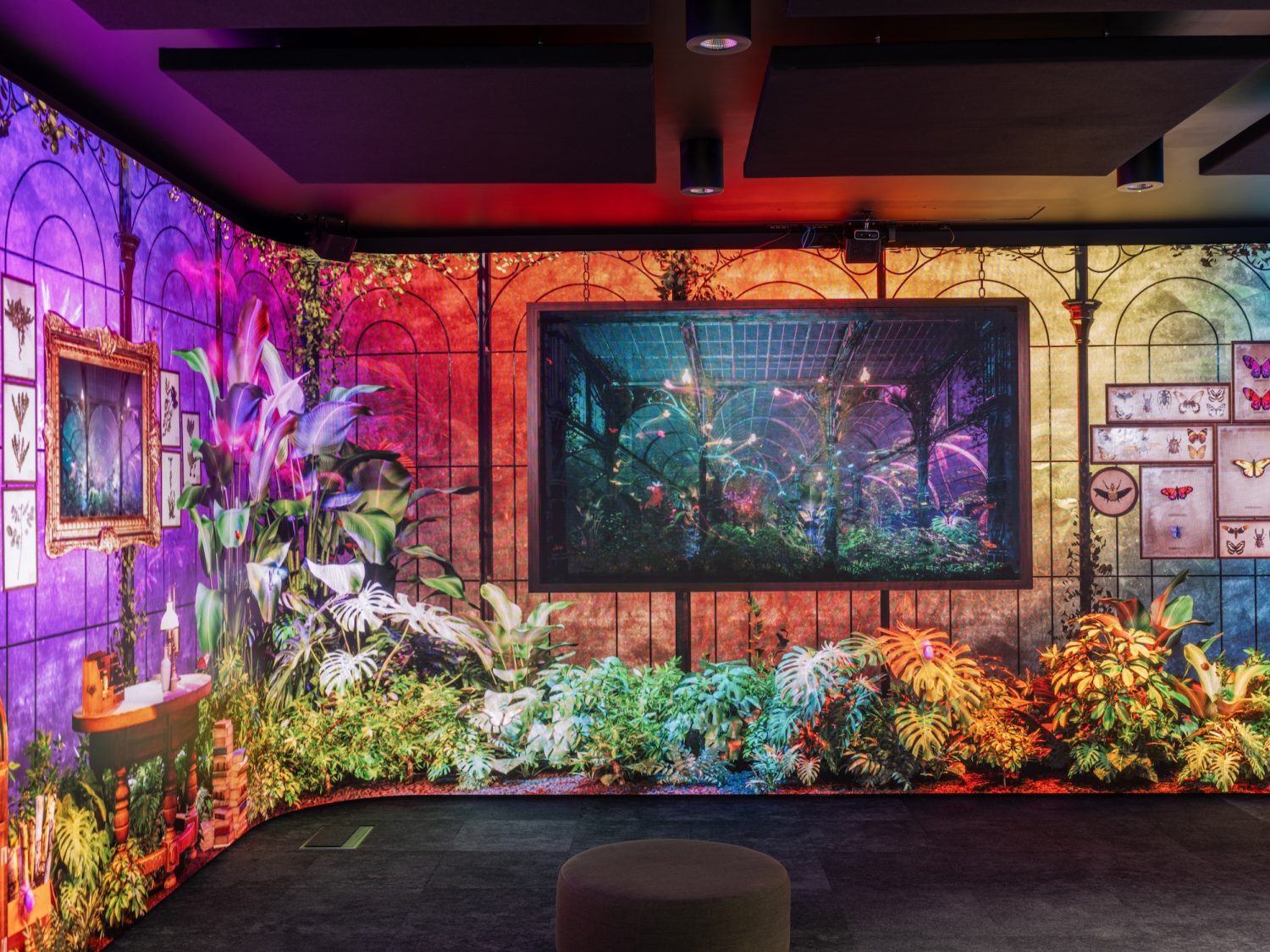
The question we get from exhibition designers and estates teams is nearly always the same. How do we put a large LED screen into a heritage or gallery space without it looking like a shopping centre? LED screens for museums and galleries work when the screen disappears into the exhibit and the content does the talking. That means the right pixel pitch for the closest visitor, a front surface that survives hands and cleaning, brightness set for the room rather than the datasheet, and museum digital signage a small in-house team can run for years. None of the projects in this guide is a national museum, but all three share the museum problem: close viewers, dark rooms and content never authored for LED. The lessons come from the culture-sector projects in our work.
Key takeaways
- Rule of thumb: pixel pitch in millimetres equals minimum viewing distance in metres. A visitor at 1 m needs 1.5 mm to 1.9 mm.
- Contrast and surface finish matter more than peak brightness indoors. A darker, resin-protected LED surface reads better than a bright glossy one under gallery lighting.
- Work out the native canvas from the cabinet layout before content production begins, and hand the content producer that pixel map.
- Immersive rooms live or die on geometry, calibration and content workflow, planned together rather than in sequence.
- Interactive walls are one signal chain, from sensor to processor to LED. Bolting interaction on afterwards is where projects go wrong.
- Permanent exhibits suit DFC or DX Series cabinets. Temporary shows and touring exhibitions suit DRE hire stock, delivered and struck on the exhibition calendar.
- Give building services the calibrated power draw, not the nameplate load, and agree technician access before the joinery is drawn.
At a glance: three culture-sector projects
| Project | Setting | What we supplied | Format / pitch |
|---|---|---|---|
| Pixel Artworks Lighthouse, Farringdon, London | Creative HQ and client experience space | 270° immersive LED room, history wall, joinery-split bar wall, camera-driven interactive wall | Permanent, about 61 m² of LED across four features. Immersive room 16.36 m × 2.48 m at 1.95 mm, resin-protected DRE Series |
| Zach Lieberman exhibition at Verse, Cromwell Place, South Kensington | Contemporary digital art gallery | Two 2 m × 2 m high-contrast LED screens for digital artworks | Temporary exhibition, hire stock deployed at a night’s notice, pitch not recorded |
| Botto’s Algorithmic Evolution at Verse, Mortimer Street, London | Four-day generative art exhibition, February 2025 | 24 fine-pitch screens: 22 plinth-mounted panels and two back-to-back walls | Hire, 1.29 mm DRE Series plinth panels and 2.48 m DEX Series walls at 2.06 mm |
Why LED screens for museums and galleries need a different specification
LED screens for museums and galleries need a finer pixel pitch, a protected front surface, lower calibrated brightness and per-cabinet colour control than retail displays, because visitors stand within a metre of the screen under conservation lighting. Specify from the closest viewing position, not from the datasheet. A retail video wall is designed to be seen from across a concourse. A gallery screen is stood in front of, sometimes for minutes, next to objects that must not be washed in stray light.
Start with viewing distance. Pixel pitch in millimetres equals minimum viewing distance in metres: a 2.5 mm LED screen reads as continuous from 2.5 m, a 1.5 mm screen from 1.5 m. Below that distance the pixel grid becomes visible. In an exhibition hall where the barrier rope sits 600 mm off the wall, that points you towards 1.5 mm or finer. Measure from the real visitor route, including benches, wheelchair positions and children sitting close to the work. Our pixel pitch guide walks through the maths in more detail.
The canvas comes next. Every LED wall has a native resolution defined by cabinets across and cabinets high multiplied by the pixels per cabinet. A finer pitch means more pixels, more processing and more data distribution for the same wall size, and it changes what the content team has to author. We hand the content producer the exact pixel map before a single cabinet is ordered, because content scaled on the fly loses sharpness and can introduce banding in slow gradients.
The surface itself is the third decision. Standard SMD (surface-mounted device) modules have exposed LEDs on a black mask. They look excellent but are vulnerable to a knock from a pushchair, a handbag or a school group. Resin-protected or glue-on-board finishes bury the LEDs in a hard coating. They cost more per square metre but they clean with a cloth and shrug off contact. For any exhibition display visitors can reach, we specify a protected surface as standard.
Brightness, black level and colour for gallery LED screens
Gallery LED screens should be indoor-rated cabinets calibrated to the room and locked in the processor, not high-brightness retail products turned down. Dimming a cabinet built to fight daylight to a fraction of its output flattens the greyscale, which is exactly where dark artworks and slow fades live.
Don’t ask how bright the screen is. Ask what output keeps the contrast in that room. Ambient light, wall colour, reflective flooring and nearby projection all affect the answer, so commissioning should happen under the final lighting states with dark greys, slow fades and near-black transitions as well as bright footage. Once the level is agreed, lock it in the processor so a well-meaning volunteer cannot turn it up.
Galleries care about colour accuracy in a way few other sectors do. Ask for factory calibration data per module, plan a post-install calibration on site, and choose a processor that supports per-cabinet colour and brightness adjustment. Both Brompton and Novastar processors handle this well. At the Lighthouse we specified a NovaStar H2 to suit the mixed video and interactive workflow. The project still needs a practical approval process: controlled test material agreed with artist and curator, and a recorded configuration that can be restored after servicing.
Immersive LED rooms for museums and galleries
An immersive LED room wraps the screen around two, three or four walls so the visitor stands inside the image. It works when the corner geometry, cabinet tolerance, calibration and content workflow are designed together. Done badly, it is a room with obvious seams and a perspective break in every corner.
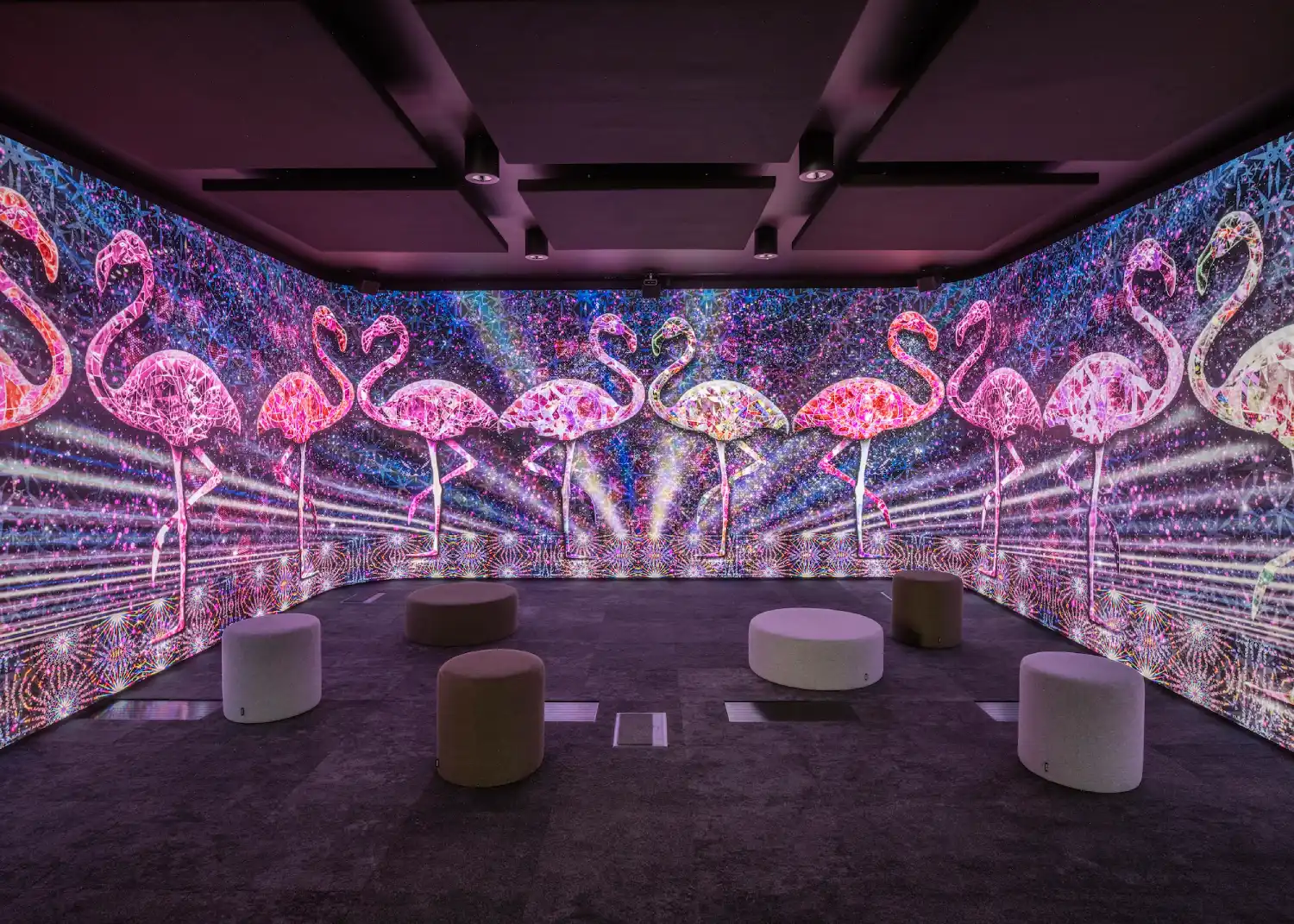
The Originals Theatre in the immersive LED room at the Pixel Artworks Lighthouse in Farringdon is a 270° wraparound room, 16.36 m along the wrap and 2.48 m high. Pixel Artworks designed it with curved corners rather than mitred ones, specifically to remove the perspective break the eye picks up at a hard 90° join. They chose a resin-protected DRE Series cabinet at 1.95 mm over a standard SMD equivalent for contrast, colour reproduction and durability, because clients stand within touching distance of the wall.
Geometry first. Curved corners need cabinets that can be arranged on a radius, and the radius sets the cabinet width you can use. Decide the geometry before you choose the product, not after. Curves also raise the stakes on mechanical tolerance, because a step between cabinets on a radius shows as a shading change on the front face.
Content to the pixel map. A curved room has one native canvas. Content authored to a generic frame and scaled at playback softens exactly the detail the visitor is standing close enough to see.
Access and maintenance. A room with LED on three sides has one way in. Agree how a technician reaches every cabinet, where the power and data distribution sits, and how a failed module is swapped without closing the exhibition for a day.
For a permanent museum room we normally specify from the fixed-install ranges. The DFC Series at 1.5 mm is the premium option and the DX Series at 2.5 mm suits larger rooms where visitors are held further back. Details are on our 1.5 mm direct-view display page and our 2.5 mm direct-view display page. Where the design calls for a curve tighter than rigid cabinets allow, or a ceiling element, the LVW flexible curtain can follow the form.
If you are moving a cultural project from concept into technical specification, our LED video walls page covers the fixed-install ranges in more depth, and the sector case studies in our work show what each range looks like installed. To talk through a pitch study, a content resolution or an access constraint before the wall build and media package are fixed, contact us.
Interactive LED walls in museums: one signal chain, not a bolt-on
An interactive LED wall is one signal chain, from sensor or camera through compute and processor to the screen, and it should be documented and signed off by the LED supplier and the content studio together. Interactive exhibits are where museums most often get burned: a supplier fits a wall, a separate studio builds a touch or camera experience, and the two meet on site a week before opening.
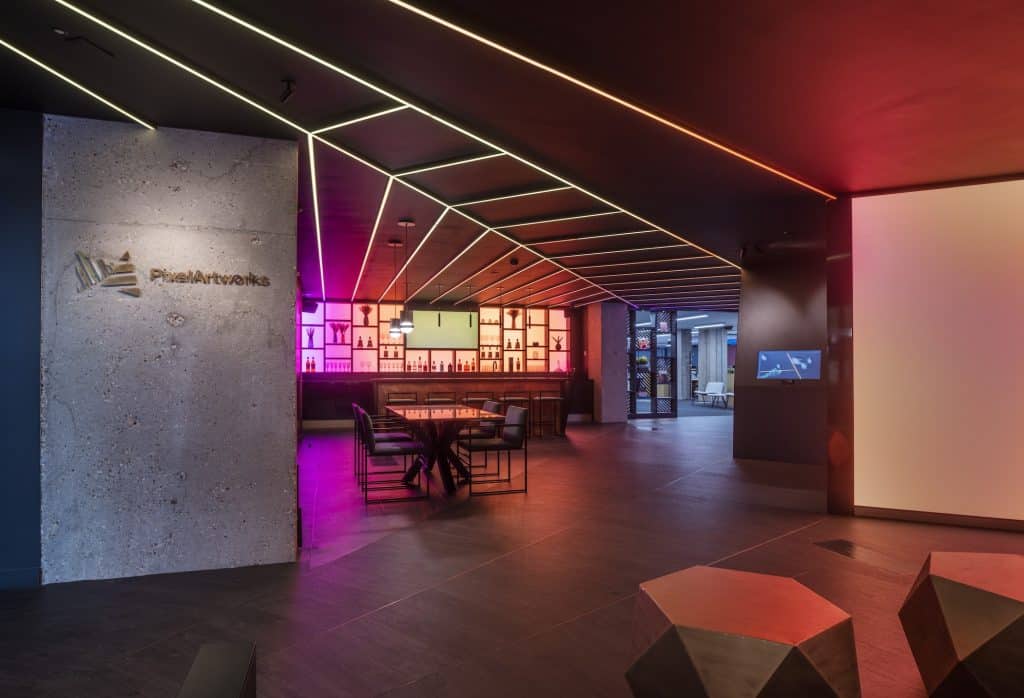
The interactive wall at the Lighthouse is 3.0 m wide and 2.5 m high. Visitors type a prompt on a tablet, the system generates camera-driven visuals, and the LED wall shows the result. Before we built it, we documented the whole signal chain: input device, compute, processor, LED. That forces the answers to the questions that otherwise surface on opening week.
- Where do the cameras or sensors physically mount, and do they have line of sight past the visitors?
- Where does the real-time processing run, and what happens if that PC fails?
- What latency is acceptable before the response feels disconnected from the visitor’s action?
- How is the interactive content tested against the real pixel map, not a monitor?
- What does the wall show if tracking stops? It should be an intentional state, never an error window or a black input.
- Who resets the exhibit at 9 am and who gets the call when it hangs?
Test against real visitor behaviour, too: several people at once, someone standing still, someone crossing a tracking zone halfway through a sequence, mobility aids and different body heights. Where the wall carries instructions or interpretive text, the GOV.UK guidance on WCAG 2.2 is a useful reference for contrast and understandable interfaces, alongside a physical assessment of routes, reach and captions.
Our custom LED displays team handles the unusual formats this work tends to produce, from odd aspect ratios to LED set into cases and plinths.
Hiring LED screens for temporary exhibitions and touring shows
Shows that run for weeks rather than years are usually better served by hire stock than a fixed installation. Hire cabinets are built for repeated rigging, come with crew and transport, and sit on the exhibition budget rather than a capital one.
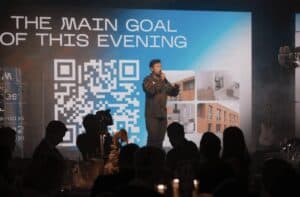
We supplied two LED screens for the Zach Lieberman exhibition at Verse, a clean, minimalist gallery at 4 Cromwell Place in South Kensington showing mostly digital art. The organisers asked us the night before opening for two 2 m × 2 m screens with enough contrast to do justice to generative work. We delivered and rigged them for the run and struck them at the end. We returned to Verse in February 2025 with 24 fine-pitch screens for Botto’s Algorithmic Evolution: 22 plinth-mounted DRE Series panels at 1.29 mm, one algorithm per panel, and two 2.48 m DEX Series walls at 2.06 mm mounted back-to-back in the centre of the gallery. Four days, 24 screens, no dead panel. For that kind of work the DRE Series hire fleet is the right tool.
Hire cabinets should not become the default for a permanent wall, though. A fixed installation usually benefits from reduced depth, installation-specific framing and front service access, which is what the DFC and DX ranges are for.
Two practical points for temporary shows. Floor loading and fixings in a listed building are often the limiting factor, so send the venue’s structural constraints early and let the supplier choose between ground-supported and flown builds. And black level matters more than brightness for art content: a deep black mask makes a dark artwork sit on the wall rather than glow in a grey rectangle. Details of what we hold in stock are on our LED screen hire page.
Installing LED screens in a museum: heat, acoustics and access
Installing an LED screen in a museum means planning heat, noise, structure and service access around the collection before the joinery is drawn. A corporate reception forgives most of these. A gallery with loaned textiles does not.
Working at height around collections needs a method statement the venue’s conservation team will accept. We work to the Work at Height Regulations 2005 and build around the object-handling rules the venue sets. For loaned objects, the environmental and security conditions attached to the loan can dictate where a screen may sit and how much heat it may emit.
An LED wall is a heater. A 20 m² wall at conservation brightness dissipates far less than the same wall at full output, but it still needs to be accounted for in the room’s environmental control if paintings or textiles share the space. Give the building services engineer the maximum connected load for distribution design and the expected draw at the calibrated brightness for heat removal, not just the nameplate figure.
Acoustics matter in quiet galleries. Power supplies, media servers and ventilation can become audible during low-level sound works or silent installations. Assess noise in the final operating mode, not during a bright factory test.
The steelwork behind the wall may be hidden, but inaccuracies there appear on the front face. The frame needs adjustment in several axes, planned cable paths, ventilation, and a safe way to remove modules and power supplies. Front service access reduces depth but technicians still need to reach every part and have somewhere to put a removed module. Screens set into cases, plinths and joinery need this agreed at drawing stage, which is where our custom LED displays team usually gets involved.
Power and data should reach the wall through dedicated, labelled routes planned in the joinery drawings. We have found more than one exhibit running from an extension lead behind a plinth, and it never ends well.
Commissioning should reproduce the exhibition, not a showroom. Check alignment across the whole surface, confirm mapping against native content, record the processor settings, test restart after a power interruption, and run a camera test if the work will be filmed.
Content management decides whether the exhibit still looks right in three years. A museum digital signage setup should not need a specialist to update. A simple playback device feeding the processor, with a schedule and a locked brightness, is enough for most permanent exhibits. Keep the interactive compute and the playback separate so a crash in one does not take the other down. On handover we leave the processor configuration, calibration files and a spares list with the venue, and we suggest keeping them with the exhibit records rather than in a contractor’s inbox.
Our standard warranty covers the cabinets on a three-year return-to-base basis, with module-level spares held so a single failed tile does not become a shipping exercise. If you want an early feel for sizes and pitches before a site visit, the LED screen configurator gives a first pass.
From the field
I spent a long time at the Lighthouse looking at corners. Pixel Artworks had made the call to curve them rather than mitre them, and when I stood in the centre of the room the image just carried on round. No line, no perspective jump. The trade-off was that every cabinet on the radius had to sit within a tight tolerance, and my team spent longer on the mechanical alignment than on anything else. That is the part nobody photographs, and it is the part that makes an immersive room work.
The Verse job was the opposite end of the scale. A phone call the evening before, two square screens, a gallery that wanted the art to look like it was hanging on the wall rather than playing on a telly. My worry going in was contrast, because generative art has a lot of near-black. We sent the highest-contrast hire stock we had and it paid off. I now ask to see the darkest material early on every gallery job, because bright footage makes almost any sample look good for a few minutes. What I took from both projects is that museums and galleries do not want the screen noticed. They want the work noticed.
LED screens for museums and galleries: frequently asked questions
What pixel pitch do LED screens for museums and galleries need?
Choose the pitch from the closest point a visitor can stand. The pitch in millimetres equals the comfortable viewing distance in metres. Where a barrier holds visitors about a metre back, 1.5 mm to 1.9 mm is typical. Larger halls where the wall is viewed from several metres can use 2.5 mm without visible pixel structure. Test representative content at the real distance.
Are LED screens too bright for a gallery environment?
Not if they are specified for indoor use and calibrated on site. Brightness is locked in the processor at a level suited to conservation lighting, so staff cannot accidentally raise it. Choose a cabinet designed for indoor viewing rather than a retail or outdoor product turned down, because heavily dimmed high-brightness cabinets lose greyscale detail in dark scenes.
Can visitors touch an LED screen without damaging it?
Standard surface-mounted LED modules are vulnerable to knocks and should be kept behind a barrier. Resin-protected or glue-on-board finishes seal the LEDs in a hard coating that resists contact and can be wiped clean. For any exhibition display within reach of the public, including immersive rooms and interactive exhibits, we specify a protected surface as standard.
How do immersive LED rooms avoid visible seams and corner breaks?
Curved corners remove the perspective jump the eye sees at a hard 90° join. Cabinets are arranged on a radius, mechanically aligned to tight tolerances, and calibrated as one canvas. Content is authored to the exact pixel map of the room, so nothing is scaled at playback. The Pixel Artworks Lighthouse used this approach on its 270° room.
Should a museum buy or hire LED screens for an exhibition?
Permanent galleries and long-running exhibits justify a fixed installation using DFC or DX Series cabinets, with framing and service access designed for the room. Temporary shows, touring exhibitions and events lasting weeks rather than years are usually better served by DRE Series hire stock, which is built for repeated assembly and can be delivered, rigged and struck around the exhibition calendar.
Can an LED screen be filmed without scan lines?
It can, but a high quoted refresh rate does not guarantee the result on its own. Camera frame rate, shutter settings, LED scan behaviour, brightness and processor configuration all interact. If visitors, broadcasters or a documentation team will film the work, test the intended cameras and shooting formats during commissioning rather than relying on a single datasheet figure.
Can an LED screen be built into a case, plinth or unusual shape?
Yes. Cabinets come in fixed modules, but custom framing, flexible LED curtain and bespoke fabrication allow columns, curves, ceiling elements and screens set into joinery. The bar wall at the Lighthouse was split across joinery sections and mapped as one canvas, and the Botto panels were plinth-mounted. Our custom LED displays team handles this work, with maintenance access agreed at drawing stage.
Who maintains the screen after the exhibition opens?
Most permanent installs are run day to day by in-house staff using a playback device and a scheduled brightness profile. Our cabinets carry a three-year return-to-base warranty, and we hold module-level spares so a single failed tile is swapped rather than shipped. Interactive exhibits should have a documented reset procedure, stored configuration backups and a named contact for faults.
Conclusion
Get the pitch, surface and brightness right for the room and the screen stops being the story. That is the whole brief for LED screens for museums and galleries, whether the exhibit is a 270° room or a single square canvas for digital art.
Send us the drawings and the closest viewing distance for your LED screens for museums and galleries. Contact us or call +44 (0)203 489 9878 and we will come back with a specification you can put in front of the design team.