Key takeaways on how to specify LED panels for an event
| Topic | Quick rule | Why it matters | Pro tip |
|---|---|---|---|
| Pixel pitch & viewing distance | Minimum comfortable distance (m) ≈ pixel pitch (mm). For crisp text or on-camera work use 1.5–2×. | Legibility, perceived sharpness and reduced moiré on cameras. | Plan from the front-row distance; if filming, validate with camera tests. |
| Brightness (nits) | Indoors: 800–1,200. Outdoors: 3,500 and above for daylight; more for direct sun. | Readability against ambient light and sunlight. | Don’t run 100% for long periods; manage glare for cameras. |
| Refresh rate (filming) | Specify up to 3,840 Hz. Match camera shutter and frame rate in rehearsal. | Prevents flicker, banding and rolling artefacts on video. | For broadcast-critical work, ask for synchronisation or genlock. |
| Ingress protection (IP) | Outdoor rain exposure: IP65 (front) typical; confirm rear protection. | Weather resilience and electrical safety. | Use connector covers and drip loops; check cable routing. |
| Rigging & wind planning | Engineer sign-off; size ballast to calculations; set wind action thresholds. | Structural safety and event continuity. | Prefer truss for outdoor; define “pause/strike” wind speeds in RAMS. |
| Power sizing | Single-phase: A ≈ (Max W/m² × area m²) ÷ 230. Three-phase: I ≈ P ÷ (√3 × 400 × pf). | Prevents trips and overheating; protects upstream supplies. | Add at least 15% headroom; separate feeds for audio and lighting where possible. |
| Weight & access | DRE Series: 9.2 kg per 496 × 496 mm cabinet (about 37 kg/m² before frames). Verify floor loading and access routes. | Staging safety and manual handling planning. | Confirm lift sizes, door widths and any load restrictions early. |
| Curves & floors | Use compatible frames and locks; check allowed angles and floor load limits. | Guarantees fit-up and protects modules. | For interactive floors, specify slip rating and protective surface. |
| Control system | NovaStar for most shows; Brompton or advanced processing for complex camera workflows. | Colour pipeline consistency and camera performance. | Request a 1:1 pixel map and a backup controller where mission-critical. |
| Content delivery | Design to the wall’s exact pixel resolution; avoid tiny fonts. | Sharp, artefact-free playback. | Supply a pixel map early; test key slides and videos on site. |
Note: ranges are typical; exact values depend on the chosen system and content. DRE Series figures are from the Dynamo datasheet.
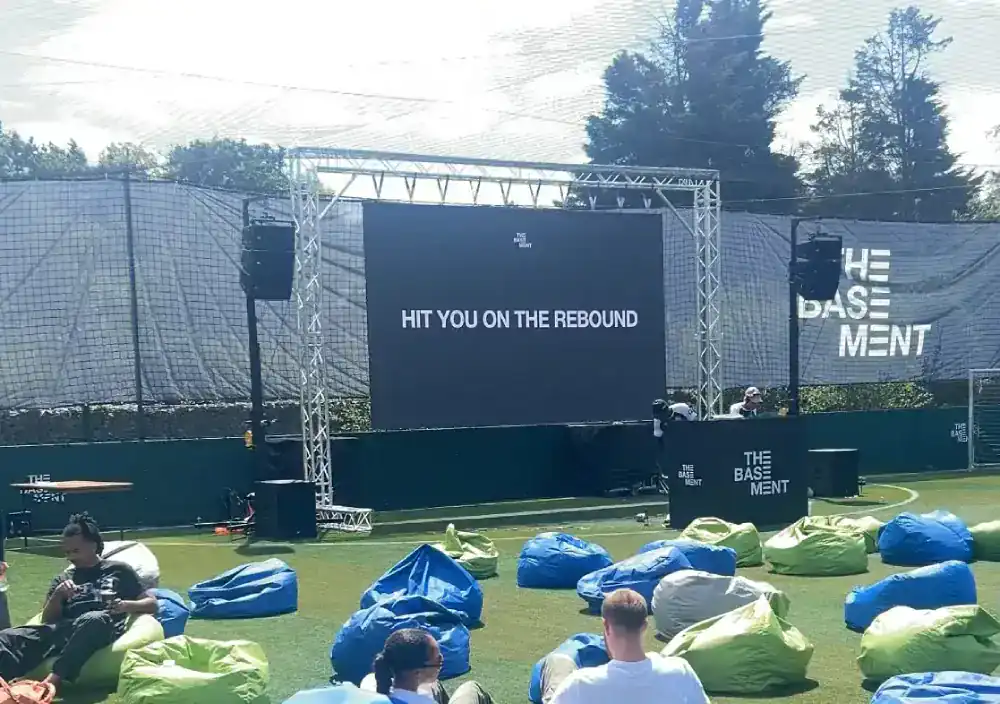
Specifying rental LED panels: the figures that matter
Pixel pitch and viewing distance
Pixel pitch is the distance from the centre of one LED pixel to the next, measured in millimetres. A simple rule of thumb:
Minimum comfortable viewing distance (metres) ≈ pixel pitch (mm) × 1.5–2.0.
Examples: 1.9 mm → about 3 m; 2.6 mm → 4–5 m; 3.9 mm → 6–8 m. The LED video wall viewing distance guide works through the arithmetic in more detail.
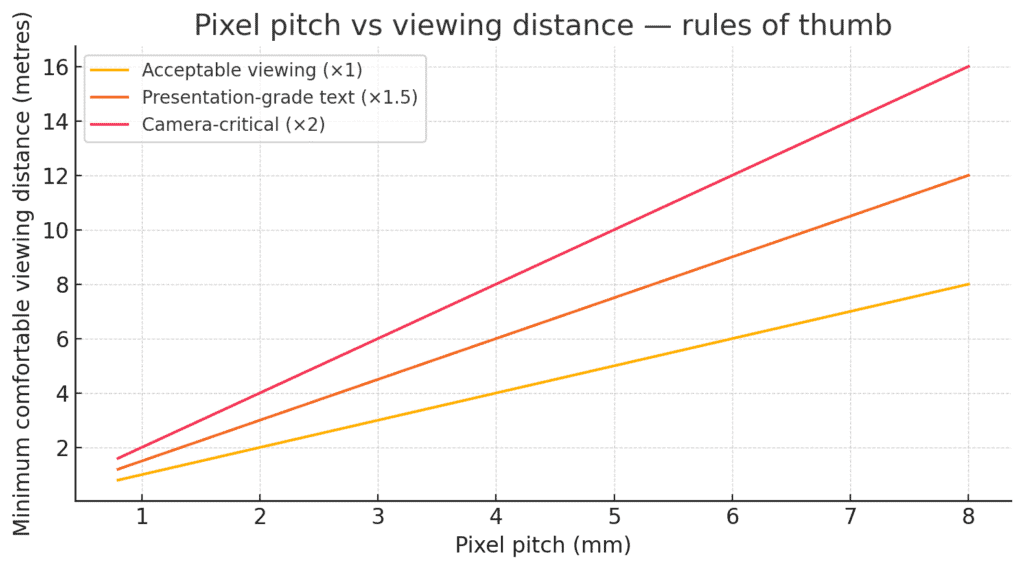
If your audience is closer than the minimum distance they will see individual pixels. Further back, a finer pitch still looks sharper, in the same way a 4K television looks better than an HD set of the same size at the same distance, so a lower pitch is rarely wasted where the budget allows. For conferences, awards and LED backdrops behind a lectern, 1.9–2.6 mm is common. For larger stages and fan zones viewed at distance, 3.9 mm is a proven workhorse.
Brightness (nits)
Nits measure luminance. Indoors, 800–1,200 nits is usually ample; DRE Series indoor cabinets are rated above 800 nits. Outdoors you are competing with sunlight, so specify 3,500 nits and above for daylight, which is where DRE outdoor cabinets sit, and more where the screen faces direct sun. Fixed outdoor displays built for full sun run higher still. Higher brightness increases power draw and heat, so plan power and ventilation accordingly.
Refresh rate and filming
A low refresh rate can strobe or band on camera. For events that will be filmed or live-streamed, specify up to 3,840 Hz and coordinate with the video director on camera shutter angles. Where critical, request signal chains that support frame synchronisation or genlock to your broadcast system. See genlock for how the synchronisation works.
Colour uniformity and batch consistency
Ask whether the rented cabinets come from the same LED batch and are calibrated as a set. Mixed batches can create visible brightness or colour seams on gradients and skin tones.
IP rating and environment
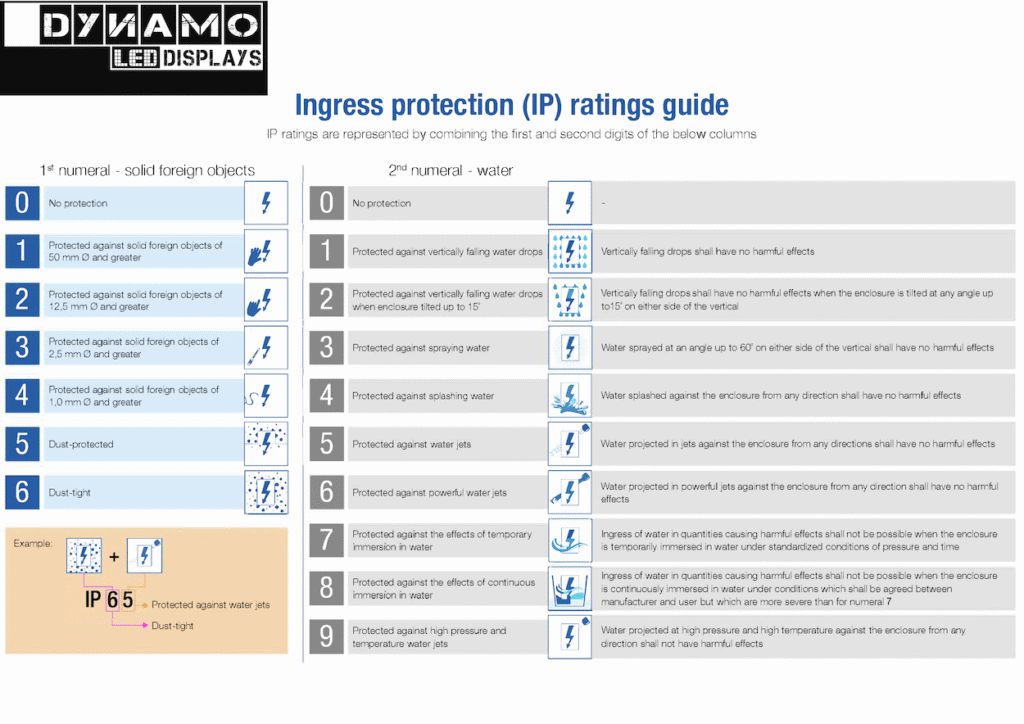
Outdoor events demand hardware designed for the elements. IP65 on the front face is the common minimum for rain exposure; it indicates a dust-tight enclosure with resistance to water jets under IEC 60529. Confirm the rear rating too: DRE outdoor cabinets are IP65 front and IP54 rear, so cable ingress and connector covers still belong in the risk assessment.
Weight, rigging and logistics
LED walls act like sails in wind and add concentrated point loads to truss or ground-stack systems. A DRE Series cabinet weighs 9.2 kg (496 × 496 mm), roughly 37 kg/m² before frames, rigging and processors are added. Ensure your supplier provides:
- Total system weight (cabinets, frames, rigging, processors).
- Certified rigging plan and wind-load analysis for outdoor builds.
- Safe Working Load (SWL) and inspection documents for lifting equipment, in line with the PLASA rigging and stage engineering guides.
Built for the road: what makes a rental panel different?
- Quick-lock and fast rigging: tool-less interlocks and guided alignment pins reduce build times and improve seam quality.
- Lightweight, robust frames: die-cast aluminium (and, in some systems, reinforced composites) balances rigidity with low weight to ease handling and reduce structural demands.
- Serviceability: front or rear module access and removable power and data packs speed up field swaps.
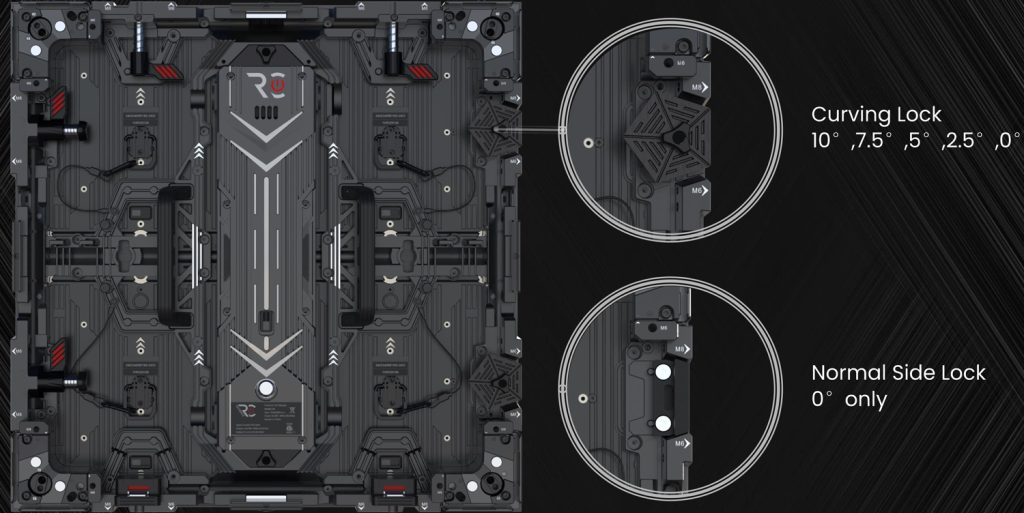
- Creative geometry: rental systems often support concave and convex curves, columns and arches using compatible frame kits, useful for theatrical reveals and exhibition features.
- Ruggedised faces: resin-protected surfaces such as X-GOB glue-on-board protection improve impact, moisture and dust resistance while keeping deep blacks and high contrast, ideal for high-traffic environments.
Dynamo works extensively with NovaStar control systems and show-ready workflows to ensure rapid deployment and colour-consistent results across mixed content formats.
Outdoor events: plan for weather and wind
Taking your screen outside introduces three non-negotiables:
- Ingress protection: specify at least IP65 (front) and inspect seals, gaskets and connector covers.
- Brightness headroom: target 3,500 nits and above for overcast daylight; push higher for direct sun.
- Engineering and safety: obtain structural sign-off, ground anchorage details for ground stacks, and a wind action plan (build, operate and de-rig thresholds) in line with the HSE guidance on temporary demountable structures.
Checklist: 10 questions to ask an LED wall rental company before booking
- Who is on site? Will an experienced LED technician stay through rehearsals and live?
- What are the contingencies? Confirm spare cabinets, PSUs, receiver cards and data and power leads.
- Batch consistency: are all tiles from the same LED batch and pre-calibrated together?
- Schematics: request power distribution and data topology (redundant loops where available).
- Structural data: total weight, centre of gravity, wind ratings and rigging method (fly or ground stack).
- Camera plan: stated refresh rate, potential genlock and tested camera settings for rehearsal.
- Ingress protection: for outdoor, written confirmation of the IP rating and any rain shrouds or connector covers.
- Power budget: maximum W/m² and circuit plan. A simple sizing formula: Max amps ≈ (Max W/m² × screen area m² ÷ 230) × 1.15. The 1.15 factor adds a sensible allowance.
- Content checks: native resolution, aspect ratio and safe areas for lower thirds, interpreter boxes or ticker elements.
- Evidence: showreels and case studies for similar venues and audience distances. For a worship setting, see our guide to LED screens for churches.
Rental LED panels in practice: Dynamo event projects
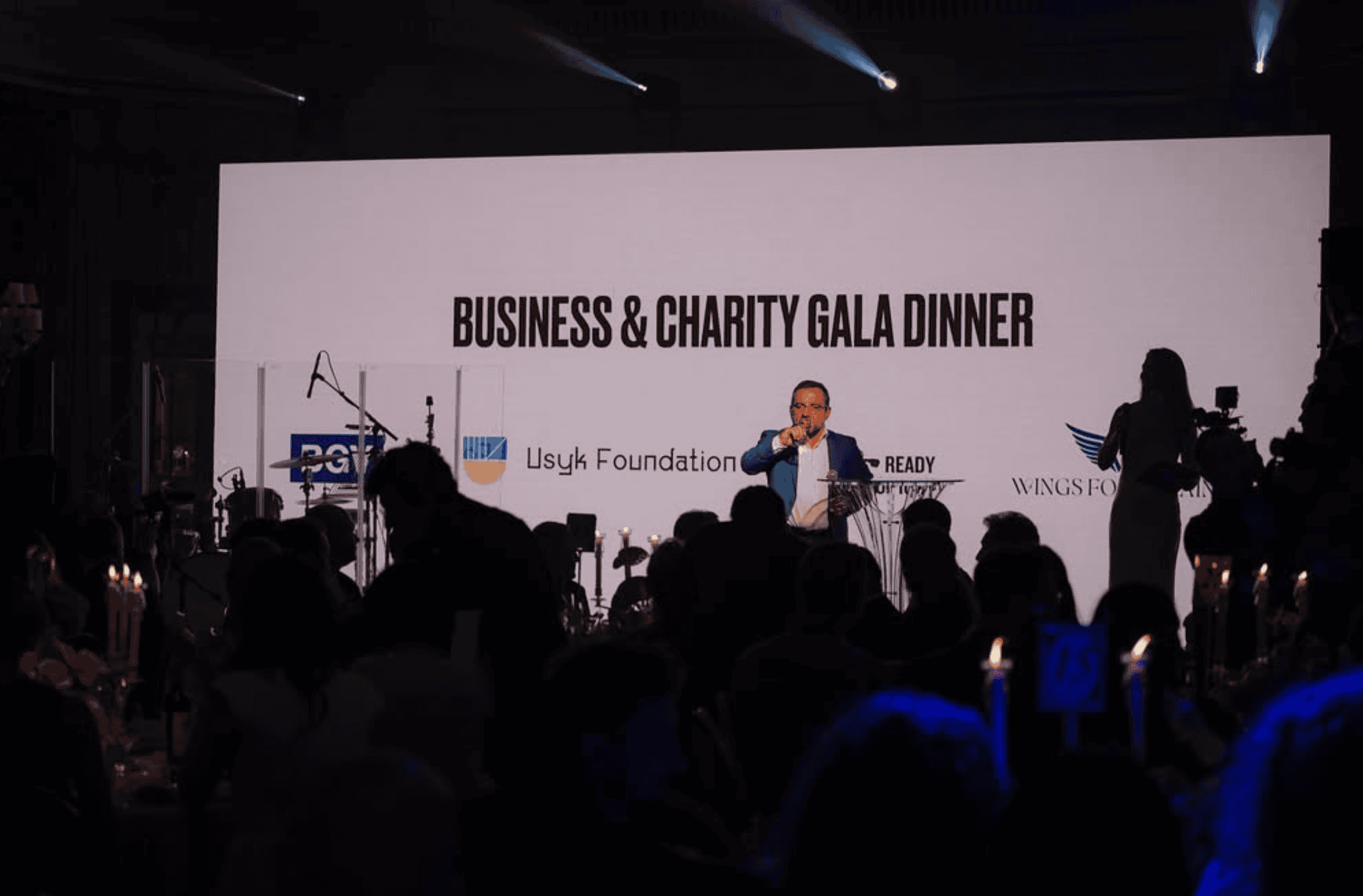
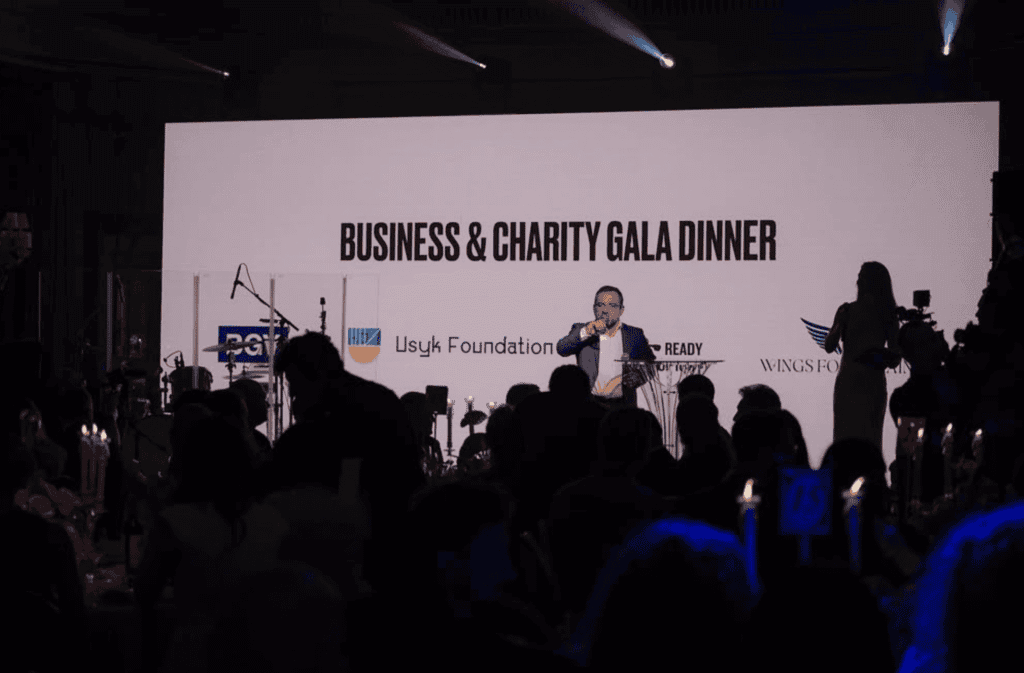
2 mm DRE Series backdrop for Oleksandr Usyk’s charity gala, The Dorchester
For the Usyk Foundation gala on 18 July 2025, Dynamo built a 7 m × 3 m DRE Series screen at 2 mm pixel pitch in the Dorchester ballroom. It carried live auction feeds, video montages and camera close-ups, driven by a NovaStar H5 splicer and a media server. The fine pitch mattered because the evening was filmed close to the stage. Full write-up: Oleksandr Usyk charity ball at The Dorchester. For a smaller indoor hire from the same 2 mm stock, see the big TV hire for the Fiit x WIT Fitness launch at One New Change.
270 m² of exhibition LED for BAE Systems at DSEI, ExCeL London
At DSEI 2021 the BAE Systems stand used 270 m² of LED in total: 52 double-sided totems, L-shaped banners, headers and a 10 m × 4 m right-angle hub in 2 mm high-contrast LED, all run as one canvas from a control server after a week of on-site testing and rehearsals with the film crew. Full write-up: BAE Systems at DSEI 2021.
Budgeting power on real shows
For outdoor fan zones we budget power from the cabinet’s maximum W/m² figure with the formula above, then cap peak white in content, because full-screen white slugs are rare in real productions. A 7 m × 3 m DRE wall at its 600 W/m² maximum draws up to 12.6 kW, about 55 A single-phase, so with the 1.15 allowance we plan for a 63 A supply. Capping white preserves headroom, reduces generator size and keeps the screen cool without a visible loss of brightness. The LED screen hire power requirements guide covers the calculation in full.
Typical configurations and use cases
- Conference backdrops (indoor): 1.9–2.6 mm; 800 nits and above; up to 3,840 Hz; slim frames for tight stages.
- Festival and arena stages: 3.9 mm main wall; matching side IMAG screens; robust frames; redundant data.
- Outdoor fan zones: 3.9 mm; 3,500 nits and above; IP65 front face (DRE outdoor or DRX outdoor LED); engineered ground stack with ballast and wind plan.
- Immersive activations: resin-protected surfaces such as the DRE Series for touch-prone areas; LED floors (DI Series) for interactive sets; see the LED floor hire at Selfridges case study for a walk-on stage.
Control and content management
- Processors: we deploy NovaStar and Brompton Technology systems for reliable scaling, mapping and colour management across show conditions.
- Content delivery: for rentals, media servers or switchers feed the processor; for long-term installs, a cloud-based CMS enables scheduled or local updates without constant internet access.
Standards and guidance referenced
- IEC 60529 — IP code definitions for dust and water ingress.
- HSE — UK health and safety guidance for events.
- PLASA — rigging practice and equipment inspection.
- HSE — temporary demountable structures at events.
Event LED screen rental: frequently asked questions
What pixel pitch LED wall do I need for a conference?
Most conference backdrops use 1.9–2.6 mm. Work from the front row: the minimum comfortable viewing distance in metres is roughly the pitch in millimetres times 1.5–2, so a 1.9 mm wall reads cleanly from about 3 m. If the session is filmed or streamed, stay at the finer end so close-up camera shots do not show the pixel grid.
What brightness do I need for an event LED screen?
Indoors, 800–1,200 nits is ample; DRE Series indoor cabinets are rated above 800 nits. Outdoors you compete with daylight, so specify 3,500 nits and above, which is where DRE outdoor cabinets sit, and more where the screen faces direct sun. Higher brightness draws more power and heat, so plan supplies and ventilation to match.
What refresh rate should I ask for if we are filming?
Specify up to 3,840 Hz and rehearse with the cameras. Refresh rate alone does not remove banding: shutter angle and frame rate must be matched to the wall in rehearsal, and broadcast-critical shows should add frame synchronisation or genlock between the processor and the vision mixer.
Do I need IP65 rental panels for an outdoor event?
Yes. IP65 on the front face is the usual minimum for rain exposure, meaning dust-tight and protected against water jets under IEC 60529. Confirm the rear rating too: DRE outdoor cabinets are IP65 front and IP54 rear, so connector covers, drip loops and cable routing still need attention in the risk assessment.
Can rental LED panels curve?
Many rental systems form concave or convex curves using curving locks or compatible frame kits, which is how columns, arches and wrap-around stage sets are built. Ask for the allowable angle per cabinet, whether the curve is inward or outward only, and how seams look at the chosen radius before content is designed.
How do I size power for an LED wall?
Start from the cabinet’s maximum power figure in watts per square metre, multiply by the screen area, divide by 230 for single-phase amps and add a 15% allowance. A 7 m × 3 m DRE wall at 600 W/m² needs about 63 A on that basis. Ask the supplier for circuit layouts and diversity assumptions.
What information should I provide to the rental company when booking an LED wall?
Give the venue, dates and get-in times, the screen size or stage area available, the closest viewing distance, whether the event is filmed, indoor or outdoor exposure, rigging options (fly or ground stack), available power and access routes, and the content format. With those, the rental company can propose pitch, brightness, structure and power without guesswork.
Will a technician stay on site?
They should. Insist on an on-site LED engineer through rehearsals and the live event, plus spare cabinets, power supplies, receiver cards and leads for rapid swaps. Ask who that engineer is, and whether the same crew handles the de-rig, so accountability for the screen stays in one place.
Ready to specify your event LED screen?
Send us the venue, dates, closest viewing distance and whether the show is filmed, and we will propose the right pitch, brightness, rigging and power.
Get a quote for event LED screen rental panels. Contact Dynamo LED Displays or call 020 3489 9878.