An LED mobile phone screen is one of two things: an LCD panel lit from behind by white LEDs, or an OLED panel in which every pixel makes its own light. No phone uses the direct-view LED tiles found in video walls. That difference sets the screen’s contrast, battery life and lifespan.
Updated September 2026: rewritten to cover LCD, OLED and microLED phone screens, and how they compare with large-format LED displays.
Key takeaways
- “LED phone screen” on a spec sheet nearly always means an LED-backlit LCD. OLED is the self-emissive alternative and is now standard on premium phones.
- An LCD backlight stays on whatever is on screen, so blacks are dark grey and power draw barely changes with content. OLED pixels switch off for black, so dark content saves battery.
- Phone panels pack roughly 400 to 460 pixels per inch, a pixel pitch of about 0.055 to 0.065 mm. Indoor LED video walls run 0.9 to 2.5 mm pitch because they are viewed from metres away, not centimetres.
- MicroLED, which is inorganic and self-emissive, is the route to a true LED phone screen. So far it has reached large premium TVs, not mainstream phones.
What “LED” means on a phone spec sheet
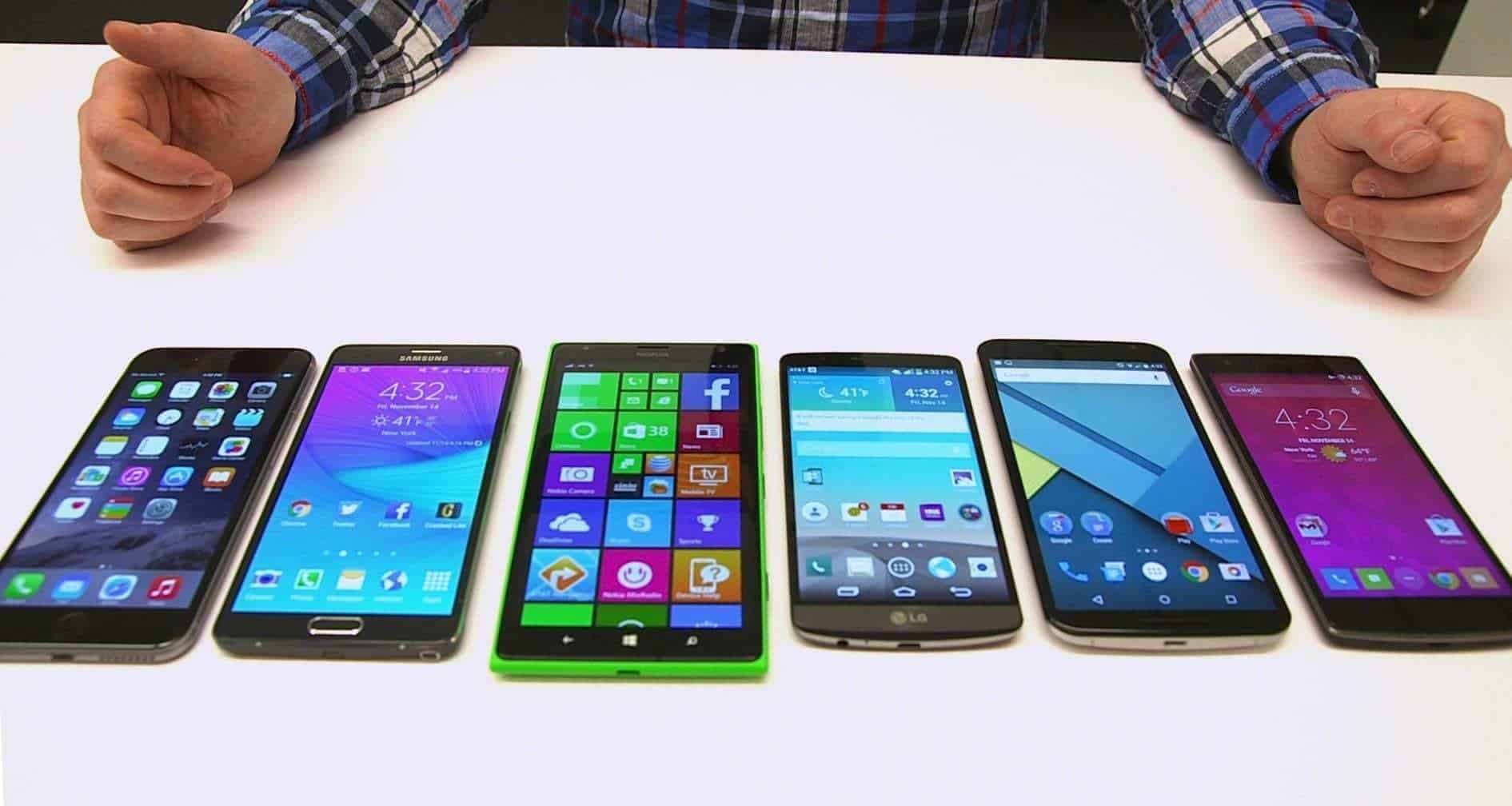
The word LED is used for three quite different screens, and phone marketing blurs them. When a phone is sold as having an LED display, it is almost always an LCD with an LED backlight. The LEDs light the panel; the liquid crystal layer in front of them shapes the picture. The same shorthand gave us the “LED TV”, which is also an LCD.
OLED is different. The organic light-emitting diodes are the pixels, so the panel needs no backlight at all. LG Display’s OLED technology page describes it as self-emissive for exactly this reason. Nearly every flagship phone sold today, and every foldable, uses an OLED panel.
The third meaning is the one we work with every day at Dynamo: direct-view LED, where each pixel is a cluster of red, green and blue LEDs mounted on a module and viewed directly. That is what an LED display for a reception wall, a shop window or a stadium is made of. It has never been used in a phone, and the table below shows why.
| Screen type | What lights the picture | Black level | Typical pixel density | Where you find it |
|---|---|---|---|---|
| LED-backlit LCD | White LEDs behind or beside the panel, always on | Dark grey; light leaks through the crystals | 300 to 460 pixels per inch | Budget and mid-range phones, most laptops and monitors |
| OLED | Each organic sub-pixel emits its own light | True black; the pixel is off | 400 to 460 pixels per inch | Flagship phones, foldables, smartwatches, premium TVs |
| Direct-view LED | Discrete red, green and blue LEDs per pixel | Near black, set by LED surface and pitch | 0.9 to 2.5 mm pitch indoors (about 10 to 28 pixels per inch) | Video walls, retail windows, stadiums, media facades |
How an LED-backlit LCD phone screen works
In a phone LCD, a strip of white LEDs sits along one edge of the panel. A light guide plate spreads that light evenly across the back of the screen, and diffuser films smooth it out. In front of the light sit the liquid crystals, which twist to let more or less light through each sub-pixel, and a colour filter that turns white light into red, green and blue. The LED-backlit LCD design has been the norm since the late 2000s.
The older alternative was a cold-cathode fluorescent backlight, which is what early flat-screen TVs and laptops used. Those tubes contained mercury, needed a high-voltage inverter and took up space. LEDs are small, run on low voltage and contain no mercury, which is why phones adopted LED backlights early and never looked back.
The weakness is the same one every LCD shares. The backlight is on whenever the screen is on, so a black pixel is really a shutter trying to block light. Some always gets through, which is why LCD blacks look grey in a dark room. Mini-LED backlights with thousands of separately dimmed zones fix much of this on premium tablets and laptops, but they are too thick and power-hungry for a phone.
How an OLED phone screen works
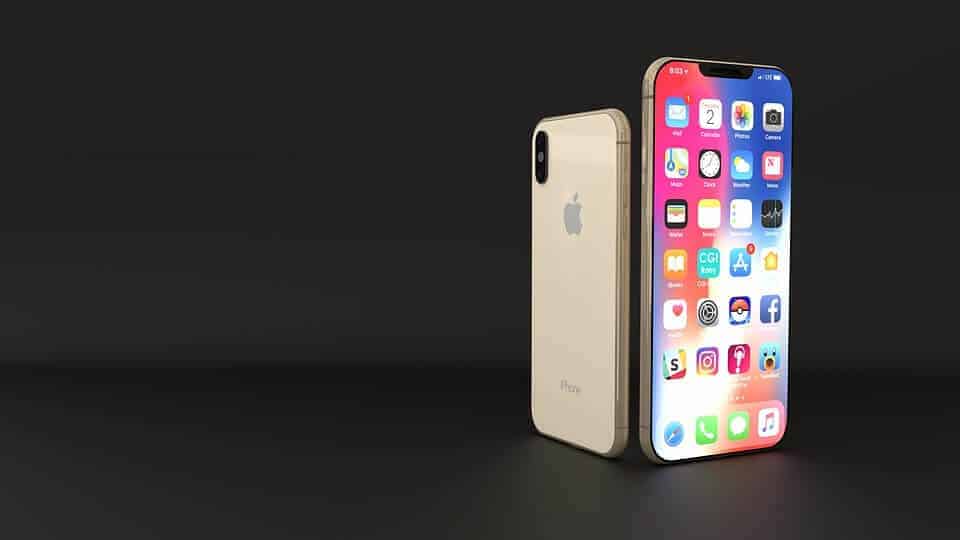
An OLED panel drops the backlight, the light guide and the colour filter. Each sub-pixel is a thin layer of organic material sandwiched between two electrodes. Pass a current through it and it glows red, green or blue; cut the current and it goes completely dark. Because nothing sits behind the pixels, the panel can be made very thin and built on a plastic substrate, which is what makes foldable phones possible.
The result is true black, high contrast and wide viewing angles, the same qualities we cover in our guide to true black LED technology on large screens. OLED also has known trade-offs. The organic materials age, and the blue emitter ages fastest, so a static element left on screen for months can leave a ghost. We explain the equivalent question for large screens in do LED screens suffer burn-in?. Many OLED phones also dim by pulsing the pixels on and off, which some people notice as flicker at low brightness.
For a running list of which handsets use OLED panels, OLED-Info tracks releases by manufacturer.
Battery life: why dark mode only helps OLED phones
On an LCD phone the backlight draws the same power whether you are reading white text on black or black text on white. Brightness setting matters; content does not. On an OLED phone the power goes to the pixels that are lit, so a mostly black screen can draw a fraction of the power of a mostly white one. That is the whole reason dark mode and always-on lock screens became practical once OLED took over.
The same logic applies to a direct-view LED wall, only at a much larger scale. A wall showing dark content with white text draws far less than one showing a full-white image, which is why LED datasheets quote both a maximum and an average power figure. If you are sizing power for a large display, our LED display parameters guide explains how to read those numbers.
How long do LED phone screens last?
The LEDs in an LCD backlight are the least likely part of a phone to fail. LED lighting makers commonly quote 50,000 hours to the point where output has dropped to 70 per cent of new. At six hours of screen time a day that is more than twenty years, so the battery, the glass and the connectors will all give up first.
OLED lifetime is a different question because the organic emitters slowly lose brightness with use. Manufacturers do not publish simple hour ratings for phone panels, and in practice most handsets are replaced long before the panel dims noticeably. Uneven wear, rather than total failure, is the realistic end-of-life symptom.
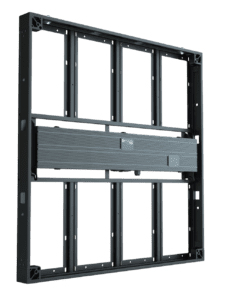
Large-format LED is built to a different brief. It runs all day in public spaces for years, so the datasheets carry explicit life figures. Our outdoor DFA Series datasheet, for example, quotes a life span of 100,000 hours, and fixed-install cabinets are designed so a single failed module can be swapped in minutes rather than replacing the whole screen.
Phone screens and LED video walls: same word, different technology
The gap between a phone pixel and a video-wall pixel is about viewing distance. A phone is held 30 cm from your eyes, so it needs 400 pixels per inch or more before the grid disappears. A reception wall is viewed from 3 m or further, so a pixel every 1.5 to 1.9 mm looks just as smooth from where people actually stand. Put the two side by side and a single LED-wall pixel is roughly 30 phone pixels wide.
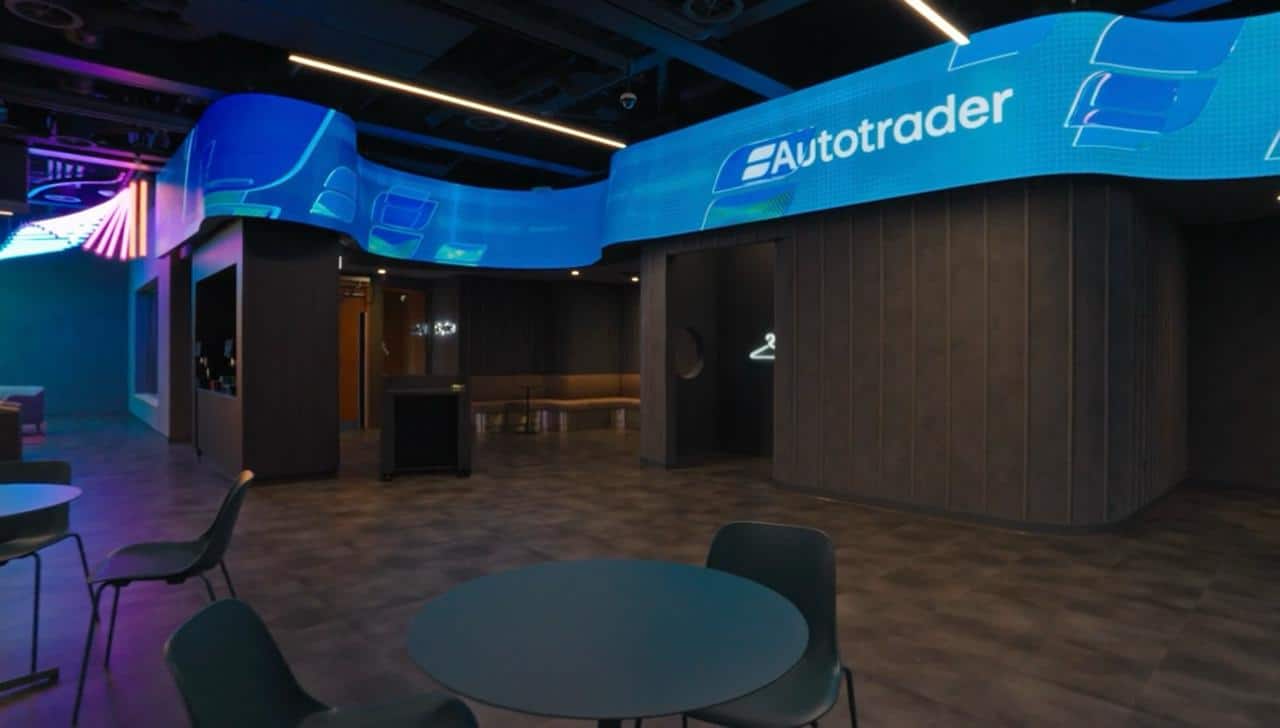
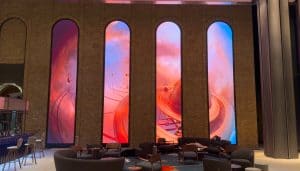
A project of ours shows the numbers in practice. At AutoTrader’s Manchester headquarters we installed two 2,500 × 2,500 mm LED walls at 1.9 mm pitch, each 1,280 × 1,280 pixels. That is about 13 pixels per inch, a fraction of a phone’s density, yet from the reception floor the image reads as one continuous surface because nobody stands closer than a couple of metres. The same site’s curved LED ribbon uses flexible 1.86 mm tiles, something no rigid phone panel or LCD could do at that scale.
Where a screen has to be viewed from arm’s length, such as a boardroom table or a broadcast set, we specify finer pitches. Our 1.5 mm direct-view LED display range exists for that case, and the LED displays guide walks through how pitch, viewing distance and cabinet size fit together.
MicroLED: the route to a true LED phone screen
MicroLED takes the inorganic LEDs used in video walls and shrinks them to a few microns, so each sub-pixel is a tiny self-emissive LED. On paper it combines the black level and thinness of OLED with the brightness and lifetime of inorganic LED, and it does not suffer organic ageing. Wikipedia’s MicroLED overview summarises the physics and the manufacturing hurdles.
Those hurdles are the reason it is not in your pocket yet. Transferring millions of microscopic LEDs onto a backplane with near-perfect yield is slow and expensive, so the first products have been large, premium TVs where the pixels can be bigger and the price higher. For where the technology stands in the UK market, and what it means for architectural and broadcast screens, see our MicroLED UK guide. The wider family of diode types, from standard SMD to OLED and beyond, is covered in what is LED technology.
LED Mobile Phone Screens: Frequently Asked Questions
Is an LED phone screen the same as an LCD?
In practice, yes. A phone described as having an LED display has an LCD panel lit by white LEDs. The LEDs provide the light and the liquid crystal layer forms the image. The only phone screens where the LEDs themselves are the pixels are OLED panels, and those are normally labelled OLED or AMOLED rather than LED.
Which is better for a phone, LED-backlit LCD or OLED?
OLED wins on contrast, thinness, viewing angle and power draw with dark content, which is why flagships use it. LED-backlit LCD is cheaper, has no burn-in risk and holds up well in bright sunlight, so it remains common on budget phones. If you read a lot at night or use dark mode, OLED is the more comfortable choice.
Do OLED phone screens suffer burn-in?
They can. Organic emitters wear with use, and the blue sub-pixel wears fastest, so a status bar or keyboard left on screen for months can leave a faint permanent ghost. Modern phones shift pixels, dim static elements and limit peak brightness to slow this down. For most users the phone is replaced before burn-in becomes visible.
Why does dark mode save battery on OLED but not on LCD?
An OLED pixel draws power only when it is lit, so a black background switches most of the panel off. An LCD backlight is on across the whole screen regardless of the picture, so black pixels cost the same as white ones. Dark mode on an LCD phone is a visual preference, not a battery saving.
Are there phones with microLED screens?
Not in the mainstream. MicroLED has appeared in large premium TVs, where the pixels can be larger and yield problems are easier to absorb. Shrinking the LEDs to phone density and placing millions of them reliably is still costly, so phone makers have stayed with OLED. It is the most likely next step, but not an imminent one.
Why is a phone’s pixel pitch so much finer than an LED video wall’s?
Because of viewing distance. At 30 cm your eye can resolve detail a phone needs 400 pixels per inch to hide. At 3 m or more, a 1.5 to 1.9 mm pitch, around 13 to 17 pixels per inch, looks equally smooth. Specifying a finer pitch than the viewing distance needs adds cost without adding visible sharpness.
Get a quote for an LED display. If you are specifying a large-format LED screen rather than a phone, tell us the room, the viewing distance and the content and we will size the pitch for you. Contact us or call 020 3489 9878.