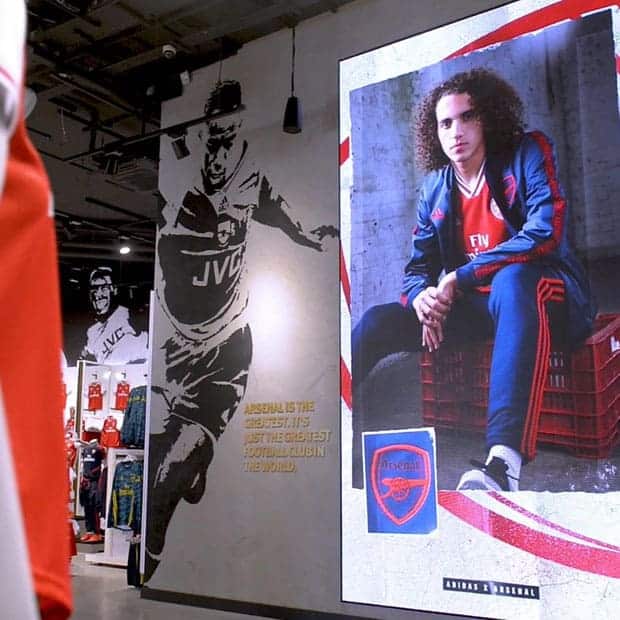
Arsenal LED screens at The Armoury: Dynamo LED Displays fitted Arsenal FC’s flagship merchandise store at the Emirates Stadium with six high-brightness LED window screens, two fine-pitch internal LED walls, a digital mural, two LED “magic mirrors”, an augmented-reality skill zone and a custom LED ticker running more than 13 m with seamless right-angle returns.
Updated September 2026.
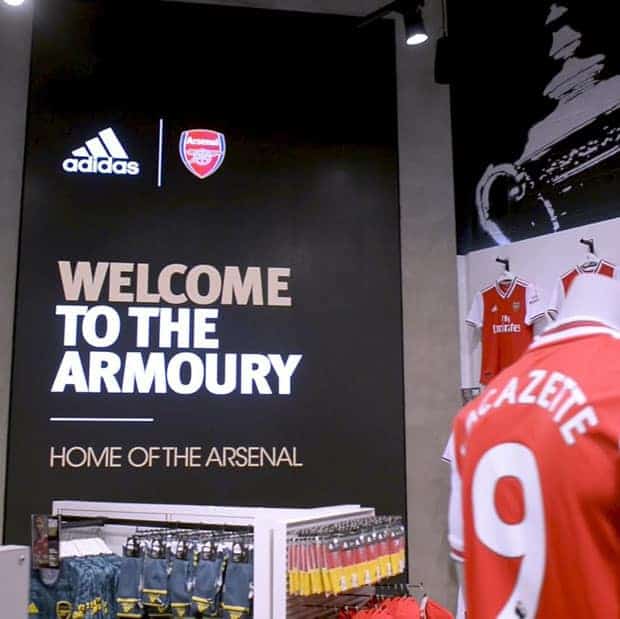
The Armoury is Arsenal Football Club’s main store at the Emirates Stadium in north London. When the club relaunched the store for its new kit partnership with Adidas, reported at £300 million, Dynamo LED Displays was commissioned to install the LED screens that turn a merchandise shop into an “Instagrammable” experience. This case study covers what we installed, why the pixel pitches differ from zone to zone, and how the custom pieces were built.
Project summary
| Venue | The Armoury, Arsenal FC store, Emirates Stadium, London |
| Client | Arsenal Football Club, store relaunch under the Adidas kit partnership |
| Year | 2019 |
| Window screens | 6 × portrait high-brightness LED, 2 m × 2.5 m, P3.9mm, 4,500 cd/m² |
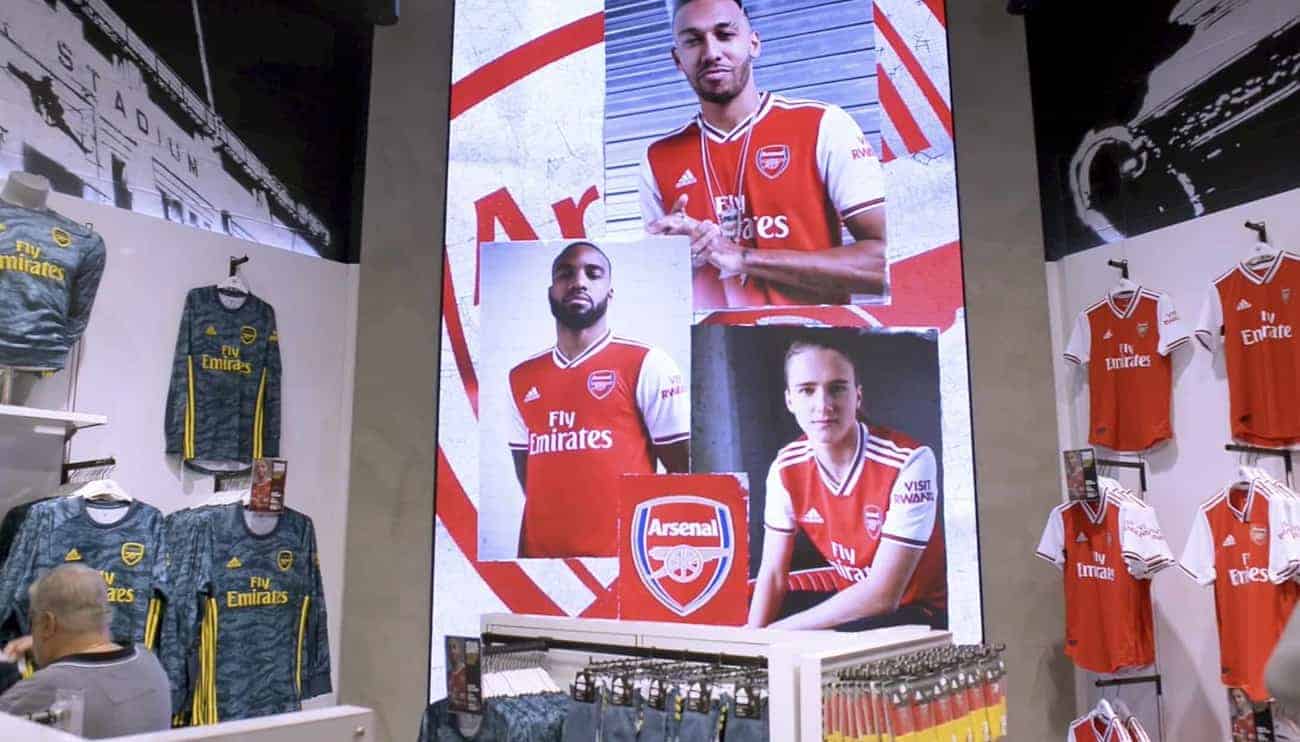
| Internal LED walls | 2 × fine-pitch LED, 2.5 m wide × 4.5 m high, P2.5mm |
| Digital mural | 1 × 4 m × 1.5 m, P2.5mm |
| Magic mirrors | 2 × 640 mm × 1,920 mm, P2.5mm, sensor-switched between video and mirror |
| AR skill zone | 1 × 3 m × 1.5 m, P1.8mm, with augmented-reality camera system |
| LED ticker | Custom P3mm ticker, more than 13 m horizontally and vertically, seamless right-angle returns |
| Scope | Design, custom build, supply and installation by Dynamo LED Displays |
The brief: a store fans would photograph
Arsenal and Adidas wanted a store that would give fans a reason to visit, photograph and share, not just a place to buy a shirt. That set the brief for the LED: every screen had to earn its place as a feature, and several had to do something a standard display cannot. The result mixes conventional retail LED, such as window screens and internal video walls, with pieces we designed for this store: mirrors that become screens, an interactive AR zone and a ticker that turns corners without a visible join.
The store also had to work as a live retail environment from day one, so the screens were specified around real viewing conditions: daylight on the window-facing displays, close viewing distances inside the store and continuous operation through trading hours.
What Dynamo installed at The Armoury
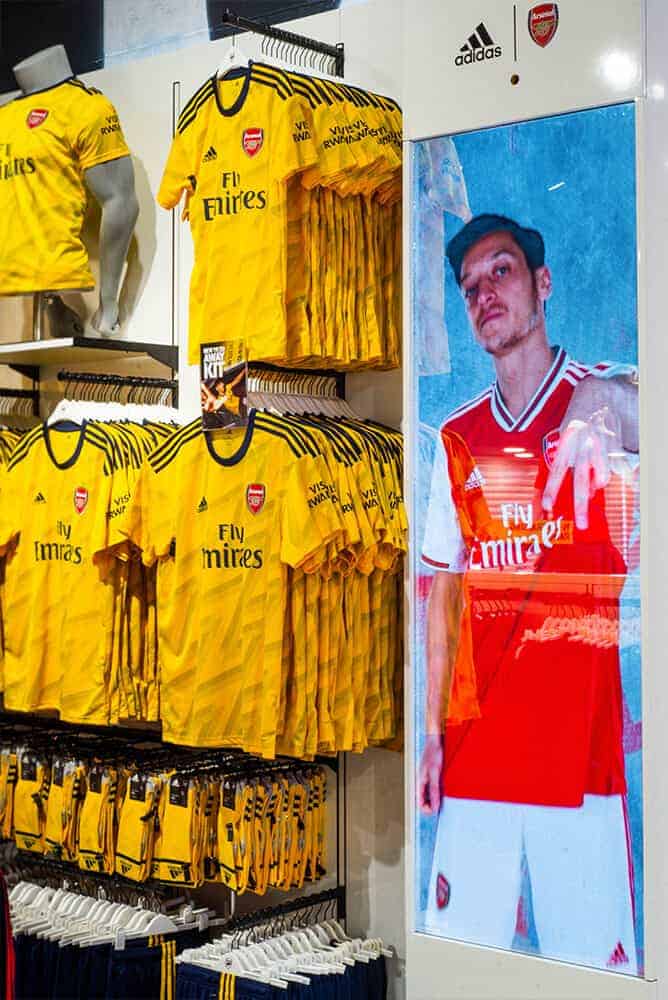
Six high-brightness LED window screens
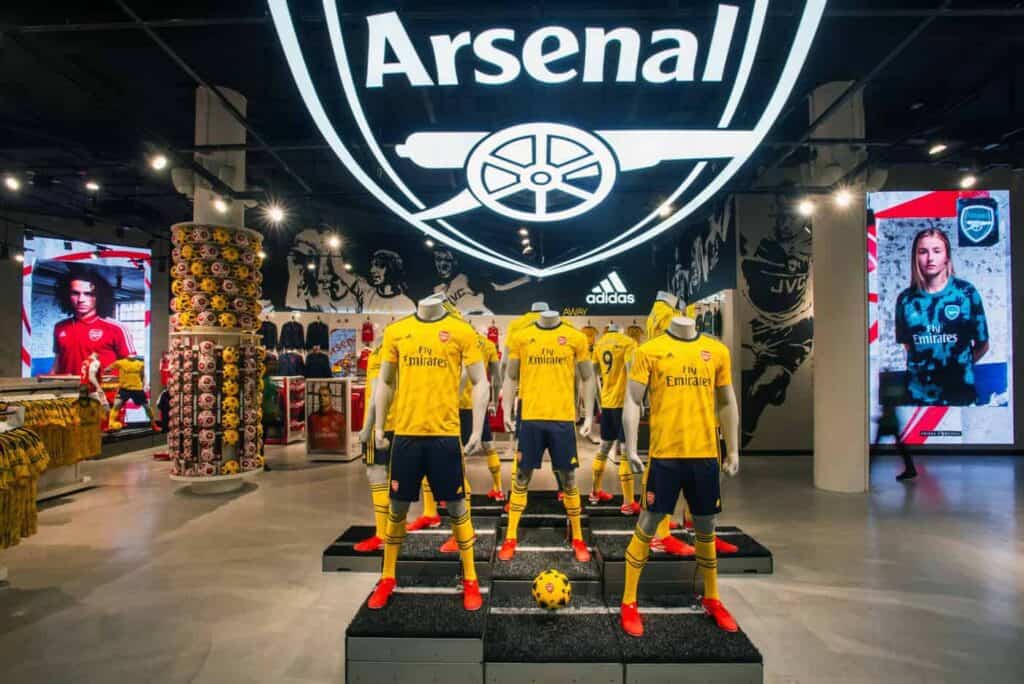
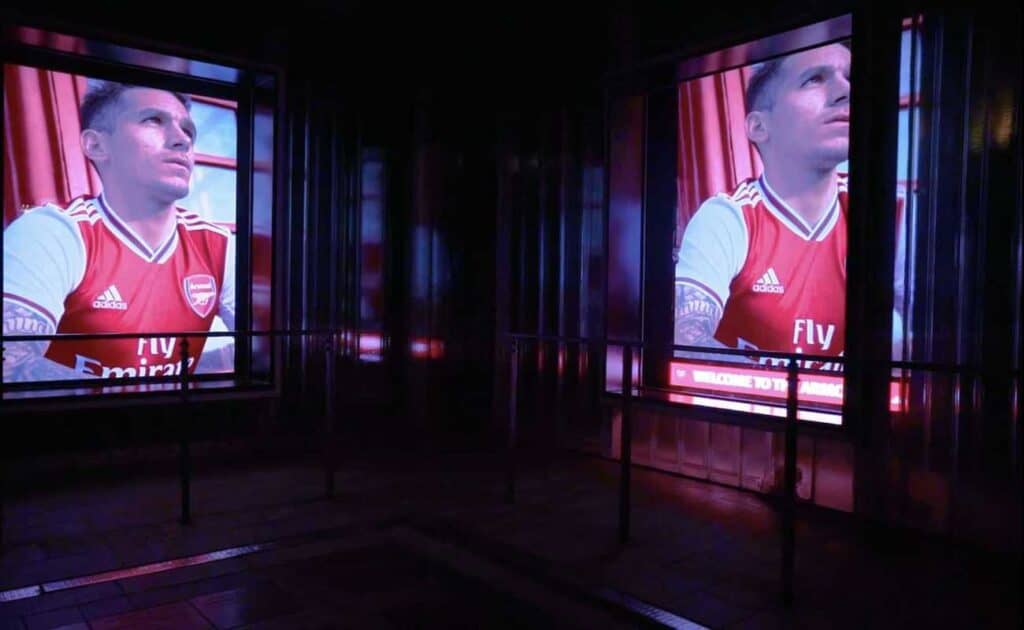
The six external-facing screens are portrait panels of 2 m × 2.5 m at a P3.9mm pixel pitch with 4,500 cd/m² brightness. They face out from the store, so they have to compete with daylight, which is why they carry far more brightness than the internal walls need. Our guide to window advertising with LED screens explains the brightness and pitch trade-offs for this kind of placement.
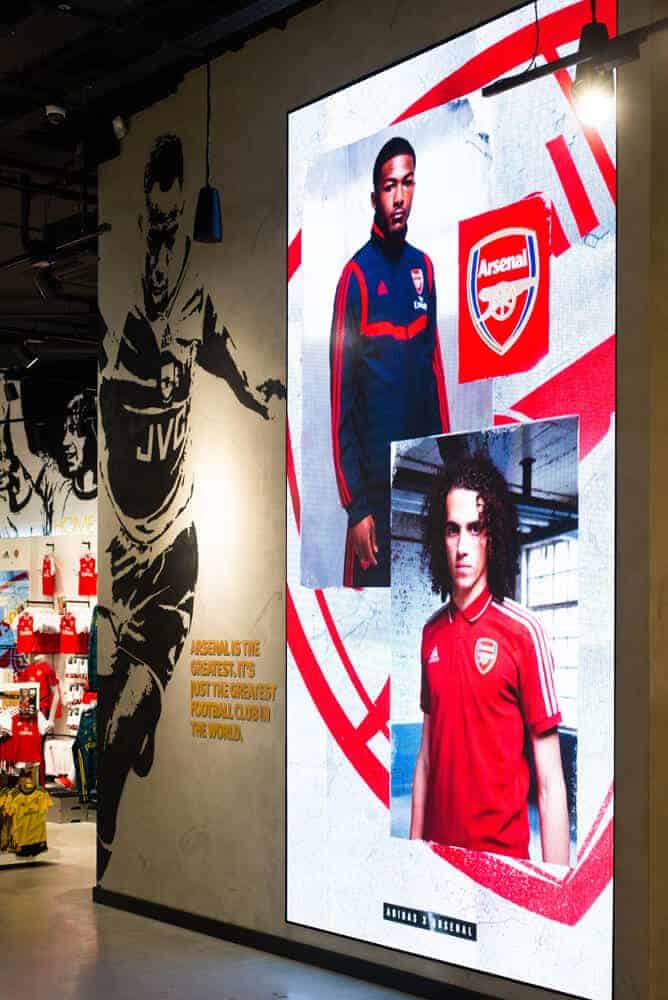
Two fine-pitch internal LED walls
Inside, two fine-pitch LED walls measuring 2.5 m wide by 4.5 m high run at P2.5mm. Tall portrait walls suit a merchandise store because they read from across the shop floor and from close range at the rails, and the finer pitch keeps player imagery and kit detail sharp at that distance. For comparable fixed-install fine-pitch walls today, see our DX Series indoor displays.

A 4 m digital mural
A single 4 m × 1.5 m P2.5mm display works as a digital mural: a landscape canvas for club messaging and campaign artwork that would otherwise have been a printed graphic. Because it is LED, the content changes with the season, the fixture list and the kit launches without any reprinting.

Two LED magic mirrors
The magic mirrors were one of Dynamo’s newest products at the time. Each is a 640 mm × 1,920 mm P2.5mm LED panel behind a mirror-finish surface. A hidden sensor switches the unit from playing video to acting as a full-length mirror when a shopper approaches, so the same piece of glass works as digital signage and as a fitting mirror.
The augmented-reality skill zone
The skill zone, also called the celebration station, is a 3 m × 1.5 m P1.8mm LED display paired with an augmented-reality camera system. Fans test their skills or perform a goal celebration and see themselves on screen alongside Arsenal players as if they were in the same shot. The footage is emailed to the fan from the store for sharing on social media or messaging apps, and the best celebrations can be selected for the stadium’s big screens.

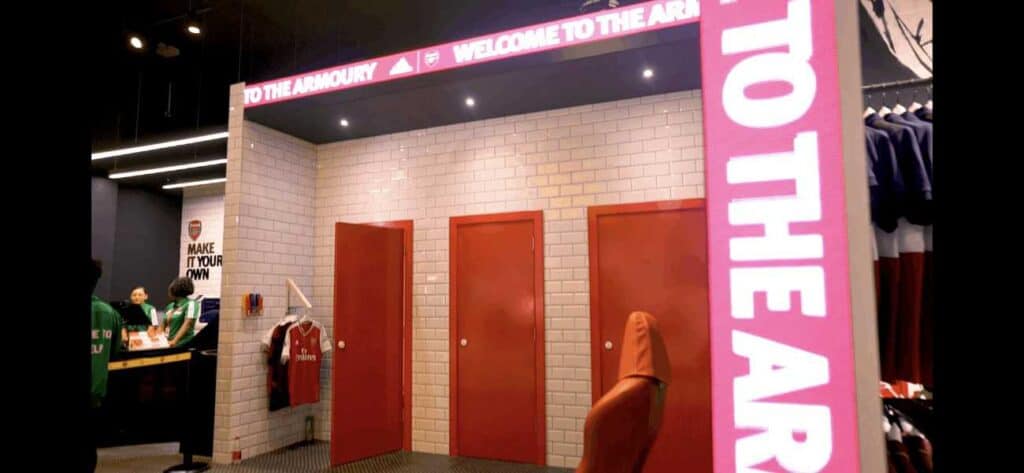
A custom LED ticker with right-angle returns
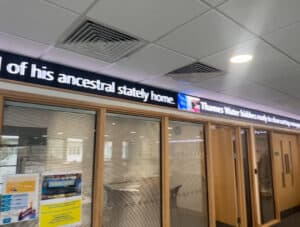
The ticker is the piece most visitors notice first. Built at P3mm, it spans more than 13 m in total, running horizontally along the fascia and vertically down the columns, and it incorporates seamless right-angle returns so the content flows around corners and back to back without a break. Standard ticker cabinets stop at a corner; these were built for the store’s geometry. Our LED tickers page covers the standard formats this custom build started from.
Why one store uses four different pixel pitches
The Armoury runs P1.8mm, P2.5mm, P3mm and P3.9mm screens within a few metres of each other, and that is deliberate. Pixel pitch is chosen for the viewing distance and the content, not for its own sake. The AR zone uses the finest pitch because fans stand right in front of it and see themselves in the image. The internal walls and mirrors at P2.5mm are viewed from across the floor and at arm’s length. The ticker at P3mm carries large text that reads from anywhere in the store. The window screens at P3.9mm are seen from outside, at the greatest distance, and put their budget into brightness rather than pitch.
The same logic applies to any retail or stadium fit-out: match pitch to the closest realistic viewing distance in each zone, and match brightness to the ambient light. Our LED video wall viewing distance guide sets out the numbers, and the full range of fixed-install pitches is on our LED display products pages.
Custom LED for retail: what made this project Dynamo’s
Dynamo’s operations director, Yvonne McDonald, described the finished store as a piece of art. In her view the project came to Dynamo because of our history of building custom LED displays rather than supplying stock cabinets: we had already put LED on double-decker buses and hot-air balloons, and built the UK’s first shop front made entirely of LED screen. At The Armoury that experience showed in the right-angle ticker returns, the sensor-switched magic mirrors and the AR integration, none of which come out of a standard catalogue.
It also follows the approach we took for the LED arch in the Manchester City directors’ box: start from the architecture and the content, then build the LED to fit, rather than fitting the space around a rectangular screen. For the wider picture on stadium and club installations, see our overview of stadium LED screens and displays.
Arsenal LED Screens at The Armoury: Frequently Asked Questions
Who installed the LED screens at Arsenal’s Armoury store?
Dynamo LED Displays designed, built and installed the LED screens at The Armoury, Arsenal FC’s merchandise store at the Emirates Stadium, as part of the store relaunch for the club’s Adidas kit partnership in 2019. The scope covered window screens, internal fine-pitch walls, a digital mural, LED magic mirrors, the AR skill zone and a custom LED ticker.
What LED screens are in the Arsenal store at the Emirates Stadium?
The Armoury has six portrait high-brightness LED window screens of 2 m × 2.5 m, two internal fine-pitch LED walls of 2.5 m × 4.5 m, a 4 m × 1.5 m digital mural, two 640 mm × 1,920 mm LED magic mirrors, a 3 m × 1.5 m augmented-reality skill zone and a custom LED ticker running more than 13 m with right-angle returns.
What pixel pitch was used for the Arsenal LED displays?
Four pitches were used, each chosen for its viewing distance: P1.8mm for the AR skill zone where fans stand closest, P2.5mm for the internal walls, mural and magic mirrors, P3mm for the ticker text, and P3.9mm for the window screens, which are viewed from outside and prioritise 4,500 cd/m² brightness over pitch.
What is the AR skill zone at The Armoury?
The skill zone, or celebration station, is a P1.8mm LED display of 3 m × 1.5 m linked to an augmented-reality camera system. Fans show off their skills or a goal celebration and appear on screen alongside Arsenal players. The clip is emailed to them from the store to share, and selected celebrations can be shown on the stadium’s big screens.
How does an LED magic mirror work?
An LED magic mirror is a fine-pitch LED panel behind a mirror-finish surface. At The Armoury each unit is 640 mm × 1,920 mm at P2.5mm. A hidden sensor detects a shopper approaching and switches the panel from playing video content to behaving as a normal full-length mirror, so one fixture serves as both digital signage and a fitting mirror.
Can Dynamo build a similar LED fit-out for another club or store?
Yes. The Armoury combines standard products, such as window screens and fixed-install fine-pitch walls, with custom builds including the right-angle ticker and the magic mirrors. We design each fit-out around the store layout, the viewing distances in each zone and the content the client wants to run, then build, install and commission the screens as one project.
Planning an LED fit-out for a store or stadium?
Tell us the space, the zones you want to animate and how the content will be used, and we will propose pitches, brightness and any custom pieces the layout needs, with a written specification to follow.
Get a quote for retail or stadium LED screens. Contact us or call 020 3489 9878.