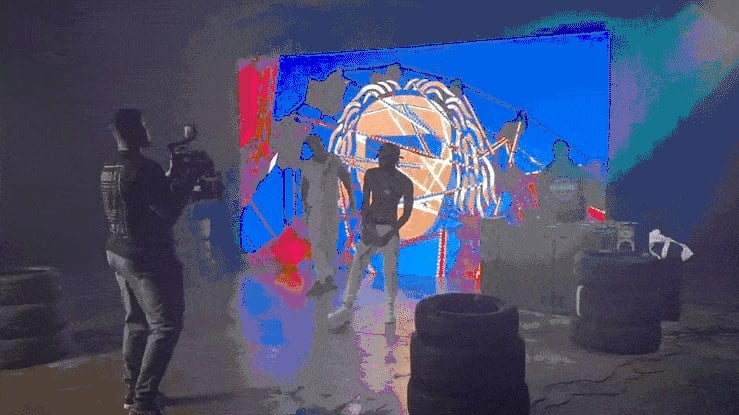
Dynamo LED Displays supplied a 2 mm LED screen hire as the backdrop for a Russ Millions music video shoot in August 2021. The screen was specified for use with video cameras and played time-coded video and content made on the set, while smoke machines, flame throwers and a lighting rig built the atmosphere around the UK drill artist.
Updated October 2026. Case study first published August 2021.
Project facts
| Artist | Russ Millions, the London drill artist whose single Body, with Tion Wayne, reached number 1 on the UK Singles Chart in 2021 |
| Project | LED backdrop for a music video shoot on a dressed set with stacked tyres, haze and flame effects |
| Screen | 2 mm pixel pitch LED screen from Dynamo’s hire fleet, specified for use with video cameras |
| Content | Time-coded video, plus graphics created on the set and uploaded to Dynamo’s media servers between takes |
| Effects | Smoke machines, flame throwers and a large lighting rig run by the production around the wall |
| Service | LED screen hire: delivery, build, content playback and de-rig by Dynamo |
| Year | August 2021 |
The brief: a backdrop the camera could film up close
A music video backdrop has a harder job than a stage screen. The camera moves to within a few metres of the wall, the operator pulls focus between the artist and the picture behind, and the edit will be watched on phones where any pixel grid or flicker shows. Russ Millions’ production wanted a wall that could carry animated graphics and timed video behind the performance, change content on the day, and hold up under smoke, flame and a full lighting rig.

What Dynamo supplied
A 2 mm LED screen specified for cameras
The wall was built from 2 mm pixel pitch cabinets chosen for filming rather than for a live audience. On camera, pixel pitch sets how close the lens can get before the LED grid shows or interferes with the sensor, and refresh rate decides whether a fast shutter sees a complete frame or dark rolling bands. A 2 mm pitch kept the grid invisible at the shooting distances used, and camera-grade processing kept the image stable. Our guide to moire on LED screens filmed by cameras explains both effects.
Time-coded video and content made on the set
The screen played time-coded video so that the picture behind the artist landed on the beat for each take. Alongside the pre-made files, the production created new graphics on the set and uploaded them to Dynamo’s media servers, so a fresh look could be on the wall within minutes rather than waiting for a new edit. That flexibility is the main reason a video shoot hires an LED wall instead of printing a backdrop or keying it in afterwards.
Smoke, flame and lighting around the wall
The set used smoke machines, flame throwers and a large lighting system to build the atmosphere seen in the video. LED cabinets are happy in haze and under strong lighting because they emit their own light rather than reflecting a projector, so the picture stayed bright and saturated with flame effects firing a few metres in front of it.
Hire, build and playback by Dynamo
Dynamo delivered and built the wall, ran playback through the shoot and de-rigged afterwards, so the production crew only had to worry about the performance and the camera. See LED screen hire for what the service includes.
DRE Series rental LED at a glance
The 2021 post described the wall as a 2 mm camera-grade screen. The closest cabinet in Dynamo’s current hire fleet is the DRE Series at 1.93 mm. The figures below are from the DRE Series datasheet for the indoor rental range; brightness, refresh rate and weight apply to every indoor pitch, cabinet resolution changes with pitch.
| Attribute | DRE Series indoor rental |
|---|---|
| Pixel pitches | 1.55 mm, 1.93 mm and 2.58 mm |
| Cabinet size | 496 x 496 mm, 55 mm or 62 mm deep |
| Pixels per cabinet | 320 x 320 at 1.55 mm; 256 x 256 at 1.93 mm; 192 x 192 at 2.58 mm |
| Cabinet weight | 9.2 kg |
| Brightness | Over 800 nits |
| Refresh rate | 1,920 to 3,840 Hz, suitable for filming |
| Viewing angle | 160 degrees horizontal and vertical |
| Contrast | 6,000:1 |
Planning an LED screen hire for a music video shoot
Pick the pixel pitch from the closest camera position
Tell us the nearest the lens will get to the wall and the cameras in use. A shoot that frames the artist tight against the screen needs a finer pitch than one that keeps the wall as a wide background. Finer pitch also lets the camera work closer before moire appears, so it is the first thing to settle. Our LED screens for XR and virtual production page covers the camera-side terms.
Match refresh rate to shutter speed
Ask the camera operator for the shutter speeds and frame rates planned, including any slow motion. A screen refreshing at 1,920 to 3,840 Hz covers normal shutter speeds; high-frame-rate work needs the processor and refresh checked in advance. On a multi-camera shoot, genlock between the LED processor and the cameras removes rolling bars when cutting between angles. The TNT Sports virtual production shoot shows this in use.
Sort content playback before the shoot day
Agree the wall resolution and file format early so the graphics team renders at the right size. Decide who triggers playback, whether video needs timecode from the playback system, and how new files reach the screen on the day. Content made on the set, as on this shoot, needs a fast route onto the media server rather than a USB stick passed across the floor.
Allow for haze, pyro and power
Smoke, flame and a lighting rig all add to the load on the location. Keep flame effects at a safe distance from the cabinets, put the LED on its own supply where possible, and confirm the power available at the location before the kit arrives. Our LED screen hire power requirements guide gives the figures to ask for.
Related Dynamo music, film and camera LED projects
- 2 mm DRE Series LED screens for Red Bull music collaborations with DOSED Films
- Virtual production LED screen hire for the TNT Sports Champions League advert
- Ten custom LED triangles for Warner Music Group
- LED floor hire for Trapstar at Selfridges
- Broadcast studio LED backdrop design
LED screen hire for music videos: frequently asked questions
What LED screen did Dynamo supply for the Russ Millions video shoot?
Dynamo LED Displays supplied a 2 mm pixel pitch LED screen from its hire fleet, specified for use with video cameras, as the backdrop for a Russ Millions music video shoot in August 2021. The wall played time-coded video and graphics created on the set and uploaded to Dynamo’s media servers, with smoke machines, flame throwers and a large lighting rig around it.
Why hire an LED screen for a music video instead of a green screen?
Because the artist, director and camera operator see the finished shot in the viewfinder. The background is in camera, so lighting, reflections and timing are real rather than fixed in post, and the content can be changed between takes. A green screen needs the background composited afterwards and gives the performer nothing to react to on the set.
What pixel pitch does a music video LED backdrop need?
It depends on the closest camera position. A 2 mm class pitch, such as the DRE Series at 1.93 mm, suits shoots where the lens gets within a few metres of the wall. A wall only ever seen as a wide, soft background can use 2.58 mm. Tell us the cameras and the tightest framing planned and we will recommend the pitch.
Will the LED screen flicker or show bands on camera?
Not when the refresh rate and shutter are matched. DRE Series cabinets refresh at 1,920 to 3,840 Hz, which covers normal shutter speeds. High-frame-rate or slow-motion work needs the refresh and processor confirmed before the day, and a multi-camera shoot benefits from genlock between the processor and the cameras.
Can content be changed on the set during a video shoot?
Yes. On this shoot the production created new graphics on the set and uploaded them to Dynamo’s media servers, so a new look was on the wall within minutes. The playback system also ran time-coded video, so the picture behind the artist landed on the beat for every take.
Get a quote for LED screen hire for a video shoot
Send us the location, the shoot dates, the wall size you have in mind, the cameras and the closest framing planned, and we will come back with a pixel pitch, a cabinet grid and a written hire quote. Get a quote or call 020 3489 9878.