If you are writing a tender or RFP for an LED display, the questions you put in the document decide the answers you get back. Most of the LED tender questions we see from procurement teams focus on price and screen size, then leave everything else to the supplier’s discretion. Common gaps: pixel pitch quoted without module resolution, parts-only warranties dressed up as full cover, and “installation included” that excludes access equipment. Most LED problems are not caused by the panels; they are caused by assumptions that were never written down. This guide covers the questions that get you bids you can actually compare and hold suppliers to, drawn from the tenders we respond to across retail, corporate, control-room and outdoor projects.
Key takeaways
The most important LED tender questions cover resolution, warranty terms, processing, service access and itemised pricing:
- Resolution must be stated in pixels (width × height) and derived from module count, not just pixel pitch. Two bids at “2.5mm” can deliver different pixel counts depending on module layout.
- A fixed-install product is not the same buying decision as a rental system. Specify which you are procuring before bids come back.
- Warranty questions must cover labour, response time and spares location, not just duration.
- The processor make and model belongs in the bid. An unspecified “controller included” line is a red flag.
- Hardware, installation, access, structural work and commissioning need separate line items. Bundled totals hide the numbers you need to compare.
- A written acceptance test defines the finish line: dead-pixel policy, colour uniformity, brightness setting, processor configuration and training handover.
- Ask who manufactures the product and who supports it in the UK.
At a glance: project facts to state in the tender
| Project fact | What to state | Why it changes the quote |
|---|---|---|
| Screen size | Active LED area in metres, width × height | Cabinet count, steelwork, processing and pixel count all follow from this |
| Viewing distance | Nearest and typical viewing distance, in metres | Narrows the sensible pitch range before bids come back |
| Environment | Indoor, shopfront, semi-outdoor or outdoor permanent | Changes brightness, IP rating, cooling and product line |
| Service access | Front service, rear access, or both | Affects cabinet depth, mounting frame and maintenance method |
| Content source | Media player, live input, CMS, broadcast feed or mixed | Determines processing, scaling and operator training |
| Power availability | Single-phase or three-phase, circuits and cable route | Impacts electrical design and peak load assumptions |
| Programme | Survey date, install window, blackout dates, handover date | Drives labour planning, access equipment and pre-build testing |
Tender questions about product type
An LED tender should specify the product category — fixed-install, rental, outdoor permanent or flexible — before pricing begins, because the mechanical design, service method and commercial assumptions differ between categories. A permanent indoor LED display should be priced as a fixed-install system: in our range, that means the DFC Series (premium fixed-install indoor LED) or the DX Series (mid-range fixed install). A temporary touring or event screen sits with the DRE Series (rental LED), outdoor permanent projects belong with the DVO Series, and flexible LED curtain requirements are a separate category again. You can compare the categories on our LED display products page.
The distinction matters because rental LED is built for repeated rigging and transport, while fixed-install LED is built around alignment, depth, service access and long-duty operation. If a tender allows suppliers to blur those categories, the cheapest price can be a different product class rather than a better-value proposal. Our indoor LED screens and outdoor LED screens pages set out the considerations behind each route.
Tender questions about the screen itself
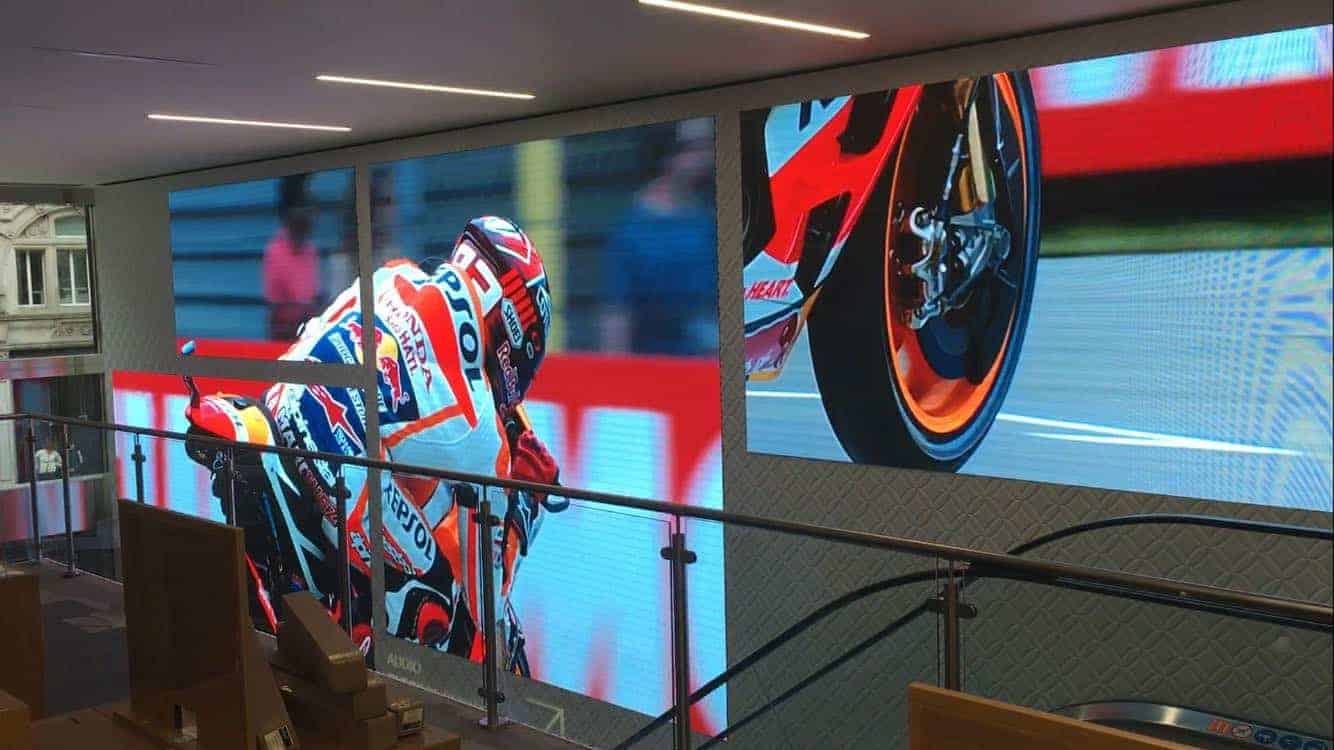
The screen questions that matter most are resolution derived from module maths, pixel pitch matched to viewing distance, calibrated brightness, and — for outdoor displays — the IP rating of both cabinet faces. Each one is answered below with the reason it belongs in your document.
What is the total resolution in pixels, and how is it derived?
This is the single most useful question in any LED tender. Resolution must come from the module maths: modules wide × pixels per module, and the same for height. A supplier who quotes resolution by dividing screen dimensions by pixel pitch is estimating, and estimates in tenders become disputes at handover. If a bidder cannot show the module layout behind their pixel count, ask again before you score the bid. Our pixel pitch guide covers how pitch, module size and viewing distance interact if you need to sanity-check the numbers yourself.
What pixel pitch is proposed, and what viewing distance is it designed around?
Pitch should follow the viewing distance and content type, not habit. A 1.5mm display looks cleaner at close range, but it carries more pixels, more processing and more modules than a 2.6mm display of the same size. If the nearest regular viewer is 6 metres away, that spend may be better used on scale or control. Asking bidders to price one alternative pitch side by side shows the trade-off before the project is locked to one route.
What is the brightness after calibration, and what is the recommended operating brightness?
Calibrating panels for colour uniformity typically costs 10–20% of raw brightness, so a response quoting peak uncalibrated nits looks brighter on paper than one quoting honest calibrated figures. Ask for both, and ask what brightness the supplier recommends running at for the stated lifetime — running a screen flat-out shortens LED life.
For outdoor screens: what IP rating applies to the front and rear of the cabinet?
Outdoor cabinets are often rated differently front and rear. Require the rating for both faces and check it against the exposure of your site. Our outdoor IP ratings guide translates the codes into practical terms.
Tender questions about processing, control and serviceability
Processing and serviceability questions decide how the display runs day to day: the processor make and model, the service access method, and the content management system your team will actually use. These are the areas bids most often leave vague, and the areas that generate the most support calls after handover.
What processor make and model is included, and what happens if it fails?
The processor is the part of the system your team will touch most often, and the part most often left vague in bids. Require the make and model. Brompton and Novastar are the established platforms — Brompton Technology and Novastar both publish full specifications, so a named model can be verified against its documented inputs, outputs and redundancy options. Then ask the failure question: is a backup processor included or available, and can the screen run in a degraded mode while a replacement ships? Ask for a signal diagram showing sources, processor, network route, cabinet mapping and operator control point. Do not accept “control system included”.
Is the screen front-serviced or rear-serviced, and what clearance does maintenance need?
This question decides whether a failed module is a 20-minute swap or a scaffolding job. Front-serviced screens can be mounted close to a wall; rear-serviced screens need access behind, either a walkway or a demountable design. Bids frequently stay silent on this because the answer has cost implications for the building. Our guide to front versus rear service sets out when each makes sense, and is worth reading before you fix the wall build-up.
What content management system is included, who is licensed to use it, and what training is provided?
A screen your team cannot update is a liability. Ask what CMS is supplied, whether licences are perpetual or subscription, how many users are covered, and what training and documentation is in the price. Subscription CMS costs that appear in year two are a classic hidden cost in LED tenders.
If you are still shaping the specification, the LED screen configurator will generate a size, pitch and resolution baseline you can write into the document — which makes every returned bid easier to compare like for like.
Tender questions about installation, warranty and the supplier behind the bid
What is itemised in the installation price?
This is where tender comparisons break down. One supplier includes survey, frame, containment, lifting and out-of-hours labour; another prices panels and assumes others will sort the wall, power and access. The second quote looks lower until the variations begin. Require every bidder to confirm “included”, “excluded” or “by others” against a fixed list: site survey, structural or fixing design, secondary steelwork, access equipment, cable containment, power distribution from the agreed point of supply, data cabling, making good, commissioning, calibration, RAMS and handover training. For UK sites, safe access and work equipment need proper planning — the HSE guidance on PUWER is a useful reference where equipment and access are part of the project.
What exactly does the warranty cover — parts, labour, or both — and where are spares held?
Warranty duration is the headline; the terms underneath decide what it is worth. A long warranty that covers parts only, with panels shipped overseas for repair, can leave a screen dark for weeks. Ask four things: what is covered, who pays for labour and access, what the turnaround commitment is, and whether spare modules are held in the UK. Our standard cover is a 3-year return-to-base warranty — the full terms are published on our warranty page. Ask every bidder for their actual warranty terms attached to the bid, not a summary sentence.
Who manufactures the product, and who supports it in the UK?
Many of the competing bids we see are re-badged panels from a factory the bidder has no ongoing relationship with. That matters five years in, when you need a colour-matched replacement module for a discontinued batch. Ask whether the bidder holds stock, whether they can supply batch-matched modules through the warranty period, and who answers the phone when something fails.
Can you provide named reference projects of comparable scope, with dates and locations?
Logos on a slide are not references. Ask for named projects you could visit or whose owners you could call, in a comparable sector and at a comparable scale. If budget benchmarking is part of your evaluation, our UK LED video wall cost guide gives current market ranges to score bids against.
Acceptance testing: how the tender proves the screen is complete
An LED tender should include a written acceptance test covering dead-pixel policy, colour and brightness uniformity, cabinet alignment and gaps, processor configuration and mapping, source switching, content playback, training with an attendance record, as-built documentation, the warranty start date and a snagging timescale. Without one, handover becomes subjective: one person thinks the screen looks fine, another sees colour shifts, missing pixels or poor scaling. For high-profile work, ask whether the supplier will complete factory pre-build testing before delivery — it catches mapping and module issues before the install window begins.
From the field
I read a lot of tenders, and the pattern I see most often is a document that specifies the screen in one line and the payment terms in three pages. The one that sticks in my memory was a corporate lobby tender that asked for “a 2.5mm screen approximately 4m wide” and nothing else — no resolution, no service access, no processor, no warranty terms. Six bids came back and not one of them was comparable to another. We ended up helping the client rewrite the spec before they could score anything.
My honest advice: send your draft tender to a supplier you trust before it goes out, and ask them what’s missing. It costs you nothing, and the questions above are the ones I would add for you anyway — send it over and we’ll mark it up. A tender that asks precise questions gets precise bids, and precise bids protect you far better than any contract clause bolted on afterwards.
LED Tender Questions: Frequently Asked Questions
What are the most important LED tender questions to ask?
Start with resolution derived from module count, then warranty terms (parts, labour, turnaround, spares location), processor make and model, front or rear service access, and an itemised installation price. These five areas account for most post-award disputes. Everything else matters, but these are the questions that make bids comparable and enforceable.
Should a tender specify pixel pitch or resolution?
Both, but resolution is the enforceable one. Pixel pitch describes LED spacing; resolution defines what the screen can actually display. Require bidders to state total pixels width × height and show the module maths behind it. Two screens at the same nominal pitch can deliver different pixel counts depending on module dimensions, and only the resolution figure protects you.
How long should an LED screen warranty be?
Duration matters less than terms. A 3-year warranty covering parts with UK-held spares and a stated turnaround is worth more than a 5-year parts-only warranty with overseas repair. Ask what is covered, who pays labour and access costs, and where replacement modules are held. Score warranty terms in your evaluation matrix, not just years.
How do I compare LED tender bids fairly?
Use one comparison schedule and make every supplier answer the same questions: resolution in pixels, calibrated brightness, named processor model, service access method, itemised installation and warranty terms in a fixed format. If one price is much lower, look first for missing frame, power, access, training or support scope rather than assuming the LED itself is cheaper.
Is rental LED suitable for a permanent installation?
Rental LED can sometimes be installed for a fixed period, but it should not be the default for a permanent display. Fixed-install LED, such as the DFC or DX Series in our range, is designed around alignment, depth, service access and long-term finish. DRE rental LED is designed for repeated handling, transport and temporary rigging.
What compliance evidence should an LED tender require?
Require electrical certification for the completed installation, structural calculations or sign-off wherever the screen’s weight demands it, CE/UKCA marking on supplied equipment, and — for outdoor screens — an IP rating for both cabinet faces appropriate to the site exposure. Ask who carries responsibility for each item, because gaps between supplier and contractor scope are where compliance failures happen.
Do LED suppliers help write tender or RFP specifications?
Reputable ones do, and it is worth taking up before the document is issued. A supplier review catches missing questions — service access, spares, CMS licensing — while they are still free to fix. Keep the specification brand-neutral so the tender or RFP remains competitive, but use supplier input to make sure every bidder answers the same complete set of questions.
Conclusion
A tender is only as strong as its questions. Nail down resolution by module maths, warranty terms rather than warranty years, a named processor, explicit service access, an acceptance test and an itemised installation price, and the bids you receive will stand up to scoring and to the contract that follows. Leave those areas open and you hand the decision to whichever bidder writes the most confident prose. Use the LED tender questions in this guide as your checklist before the document goes out — and if you want a supplier’s eye over your draft specification, or a benchmark bid to score others against, we are happy to help. Call us on +44 (0)203 489 9878 or contact us here.