When an architect’s brief calls for a display surface that sits flush with the surrounding wall plane, the specification gets more demanding than a standard LED install. A flush mount indoor LED installation needs structural, electrical, and AV teams talking to each other from day one — not bolted on at Stage 5. Leave it until the joinery package is frozen and the project pays for it in depth, access, or cooling.
This guide covers what specifiers and design teams need to know when writing flush mount indoor LED into a commercial interior scheme: structural recesses, pixel pitch selection, thermal management, processor choice, product positioning, and how to write a specification that survives value engineering.
Key Takeaways
- Flush mounting needs front-service LED cabinets, planned apertures, and a coordinated structural backing — not a shallow decorative recess sized after the fact.
- Pixel pitch should be set by closest expected viewing distance and content type, not by chasing the finest pitch for its own sake.
- Front-access cabinet design is essential where the display is recessed into a finished wall. Rear service access may not be available post-handover.
- Thermal load must be accounted for in the M&E specification. LED panels in enclosed recesses dissipate heat differently to wall-mounted or freestanding units.
- For permanent architectural installs, DFC (premium fixed install) or DX (mid-range fixed install) are the correct product routes — not rental-grade DRE.
- The specification should name the processing platform (Brompton or Novastar) and colour calibration method, not just the panel hardware.
- Early coordination with AV, M&E, fire, joinery, and interiors teams prevents the most common flush-mount specification problems.
At a Glance: Flush-Mount Indoor LED Project Facts
| Parameter | Typical Range |
|---|---|
| Pixel pitch | P1.2–P2.5 (fine pitch for close-viewing environments) |
| Cabinet depth | 65–100mm depending on series |
| Required recess depth | Cabinet depth + 100–150mm service void |
| Front luminance | 500–800 nits typical indoor operating range |
| Viewing distance | 1.5–8 metres typical for lobby and reception |
| Power draw | 250–450W per m² at full white |
| Weight | 25–38 kg per m² depending on pitch and construction |
| Indoor IP rating | IP20–IP30 (confirm EMC certification as a specification line item) |
| Product route | DFC (premium fixed install) or DX (mid-range fixed install) |
| Recommended processor | Brompton Tessera or Novastar NovaPro |
| Supplier | Dynamo LED Displays — dynamo-led-displays.co.uk |
Flush Mount Indoor LED Installation: Structural Recess Requirements
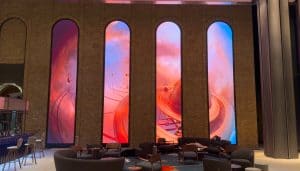
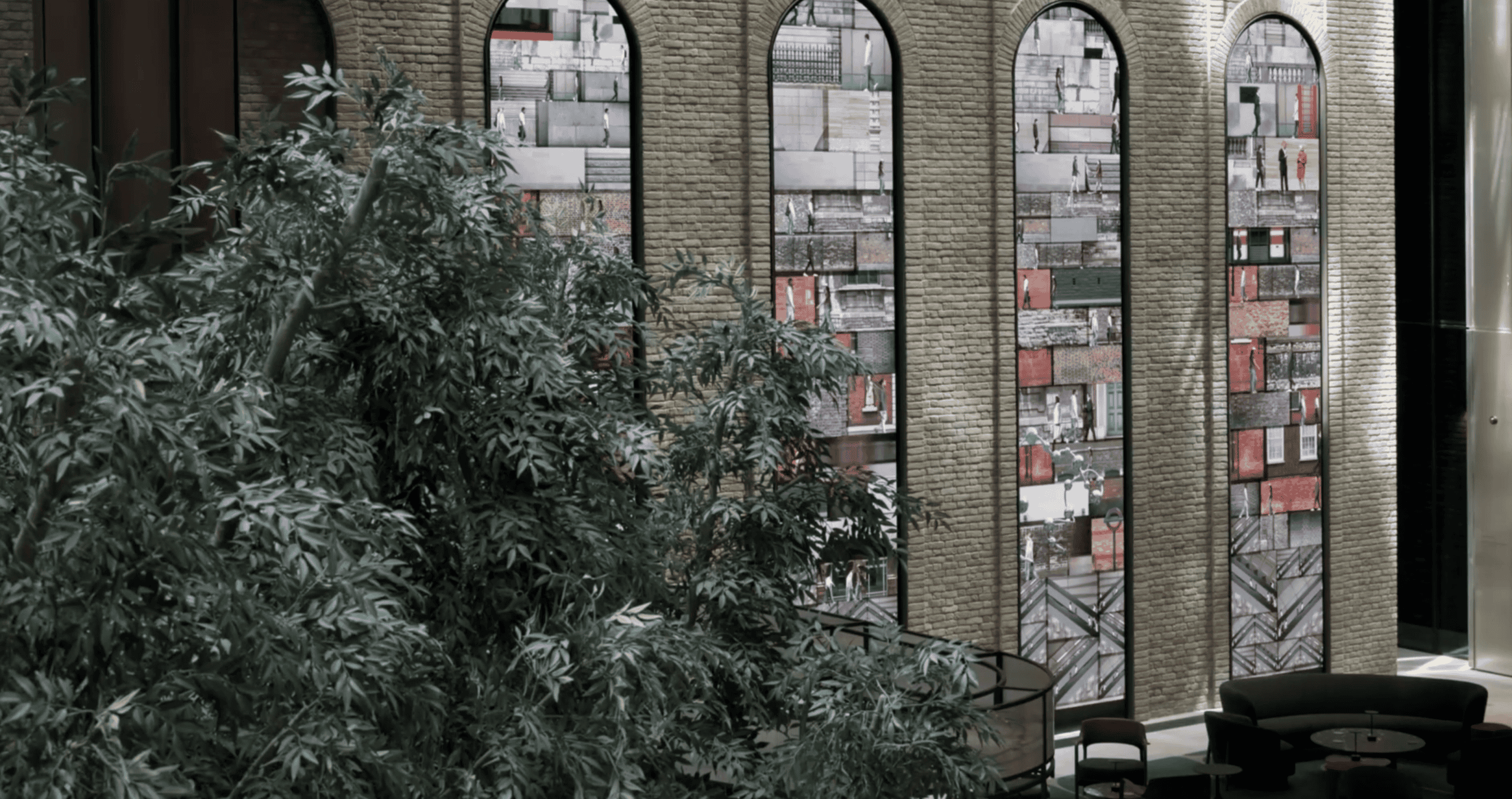
A flush-mounted LED display is part of the architecture. If it is treated as a late AV item, the wall often ends up too shallow, too hot, too uneven, or too difficult to service.
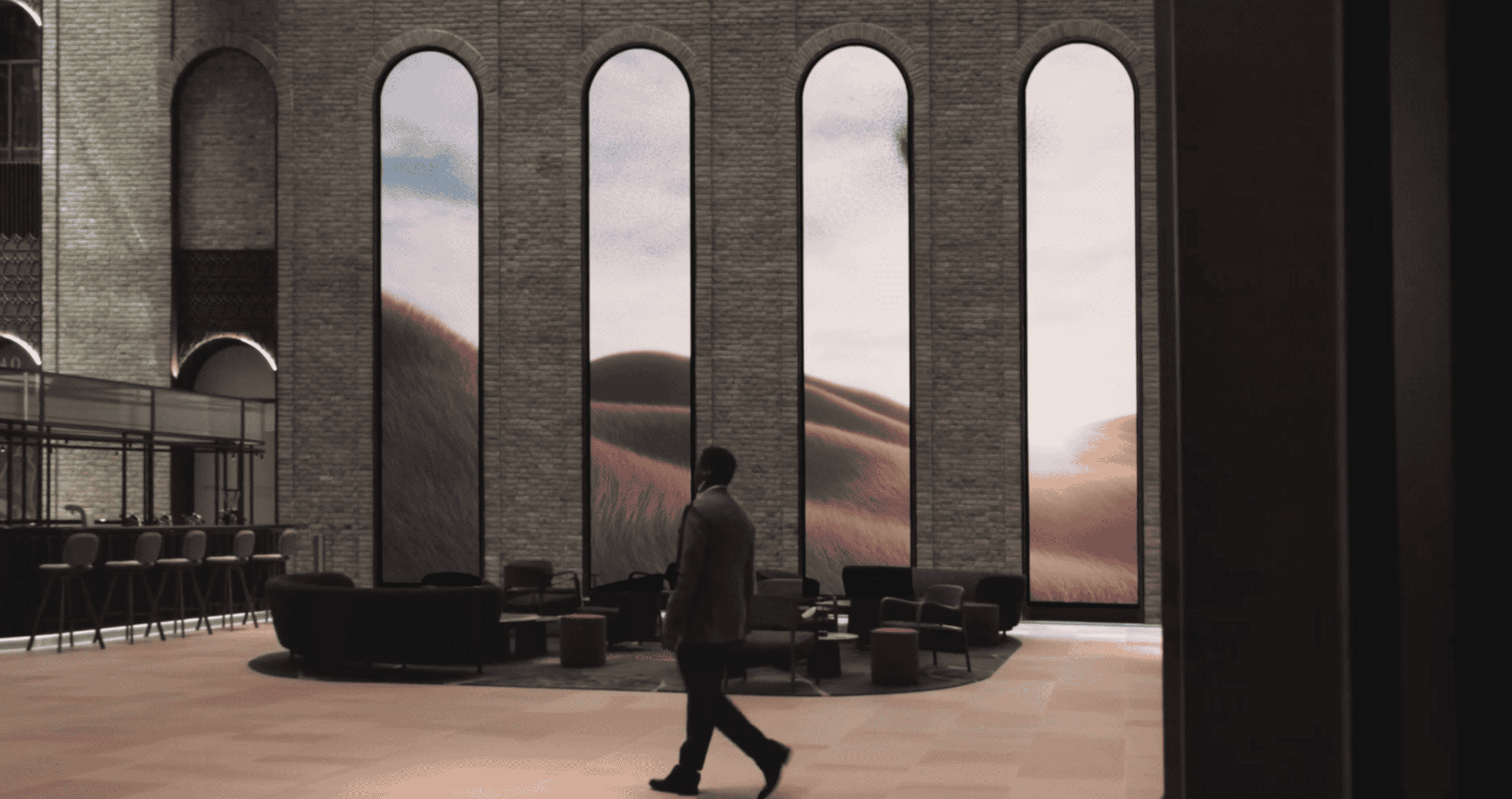
The first questions are practical. What is the finished wall build-up? Is the LED face intended to sit exactly flush, slightly proud, or slightly recessed? Where can the subframe pick up structure? Can the display be serviced from the front without disturbing the architectural finish?
The Recess
The single most common failure point on flush-mount projects is the recess. If the structural opening is sized only to the display face dimensions without allowance for the cabinet frame, mounting hardware, and service void, the install team arrives on site to find an opening that does not fit.
A well-written specification defines the recess as a clear opening: display width plus trim allowance each side, display height plus trim allowance top and bottom, and a depth equal to the cabinet depth plus the service void. That service void — the gap behind the cabinets — provides space for cabling, signal distribution, and airflow. For most fine-pitch indoor cabinets, 100mm behind the panel is workable, though 150mm gives the install team more flexibility and improves long-term serviceability.
The recess wall should be load-bearing or fitted with a steel subframe capable of supporting the display weight. A P1.8 flush-mounted LED display at 3 metres wide by 1.8 metres tall weighs roughly 180–200 kg. That load needs a defined fixing strategy — not a plasterboard partition with toggle bolts. For plasterboard walls, the backing structure needs to be set out before boarding. For timber or metal joinery, the specification should confirm whether the joinery is decorative only or expected to carry load.
Shadow gaps are often useful. A small, consistent margin hides normal construction tolerance and gives the LED face a controlled edge. A “zero gap” detail can look good on a render, but it leaves very little room for real construction movement.
Front-Access Design
For any display recessed into a finished wall, front-access cabinet design is not optional. Once the wall is closed and the trim fitted, rear access may require partial demolition. Custom LED display solutions with front-serviceable cabinets allow individual modules to be removed, replaced, or recalibrated without disturbing the surrounding finishes. The DFC Series uses a die-cast aluminium cabinet with a magnetic front-access module system, allowing a single cabinet to be serviced in minutes. The DX Series uses a steel cabinet construction suited to most commercial lobbies and reception areas — it shares the front-access principle but at a lower price point, making it the practical choice where ultra-tight recess tolerances are not the primary constraint.
Thermal Management
LED panels generate heat. In a freestanding or wall-mounted configuration, natural convection handles most of the thermal load. In a flush-mounted recess, that convection path is restricted.
At typical indoor content brightness (300–500 nits), a fine-pitch flush-mounted LED display draws around 120–180W per m². That heat has to go somewhere. Options include passive ventilation slots above and below the recess concealed behind trim, ducted extraction tied to the building HVAC, or forced-air cooling within the service void. The approach depends on the recess geometry and the building’s mechanical strategy.
The specification should avoid trapping the rear of the display in a sealed pocket unless the manufacturer’s installation guidance supports that build-up. CIBSE Guide A provides reference data for internal heat gains from electrical equipment that can inform the M&E consultant’s calculations.
If you are working through a thermal strategy for a recessed install, our technical team can review your section drawing.
Pixel Pitch Selection for Architectural Flush-Mount Applications
Pixel pitch should be set by viewing distance and content, not by whoever quotes the finest number. As a working guide, pixel pitch in millimetres roughly maps to a comfortable close viewing distance in metres. A P2.5 display is usually comfortable from around 2.5 metres and beyond. A P1.5 suits closer viewing, detailed text, or environments where people stand near the display.
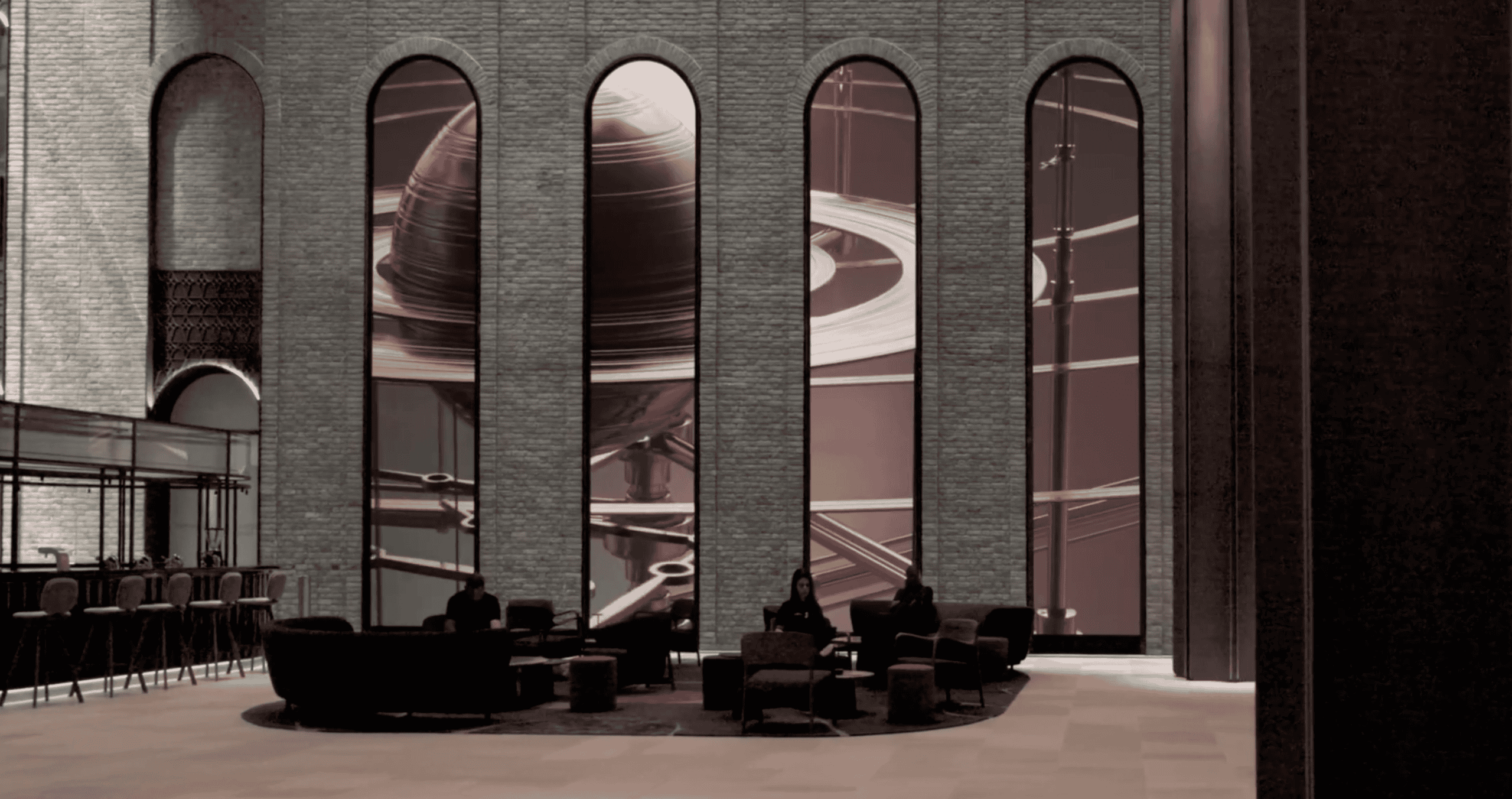
We usually spec for the closest regular viewing position, not the average. A lobby with a seating area at 2 metres gets specced at P1.5 even if most foot traffic passes at 5 metres.
| Use case | Common viewing condition | Pitch direction |
|---|---|---|
| Reception, atrium, retail feature wall | People moving past at 2.5–8m | P2.0–P2.5, depending on content |
| Boardroom, briefing room, showroom | Seated viewers, text and interface content | P1.5–P2.0 |
| Gallery, close-view brand content | Viewers may stand within 2m | Finer pitch may be justified |
Content matters as much as distance. Large-format motion graphics tolerate a coarser pitch than small typography or spreadsheets. For architectural briefs, specifying the pixel pitch as a performance requirement — “the display shall deliver artifact-free viewing at X metres” — gives the supplier flexibility to propose the most cost-effective solution while protecting the design intent. Our guide to LED viewing distance covers the calculation method in detail.
If the architectural package already includes a flush recess, send us the elevation, section, wall build-up, and intended viewing distance. Start with our fine-pitch indoor LED panels and we can work from there into a project-specific specification.
Model your flush-mount specification → LED Screen Configurator
Colour, Processing, and Content Planning
A flush-mounted LED display is often surrounded by controlled lighting and neutral finishes. Colour accuracy matters more here than on a retail or event screen, and a display running much cooler than the surrounding lighting can feel harsh.
The specification should require factory calibration to a defined colour space and name the processing platform. Brompton Technology’s Tessera platform offers per-LED calibration and dynamic calibration that compensates for LED ageing — our default for architectural installs where long-term colour consistency is the priority. Novastar’s NovaPro platform suits projects where the budget is tighter and the content pipeline is simpler, while still delivering reliable colour management on permanent installs. Naming the platform in the specification prevents the contractor substituting a lower-tier processor during procurement.
A flush-mounted LED display is not tied to 16:9. It can be wide, tall, wrapped around a corner, or set into a feature wall at a size that matches the space. That flexibility comes with a content responsibility. If the display is 5 metres wide and 1.5 metres high, the content team needs to know that early. The decisions around content format, source scaling, and native pixel dimensions affect pitch, processor choice, and the finished size. Explore the full fixed-install LED product catalogue for options suited to architectural formats.
From the Field
Daniel, Technical Director — Dynamo LED Displays
I see problems when the LED display is drawn as a black rectangle with no section behind it. My first question is usually not “what pitch do you want?” — it is “where does the heat go, and how does my engineer change a module without damaging the finish?”
I would rather have that conversation while the wall is still a drawing. Once the joinery is built, every missing 20mm becomes expensive. I have been on projects where a conversation at RIBA Stage 3 saved weeks on site and killed a recess rework before it started. If I can see the elevation, section, nearest viewing distance, and finish material at Stage 3 rather than Stage 5, I can usually tell the design team where the risk is before it turns into site work. For more on how LED video walls integrate into commercial schemes, our project portfolio covers a range of architectural installations.
Flush Mount Indoor LED: Frequently Asked Questions
What recess depth do I need for a flush-mounted LED display?
Total recess depth typically falls between 165mm and 250mm. The depth should equal the cabinet depth plus a service void of 100–150mm. Most fine-pitch indoor LED cabinets are 65–100mm deep. Always confirm the exact cabinet dimensions with the supplier before finalising the structural opening, as depths vary by product series and pixel pitch.
Can flush-mounted LED panels be serviced from the front?
Yes, provided the specification calls for front-access cabinets. Front-serviceable designs use magnetic or tool-free module retention, allowing individual LED modules to be removed and replaced without accessing the rear of the display. This is essential for any recessed installation where the back of the screen is enclosed within a wall build-up.
What pixel pitch should I specify for a corporate reception area?
P1.5 to P2.0 is the standard specification for a corporate reception where visitors stand 2–4 metres from the display. Going finer than P1.5 for this viewing distance adds cost without a visible improvement. The right pitch depends on viewing distance, content type, and budget — not on chasing the finest pitch for its own sake.
How much heat does a flush-mounted LED display generate?
At typical indoor brightness levels (300–500 nits), fine-pitch LED panels draw approximately 120–180W per square metre. In an enclosed recess, this heat must be managed through ventilation, extraction, or forced-air cooling. Include a thermal analysis clause in the M&E specification to ensure the mechanical engineer accounts for the display’s heat output.
Do I need to specify the video processor in the architectural brief?
Yes. The processor controls colour accuracy, scaling, and input management. Naming a processor platform — Brompton Tessera or Novastar NovaPro — in the specification ensures the installed system meets the colour performance and calibration requirements expected of a permanent architectural display. Leaving it unspecified risks the contractor substituting a lower-tier platform during procurement.
Can a flush-mounted LED display be completely frameless?
It can be designed with a very minimal visible edge, but “frameless” still needs a construction detail. The LED modules, cabinets, and surrounding finish all require tolerance. A small shadow gap or controlled trim often gives a cleaner finished result than forcing a zero-gap detail that leaves no room for adjustment, expansion, or service work.
Does a flush-mounted LED display need ventilation?
Yes. Even at interior brightness settings, LED electronics and power supplies generate heat. A flush wall should not trap the display in a sealed pocket unless the selected product and installation guidance allow it. In enclosed recesses with inadequate ventilation, sustained elevated temperatures can accelerate LED and driver degradation — making thermal design a lifespan factor, not just a comfort one.
What is the typical lifespan of a flush-mounted LED display?
A fine-pitch indoor LED display has a rated lifespan of 100,000 hours to half-brightness — equivalent to 17–23 years at 12–16 hours daily use in a commercial environment. We recalibrate installed displays annually to maintain uniformity as individual LEDs age at different rates. Practical lifespan is often governed by content requirements and technology refresh cycles rather than LED degradation, but poor thermal management in an enclosed recess can shorten that figure.
Conclusion
Specifying flush mount indoor LED for an architectural project is a coordination exercise as much as a product selection. The structural recess, thermal strategy, pixel pitch, processing platform, product route, and service access design all need to align — and they need to be resolved during design stages, not on site. When the specification is clear and the disciplines are coordinated early, the result is a flush mount indoor LED surface that reads as part of the architecture rather than something fixed to it.
For guidance on specifying flush mount indoor LED for your project, speak to our technical team on +44 (0)203 489 9878 or get in touch through our website.