A hanging LED banner puts the message where a crowded exhibition hall can actually see it: above the stand, not behind the people standing on it. This case study explains how we supplied on hire and installed a 22.5 m² U-shaped hanging LED banner and a 3 m × 2 m booth wall, both at 1.29 mm pixel pitch, through our LED screen hire service for the Biotech Healthcare (Biotech) stand at ESCRS 2026, the 44th Congress of the European Society of Cataract and Refractive Surgeons, at ExCeL London. Biotech is an ophthalmic company whose EYECRYL PHAKIC lens branding ran on the displays, and we worked for the stand contractor SOMOS Congress. It is written for exhibitors, stand builders and event producers weighing an overhead LED display against a printed fascia.
Key takeaways
- A U-shaped hanging LED banner of 6 m + 6 m + 3 m, each face 1.5 m high, gave the Biotech stand three live faces above head height, read from three directions.
- The same DRE Series 1.29 mm cabinets built the hanging banner and the 3 m × 2 m booth wall, driven by one processor and control system across both viewing distances.
- Squared corners were built from standard cabinets with corner cabinets and hanging bars, so the three faces read as one continuous canvas rather than three separate displays.
- The rigging structure was arranged by the stand contractor with the venue. Dynamo attached the cabinets to it, commissioned the system and kept technicians on standby through the show.
- Programme content is a file, not a print, so a speaker line-up or a session time can change on a hanging LED banner without touching the stand build.
Project facts
| Item | Details |
|---|---|
| Event | ESCRS 2026, the 44th Congress of the European Society of Cataract and Refractive Surgeons |
| Venue | ExCeL London |
| Dates | Congress 11 to 15 September 2026; stand live 11 to 14 September; build-up 8 to 10 September; de-rig 14 to 15 September |
| Client | SOMOS Congress (stand contractor) for Biotech Healthcare, an ophthalmic company (EYECRYL PHAKIC) |
| Hanging banner | U-shape, 6 m + 6 m + 3 m runs, 1.5 m high, 22.5 m² nominal, squared corners |
| Booth wall | 3 m × 2 m, 6 m² nominal, freestanding inside the stand |
| LED product | DRE Series rental LED, 1.29 mm pixel pitch, on both displays |
| Cabinet format | 496 × 496 mm, 384 × 384 pixels per cabinet |
| Specified pixel count | Approximately 17.1 million across both displays |
| Specified brightness | 800 to 1,000 nits (indoor) |
| Processing | Professional broadcast-grade video processor and control system driving both displays |
| Content | Client-supplied |
| Additional screen | One 55-inch commercial display, supplied and installed |
| Dynamo scope | Delivery, LED build and fitting to the client-provided truss, commissioning, cable management, on-stand sign-off, standby technicians, de-rig, de-cable and removal |
A hanging LED banner is an LED display suspended above an exhibition stand from a truss or rigging structure, rather than standing on the floor or fixing to a wall. It is usually wide and short, sits above head height, and carries branding or programme content that has to be read from a distance across the hall. It is also called an overhead LED banner.
The format works because it borrows the one dimension a stand cannot buy more of: height. Floor space at a congress is fixed by the stand booking. The air above it is only limited by the venue’s rigging rules and the contractor’s structure.
Quick definitions
- Pixel pitch: the distance in millimetres between the centres of two neighbouring pixels. A smaller pitch means more pixels per square metre and a shorter comfortable viewing distance.
- Nits: the unit of brightness (candela per square metre). A cabinet’s rated brightness is what it can produce; the level a display is set to in use is a separate operating choice.
- Squared corner: a 90° turn in the LED surface built with corner cabinets, so a graphic can run round it without a break. Our right-angle LED wall case study covers how content behaves at a corner.
Why the Biotech stand needed two viewing distances
The Biotech stand at ESCRS 2026 used a hanging LED banner for people approaching the stand and a 3 m × 2 m booth wall for the seating area, both at 1.29 mm, because each was read from a different distance. A congress stand has two jobs at once: to be found from across the hall and to hold attention once a delegate has arrived.
The beacon: a U-shaped hanging LED banner
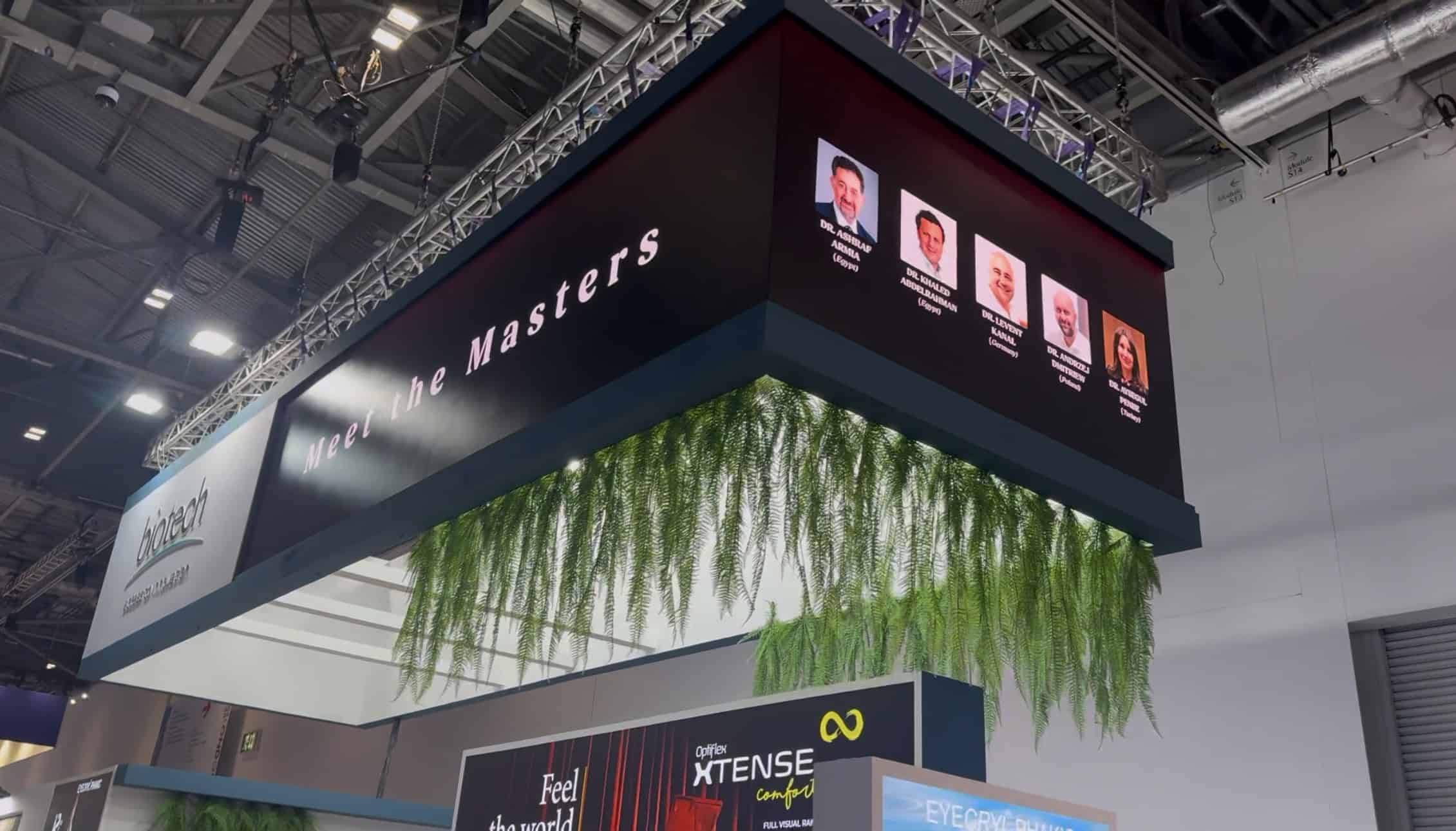
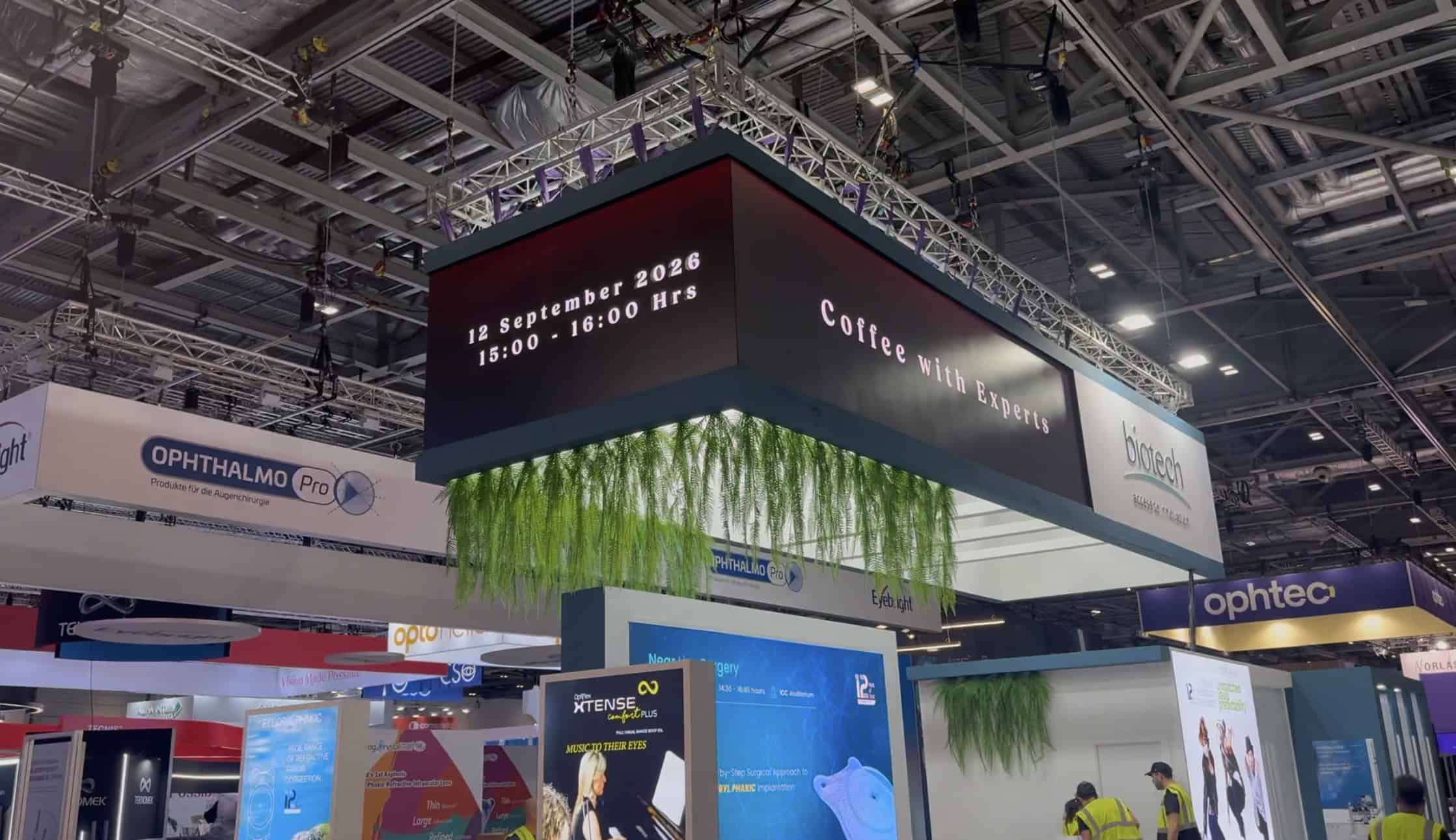
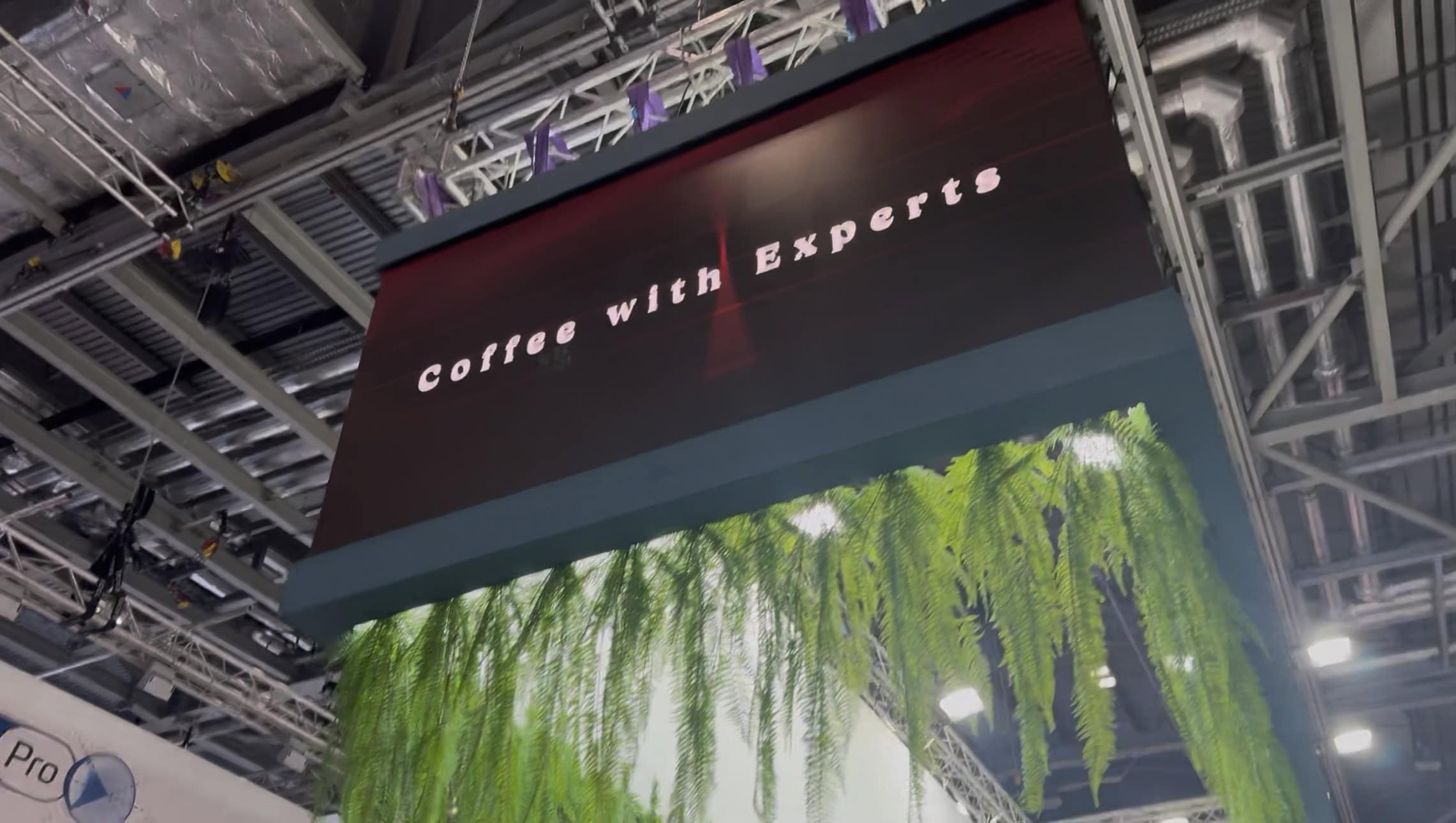
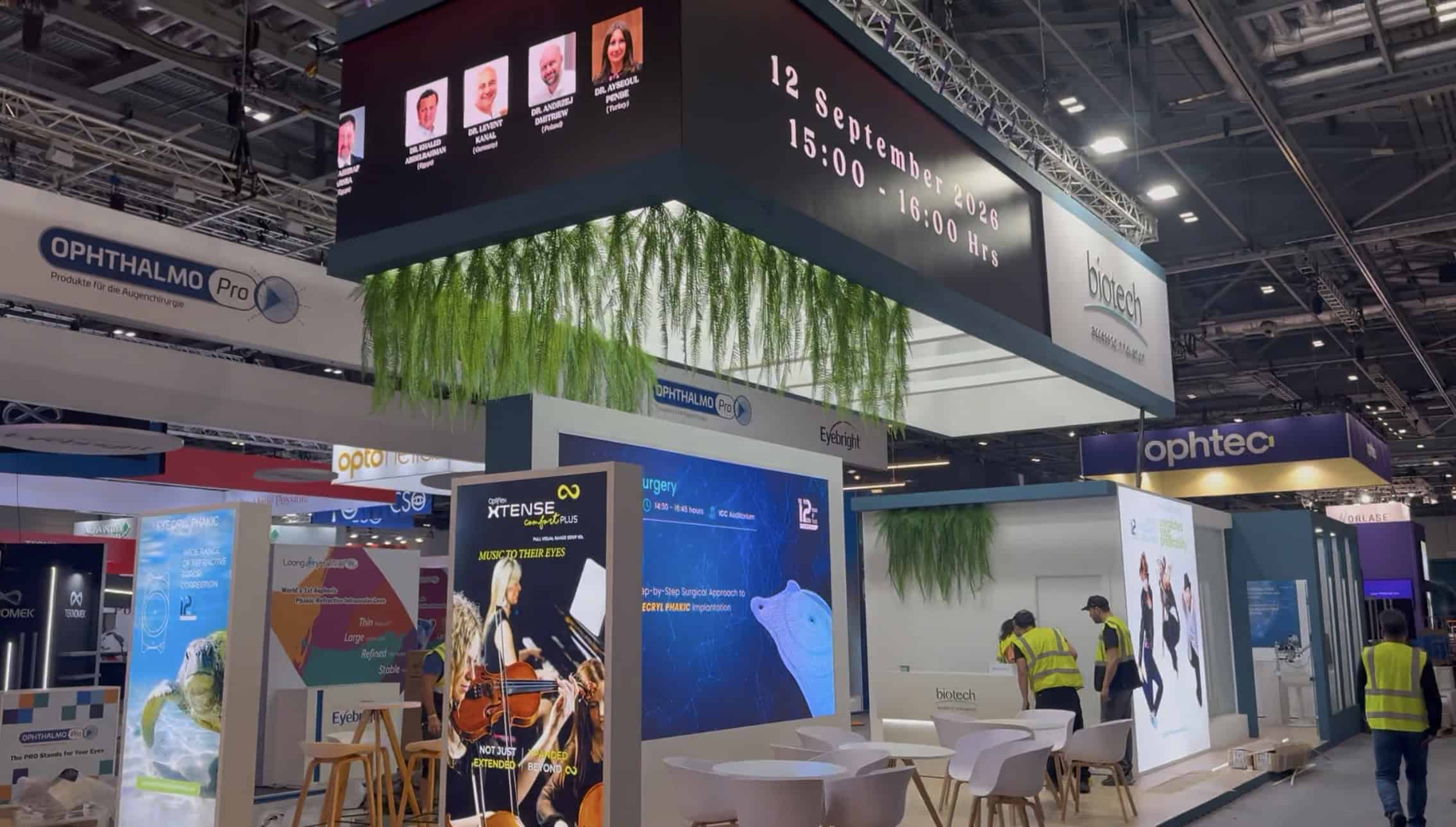
The hanging banner was the stand’s beacon. Three faces wrapped the top of the stand so that it could be read from three directions above head height. Through the show it carried the “Meet the Masters” speaker line-up with headshots, the “Coffee with Experts” invitation and session slots such as “12 September 2026, 15:00 to 16:00 Hrs”. That is exactly what a congress delegate is scanning for: who is speaking on this stand, and when.
The close-up display: a freestanding booth wall
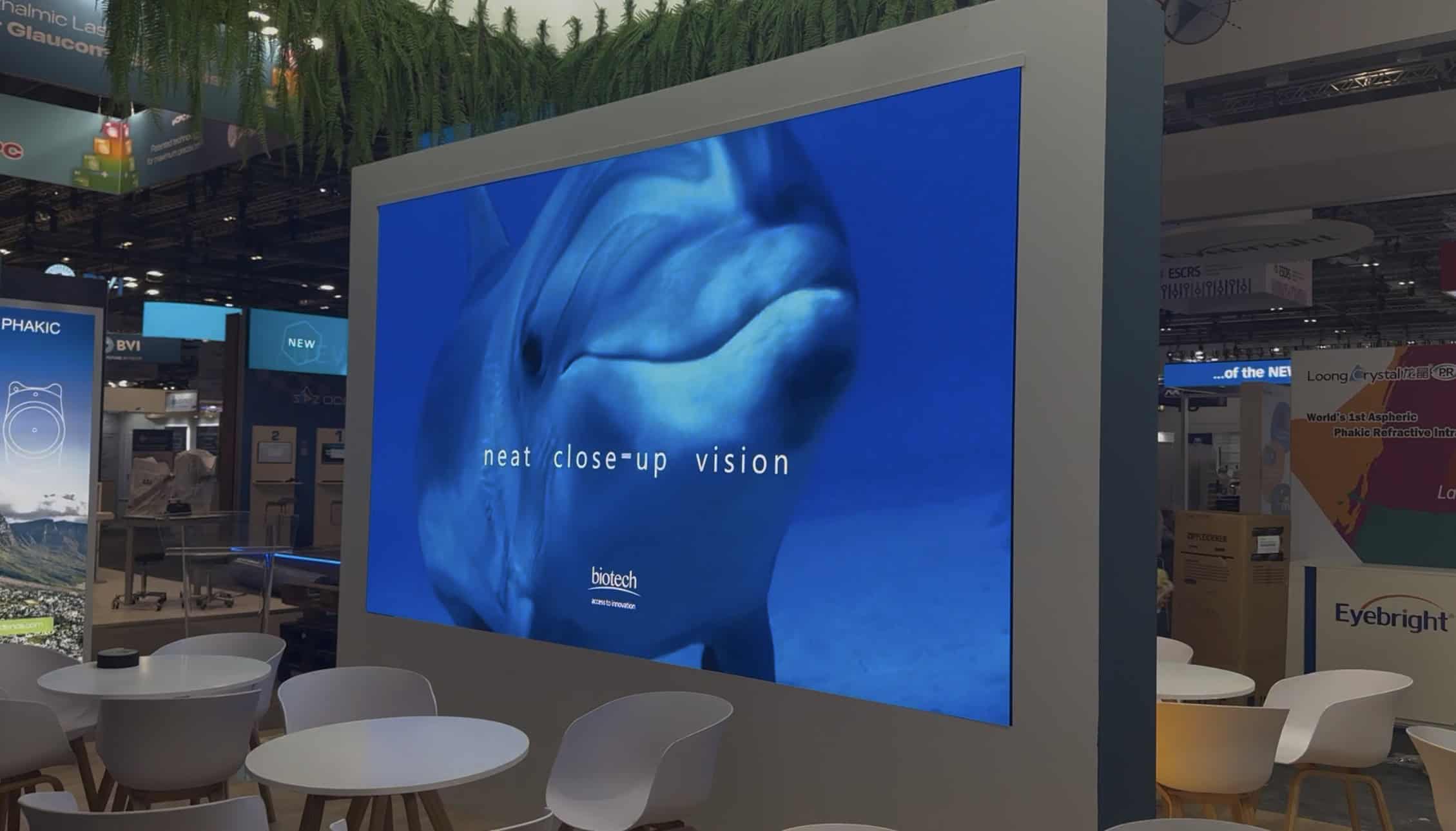
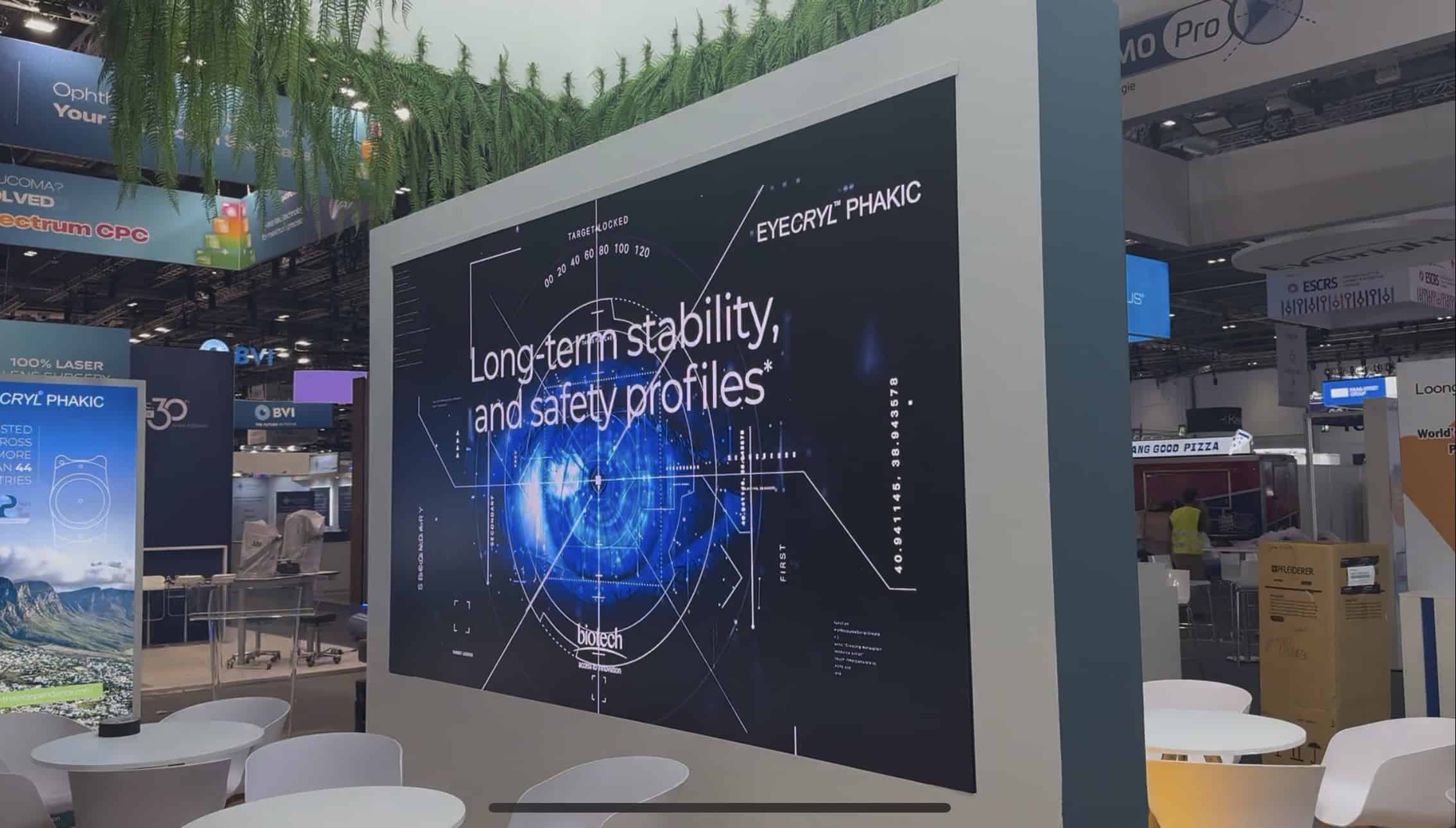
Inside the stand, a 3 m × 2 m booth wall stood beside the seating area of tables and chairs. It carried Biotech’s product messaging for the EYECRYL PHAKIC lens, including a dolphin sequence with the line “neat close-up vision” and an eye graphic with the line “Long-term stability, and safety profiles”. A display beside the tables is viewed at close range, which is why it needed the same fine pitch as the banner overhead rather than a coarser panel.
The banner was built as a U from standard DRE Series cabinets, hung from the contractor’s truss, and specified at 1.29 mm so that photographs and small type held up at close range as well as from across the hall.
Shape and dimensions
The three faces measured 6 m + 6 m + 3 m, each 1.5 m high, for 22.5 m² nominal. Quoted areas for a U-shape with squared corners are nominal because the cabinet layout and the exact built dimensions are confirmed at the drawing stage, once the cabinet grid is laid over the contractor’s structure.
The squared corners were built from standard cabinets using corner cabinets and hanging bars, so a graphic can run round the corner rather than stopping at a fascia panel. The rule from our right-angle wall applied here too: keep headshots and logos away from the corner line unless the design intends a wrap.
Rigging to the client’s truss
The rigging and suspension structure was arranged by SOMOS Congress with the venue. Our job was to build and fit the LED to it, commission it and sign it off on the stand. The truss, the stand build, the flooring, the furniture and the stand electrical supply were all outside our scope. Agree that split in writing early, because the venue’s rigging team, the stand builder and the LED supplier each own a different part of the load path. A DRE Series cabinet weighs approximately 9.2 kg, so the cabinet grid gives the cabinet-only mass per face as soon as it is drawn. The installed load also has to include the hanging bars, cabling and anything else attached to the structure. A planted fern canopy hung beneath the banner, which is another reason to settle the rigging plan before the LED order is finalised. Our guide to rigged versus ground-stacked hire screens explains what the venue will ask for on a suspended build.
Pixel pitch and pixel count
Both displays used DRE Series cabinets at 1.29 mm pixel pitch, 384 × 384 pixels per 496 mm cabinet. Pixel counts come from the number of cabinets multiplied by the pixels per cabinet.
1.29 mm is a pitch normally specified for a display people stand close to, and here it was used overhead as well. Fine pitch suits the content this banner carried: speaker headshots, names in small type and session times need pixel density to stay sharp, and a banner above a busy stand is read at close range by delegates passing beneath it as well as from across the hall. A fine pitch does not make small text readable from every approach, though, and the hardware is not a reason to fill the banner with detail. Our post on viewing distance and pixel pitch gives the working rule for other stands.
Brightness and viewing angle
The project specification called for 800 to 1,000 nits for the indoor hall, and the DRE Series cabinets are rated above 800 nits with a 160° viewing angle horizontally and vertically. The wide angle matters more than usual on a hanging banner, because most delegates read it from below and from an angle rather than square on.
The booth wall: 3 m × 2 m at close range
The booth wall was a 3 m × 2 m freestanding exhibition stand LED screen inside the stand, positioned beside the tables and chairs. At 1.29 mm the pitch is fine enough for the close range a seated delegate has from a display beside the table.
One cabinet type, two displays
Building both surfaces from the same 496 mm cabinet has a practical payoff during the show. One processor and control system drove both displays, and the same modules and service method apply to both. The cabinets offer front and rear service. Whether a fault on a suspended banner can be dealt with in place depends on the access arrangements and on the fault itself. At the same pitch, the banner and the booth wall read as one system rather than a banner and a sign.
Processing, content and commissioning
One professional broadcast-grade video processor and control system drove both LED displays, approximately 17.1 million pixels specified in total, with content supplied by the client. Our role was to make that content land on the right pixels, on time, and keep it there for four show days.
Client-supplied content
Content creation was not part of our scope. What the content designer needs from the LED supplier is the canvas for each face in pixels, and where the corners fall in that canvas, so the banner artwork can be built once and mapped across the three faces. One processor drove both displays, but the output arrangement still has to reflect the separate banner faces and the booth wall. Programme-driven content, such as a speaker line-up that changes by session, suits an LED banner better than print because the change is a file, not a reprint.
Commissioning and standby
Installation covered delivery to ExCeL London, building and fitting the LED to the truss, full system commissioning, cable management and sign-off on the stand. Through the event our technicians were on standby, remotely and on site if required, to resolve any issue with the LED displays. A dedicated full-time on-site technician was not part of the scope. Settle that distinction before the stand opens so the contractor knows what cover they have.
The 55-inch display
One 55-inch commercial display was supplied and installed on the stand alongside the LED. There is nearly always a place for a conventional display on a congress stand, and supplying it with the LED keeps one supplier responsible for everything that lights up.
Build-up, show days and de-rig at ExCeL London
The stand was live from 11 to 14 September 2026, with build-up on 8 to 10 September and de-rig on 14 to 15 September. We work at ExCeL London regularly, which matters on a suspended build because the venue’s rigging schedule and loading access set the order in which everything happens.
Stand electrical supply is provided at the stand by the venue or client, not by the LED supplier. The DRE Series is rated at a maximum of 600 W/m², so the power positions and capacity should be agreed with the stand contractor when the LED areas are fixed. A display’s nominal area is a starting point for that conversation, not a confirmed power requirement. Our note on power requirements for hire screens covers what to ask the venue for.
This is the brief we work from on a suspended LED build, and a short pack from the stand contractor covering it is enough for an accurate hire proposal:
- Stand drawings with the truss or suspension structure marked, including its height above the floor.
- The banner dimensions per face, and whether the corners are open or squared.
- The confirmed rigging arrangement with the venue, and who is responsible for it.
- The nearest viewing distance for each display, so the pitch can be set to the content.
- Power positions and capacity at the stand.
- Build-up and de-rig windows, and the content deadline.
Our BAE Systems stand at DSEI case study covers another exhibition LED hire. More exhibition LED screen projects are on our site.
From the field
The point I would draw out from this build is the shape. Three live faces above the stand give a display that can be read from three directions without taking any floor space from the stand itself. On this build a planted fern canopy hung beneath the banner, and the LED sat above it as part of the stand rather than a screen bolted on.
The other point I would emphasise is the split of responsibility. Here the contractor arranged the structure with the venue, and we built the LED onto it, commissioned it, kept technicians on standby and de-rigged it at the end. Once the corner cabinets make the three faces one canvas, the content team can treat the banner as a single display.
Hanging LED Banner: Frequently Asked Questions
Can a hanging LED banner be a single flat run rather than a U-shape?
Yes. DRE Series cabinets are designed for stacking, hanging and stitching, so a hanging LED banner can be one flat run on a single truss, an L-shape with one corner, or a U-shape with two. The shape follows the stand: a single run suits a stand on one aisle, and the U-shape used on the Biotech stand at ESCRS 2026 suits a stand approached from three directions.
How is a hanging LED banner rigged at ExCeL London?
The suspension structure is arranged by the stand contractor with the venue, which controls rigging in its halls. The LED supplier then attaches the cabinets to that structure using hanging bars on the top row, cables the display and commissions it. On this build SOMOS Congress arranged the truss with ExCeL London and Dynamo attached, commissioned and later de-rigged the LED.
What pixel pitch does a hanging LED banner need?
It depends on what the banner shows and how close people pass beneath it. A banner carrying only a logo can use a coarser pitch. A banner carrying speaker headshots, names and session times, read at close range by delegates passing beneath it, benefits from a fine pitch. The Biotech banner used DRE Series cabinets at 1.29 mm and carried exactly that kind of content.
How is the weight of a hanging LED banner calculated?
A DRE Series cabinet weighs approximately 9.2 kg, so the cabinet grid gives the cabinet-only mass per face once the layout is drawn. The installed load adds the hanging bars, cabling and any other attached equipment, and that is the figure the venue’s rigging team and the stand contractor need early, because the structure has to be designed for the LED plus anything else hung from it, such as the planted canopy on the Biotech stand.
Can the same LED cabinets be used for the hanging banner and a booth wall?
Yes. On the Biotech stand the hanging banner and the 3 m × 2 m booth wall were both built from DRE Series 1.29 mm cabinets, driven by one processor and control system. One cabinet type means one set of modules and one service method for both displays, and the content looks consistent whether it is read from the hall or from a seat inside the stand.
Who supplies the content for a hanging LED banner?
The client or their agency normally supplies the content, as Biotech did here. The LED supplier provides the pixel canvas for each face and shows where the corners fall so the artwork can be built once and mapped across the whole banner. Programme content such as a speaker line-up or a session time can then be changed as a file rather than a reprint.
The Biotech stand at ESCRS 2026 shows what a hanging LED banner does that a printed fascia cannot: it puts a changing programme above the stand where it can be read from three directions. The decisions that made it work were made early, on the rigging, the corners, the pitch and the content canvas.
If you are planning a hanging LED banner or an LED booth wall for an exhibition stand, send us the stand drawings, the rigging arrangement and the show dates through our contact page, or phone +44 (0)203 489 9878, and we will come back with a written hire proposal for the LED banner and wall.
Written by: Daniel Reynolds, Managing Director, Dynamo LED Displays