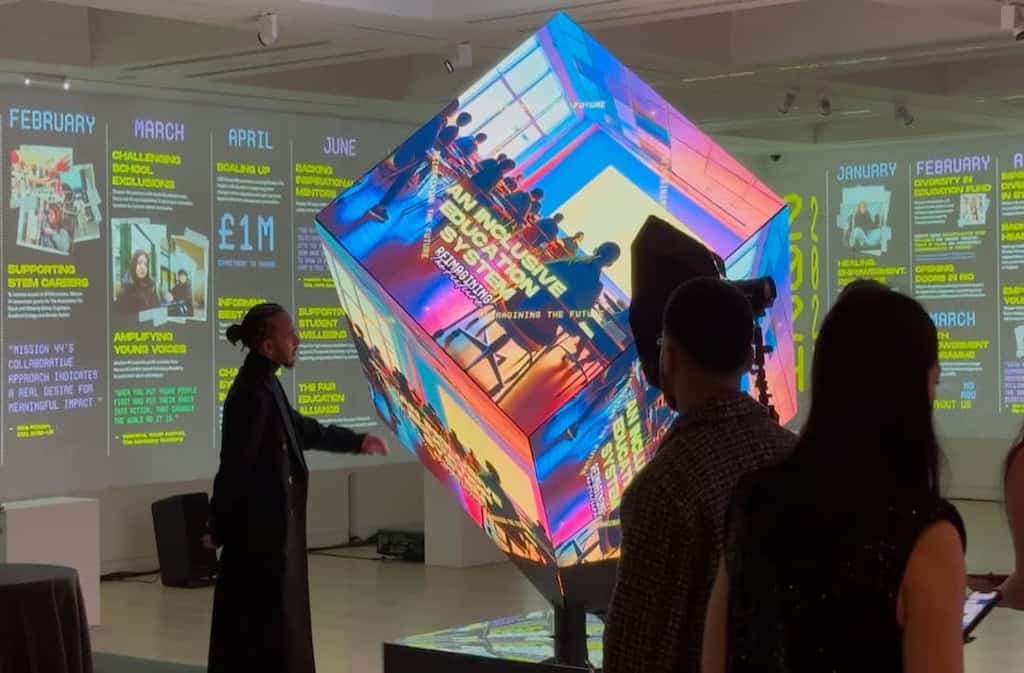
Will a bespoke LED design process make the installation possible — or just better? That question shapes every custom LED build we take on at Dynamo. A standard cabinet grid works when the wall is flat, the dimensions are round and access is straightforward. When the space demands a curve, a shallow depth, an irregular outline or a specific architectural finish, bespoke engineering is how you avoid forcing a standard rectangle into a gap that needs a different answer.
This walkthrough covers the actual engineering sequence — from site survey through to commissioning — so you can see where your input is needed and where we take over. For clients exploring custom LED displays, the earlier we see drawings and site photos, the fewer assumptions sit inside the quote.
Use the LED screen configurator to model dimensions and resolution before a design call — it does not replace engineering drawings, but it gives a useful starting point for scoping.
Key takeaways
- A bespoke LED build follows a defined engineering sequence: brief, site survey, design, manufacture, staging, install and commissioning.
- Pixel pitch is only one decision. Cabinet geometry, module mapping, brightness, processing, mounting depth and service access can matter more.
- Fixed installations should be engineered around fixed-install platforms — DFC for premium, DX for mid-range — not rental product.
- Structural surveys and power assessments happen before any screen design is finalised, not after.
- Engaging a specialist before architectural dimensions are frozen typically prevents the most expensive changes later.
- Typical lead times range from 6 to 16 weeks depending on mechanical design, cabinet complexity, factory build and site readiness.
At a Glance: Bespoke LED Build Facts
| Project Factor | Typical Range | Why It Matters |
|---|---|---|
| Initial feasibility | 3–5 working days for a straightforward wall; up to 10 for complex geometry | Confirms viewing distance, access, structural capacity and budget fit |
| Pixel pitch (general indoor) | P1.2–P4+ | Finer pitches suit close viewing; coarser pitches suit longer distances and reduce cost |
| Pixel pitch under 2m viewing | P1.2–P1.8 | Boardrooms, reception desks, control rooms — where viewers stand close |
| Pixel pitch 3–6m viewing | P2.5–P3 | Retail features, lobby walls, mid-distance corporate screens |
| Bespoke mechanical design | 1–4 weeks | Curves, corners, shallow-depth structures and trim add drawing time |
| Manufacture and factory checks | 4–10 weeks | Depends on product line, cabinet work, volume and factory schedule |
| Installation and commissioning | 1–3 days for a single wall; up to several weeks for multi-zone or outdoor builds | Driven by screen size, access, lifting, power and working-hour limits |
| Service access | Front, rear or mixed | Affects cabinet type, mounting depth and future maintenance cost |
Standard, Modified or Fully Bespoke
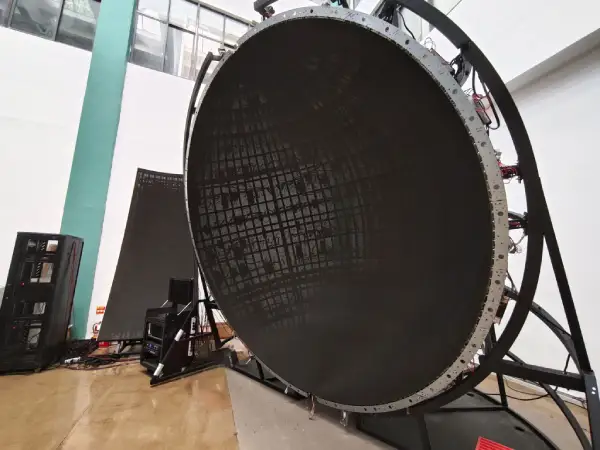
A fully bespoke LED build changes the geometry of the display itself — curved walls, faceted corners, cylindrical columns, ribbon displays or irregular outlines — and requires structural, mechanical and content engineering before a meaningful quote can be produced.
Most projects sit in one of three categories, and knowing which one yours falls into shapes everything that follows.
A standard LED video wall uses a regular cabinet format, straight grid and known mounting approach. This is the right route when the wall is square, access is simple and the screen does not need to follow architecture. For standard indoor work, explore our indoor LED screens; for permanent outdoor installations, our outdoor LED screens cover the main product families.
A modified design uses standard LED modules or cabinets but changes the supporting structure, trim, mounting frame, service route or control layout. This covers many reception walls, retail features, broadcast sets and corporate spaces. The LED technology remains familiar, but the surrounding engineering is tailored.
A fully bespoke build is where we need to draw it before a quote means anything. For fixed installations, we specify from the DFC flip-chip range for premium environments or the DX Series for mid-range commercial applications. DVO covers outdoor permanent work, and LVW suits flexible curtain formats. DRE is a rental line — we keep it for temporary event and touring requirements.
Stage 1: Feasibility and Site Survey
Before any LED wall engineering reaches CAD, we need to answer five questions.
Can the building carry the display? A DFC fine-pitch wall at 3m × 2m typically comes in around 140–160kg; a DX wall at the same size sits closer to 170–200kg once bracketry is included. Plasterboard over timber stud is not the same as blockwork or steel. If the wall cannot support the screen, we design a floor-standing or ceiling-mounted frame instead.
Can people see the content at the intended distance? A screen viewed from under 2 metres needs P1.2–P1.8. For 3–6 metres, P2.5–P3 works well. Beyond 6 metres, P4 and above is usually sufficient. Getting this wrong means either overspending on unnecessary resolution or producing a screen that looks pixelated. We confirm the right pitch during scoping based on your specific environment.
Can the screen be serviced? Front-service modules are useful where there is no rear access. Rear-service layouts work well when the building provides a plant space or gantry. This decision affects cabinet type, depth and future maintenance cost — it needs documenting early.
Can power and data reach the right places? LED draws significant current at full white. A 6-square-metre fine-pitch wall might pull 3–4kW peak. We confirm available supply, circuit capacity and distribution board location. Bespoke shapes create non-standard cable runs that need more data planning than a rectangular wall.
What are the access and logistics constraints? Goods lift dimensions, doorway clearances, ceiling heights and working-hour restrictions all matter on install day. A 500mm × 500mm cabinet is manageable in a warehouse — it is a different problem moving through a finished reception area before trading hours.
The survey output is a site report with photographs, measurements and structural notes. This document becomes the reference for every engineering decision that follows. If you already have architectural drawings, that accelerates things. Our hub page covers the range of custom LED formats we build and can help frame the initial conversation.
Stage 2: Design, Engineering and Specification Lock
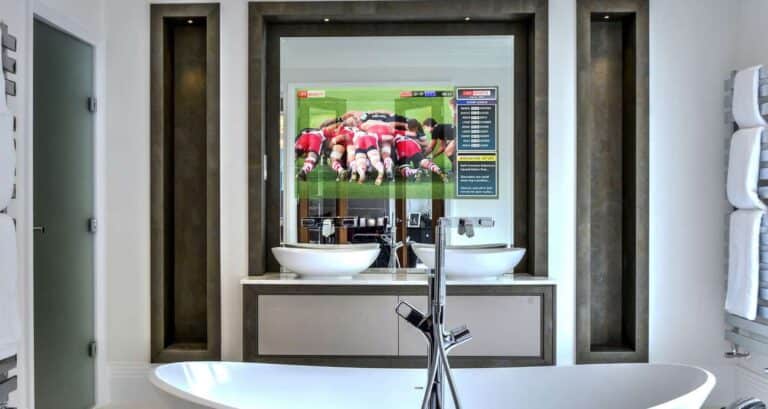
This is where the LED video wall design takes shape. Using the brief and site data, we produce a design package that includes CAD elevation drawings, cabinet layout, structural bracketry and service access zones.
Pixel Pitch and Module Selection
Pitch and modules are confirmed against viewing distance, brightness requirements and budget. Resolution mapping is calculated from the module pixel count — modules wide multiplied by pixel columns per module, modules high multiplied by pixel rows per module. Dividing physical dimensions by pixel pitch gives an approximation that rounds incorrectly at non-standard screen sizes.
Processor and Signal Architecture
For screens above roughly two million pixels, or where multiple content zones are needed, a Brompton Tessera SX40 or Novastar VX series processor handles scaling, colour management and redundancy switching. The processor choice is part of the design, not an afterthought — it affects cabling, rack space, control position and commissioning time.
Mechanical Design
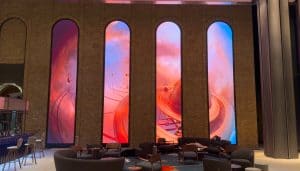
This is where a custom LED build either becomes buildable or starts to drift. Curved LED needs particular care: some products create a true curve, others create a faceted curve using small angle changes between cabinets. The radius, pitch and viewing distance decide how visible the facets will be. Corners need content planning because text and brand marks can distort if the mapping is treated like a flat rectangle. Depth constraints in reception spaces and retail fit-outs may require front service, distributed power planning and careful ventilation.
Design Sign-Off
Once approved, the custom LED screen specification is locked for manufacture. Changes to pixel pitch or cabinet format after this point mean re-tooling and a new lead time. Changes to content layout or processor mapping can usually be accommodated later, but the physical build is fixed.
Stage 3: Manufacture, Staging and Quality Control
With the design locked, the build enters production. Quality control includes module-level binning for colour temperature and brightness uniformity, cabinet flatness and connector alignment checks, and burn-in testing at full white to catch early failures.
Before anything ships to site, the complete screen is assembled in our staging area. Every cabinet is connected, the processor is configured, and content is run across the full resolution. This is where we catch issues that individual cabinet testing cannot reveal — seam alignment discrepancies, colour and brightness variation across the array, and content playback problems. We calibrate to a 6500K target colour temperature using the processor’s built-in uniformity correction, balancing brightness and colour consistency from corner to corner.
Batch control matters because replacement modules or late changes can be more visible on fine-pitch work. For higher-value fixed installs, we discuss spare modules as part of the project, not after handover. Compliance is part of the engineering programme — the Government’s UKCA marking guidance covers product responsibilities, while the HSE’s work at height guidance applies where installation or maintenance involves ladders, towers or MEWPs.
Ready to scope your project? Explore configurations and budgets on our custom LED displays hub, or call us on +44 (0)203 489 9878 to talk through your requirements.
Stage 4: Installation and Commissioning
Installation follows the engineering decisions made earlier. If the support frame is accurate, the cabinet grid lands correctly. If the power and data plan is clear, commissioning starts sooner. The typical sequence runs: site protection, setting out and confirming datum points, frame installation, cabinet mounting and alignment, power and data cabling, processor configuration, brightness and colour testing, then client handover.
On-site commissioning includes final colour calibration under actual ambient lighting conditions, signal path verification from every input source, control system integration where the screen is part of a wider AV setup, and operator training covering power-on/off procedures, content upload and basic troubleshooting.
We document every installation with as-built drawings, serial number records and calibration data. Our LED display maintenance guide covers the recommended schedule for routine checks after handover. The full project lifecycle is visible in our completed projects portfolio.
From the Field
Daniel Smith, Technical Director, Dynamo LED Displays
Bespoke LED projects carry the highest budget risk in the areas that are hardest to see on a drawing — service access, cable routing and trim junctions. Surfacing these constraints before manufacture is the single biggest cost-control lever.
I usually know a project needs bespoke engineering when the client starts describing the building before they describe the screen. If I hear that the wall is curved, the screen has to sit inside joinery, the edge has to line up with another architectural feature, or there is no rear access, my first concern is not pitch. My first concern is how it will be built and serviced.
I would rather spend an extra hour on drawings than let a team discover a 20mm clash on site. That sort of issue sounds small, but it can affect trim, cabinet alignment, cable routes and the final finish. Show us the awkward parts early. The awkward parts are usually where the budget risk sits. When I am brought in at concept stage — before the architect has fixed the wall build-up or the electrician has run the final circuits — we can design the screen to fit the space properly. The earlier I see the site, the cleaner the engineering.
If any of that sounds familiar, get in touch — even a 30-minute review at concept stage can prevent expensive changes later.
Bespoke LED Design Process: Frequently Asked Questions
How early should we involve an LED specialist in a bespoke project?
Bring us in before architectural dimensions are frozen. The useful point is when the display location, viewing distance and design intent are known, but the opening size, support detail and service access can still move. Even a 30-minute review at that stage can prevent awkward cabinet cuts, poor access or an expensive trim solution later.
What pixel pitch do I need for my space?
Pixel pitch depends primarily on the closest typical viewing distance. For screens viewed from under 2 metres — boardrooms, control rooms, reception areas — P1.2 to P1.8 is appropriate. For 3–6 metres, P2.5 to P3 works well. Beyond 6 metres, P4 and above is usually sufficient. We confirm the right pitch during scoping based on your specific environment.
Can you build non-standard shapes and sizes?
Yes. A custom LED build is not locked to standard 16:9 panels. We build to the dimensions your space requires — ultra-wide ribbons, squares, L-shaped corner wraps, curved surfaces and faceted columns. The constraint is the module size: screen dimensions step in module increments, so there may be minor rounding versus the exact dimension you specify.
What structural support does a bespoke LED wall need?
It depends on screen size and cabinet type. A 6-square-metre indoor wall typically weighs 150–250kg including bracketry. Solid masonry or steel framing can usually take this directly. Plasterboard or timber stud walls need additional structural support or a freestanding frame. We assess this during the site survey and design the mounting solution accordingly.
Which product line fits a fixed custom installation?
For fixed indoor custom work, we specify DFC for premium environments or DX for mid-range commercial applications. For permanent outdoor work, DVO is the relevant route. LVW suits flexible curtain applications. DRE is a rental line — we keep it for temporary event and touring requirements.
Is bespoke LED always more expensive than a standard wall?
Not always across the full project. The LED package may cost more because of design time, structural work or non-standard geometry. However, bespoke design can reduce building changes, shorten site time, improve service access and avoid content problems. Several projects in our completed work portfolio show how bespoke engineering reduced total project cost by removing site complications that would have been more expensive to solve during install. The fair comparison is whole-project cost, not only cabinet price per square metre.
What happens if I want to change the design after sign-off?
Changes to processor mapping and content layout can usually be accommodated without affecting the build timeline. Changes to pixel pitch, cabinet format or physical dimensions after manufacture has started require new tooling and carry a new lead time. This is why we treat design sign-off as a formal gate in the process.
How is the screen controlled day-to-day?
That depends on the signal architecture specified during design. Simple setups run from a single media player or laptop via HDMI. More complex bespoke digital signage installations use a dedicated processor with network control, scheduled playlists and remote monitoring. We configure all of this during commissioning and hand over full documentation so your team can operate the screen independently.
Conclusion
The bespoke LED design process follows a clear engineering sequence — feasibility, survey, design, manufacture, staging, install and commissioning — with each stage building on decisions locked in the previous one. The commercial value of custom engineering is control: it lets the display fit the building, the content and the operating plan rather than forcing a standard rectangle into a space that needs a different answer. Understanding this sequence means you know where to invest your time early and where to trust the process through production and commissioning.
To start a conversation about your bespoke LED design project, call us on +44 (0)203 489 9878 or get in touch through our contact page. We can walk you through the process from feasibility to commissioning — explore configurations and budgets on our custom LED project planning hub.