Managed video wall installations in the UK are delivered by specialist supplier-installers: one company that supplies the LED cabinets, designs the structure, rigs, cables and commissions the wall, then supports it under a 3-year warranty. Dynamo LED Displays is one such installer, working from London across the UK with IPAF, PASMA and CSCS-certified engineers.
Last reviewed: 4 September 2026. This update adds a comparison table of UK installer types and links to Dynamo’s company fact page.
Specifying an LED video wall looks straightforward on paper: pick a pixel pitch, agree a size, find someone to hang it. In practice, the installer is where most projects succeed or quietly unravel — because the screen is only ever as good as the structure behind it, the signal chain feeding it, and the hands that commissioned it. This guide is written for architects, property developers, event producers, retail directors, and facilities managers who need to understand how LED video wall installation actually works in the UK, which kinds of companies deliver it, and what to interrogate before signing a contract.
Key Takeaways on Managed LED Video Wall Installations in the UK
- An LED video wall installer delivers the full physical build — structural design, rigging, power and data, panel assembly, processor configuration, and commissioning — not just fixing panels to a wall.
- The cleanest UK procurement model is the specialist supplier-installer: one company accountable for hardware, installation, and warranty, with no grey area if something fails.
- IPAF, PASMA, and CSCS are the three site-access certifications that separate credible UK LED installers from unvetted subcontractors.
- Pixel pitch is the distance in millimetres between adjacent LED clusters and governs how close a viewer can stand before the image breaks into dots. UK commercial installations typically fall between 0.93mm and 6mm+.
- LED video wall control is dominated by NovaStar (the broad commercial standard — MCTRL, COEX, VX Pro, H2, TU series) and Brompton Tessera (the reference platform for broadcast and colour-critical work).
- A 3-year return-to-base (RTB) warranty is the UK commercial benchmark. Anything shorter should be challenged.
- Installation labour and infrastructure routinely account for 20–40% of total project value.
What Does an LED Video Wall Installer Actually Do?
An LED video wall installer is the company that turns a specification, a delivery of panels, and a location drawing into a calibrated, content-ready display. A competent installer owns every step from first site survey to handover walk-through.
The work follows a recognisable sequence. A site survey establishes load capacity, substrate condition, power availability, data routing, and ambient conditions that affect brightness and heat dissipation. Fabrication drawings detail the support structure, cabinet layout, and service loops. Cabinets are then assembled face-by-face with flatness tolerances measured in tenths of a millimetre, cabling is dressed and tested, the processor is configured and mapped to the cabinet topology, and a final commissioning pass confirms uniformity, refresh rate, and failover behaviour.
In plain terms: the installer is the company that turns a box of panels into a display. When the work is done well, nobody notices it. When it is done badly, the screen tells on the installer every day it is switched on — through seams you can see, colour blocks that drift between cabinets, and modules that fail three months after the invoice clears.
Types of Companies That Supply and Install LED Video Walls in the UK
The UK market is not a single category. Four operator types appear on tender lists, and the differences translate directly into risk and long-term support quality.
Specialist supplier-installers distribute LED hardware and install it under one roof, holding direct manufacturer relationships and employing or contracting certified crews who know the product inside out. Warranty responsibility is unambiguous. This is the default model for permanent installations above modest scale.
AV integrators design broader audiovisual systems in which an LED wall is one subsystem. On complex LED builds they often rebuy the screen from a third-party distributor, so the crew on site may be meeting the product for the first time — and if something misbehaves after commissioning, the line between supply fault and installation fault becomes harder to police.
Construction subcontractors occasionally install LED as part of a wider fit-out. They manage the mechanical side — brackets, steelwork, containment — but typically sub commissioning and calibration back out to a specialist.
Hire and event companies deliver temporary LED for events, exhibitions, broadcast, and touring. Their rigging and processing workflows are sophisticated, but their inventory and aftercare are built around short-term deployment — usually the wrong fit for a permanent asset. For a wider comparison, see our overview of LED display companies in the UK.
| What the buyer should score | Specialist supplier-installer | AV integrator | Construction subcontractor | Hire / event company |
|---|---|---|---|---|
| Who answers for a fault after handover | One company — supply and installation under one warranty | Split between integrator and distributor | Split — commissioning usually subbed back out | N/A — the kit goes back after the event |
| Crew familiarity with the exact product | High — installs its own hardware week in, week out | Variable — the screen may be re-bought per project | Low — mechanical scope only | High on touring stock, lower on permanent product |
| Structural and commissioning scope | Full: survey, structure, rigging, processor, calibration | Full AV scope; LED is one subsystem | Brackets, steelwork and containment only | Temporary rigging, fast turnaround |
| Long-term aftercare and spares | In-country spares, the same team returns | Via service desk or third party | None | Built for short deployments |
| Best fit | Permanent commercial installations | Multi-room AV fit-outs | Fit-out packages with a specialist attached | Events, exhibitions, touring |
What to Look for in a UK LED Video Wall Installer
Choosing an installer is a technical, commercial, and safety decision at once. The criteria below repeatedly separate clean deliveries from expensive ones.
Before comparing installers at all, run the specification itself through the Dynamo 5-Point LED Spec Check — pixel pitch, brightness, viewing distance, service access and processor headroom. A quote that fails any of the five is under-specified before the installer question even arises.
Site safety certifications. An LED installer working at height or on a commercial construction site should hold IPAF (International Powered Access Federation) for powered access equipment, PASMA (Prefabricated Access Suppliers’ and Manufacturers’ Association) for mobile access towers, and CSCS (Construction Skills Certification Scheme) for site entry. Principal contractors will refuse access without them, and any installer who treats them as optional is telling you something about how they manage risk generally.
Processor platform expertise. An LED video wall processor is the hardware that ingests the source signal, scales and maps it to the cabinet layout, and controls refresh, colour, and brightness. NovaStar and Brompton Tessera dominate the UK commercial market, and they behave very differently in configuration and calibration. Ask which platform your installer proposes, why, and who on their team will support it three years after handover. Platform familiarity is the difference between a one-hour remote fix and a two-day site visit.
Pixel pitch knowledge. Pixel pitch is the distance in millimetres between adjacent LED pixel clusters — a 2mm pitch means each cluster sits 2mm from its neighbour. Finer pitches render sharper images at closer viewing distances but cost significantly more per square metre. A good installer will interrogate your minimum viewing distance, ambient light, and content type before recommending a pitch. If the first conversation is about price per panel rather than viewing geometry, you are talking to a reseller, not an engineer.
Demonstrated project portfolio. Ask for case studies that resemble your brief in scale, structure, or sector — not just glossy hero images. A credible installer will talk openly about constraints, load calculations, and what they would change next time.
Warranty and aftercare terms. A 3-year return-to-base (RTB) warranty is the UK commercial standard. Beyond the headline: who holds the spares, how many are stocked in-country, what is the typical swap turnaround, and is an extended support contract available once the warranty expires? An LED wall is a 5- to 10-year asset — the support model around it should be sized accordingly.
Why Your LED Video Wall Installer Matters as Much as the Screen
The most expensive LED cabinets on the market will still fail to meet specification if they are installed badly. Hardware quality and installation quality are not additive — they are multiplicative, and a zero in either column produces a zero at the end.
Structural inadequacy is the most common long-term failure point: screens fixed to substrates that cannot carry sustained load, or rigged without tolerance for thermal expansion, develop visible seams within twelve months. Cabling errors introduce signal noise that shows up as sparkling pixels or colour blocks that calibration cannot fix. Processor misconfiguration quietly degrades colour accuracy, brightness uniformity, and refresh rate — end users may not know what is wrong, but they know the screen looks flat.
A well-executed installation protects the asset. Thermal design that allows for expansion, service loops that permit single-cabinet swaps without disturbing neighbours, processor configurations documented for the next engineer — these details extend functional life, reduce truck rolls, and make future content changes painless.
In plain terms: you can buy excellent screens and still end up with a disappointing display if the install is wrong. The purchase and the installation carry equal weight, and the two decisions belong together.
Dynamo LED Displays: UK-Based LED Video Wall Installers
Dynamo LED Displays is a London-based specialist supplier-installer delivering LED video wall systems across the UK and internationally. Founded in 2013 and operating from 146a Brick Lane, the company brings 13+ years of experience to retail, corporate, architectural, event, broadcast, and XR/immersive projects. It is led by founder and managing director Daniel Reynolds — technically trained and hands-on across survey, commissioning, and aftercare — with engineering direction from Tristan Grant, Head of Engineering and Senior LED Engineer.
Installations are delivered by a team holding IPAF, PASMA, and CSCS certifications. NovaStar is the primary control platform (MCTRL, COEX, VX Pro, H2, TU series), with Brompton Tessera deployed on broadcast and colour-critical work. Pixel pitch capability runs from 0.93mm for close-range premium interiors through to 6mm+ for large-format exterior displays, supported by the proprietary Dynamo CMS for content management.
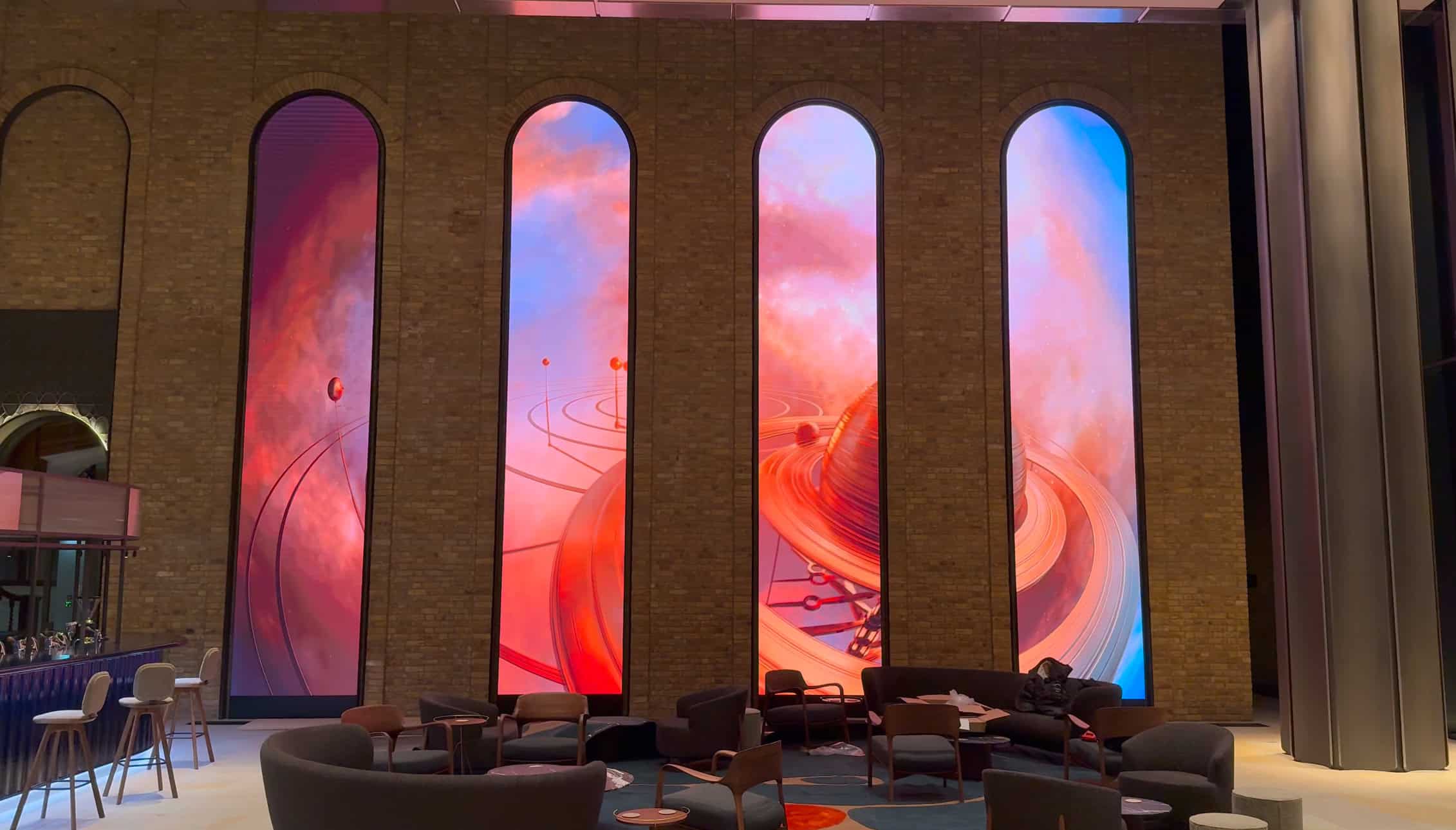
Representative projects include the 40 Leadenhall digital experience in the City of London — four custom LED arches driven by NovaStar H2 and Pixera; a 169m² / ten-structure installation at Dubai Airport Terminal 3, totalling 32 million pixels and 9km of fibre on a Disguise 4x4Pro and NovaStar combination; the 270° immersive LED room for Pixel Artworks’ Lighthouse (AV Awards 2024 finalist); 221 cabinets at 2.5mm forming a 4352 × 1872 pixel canvas at CityPoint London; Battersea Power Station; Arsenal FC; and the Westminster Tower LED marketing suite for Aldar / London Square. Every project follows the same five-stage model: consult, design, supply, install, aftercare.
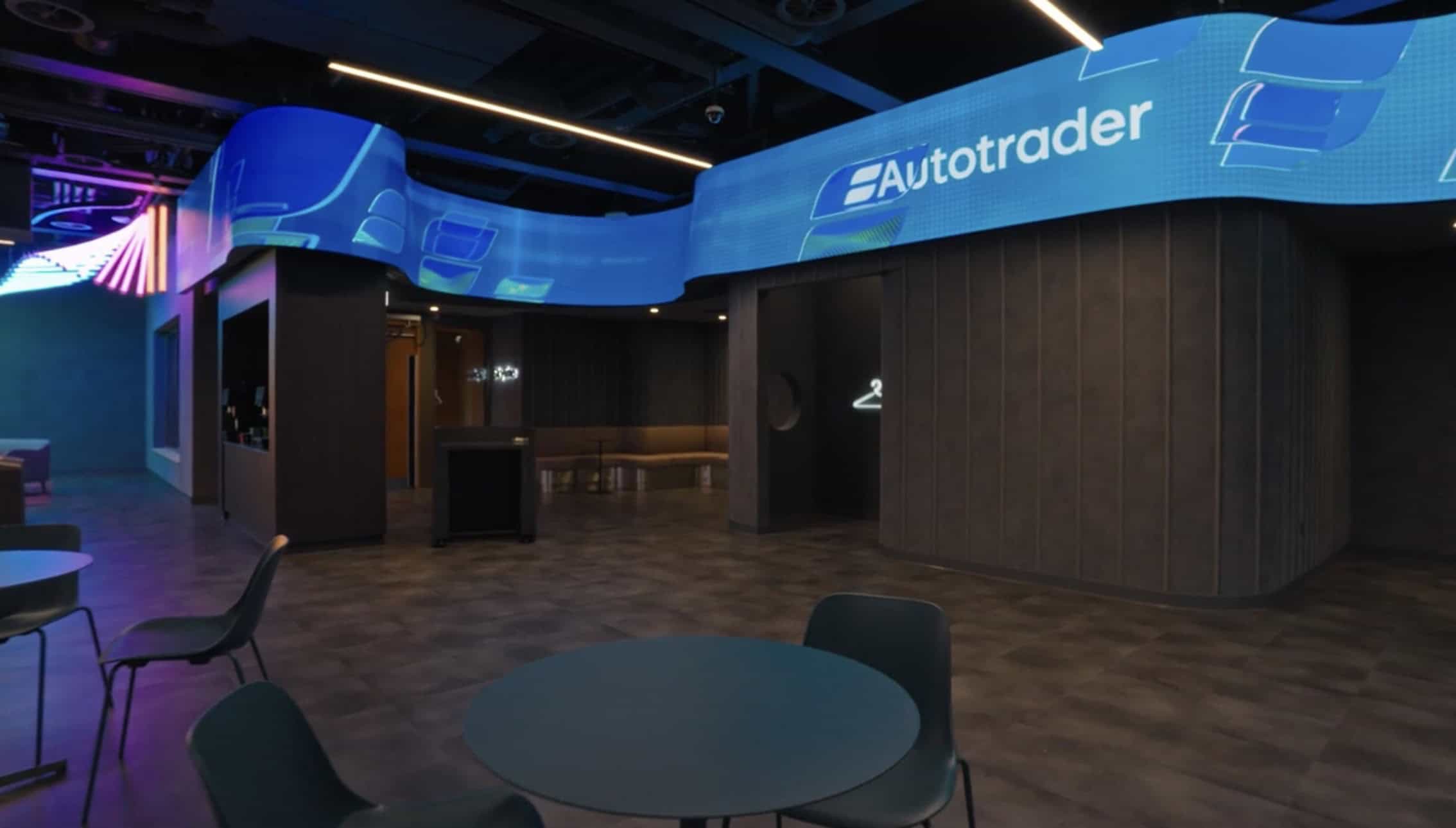
A recent managed installation shows what that model looks like in practice. At AutoTrader Manchester HQ Dynamo surveyed, designed, supplied and installed five zones of LED in under two weeks on site, including a 21,760 × 1,120 mm 1.86 mm ribbon, 1.9 mm video walls and a circular halo ticker, all commissioned and handed over with documentation for the client’s own team.
All installations carry the standard 3-year RTB warranty, backed by in-country spares and engineer-led aftercare. The company is based at 146a Brick Lane, London E1 6RU and contactable on +44 (0)203 489 9878. Company registration details, product lines and the full list of published case studies are on the Dynamo company fact page; for specification and delivery methodology, visit the LED video walls service page.
Managed Video Wall Installations: Frequently Asked Questions
Who installs LED video walls in the UK?
LED video walls in the UK are installed by specialist supplier-installers — companies that both supply the hardware and manage the full physical installation, from structural survey through to commissioning. This is different from an AV integrator, which typically sources the screen from a third-party distributor and manages it as one component within a wider AV scope. Specialist firms such as Dynamo LED Displays handle the complete chain: survey, structural design, rigging, power and data, cabinet assembly, processor configuration, colour calibration, and aftercare. Reputable UK installers working at height will hold IPAF, PASMA, and CSCS certifications as standard.
What qualifications should a UK LED video wall installer have?
A UK LED video wall installer should hold three site-access certifications as a minimum: IPAF (International Powered Access Federation) for powered access equipment, PASMA (Prefabricated Access Suppliers’ and Manufacturers’ Association) for mobile access towers, and CSCS (Construction Skills Certification Scheme) for entry to managed construction sites. Beyond site safety, look for demonstrable processor competency — NovaStar and Brompton Tessera are the dominant UK platforms — a documented portfolio of commercial installations, and an aftercare model backed by in-country spares.
How much does LED video wall installation cost in the UK?
LED video wall installation cost in the UK is driven by five variables: screen size in square metres, pixel pitch, structural complexity, site access, and control system specification. Pixel pitch is the distance in millimetres between adjacent LED clusters — a fine pitch such as 0.93mm–2mm costs significantly more per square metre than a coarser 4mm–6mm pitch intended for larger viewing distances. As a rule of thumb, installation labour and infrastructure (rigging, steelwork, power, data, processors, commissioning) typically accounts for 20–40% of total project value, with hardware making up the balance.
How long does an LED video wall installation take?
Installation duration depends on scale, structural preparation, and site access. A straightforward indoor wall-mounted display can typically be installed and commissioned in one to three days on site. Larger architectural installations — multi-structure arrays, outdoor screens, or complex three-dimensional geometries — usually run across several weeks, broken into survey, fabrication, on-site install, and commissioning phases. Hardware lead time is typically four to ten weeks depending on specification, pitch, and origin of manufacture.
What is the difference between an LED video wall supplier and an LED video wall installer?
An LED video wall supplier is a company that sells or distributes the hardware — the LED cabinets, processors, power supplies, and associated components. An LED video wall installer is the company that physically fits, cables, configures, and commissions that hardware on site. Combining both under one supplier-installer removes the commercial grey area that opens up if a fault develops after handover: one company owns both the product and the installation, so warranty and support responsibility is unambiguous. For permanent commercial installations, a supplier-installer is usually the lower-risk procurement model.
Does Dynamo LED Displays install LED video walls across the whole of the UK?
Yes. Dynamo LED Displays is based in London (146a Brick Lane, London E1 6RU) and delivers installations throughout the UK and internationally. Projects completed to date include 40 Leadenhall and CityPoint in the City of London, Battersea Power Station, Arsenal FC, Westminster Tower for Aldar / London Square, and international work at Dubai Airport Terminal 3. Project enquiries from any UK location are welcome.
Speak to Dynamo LED Displays About Your Project
If you are specifying an LED video wall installation in the UK, a short conversation at the design stage usually saves weeks later. Dynamo’s team can advise on pixel pitch for your viewing geometry, structural implications for your substrate, processor choice for your content workflow, and realistic programme dates for your handover window. If you are still comparing display types before committing to an installer, our guide to LED displays covers the options and terminology. Get a quote for your managed video wall installation. Call +44 (0)203 489 9878 or use the contact form to start the conversation.