A shopfront LED façade integrates into the building exterior and dominates from 10–50 metres; a window LED display targets pavement-level viewers at 1–10 metres from behind glass without altering the building. Both are forms of retail digital signage, but choosing between a shopfront LED façade and a window LED display comes down to where the display has to work hardest. A façade faces weather, planning scrutiny and long-range footfall. A window display fights reflections, sunlight and merchandising space. This guide breaks down both approaches so you can specify the right solution for your site. If you are newer to the technology itself, start with our guide to LED displays.
Key Takeaways
- A shopfront LED façade mounts externally and dominates the streetscape from a distance; a window LED display sits behind existing glass and targets pavement-level viewers without altering the building fabric.
- Façade screens typically require 5,000 nits or above to compete with direct daylight; window displays need more output still because glass absorbs 10–30% of light transmission.
- Façade installations need structural surveys, weatherproofing and usually planning consent; window displays deploy in days with minimal structural work and are easy to remove at the end of a lease or campaign.
- Pixel pitch should follow viewing distance — street-level shopfronts with pedestrians at one to three metres need fine pitches (P1.9–P2.5); set-back or elevated façades can use P3–P4.
- Product direction: outdoor permanent façades point to the DVO Series; indoor window installs suit the DFC or DX Series depending on pitch and budget.
- Dynamo has delivered both approaches in premium retail — structural LED shopfronts for brands including Superdry at Heathrow and Hour Passion at Gatwick, and behind-glass window installs for Hermès and Canada Goose.
Shopfront LED vs Window LED: Key Differences
- A shopfront LED façade covers the exterior structure and dominates the streetscape from a distance; a window LED display sits behind glass and targets close-range foot traffic.
- Façades need outdoor-rated cabinets (IP65 minimum) with higher brightness, typically 5,000 nits or above, to compete with direct sunlight.
- Window LED displays can use indoor-rated panels at finer pixel pitches, since the viewing distance is shorter and the glass provides weather protection.
- Standard single-pane float glass absorbs roughly 10–15% of visible light output; tinted, low-E or laminated units can push that loss above 25%, so window-mounted screens still need higher-output panels compared with a standard indoor wall.
- Façade installs require structural surveys, planning consent in most UK local authorities, and ongoing weatherproofing maintenance.
- Window LED displays are faster to deploy, easier to update seasonally, and simpler to remove if the lease ends.
- Match product to environment: outdoor façades need IP65-rated cabinets (DVO Series); indoor window installs benefit from finer pitch and lighter weight (DFC Series or DX Series); where see-through sightlines matter, a curtain-format display (LVW Series) preserves store visibility.
At-a-Glance: Façade vs Window LED
| Decision Point | Shopfront LED Façade | Window LED Display |
|---|---|---|
| Typical location | External wall, canopy, fascia or architectural frame | Behind glass, suspended, wall-mounted or integrated into window set |
| Common viewing range | 5–50 metres | 1–20 metres |
| Typical pixel pitch | P3.9–P10 depending on distance | P2.5–P7.8 depending on content and transparency |
| Brightness requirement | 5,000–8,000+ nits | 2,500–5,000 nits |
| IP rating | IP65 front, IP54 rear minimum | IP20–IP43 (glass-protected) |
| Planning sensitivity | Usually higher (illuminated signage rules) | Usually lower, but still site-dependent |
| Structural requirement | Steelwork, wind load, drainage, safe service access | Internal hanging, wall support, floor loading or mullion coordination |
| Product fit | DVO Series — built for permanent exterior IP65 mounting | DFC Series (premium fixed indoor), DX Series (mid-range fixed indoor), LVW Series (curtain/transparent) — all indoor-rated, glass-protected |
| Content style | Large headlines, brand motion, wayfinding, campaign loops | Offers, product launches, seasonal creative, street-level detail |
| Install lead time | 6–12 weeks (surveys, consent, fabrication) | 2–4 weeks |
The Decision Starts with Viewing Distance
A common mistake is to start with a proposed screen size and then choose the pixel pitch afterwards. For retail, we prefer to start with the viewer.
A customer standing 1.5 metres from the glass reads content differently from someone crossing a junction 25 metres away. Close viewers notice pixel structure, moiré, text edges and colour consistency. Distant viewers notice movement, contrast, scale and whether the creative is legible before they walk past.
| Typical primary viewer distance | Sensible pitch direction | Content type |
|---|---|---|
| 1–3 metres | P1.9–P2.9 where detail matters | Product detail, price, portrait video, close-range retail copy |
| 3–8 metres | P2.5–P4 | Window promotions, brand loops, campaign messages |
| 8–20 metres | P3.9–P6 | Fascia, shopfront, roadside retail, shopping centre approach |
| 20 metres plus | P6–P10 or wider if content is simple | Large-format façade graphics, directional messaging, landmark branding |
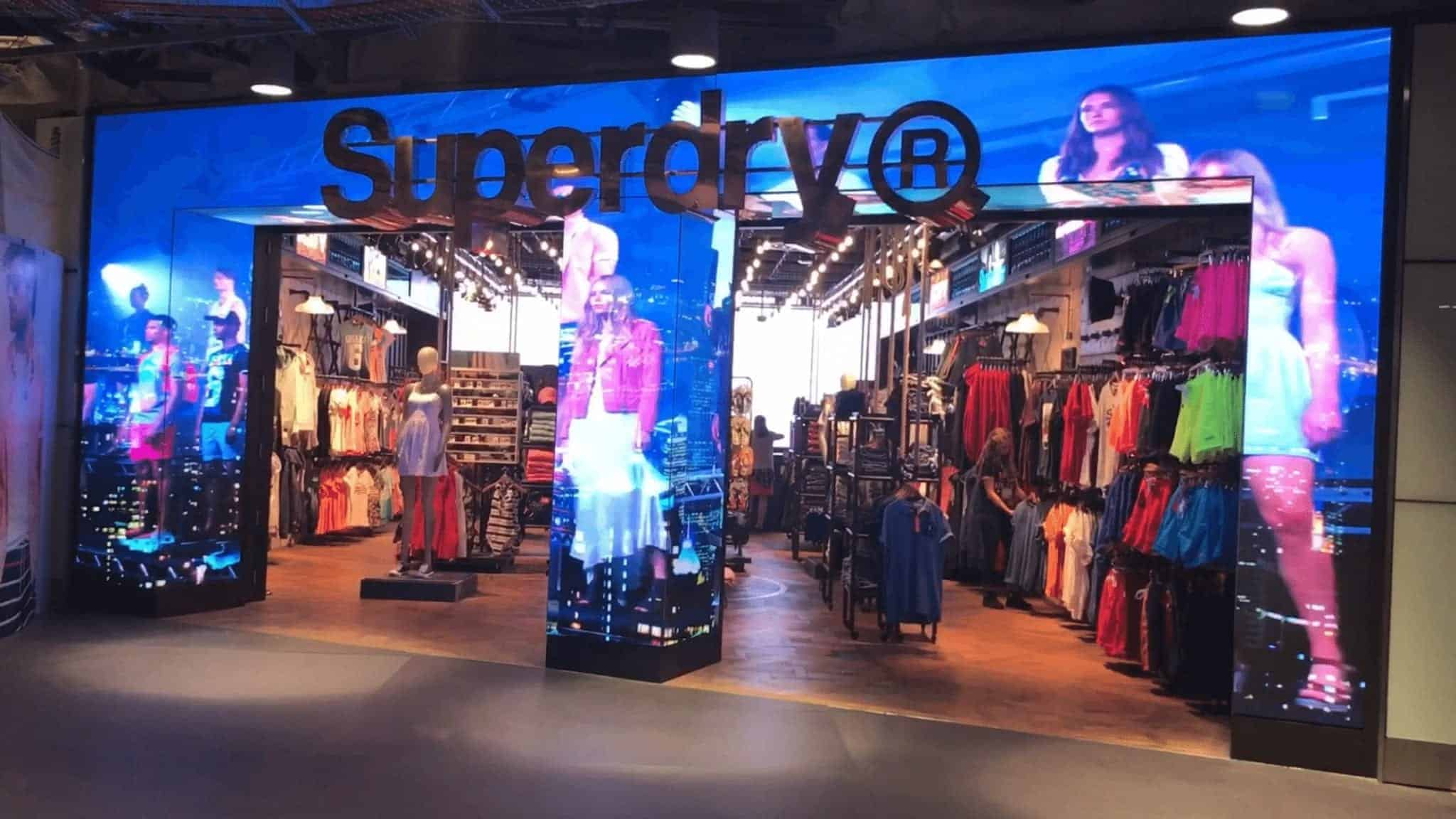
These are not hard limits. A P4 display can look clean at shorter distances with the right content, and a P8 façade can work well when the message is large and simple. The problem comes when a tight product offer is pushed onto a wide-pitch outdoor screen, or when a fine-pitch window LED display is specified for a viewer who is mostly 30 metres away. For the arch-and-pillar approach at an airport, see our Superdry Heathrow LED shopfront.
If you are still early in the product choice, our LED display products page gives a useful overview of the main formats before narrowing the specification.
When a Full Façade Makes Sense
A shopfront LED façade is the right direction when the screen has to operate as part of the architecture rather than just a campaign surface. It is visible when the store is closed, it reads from across the street, and it can turn a plain elevation into a moving brand asset.
Retail flagships on high-footfall high street locations use façade LED to pull shoppers from the opposite pavement. At viewing distances of 10–25 metres, a P6 panel still resolves cleanly, and the cost per square metre drops compared with fine-pitch alternatives.
The trade-off is complexity. DVO Series outdoor cabinets are IP65-rated, front-serviceable and designed for permanent exterior mounting, but the screen is only part of the project. Structural steelwork, cable routing, ventilation, drainage and wind load all need designing before a single cabinet ships. Most UK councils classify a lit façade as illuminated advertising, which triggers Advertisement Consent under the Town and Country Planning (Control of Advertisements) Regulations. The UK Government’s guidance on outdoor advertisements and signs is a sensible starting point, but local context still matters — conservation areas, listed buildings and highway restrictions can all change the route.
Brightness matters too. A south-facing façade in summer needs 6,000 nits or more to stay readable in direct sun. That drives power consumption up and demands active cooling. But over-specifying wastes money on power and cooling, and a display that looks punchy at midday can become a nuisance after dark if brightness control is treated as an afterthought.
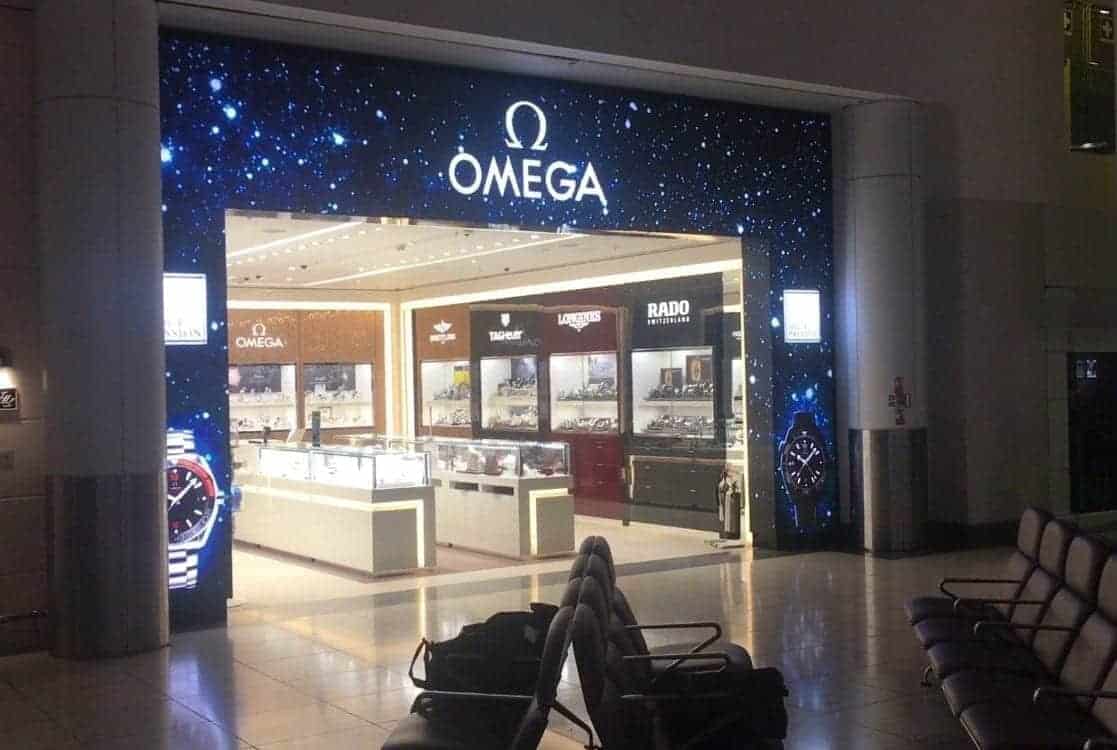
If the location justifies the investment — a flagship store, a venue entrance, a brand activation that will run for years — a façade is hard to beat for street presence. Dynamo’s Superdry installation at Heathrow is a strong example — the entire storefront is a single LED canvas visible across the terminal concourse. Similarly, our Hour Passion boutique at Gatwick, a Swatch Group watch retailer, is believed to be the UK’s first structural LED shopfront, where the glazing itself was replaced by screen. For clients looking at an external retail frontage, our outdoor shopfront LED installations page covers the use case in more detail.
When a Window LED Display Wins
A window LED display sits behind the glass and faces outward. It replaces static vinyl, poster displays or traditional LED poster formats with moving content that can change by the hour, without altering the building exterior. The Pretty Green LED window screens in London and Liverpool are a typical example.
Window LED tends to win where the lease restricts façade changes, the store sits in a managed high-street estate, the main audience is walking within 1–10 metres, or campaigns change frequently.
There are two main types to consider: a conventional indoor LED screen behind glass, or a transparent or curtain-style format where sightlines through the window still matter. For a premium fixed indoor display, DFC Series panels offer finer pixel pitches with slim cabinet profiles suited to close-range viewing. For a more cost-controlled fixed install, DX Series covers the mid-range. Where a lighter, open visual layer is needed, LVW Series curtain-format displays preserve store visibility better than a solid LED wall.
Indoor cabinets are lighter, thinner and available in finer pixel pitches — P1.5 to P2.5 is common for pavement-level viewing. Installation is faster: a window LED display can go from sign-off to live content in two to four weeks with no structural survey, no planning application and no scaffolding.
The trade-off is glass. Glass introduces reflection, glare, heat build-up and extra distance between the viewer and the pixels. A display that looks bright in a showroom can become flat when it sits behind a reflective shopfront on a sunny south-facing street. The darker the internal shop floor, the more the glass behaves like a mirror. Standard single-pane float glass absorbs roughly 10–15% of visible light output, while tinted or low-E coated glass can push losses above 25%. For a sun-exposed frontage, specifying a 5,000-nit high-brightness panel solves the problem without needing outdoor-rated hardware.
Window LED displays also suit multi-site rollouts. A chain with 30 stores can deploy identical units across the estate in weeks, manage content centrally, and swap screens out at lease end without leaving structural modifications behind.
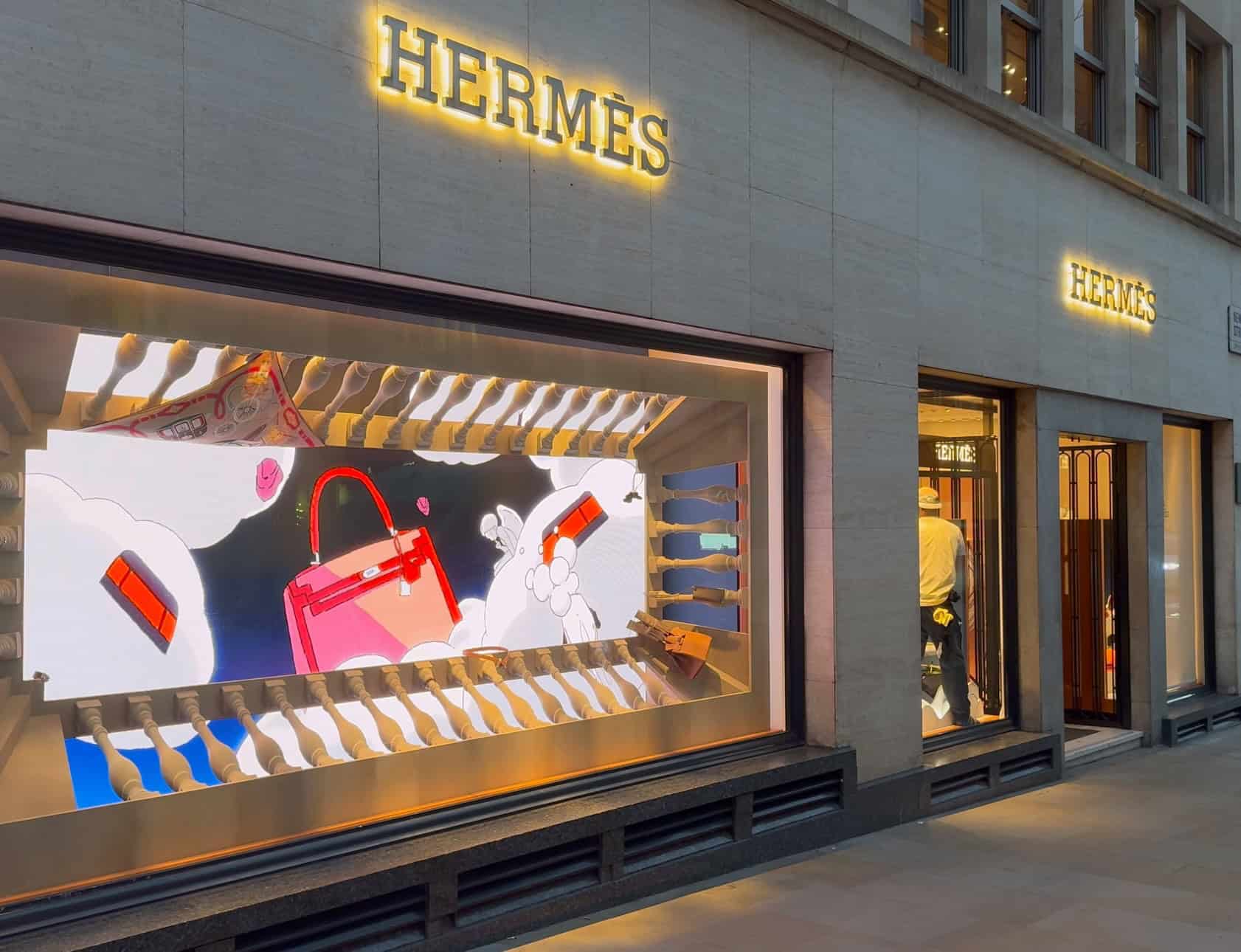
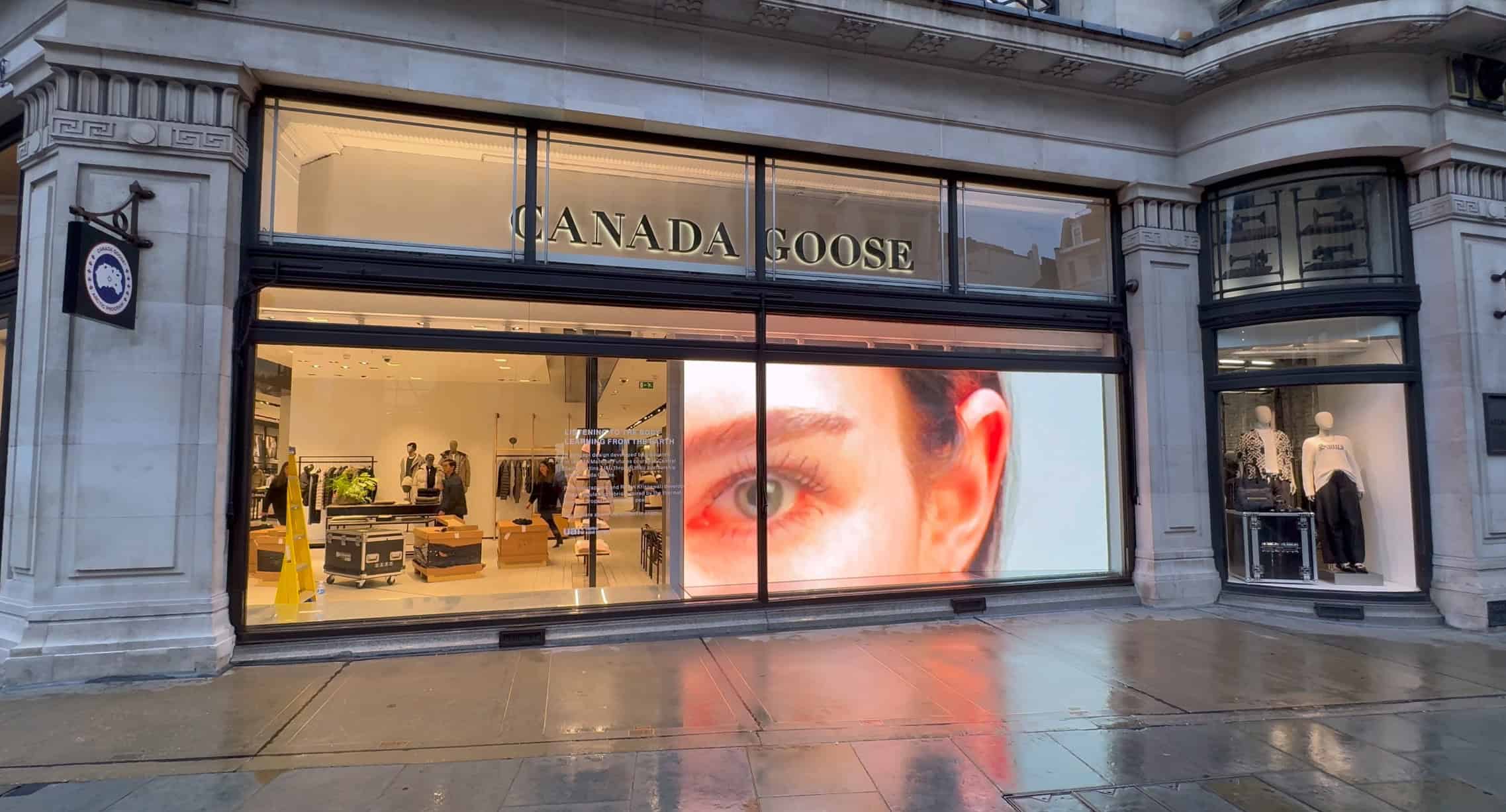
Dynamo’s Hermès 2024 festive window displays show this approach at luxury scale — high-impact seasonal content delivered behind existing glazing without altering the building fabric. Our Canada Goose window LED install is another case in point: a behind-glass display that was fully removable at the end of the campaign.
If you already know the window or façade dimensions, build a quick spec using the configurator before a site survey.
Structure, Access and Compliance
A shopfront LED façade requires structural steelwork, wind-load calculations, drainage design and Advertisement Consent under UK planning regulations. A window LED display avoids most external works but still needs load assessment for hanging or wall-mounting. In both cases, the screen is only one part of the project.
Even a modest external screen needs attention to mounting points, cable routes, wind load, drainage, corrosion resistance, fire strategy, safe isolation and maintenance access. The Construction Design and Management Regulations may apply depending on the project scope — the Health and Safety Executive’s CDM 2015 guidance is a useful reference when building works, access equipment and multiple trades are involved.
Window LED usually has a simpler structural path, but it still needs proper planning. Hanging a display from a shopfront bulkhead, suspending it behind glass or fixing it to a return wall all create loads and access requirements. Serviceability is often overlooked: if a module fails, can it be reached without removing half the window set? Can staff isolate the display safely? Is there enough ventilation when the front door is closed overnight?
Processor choice matters for colour handling, refresh rate and camera-facing content. We typically specify Brompton for camera-facing retail façades where colour accuracy and high refresh rates matter, and Novastar where the content workflow is simpler and budget is tighter.
Content Strategy: What Each Format Should Actually Show
A façade screen should be treated like retail signage with motion, not like a website stretched onto a building. It needs short messages, strong hierarchy and enough dwell time for someone moving past at walking pace — two to three seconds of clear sightline. Large typography, brand colour, category cues and seasonal motion usually work better than crowded price lists.
A window LED display can carry more detail because the viewer is closer and often moving more slowly. Product launches, timed offers, event messaging, collection drops, pricing and QR codes all work at this range. If the screen sits behind reflective glass, small copy and low-contrast creative will still underperform.
Both formats benefit from ambient light sensing — worth specifying for any street-facing screen.
Cost Drivers That Change the Answer
A shopfront LED façade is not always more expensive than a window LED display, but it often carries more associated cost. Façade projects add structural design and fabrication, access equipment, weatherproof power and data, planning support, landlord approvals and service access provision. Window LED cost drivers lean towards higher pixel density, high-brightness indoor product, transparent or curtain-style formats, custom suspension, ventilation and content adaptation for glass reflection.
On a like-for-like square metre basis, fine-pitch indoor LED can cost more than a wider-pitch outdoor façade panel. But once structure, access and permissions are included, the external route can overtake it. That’s why we quote the full installed job, not just module prices. If you have dimensions and a rough viewing distance, the LED screen configurator can help shape an early brief before a site survey.
From the Field
Daniel Reynolds, Dynamo’s MD, on choosing between formats:
I look at the glass before I look at the screen. If I can see the sky, buses and opposite buildings reflected in the shopfront, I know the content and brightness plan will matter as much as the pixel pitch. My first question is usually where the customer is standing when the message needs to land.
I have also seen façade ideas that looked strong on a drawing but became difficult once access, landlord rules and night-time brightness were discussed. My advice is to test the decision against the street, not against a brochure. Walk the pavement at the time of day your customers arrive. Stand where they stand. Look at where your competitors’ signage catches your eye — and where it does not. That ten-minute exercise tells you more about which approach to take than any spec sheet.
Shopfront LED vs Window LED: Frequently Asked Questions
Can I use the same LED panel for both a façade and a window display?
Not usually. A shopfront LED façade needs outdoor-rated cabinets (IP65 minimum) with higher brightness to handle direct sunlight and weather exposure. A window LED display uses indoor-rated panels, which are lighter and available in finer pixel pitches. Trying to use outdoor panels indoors wastes budget; using indoor panels outdoors risks water damage and premature failure.
Do I need planning permission for a window LED display?
In most cases, a screen behind glass is treated as an internal fitting and does not trigger Advertisement Consent — but enforcement varies, and some local planning authorities have challenged prominent internally-lit displays visible from the highway. A façade-mounted screen almost always triggers the consent process. Confirm with your local planning department early, particularly in conservation areas or designated high-street zones.
What pixel pitch works for a retail window display?
For pavement-level viewing at one to three metres, a pixel pitch between P1.5 and P2.5 delivers sharp, detailed imagery. Wider pitches can work where the display is larger, more transparent or viewed from further away. Our retail LED buying guide covers pitch selection in more detail.
How bright does a window LED screen need to be?
A window LED screen typically needs 2,500–5,000 nits depending on sun exposure. North-facing or shaded windows work well at 2,500–3,500 nits. South- or west-facing windows in direct afternoon sun need 4,000–5,000 nits to stay readable. Glass absorbs a portion of the output — more so with tinted or coated glazing — so the panel’s rated brightness should account for that loss.
Is transparent LED better for retail windows?
Transparent LED is useful when the shop still needs visibility into the store, or when the display should feel lighter than a solid screen. It is not always the right choice for fine text, detailed imagery or close-up product creative. It works well when content is bold, high-contrast and designed around the transparent pixel structure.
Can LED window displays run 24/7?
The panels themselves are designed for continuous operation, but most councils have rules about illuminated displays operating between certain hours, particularly in residential areas. Scheduling content via a CMS means you can dim or blank the screen overnight without manual intervention.
Should we choose DVO, DFC, DX or LVW for retail?
For outdoor permanent shopfront façades, DVO Series is the natural fit — IP65-rated and built for exterior mounting. For premium fixed indoor window or in-store work, DFC Series is the higher-spec route. DX Series suits mid-range fixed installs where the budget and brief are more controlled. LVW Series fits flexible curtain-style applications, particularly where openness or lighter visual treatment matters.
What is the main maintenance difference?
Façade LED needs safe external access, weather-aware servicing and proper isolation. Window LED is usually easier to reach, but it can still be awkward if the screen is trapped behind fixtures, shutters or merchandising. We prefer to plan service access during design rather than solve it after the first module needs attention.
Conclusion
The choice between shopfront LED vs window LED comes down to viewing distance, site constraints, content style and maintenance reality. Choose a shopfront LED façade when the display needs to be part of the building and speak across the street. Choose a window LED display when the glass frontage is the campaign surface, the audience is close, or the site cannot support external works. In many retail schemes, the strongest answer is not either/or — a façade handles long-range brand work while a window LED display delivers campaign detail at pavement level.
If you are weighing up the options for a live retail site, we can survey the building, test the shopfront and window LED decision against the street and handle everything from specification through to install and content management. Explore our retail LED case studies or build your spec using the configurator.
Call us on +44 (0)203 489 9878 or get in touch here to talk through your shopfront or window LED project.