
LED screen glare and reflection problems are rarely solved by turning the brightness up. The screen is fighting two separate battles. One is emitted light: whether the screen’s own output can compete with ambient daylight. The other is reflected light: sunlight and luminaire glare bouncing off the screen face straight into the viewer’s eye line. This guide covers the physical controls that deal with the second battle, from matte louvred masks and surface finishes to shading and siting, and how to choose between them without restricting viewing angles or creating a maintenance problem.
Key takeaways
- Glare on an LED screen is mostly a reflection problem, not a brightness problem. Raising nits treats the symptom, not the cause.
- The louvred mask around each LED does more for daytime contrast than the LEDs themselves. A matte, ribbed mask traps incident light instead of returning it to the viewer.
- A matte finish trades a sharp mirror reflection for a diffuse grey haze, so samples must be judged on black level as well as reflection sharpness.
- Deeper louvres shade the LEDs from high-angle sun, but they narrow the vertical viewing angle and hold dirt. The right depth depends on where the audience stands.
- In the UK, a west-facing LED screen takes low evening sun directly on its face. A survey at the worst time of day tells you more than a datasheet.
- An ambient light sensor and capable processing let the screen run at the minimum brightness that still holds contrast, rather than at maximum all day.
At a glance: the main control methods
| Method | What it does | Where it applies |
|---|---|---|
| Matte louvred mask | Ribbed matte surround traps incident light and shades LEDs from high-angle sun | All fixed-install LED screens, indoor and outdoor |
| Black-face LEDs | Darker package body reflects less ambient light | Fine-pitch indoor, premium outdoor |
| Matte surface coating | Diffuses specular reflection from protective layers | Coated or GOB-encapsulated modules |
| Siting and orientation | Keeps direct sun off the screen face at peak viewing times | Every outdoor project, decided at survey |
| Ambient brightness sensing | Matches output to conditions, avoids over-driving | Outdoor and daylight-facing indoor screens |
Where does LED screen glare come from?
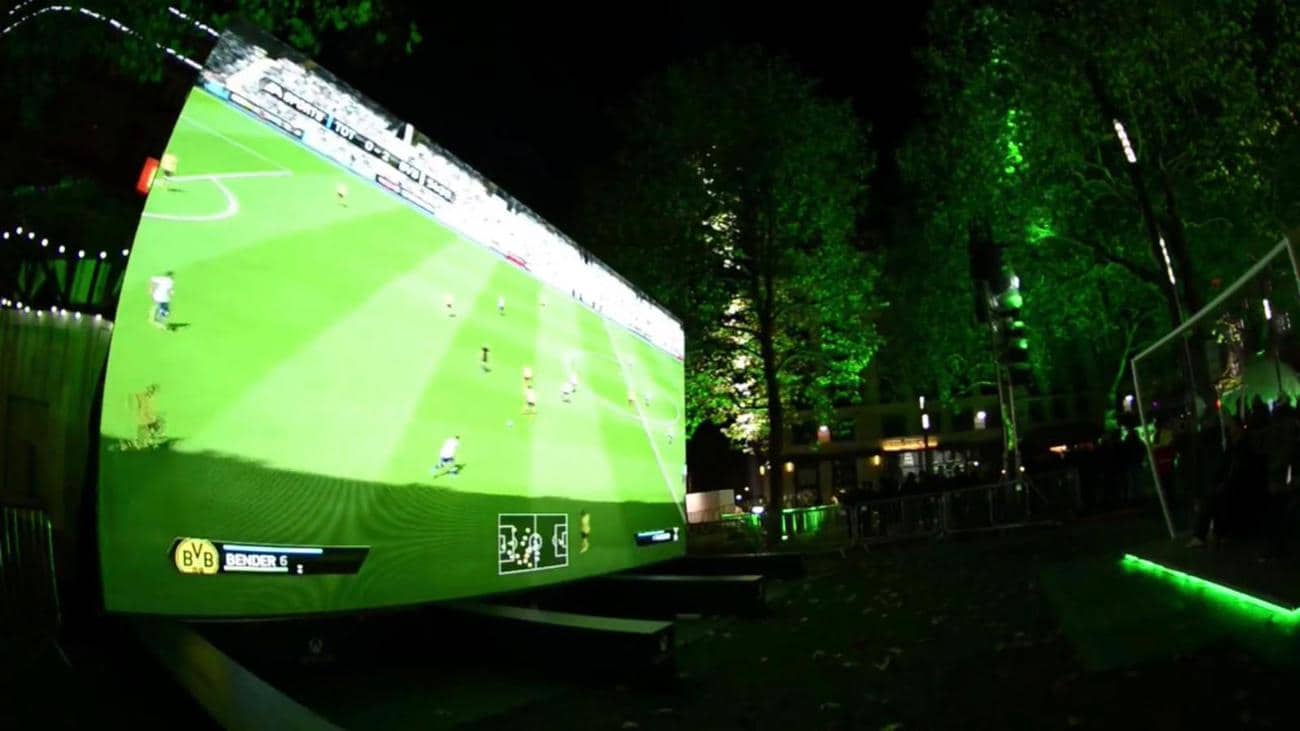
Glare on an LED screen is ambient light, from the sun or from luminaires, reflecting off the module face and any surface coating. That reflected light adds to both the white level and the black level, which is why it collapses contrast rather than simply dimming the image. A simplified version of the sum:
Effective contrast = (white luminance + reflected ambient light) ÷ (black luminance + reflected ambient light)
If the reflected component becomes dominant, black areas turn grey and saturated colours lose depth. Raising peak brightness may keep white text readable, yet dark photographs and low-level video stay washed out. This is why a nominal nits figure cannot describe outdoor visibility on its own: a screen with a high brightness rating can still look weak when its face catches a bright reflection, while a well-orientated screen stays legible at lower output because its apparent black level is lower. Our guide to outdoor brightness and nits requirements in direct sunlight covers the emitted half of the equation; this article is about the denominator.
An LED module face is not one material. It is thousands of LED packages sitting in a moulded plastic mask, sometimes under a protective coating, and every one of those surfaces reflects some ambient light. Reflection comes in two forms. Diffuse reflection lifts the whole screen face evenly; this is what makes a screen look milky in daylight. Specular reflection is the mirror-like glint from a glossy surface, which puts a moving hotspot of sunlight across the image as the sun tracks. Specular is the more damaging of the two, because it is bright, localised and impossible to out-shine. The fix for each is different, which is why glare control is a stack of measures rather than one feature on a datasheet. The International Commission on Illumination defines the luminance measurement framework these contrast figures rest on, but on a live project the readings that matter are taken from where the audience actually stands.
How do matte masks and louvres reduce glare?
A louvred mask is the moulded black plastic surround the LEDs sit in, shaped with small ribs (sometimes called louvres or shader ribs) above each LED row. It reduces glare in two ways: the ribs shade each LED from sunlight arriving from above, and the matte black surface absorbs light arriving from most other angles instead of returning it to the viewer. It is the main reason permanent outdoor LED screens have a ribbed rather than flat face.
Mask quality is one of the quieter differences between module grades. A deep, dense, genuinely matte black louvred mask costs more to mould and more to keep consistent across thousands of modules, but it is the single biggest contributor to daytime contrast. On our DVO outdoor permanent range, the louvred mask is part of why the screen stays legible without being driven flat-out all day.
Two cautions. First, matte is not magic: a matte texture scatters incoming light rather than removing it, so a poorly chosen finish can trade a recognisable mirror image for a face that reads grey across a wide viewing area. Judge samples on black level as well as reflection sharpness, with the module switched off under direct and oblique light, and again when wet if the screen is exposed. Second, louvred masks are directional. A mask tuned to shade high-angle summer sun will slightly restrict the vertical viewing angle, and a deep rib can begin to hide part of each pixel from elevated or low positions. For a screen mounted high on a building viewed from street level, that restriction is free performance; for a screen with a balcony above it, check a physical sample from the highest, lowest and widest audience positions before approving the geometry. Deep profiles also retain dust, road film and salt, which matters on roadside and coastal sites.
The same principle applies indoors at fine pitch, where there is no sun but plenty of downlighting and window light. Black-face LED packages, where the package body itself is dark rather than white, cut diffuse reflection at the source. That trade between peak brightness and black-level depth is the thinking behind our Dark Magic black-face LED displays: accept slightly less raw output in exchange for blacks that stay black under gallery and studio lighting.
Does a gloss GOB finish cause reflections?
A gloss GOB (glue-on-board) finish adds a specular, mirror-like reflection that a bare matte louvred mask does not have, because the resin layer sealing the module face behaves like a sheet of glass over the screen. The protection case for GOB is real: it resists knocks, moisture and dust, which matters for lower mounting heights and busy environments. But on a screen facing open sky or a bank of windows, a gloss layer can mean a visible bright reflection sliding across the image through the day. Matte-finish GOB diffuses that reflection, at the cost of a small amount of perceived sharpness up close.
Our position is straightforward: choose the finish for the environment, not the brochure. A screen behind a reception desk under controlled lighting can carry a gloss finish without issue. A screen facing a glazed atrium or the southern sky should be matte-masked or matte-coated. Where a project needs both impact protection and glare control, matte GOB is the compromise to ask for by name.
Fine-pitch premium installs are their own case. On our DFC range of 1.5mm direct-view displays, the pitch is tight enough that mask and package finish dominate the reflectance behaviour, and lighting design around the screen, keeping luminaires out of the specular angle, does the rest. How pitch interacts with viewing distance is covered in our pixel pitch guide, and our guide to indoor LED brightness for lobbies and receptions covers balancing screen output against ambient light in exactly these spaces.
Siting, orientation and brightness control
Hardware controls only go so far if the screen is pointed at the problem. In the UK the sun is low for a large part of the year, and low sun is the worst case: it arrives nearly perpendicular to a vertical screen face, travelling straight under ribs designed for high-angle summer light. A west-facing screen takes this directly during evening peak viewing hours; an east-facing screen takes it during the morning commute.
Often the cheapest fix happens before a module is selected. A small change in azimuth can stop the screen reflecting a pale building or open sky towards the audience. A slight downward tilt can move a sky reflection out of the main viewing zone, provided the new angle is checked for drainage, structure and sightlines. Recessing the display behind a canopy cuts direct solar load on the face, and dark, low-gloss finishes around the screen stop the surrounding architecture becoming a secondary glare source. At survey stage we look at the sun path across the year, the primary viewing positions, and secondary reflections from glazed buildings opposite. Glare only matters if the reflection lands where people actually stand.
Brightness control closes the loop. An ambient light sensor feeding the processor lets the screen track conditions, running hard in full daylight and dropping right down after dusk. An over-driven screen at night is its own light-pollution problem; the Institution of Lighting Professionals publishes guidance note PLG05 on the brightness of illuminated advertisements, which planners increasingly reference. Processors from Brompton Technology and Novastar both document low-brightness, high-bit-depth operation that keeps greyscale and colour balance intact when output is turned down, and at commissioning we map the sensor response so night-time output sits well below the daytime ceiling.
If you are specifying an outdoor screen and want to see how these controls come together in a current-generation cabinet, our P2.5mm outdoor LED display page covers the cabinet, mask and brightness specification in one place, and the rest of our LED display product range covers the other pitches and formats.
From the field
I have lost count of projects where the first response to a washed-out image was to ask for another thousand nits. My first check is always whether the audience is looking at emitted light or at a reflection sitting on top of it. The site visits that stay with me are the west-facing elevations: standing on the pavement at six on a summer evening with a sample module, watching a gloss face throw a sun streak straight across the image while the quote insisted the screen was bright enough. Moving a screen to the adjacent elevation, angling it a few degrees off the sun line and specifying a matte louvred face has more than once let us run lower brightness than the original spec assumed, and look better doing it.
My rule: survey at the worst time of day, not the most convenient one. Ten minutes on site with the sun where it will actually be tells you things no datasheet can.
LED Screen Glare and Reflection: Frequently Asked Questions
Why does my LED screen look washed out in sunlight?
Almost always because ambient light is reflecting off the screen face and lifting the black level, not because the screen lacks brightness. Once blacks read as grey, contrast collapses and the whole image looks pale. The fix is a combination of matte louvred mask, appropriate surface finish and sensible orientation, with brightness increases as the last resort rather than the first.
Do anti-glare LED screens reduce brightness?
Slightly, yes. Matte louvred masks and matte coatings absorb or diffuse a small share of the light the LEDs emit. In practice the trade is strongly positive: the contrast gained by cutting reflections outweighs the output lost, so the screen looks brighter to the viewer even though the measured figure is marginally lower.
What is a louvred mask on an LED module?
A louvred mask is the moulded black plastic surround the LEDs sit in, shaped with small ribs above each LED row. The ribs shade the LEDs from high-angle sunlight, and the matte black surface absorbs ambient light instead of reflecting it. It is the main reason permanent outdoor modules have a ribbed rather than flat face.
Do deeper louvres always improve outdoor visibility?
No. Deeper ribs block more high-angle light, but they narrow the usable vertical viewing range, and from elevated or low positions they can obscure part of each pixel. Extra depth also increases dirt retention and cleaning effort. Balance the required solar protection against the full audience envelope, checked on a physical sample.
Is a gloss GOB finish a problem outdoors?
A gloss GOB finish can be a problem outdoors because the resin layer adds a mirror-like reflection a bare matte mask does not have, so a screen facing open sky can show a bright reflection moving across the image as the sun tracks. Matte-finish GOB keeps the impact and weather protection while diffusing that reflection, and is the version to specify for exposed outdoor LED screens.
How should glare be tested before installation?
Use a production-intent module, lock the test content and inspect it from the planned viewing positions, including off-axis and elevated ones. Check the switched-off face, dark content, mid-tones and text under direct and oblique light, and examine outdoor samples wet. We run these checks as part of a site survey, so get in touch to arrange one.
Does glare matter for indoor LED screens?
Yes, particularly in glazed lobbies and atriums where daylight floods the space. Downlighters and window light reflect off the module face just as sunlight does outdoors, flattening contrast. Black-face LEDs such as our Dark Magic displays, matte masks and lighting design that keeps luminaires out of the reflection angle all apply indoors, alongside setting brightness to suit the room.
Conclusion
Effective glare and reflection control on an LED screen is a stack, not a single feature: a matte louvred mask to kill diffuse reflection, the right surface finish to avoid specular glint, orientation that keeps direct sun off the face, and sensor-driven brightness so the screen holds contrast at the lowest workable output. Tell us where viewers stand, when the sun hits the face and which angles matter, and the nits figure on the datasheet stops being the deciding factor. For a first pass at sizing, the LED screen configurator is a reasonable place to start.
If you are weighing up LED screen glare and reflection control for a specific site, send us the location, orientation and viewing positions and we will give you a straight answer on mask, finish and orientation. Get in touch via our contact page or call +44 (0)203 489 9878.