Every autumn the same question lands in our inbox: how does an LED screen handle cold weather, and is condensation going to kill it? The short answer is that cold air on its own is rarely the problem. An LED screen in cold weather generally runs happily; condensation is what does the damage, and it strikes in ways that surprise people — usually while a screen is switched off, not while it is running. The rest of this guide is about making February a non-event.
Key takeaways
- Cold temperatures alone rarely harm an LED screen. LEDs and driver electronics tolerate UK winter lows comfortably; the risks are moisture-related.
- Condensation forms when a surface inside or on the screen falls below the dew point of the surrounding air, most often on a powered-off screen or one moved from cold to warm.
- An IP65 rating protects against dust and jets of water. It does not stop condensation, because the moisture that condenses is in the air already inside the cabinet.
- A running screen is a self-heating screen. Scheduled low-brightness overnight content usually beats a full shutdown for fixed outdoor installs.
- Cold starting is different from running cold: the risky minutes are the first few after power-up, so a cold-soaked screen should be warmed through gently.
- Freeze-thaw cycling around 0°C is a UK speciality. Water trapped in seals and fixings expands roughly 9% when it freezes, which is why gasket condition matters more here than in colder, drier climates.
- Remote monitoring should log temperature and humidity together, not just report whether the screen is online.
At a glance: what a UK winter asks of an outdoor LED screen

| Winter factor | Typical UK condition | What it means for the screen |
|---|---|---|
| Air temperature | Single digits, dips below freezing overnight | LEDs and drivers cope; risk sits elsewhere |
| Humidity | Frequently 85%+ through winter | Small surface temperature drops cross the dew point |
| Freeze-thaw | Repeated cycles through 0°C | Trapped water expands as it freezes, stressing seals |
| Wind-driven rain | Common on exposed and coastal sites | Tests front-face sealing and cable glands |
| Daily thermal cycling | Cold nights, milder days, sun on the cabinet | Expansion and contraction works joints and gaskets |
| Shutdown pattern | Screens dark overnight or over holidays | Cold-soaked cabinets are where condensation strikes |
What does UK cold actually do to an LED screen?
The UK does not do extreme cold. Met Office UK climate averages show winter temperatures sitting in single digits either side of freezing for most of the country. What the UK does do, relentlessly, is damp air and repeated swings through 0°C. Those two shape how we spec every outdoor screen, from a P2.5mm outdoor LED display on a retail frontage to larger-pitch signage on an arena approach. Local exposure matters as much as the regional numbers: a sheltered urban elevation, an open roadside structure and a coastal installation see very different combinations of wind, rain and humidity.
The electronics side is genuinely reassuring. LEDs are semiconductors, and semiconductors run more efficiently cold than hot. Summer heat is the harder season for an outdoor screen, which is why thermal management gets a deep-dive of its own. In winter, a screen showing content generates enough waste heat to keep its own internals above the temperature of the surrounding air. That self-heating is what keeps a winter screen dry, and losing it is where most cold-weather faults begin.
Pixel pitch, for the record, is not a winter decision. Pitch is a viewing-distance decision (our pixel pitch guide covers how to choose) and the same cabinet sealing protects a fine pitch and a coarse pitch alike.
How does condensation form inside an LED screen?
Condensation needs two things: moist air and a surface colder than that air’s dew point. As air cools, its relative humidity rises; at 100% it has reached its dew point and water forms on surfaces. UK winter air is usually humid, so the dew point sits close to the air temperature. Take air at 10°C and 90% relative humidity: its dew point is roughly 8.4°C. If a metal cabinet corner, connector shell or module back is at 8°C, moisture forms on it even though nothing is anywhere near freezing. That is why the real winter threshold for an LED screen is dew point, not air temperature.
On a screen that is running, this almost never happens, because every surface inside the cabinet is warmer than the outside air. The classic condensation scenarios are all cold-screen scenarios:
- The screen powered off for a fortnight. A retail unit shut over Christmas, a venue screen dark between events. The cabinet cold-soaks to ambient, mild damp air arrives behind a warm front, and every internal surface is suddenly below the dew point. Moisture films onto PCBs, connectors and the backs of modules.
- The cold-to-warm move. A screen that has sat in an unheated van or store is brought into a heated space and powered up. This is a rental hazard above all: touring stock lives this cycle constantly, which is why our DRE Series rental screens follow a different handling routine from fixed-install lines, with cold kit given time to acclimatise before power-up.
- Morning sun on a cold cabinet. The front face warms quickly while internal air is still cold, and moisture can film on the inside of the screen face. It usually clears as the screen warms through, but repeated cycles leave mineral traces and encourage corrosion.
- The service door opened on a damp day. Humid outside air enters a colder enclosure and condenses on whatever it touches first.
The failure mechanism is rarely instant. A damp PCB that gets powered can suffer electrochemical migration and corrosion at solder joints over weeks. The fault report says “dead modules in March”; the cause was a shutdown in December.
Why an IP65 rating doesn’t stop condensation
Ingress protection ratings, defined under IEC 60529, describe resistance to solid objects and water under defined test conditions: dust, rain, jets. A front-serviceable outdoor cabinet with a properly sealed front face keeps driven rain out of the electronics, and that matters enormously on an exposed UK site.
What an IP rating does not do is stop condensation, because condensation is an inside job. Air inside the cabinet carries water vapour through every service door opening and every pressure change; sealing the box tighter does not remove it. The rating also applies to the tested arrangement: a gland fitted to the wrong cable diameter, a service panel left slightly proud, or a hole drilled on site can change the performance of the whole assembly. That is why outdoor cabinet design pairs sealing with controlled breathing (vent arrangements that equalise pressure and let vapour migrate out) plus drainage that gives water a controlled route away from modules and connectors. Conformal coating on module PCBs is worth having on outdoor product, and it is one of the questions we answer against a specific cabinet specification when we quote.
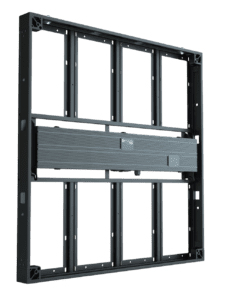
Freeze-thaw is the second UK-specific stress. Water that finds its way into a gasket seat, a fixing bore or a hairline gap expands roughly 9% when it freezes, opening the gap slightly. The next thaw lets more water in. Over several winters this cycle degrades seals that looked perfect at install, which is why our maintenance visits on outdoor screens check gasket condition, drainage weeps and cable glands in autumn, before the first frost rather than after it. Our DVO Series outdoor LED cabinets are the fixed-install line we specify for permanent external work: the sealing, drainage and service-access details are exactly the ones this section describes, and the service regime around them assumes British weather, not a datasheet climate.
If you are still at the scoping stage and want a realistic picture of outdoor LED screen options and pricing, that hub is the place to start.
Why cold-starting an LED screen is riskier than running it cold
Once a screen is operating, its power supplies, modules and processing electronics produce heat and the cabinet stabilises comfortably above ambient. The difficult period is the first few minutes after power-up. At low temperatures, power-supply start behaviour can differ from normal running, fan bearings turn stiffer, and cables and polymer seals lose flexibility, all while any moisture film from the cold soak is still sitting on the boards.
So we think in four temperature states rather than one: the operating range while the screen is running, the lowest temperature at which it may be energised normally, the storage range while unpowered, and the condition that must be reached before the main LED load comes on. Those values come from the complete system, not the LED package alone; the lowest-rated component is usually a power supply or fan, not the diode.
The practical rule that falls out of this: bring a cold-soaked screen back at low brightness and let it warm through before pushing full white at full brightness. Ramping drive current into a cold, potentially damp array is how you convert a moisture film into a fault.
How we run LED screens through winter
Three habits prevent almost all UK winter condensation faults: keep the screen gently powered overnight at low brightness instead of switching it off, log temperature and humidity together through the control platform, and inspect gaskets, glands and drainage each autumn before the first frost. They cost little or nothing. Here is how each works in practice.
Keep it running. The single most effective condensation defence is the screen’s own waste heat. For sites that want the screen dark overnight, we schedule a very low-brightness holding state rather than a hard power-off. The screen stays a few degrees above ambient, internal surfaces stay above the dew point, and the energy cost at low brightness is small. Where a screen genuinely must go dark for long periods, anti-condensation heating controlled on temperature and humidity (not a fixed timer) does the same job, provided it stays powered when the LED load is isolated.
Watch it remotely, and log the right things. Modern LED control platforms report cabinet-level data back to the operator; on fixed installs we monitor through Novastar’s cloud tools, so temperature behaviour across the array is visible from a desk. Whatever the platform, a basic online/offline alarm will not tell you a cabinet has spent three mornings near its dew point; temperature and humidity logged together will, because the margin between the coldest surface and the dew point is the number that matters. A cabinet trending colder than its neighbours in the same weather is worth a look: it may simply be shaded, or it may not be running.
Autumn checks. Gaskets and door seals for compression and damage, cable glands for movement, drainage weeps and vents for blockage, standing water on structural members, and corrosion around fasteners. Twenty minutes on an access visit in October prevents most of the winter call-out list. The same logic applies indoors: a video wall in an unheated atrium or a semi-open transport concourse lives closer to outdoor conditions than its owners assume, and benefits from the same keep-it-warm scheduling.
For budget scoping, the LED screen configurator will give you a working figure for a given size and pitch before you speak to anyone.
From the field: what condensation damage looks like
Condensation damage inside an LED screen usually announces itself as a tide line: a visible band of moisture residue across the backs of the modules. The winter call-out I still quote to clients was exactly that. The screen had been switched off completely over a Christmas shutdown to save energy, cold-soaked for two weeks, and when a mild damp front came through, the whole cabinet interior went below dew point in a single night. Nothing had “leaked”; the cabinet sealing was fine. The water came from the air that was already inside.
We dried it out, brought it up slowly at low brightness, and changed one thing in the control system: a scheduled overnight state at minimal brightness instead of a hard off. That screen has run through every winter since without a fault. I have stood on enough scissor lifts in January to have a standing piece of advice for every fixed outdoor screen we hand over: in winter, off is the risky setting, not on.
LED screen cold weather and condensation: frequently asked questions
Can cold weather damage an LED screen in the UK?
Rarely on its own. UK winter temperatures sit well within the tolerance of LED modules and driver electronics, and a running screen self-heats above ambient. The genuine winter risks are moisture-driven: condensation on cold-soaked screens and freeze-thaw stress on seals. Address those and cold weather becomes the easy season.
Where does the moisture inside a sealed LED screen come from?
From the air already inside the cabinet, not from a leak. Air carries water vapour in through every service-door opening and pressure change, and when internal surfaces fall below that air’s dew point the vapour condenses onto them. It typically happens when a screen is powered off long enough to cold-soak and milder, humid air then arrives.
Should I switch my outdoor LED screen off overnight in winter?
We advise against a hard power-off. A scheduled low-brightness overnight state keeps the screen slightly above ambient temperature, which holds internal surfaces above the dew point and prevents condensation forming. The energy cost at minimal brightness is small, and it is consistently cheaper than the module corrosion a winter of nightly cold-soaks can cause.
Does an IP65 rating stop condensation?
No. IP ratings under IEC 60529 describe protection against solids and liquid water arriving from outside, under defined test conditions. Condensation forms from water vapour in the air already inside the cabinet, which no ingress rating addresses. Sealing matters for rain; condensation control comes from thermal behaviour, cabinet breathing design, and keeping the screen running.
What temperature is too cold for an LED screen?
UK winter lows sit comfortably inside the operating range of properly specified outdoor screens; the diodes run more efficiently cold than hot, and heat is the harder engineering problem. The practical limit is a procedure rather than a number: warm a fully cold-soaked screen gently at low brightness, because the tightest cold-start limits belong to the power supplies and fans, not the LEDs.
How do you deal with condensation already inside an LED screen?
Do not run it at full brightness. Power the screen at low brightness so gentle self-heating dries internal surfaces gradually, or leave it powered off in a dry environment with panels opened for airflow where access allows. If moisture residue or corrosion is visible on module backs or connectors, book an inspection before returning the screen to normal service.
Can snow damage an outdoor LED screen?
Snow adds load to ledges, supporting steelwork and horizontal surfaces, and meltwater can reach drainage routes from an unusual direction. Ice can also obstruct vents and drains. Structural loading and water management should be assessed together at design stage rather than treating snow purely as a low-temperature issue.
Conclusion
A UK winter tends to expose weak details rather than overwhelm a well-specified screen: a degraded gland, a blocked drain, a shutdown schedule that leaves the cabinet cold-soaking every night. The physics are otherwise on your side. The hardware handles cold better than heat, and the one genuine threat is almost entirely preventable if you keep the screen gently powered and check the seals before the first frost rather than after it.
If you are planning an outdoor LED screen and want the cold weather and condensation questions answered against a real specification rather than a brochure — cabinet sealing, winter scheduling, restart behaviour and maintenance for your site — contact us or call +44 (0)203 489 9878 before the enclosure and control strategy are fixed. Changing a warm-up sequence is straightforward at design stage; retrofitting heaters and sensors after fabrication is not.