Most LED projects start with a space and ask what display will fit in it. This one ran the other way round. When British American Tobacco (BAT) approached Dynamo about an LED media wall for its London HQ, the brief was not a screen on a wall. It was a 360 LED room: a display that wraps completely round the room, in a room built especially for it.
The LED media wall is a continuous fine-pitch surface 34.72 metres wide and 2.48 metres tall, driven as one canvas of 17,920 × 1,280 pixels, and it runs the whole way round the room. The display surrounds the viewer rather than facing them. Depending on what is being watched, the room becomes a stadium, a Formula 1 pit garage, a festive grotto or a full-canvas BAT brand piece. Our partner Pixel Artworks installed the media player system and created that content. This case study covers what was built, how it is driven and why a display that wraps the whole room is a different thing from a large screen.
Key takeaways
- The 360 LED room at BAT’s London HQ is a single 34.72 m × 2.48 m surface that wraps completely round the room: 350 Dynamo DRE Series P1.93 cabinets in a 70 × 5 array, 86.1 square metres of LED.
- Resolution is 17,920 × 1,280 pixels, derived from 256 × 256 pixels per cabinet across the 70 × 5 array, a little under 23 million pixels in total.
- The room was built especially for the display, rather than the display being fitted to an existing room.
- A NovaStar H5 series processor takes multiple sources, including Apple TV and content media players, and drives the whole array as one image.
- A template system changes the environment to suit the content: a stadium for match day, a pit garage for race day, a grotto for the festive period, and full-canvas BAT takeovers.
- Pixel Artworks installed the media player system and created the content for the wall, including the template environments and the full-canvas takeovers.
Project facts
| Item | Details |
|---|---|
| Client | British American Tobacco (BAT), London headquarters |
| Brief | A 360 LED room: the display wraps completely round the room, and the room was built especially for it |
| Product | Dynamo DRE Series P1.93, 496 × 496 mm cabinets |
| Array | 70 cabinets wide × 5 cabinets tall, 350 cabinets |
| Active surface | 34.72 m × 2.48 m, 86.1 square metres, 14:1 aspect ratio |
| Horizontal resolution | 70 cabinets × 256 pixels per cabinet = 17,920 pixels |
| Vertical resolution | 5 cabinets × 256 pixels per cabinet = 1,280 pixels |
| Power | AC 230 V, 59.5 kW maximum, 30 power circuits plus a distribution box |
| Processing | NovaStar H5 series processor |
| Calibration | Completed by Dynamo: the whole 70 × 5 array calibrated as one surface before handover |
| Sources | Apple TV and content media players |
| Content | Template environments for match day, race day and the festive period, plus full-canvas BAT takeovers |
| Partner | Pixel Artworks: media player installation and content creation |
These figures describe the display surface, not the room, and every pixel count comes from the cabinet array rather than from the wall dimensions.
What makes it a 360° LED room
We set out what an immersive LED room is in our Pixel Artworks Lighthouse case study. What sets the BAT project apart is that the display goes all the way round. It is a complete wrap, not a feature wall. A large LED video wall in an atrium competes with daylight, architecture and everything else in the eyeline. In a 360 LED room there is nothing to compete with: the LED media wall wraps the whole room at a 14:1 aspect ratio, and the content changes the whole environment to suit what is on.
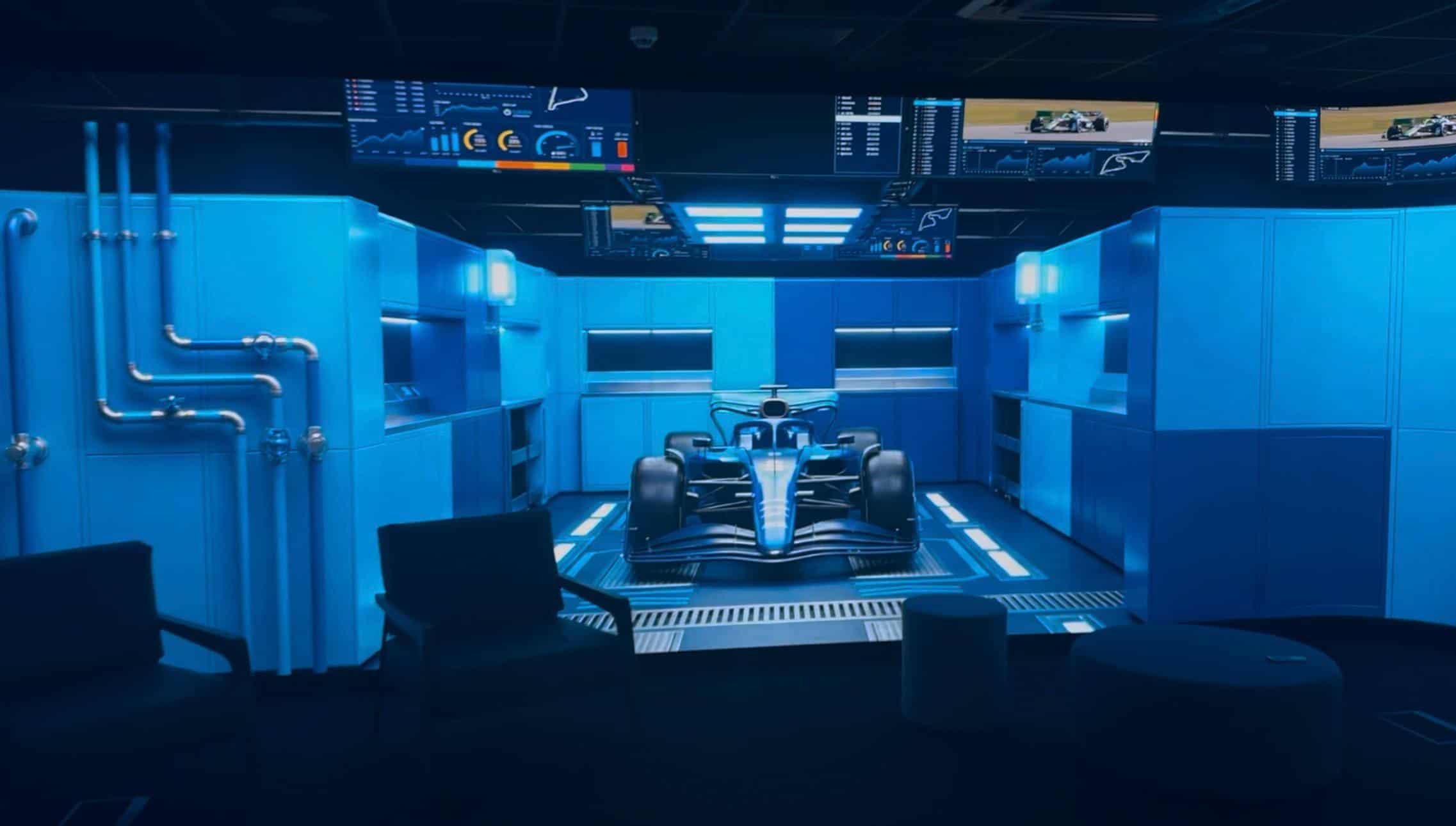
BAT’s brief was an environment where whatever is on screen, a match, a race, a brand moment, becomes the thing the room is doing. When a client builds a room for a display, the display’s viewing distances, power and supporting structure can be designed as part of the room instead of being negotiated against an existing interior. That is a freedom most installations never get, and it sets a useful test for anyone planning a corporate headquarters LED installation: not “how big a screen can we fit?” but “what should this room be able to do?”
The display: DRE Series P1.93
The LED media wall is built from Dynamo DRE Series P1.93 (1.93 mm pixel pitch), a DRE Series fine-pitch cabinet measuring 496 × 496 mm. The cabinet arithmetic is in the table above; the two figures that matter in the room are the resolution and the pitch.
Resolution
Each cabinet carries 256 × 256 pixels. Across the 70 × 5 array that produces a canvas of 17,920 × 1,280 pixels: a little under 23 million individually addressable pixels, and wider than four 4K frames placed side by side. Every one of them is driven as part of a single image.
Why the pitch matters
In a room the display wraps completely, viewers are close to the surface and there is no far wall to retreat to. A coarser pixel pitch would resolve into visible pixels at those distances. At 1.93 mm the image holds together at close range, which is what a display you are meant to stand inside has to deliver. The DRE Series page lists the four pitches in the range, from 1.29 mm to 2.58 mm, for rooms with different viewing distances.
Engineering a 360° wrap in 350 cabinets
A 360 LED room is 350 cabinets that have to read as one surface all the way round. Seventy cabinets in a row means seventy chances for small errors to accumulate. A cabinet-to-cabinet misalignment of half a millimetre, repeated along the run, leaves the surface visibly stepped by the far end. At a 1.93 mm pitch, a physical gap of a fraction of a millimetre reads as a dark seam. Getting a run of this length flat, level and optically continuous depends on accurate structural work behind the display and careful mechanical alignment of every cabinet against its neighbours. It never appears in the finished photographs, and it is where projects of this scale are won or lost. Our LED installation services page sets out how we handle structure, alignment and commissioning on projects like this.
Uniformity across 350 cabinets
Mechanical accuracy is half of visual continuity. The other half is optical: 350 cabinets have to behave as one surface in brightness and colour as well as geometry, because a patch that would go unnoticed on a small display is obvious when one image sweeps round a 34.72-metre canvas. Dynamo also carried out the full calibration of the array, so the 350 cabinets read as one even surface across the 360° wrap.
Power
The LED media wall is rated at 59.5 kW maximum on a 230 V AC supply, delivered across 30 power circuits through a distribution box. That is the maximum design load, not a measure of consumption. A load this size is normally split across many circuits so that each stays within its limits and a fault affects only a small section of the wall. It also produces heat, which is one more reason to build the room for the display: the electrical and thermal requirements can be designed into the space rather than adapted around it afterwards.
Processing: driving the LED media wall from many sources
A 17,920-pixel-wide canvas is far beyond what any single video output carries, so the LED media wall is driven by a NovaStar LED processor from the H5 series. The NovaStar H5 series processor takes in multiple sources, manages them across a very large canvas and feeds the LED as one coherent image.
Content arrives from a range of inputs, including Apple TV and content media players. What makes the installation flexible is the template system running on top of those inputs. Rather than stretching one feed across the full width, the wall shows a different environment depending on what is on.
The template system: what a 360° LED room actually does
The template system on the BAT LED media wall changes the whole room, not one wall of it. Four templates appear in the footage: a stadium for match day, a Formula 1 pit garage for race day, a full-canvas grotto for the festive period, and BAT brand takeovers.
Match day
For a match, the whole room becomes a stadium. The bowl runs right round, with BAT branding on the hoardings. The live match itself sits in a framed window drawn into the environment, so the broadcast feed is presented at a sensible size while the rest of the canvas puts you in the ground.
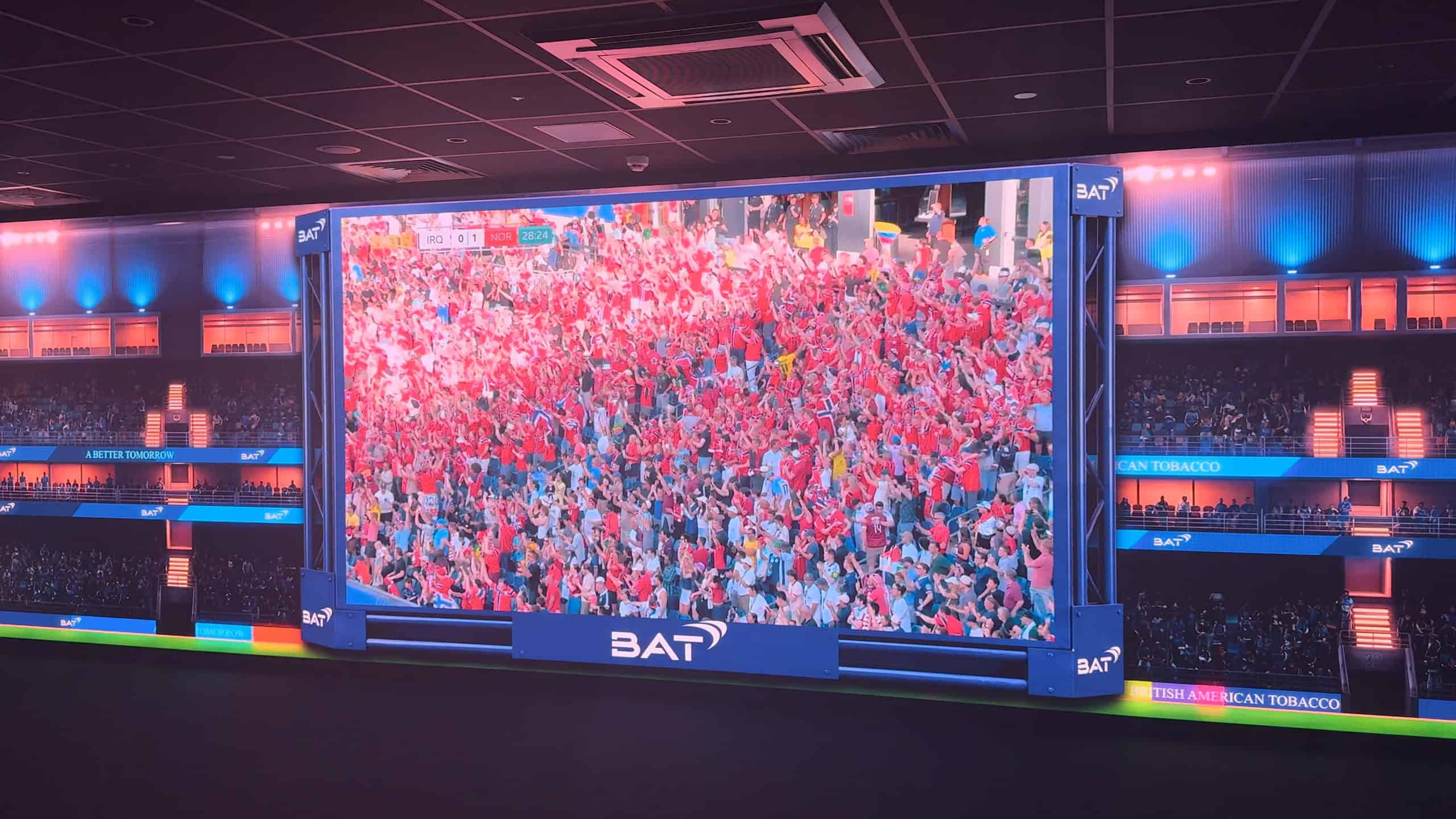
Race day
For Formula 1, the room becomes a pit garage. Timing screens run along the top of the canvas, the pit lane and grandstand sit in the centre window, and a BAT-liveried car crosses through it. A second framed window carries the driver’s point of view beside a cabinet of helmets rendered into the garage wall.
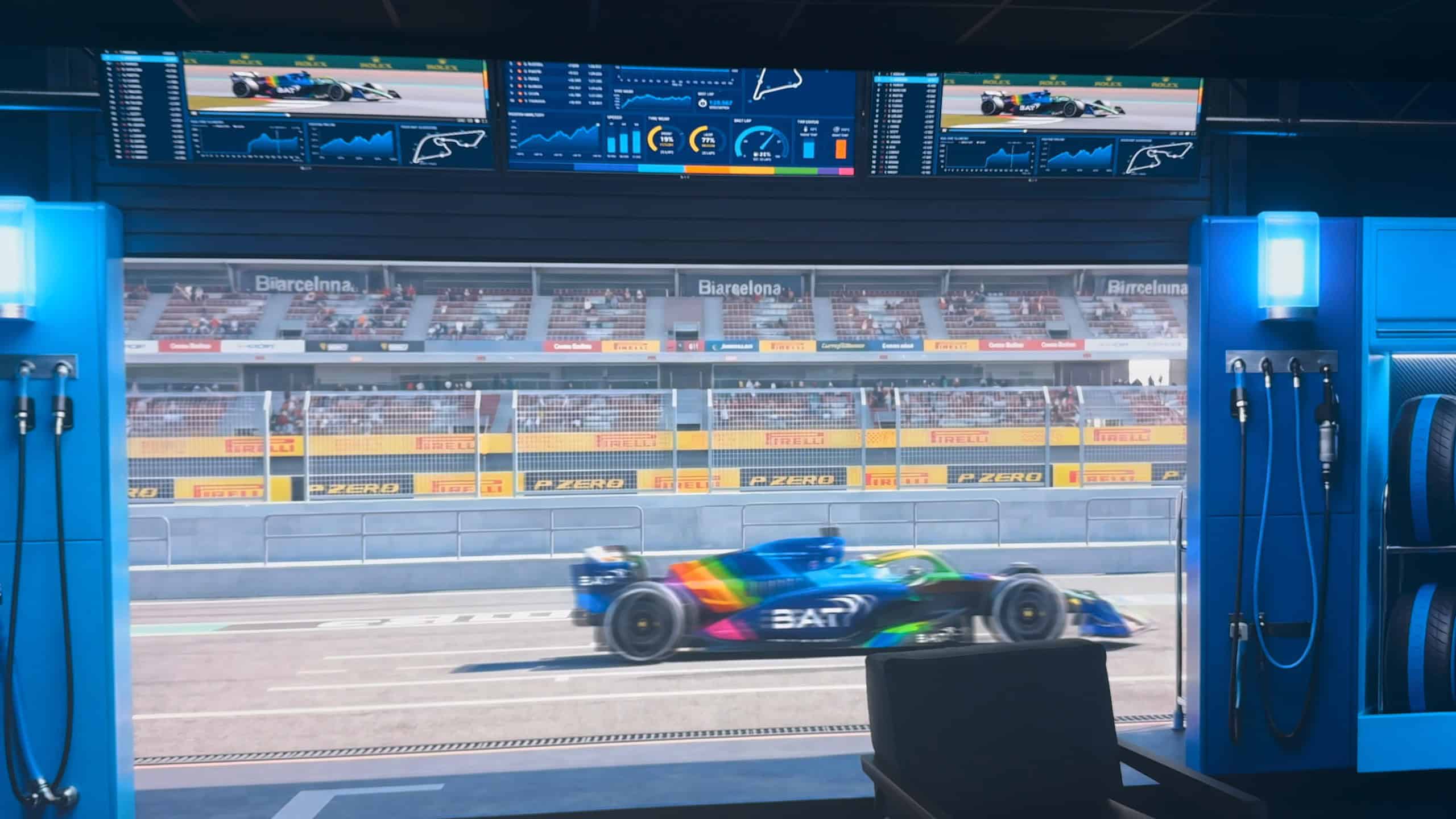
Festive takeover
For the festive period the room stops being a sports venue altogether. A full-canvas grotto runs round the wall: a lit arch with a throne, garlands, a tree in a bay window and a fireplace with a wreath. Nothing about the hardware changes. The same 86 square metres carry a completely different room.
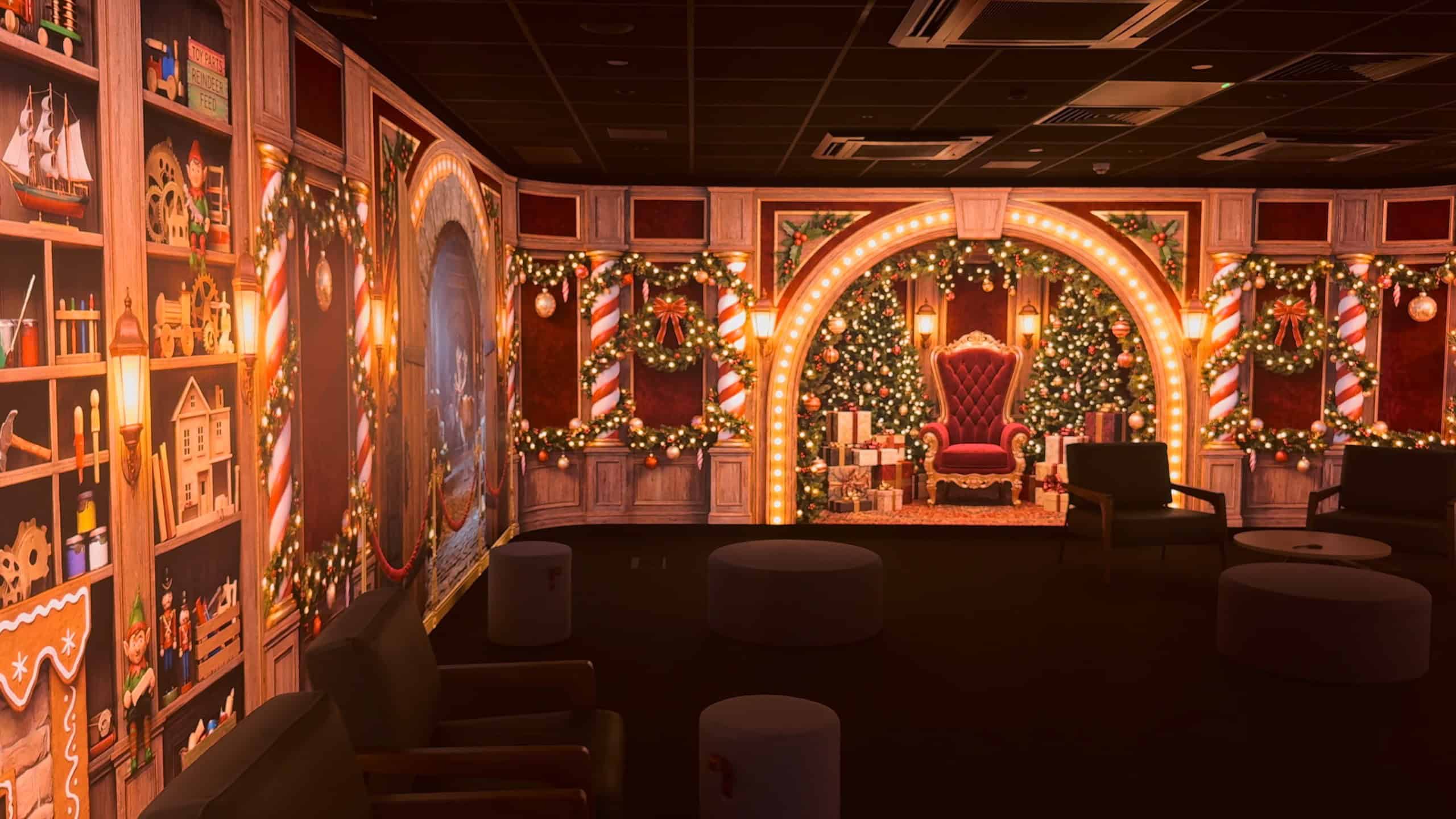
Brand takeovers
Between the environments, the wall carries BAT’s own content across all 17,920 × 1,280 pixels as a single piece: a blue city skyline with the BAT logo, and a globe with a horizon arc. These show what the full canvas looks like with one image across every cabinet, right round the room.
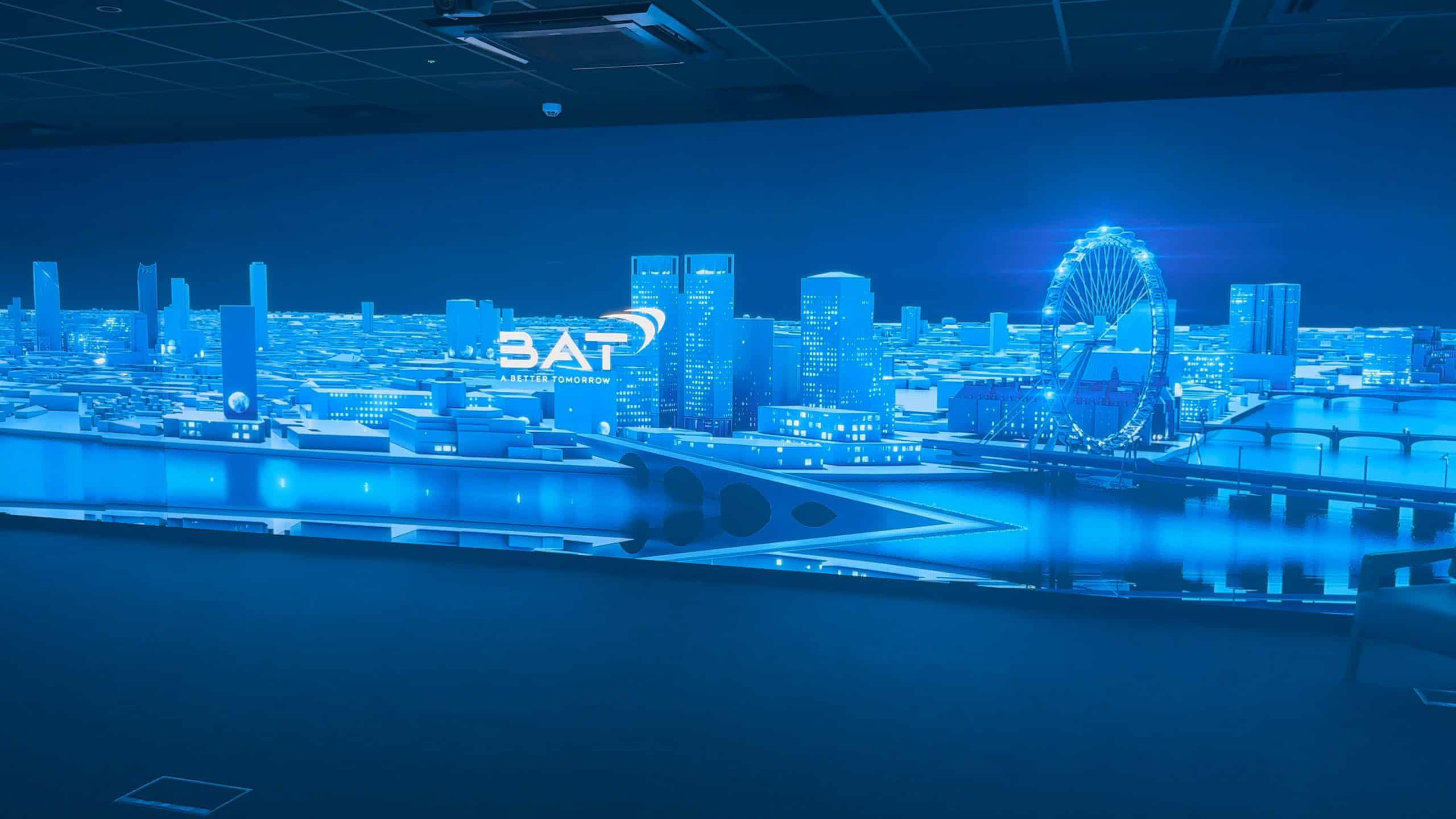
That range, from templated multi-source environments to single full-bleed takeovers, is what separates a 360 LED room from a very large television. The hardware makes it possible; the content system is what turns it into an environment. Our guide to content planning for LED walls covers the same decisions for smaller canvases.
The partnership: Pixel Artworks
Dynamo engineered and installed the LED media wall. Pixel Artworks, a Dynamo partner, installed the media player system and created the content, including the template environments and the full-canvas takeovers.
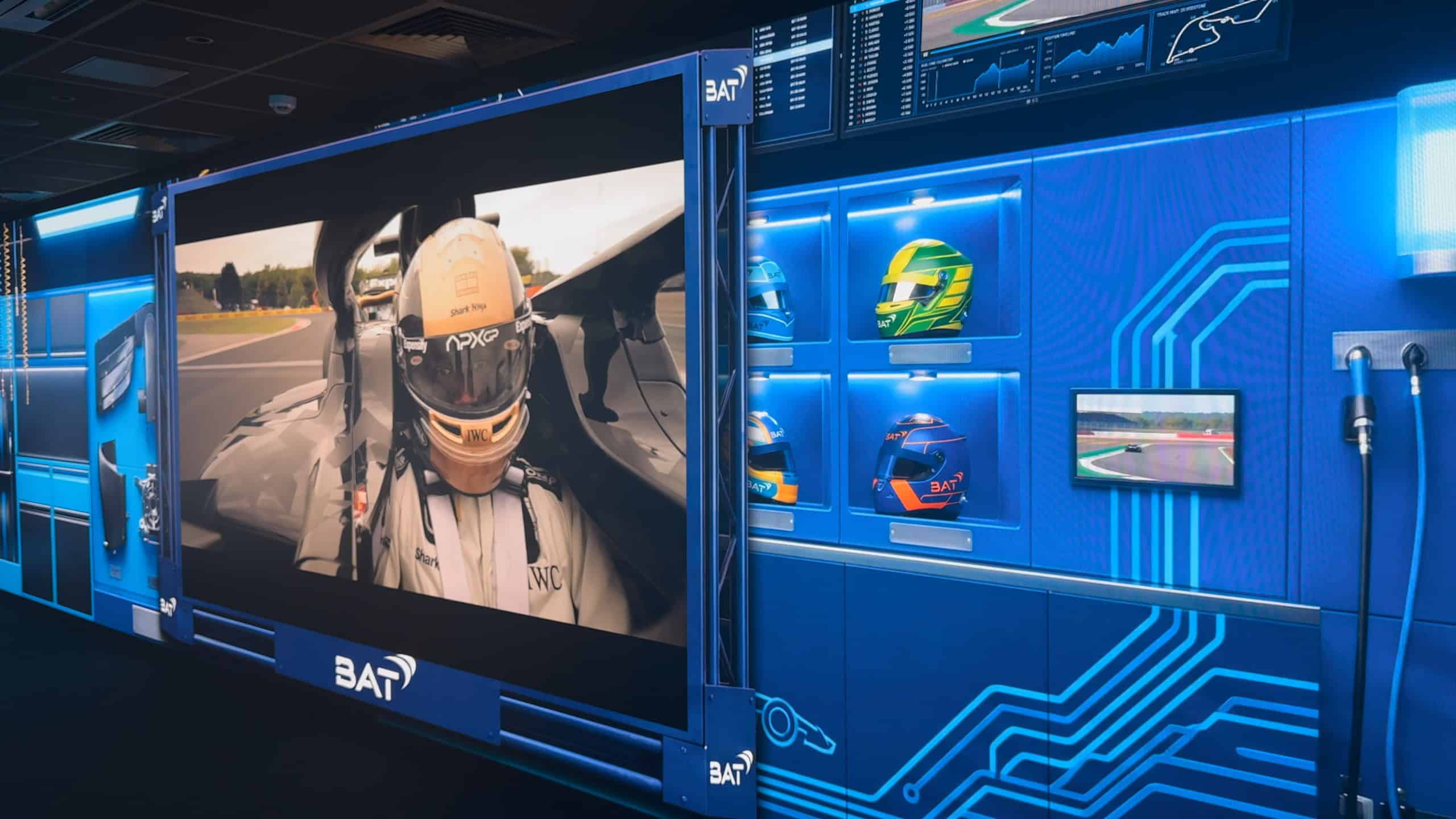
A 17,920 × 1,280 frame is not a format any off-the-shelf footage is produced in, and scaling conventional material across it would waste the room. The stadium, the pit garage, the grotto and the brand pieces are what turn 86 square metres of hardware into an environment rather than a screen. We have worked with Pixel Artworks before, on the interactive AI wall at Auto Trader’s Manchester HQ and at their own Lighthouse in Farringdon, and the split is the same each time: we engineer the display, they make it worth watching.
Display engineering and content creation are different specialisms. The strongest immersive projects come from partnerships where each is handled by people who do it every day.
From the field
What I take from this project is scope. We engineered and installed a 70 × 5 array of fine-pitch cabinets that wraps the whole room and handed over a single 17,920 × 1,280 canvas that one processor drives as one image. The alignment work along a run that long is the part I care about most, because it is the part nobody sees when it is right.
My other note is on content. On a canvas this shape, the content partner is not an add-on. Pixel Artworks built the environments that make the hardware disappear, and I would rather have that conversation at the start of a project than after the LED is on the wall.
360° LED room at BAT’s London HQ: frequently asked questions
How big is the 360° LED room at BAT’s London HQ?
The active LED surface is 34.72 metres wide and 2.48 metres tall, which is 86.1 square metres, and it wraps completely round the room. It is built from 350 Dynamo DRE Series P1.93 cabinets, each 496 × 496 mm, arranged 70 wide and 5 high. Those figures describe the display surface, not the room. The 14:1 aspect ratio is what lets one continuous image run right round and fill the viewer’s field of vision.
What resolution does the BAT LED media wall run at?
The canvas is 17,920 × 1,280 pixels. Each 496 mm cabinet carries 256 × 256 pixels, so 70 cabinets across gives 17,920 pixels and 5 cabinets high gives 1,280. That is a little under 23 million pixels in total, wider than four 4K frames side by side, and every pixel is driven as part of a single image by the NovaStar H5 series processor.
What makes the BAT installation a 360° LED room rather than a large screen?
The display wraps completely round the room rather than sitting on one wall, so it surrounds the viewer instead of facing them. The 1.93 mm pixel pitch holds a smooth image at close range. The room was built for the display, so there is nothing in it to break the effect. And the content system changes the whole environment, a stadium, a pit garage, a grotto, rather than showing a picture on a wall.
How is content managed on the BAT LED media wall?
A NovaStar H5 series processor takes in multiple sources, including Apple TV and content media players, and drives the full 17,920 × 1,280 canvas as one image. A template system built on top of those inputs decides how the canvas is arranged: a live match sits in a framed window inside a stadium environment, while a brand takeover uses every pixel for one piece.
Who created the content for the BAT LED media wall?
Pixel Artworks installed the media player system and created the content, including the match-day, race-day and festive environments and the full-canvas BAT brand pieces. Dynamo engineered and installed the LED media wall itself. The same split worked on the Auto Trader Manchester HQ project, where Pixel Artworks built the interactive AI wall on our LED.
Can Dynamo build a 360° LED room like this for another headquarters?
Yes. The approach transfers to any corporate headquarters, showroom or experience space: fine-pitch cabinets for close viewing, a structure and power design planned with the room, a processor sized for the canvas and a content partner brought in from the start. The cabinet count, pitch and canvas size follow from the room and the viewing positions, not the other way round.
Planning a 360° LED room for your corporate headquarters
If you are planning an LED video wall for a headquarters, start with the room, not the screen. What we need from you is short: the room dimensions, where people will view from, the content sources you already have and the power available. From that we will come back with a written specification and price.
BAT’s 360 LED room at its London HQ shows what that approach delivers when the display wraps the whole room and the room is built for the display. You can see more of our fixed installations in our work. To get a quote for a 360 LED room or an LED media wall, contact us or call +44 (0)203 489 9878.
Written by: Daniel Reynolds, Managing Director, Dynamo LED Displays