
Outdoor LED night dimming is one of the first questions specifiers raise once a screen is approved for an exterior site. The outdoor LED screen that looks sharp at 6,000 nits under direct sun becomes a neighbourhood nuisance at midnight if nothing reins it in. Planning authorities know this, neighbours know this, and increasingly, enforcement officers know this too.
This guide covers how auto-brightness works on modern outdoor LED screens, what UK planning conditions typically require, and how to specify dimming correctly so your screen stays compliant from day one.
Key Takeaways
- Ambient light sensors adjust outdoor LED screen brightness automatically, reducing output by up to 95 per cent after dark
- Auto-brightness alone is not enough — a scheduled luminance cap prevents the screen climbing too high if the sensor is fooled
- Most UK planning consents for illuminated signage include enforceable luminance conditions tied to night-time curfew hours
- Light pollution risk depends on luminance, viewing angle, content design and proximity to windows or roads — not just a single nit figure
- Full-white backgrounds at night are a frequent source of complaints, in our project experience more so than the hardware itself
- Night-time commissioning with real content, from real public viewpoints, catches problems that factory settings miss
At a Glance: Outdoor LED Night Dimming — Project Facts
| Factor | Detail |
|---|---|
| Typical daytime brightness | 5,000–7,000 nits (direct sunlight readability) |
| Typical night-time cap | 100–600 nits, depending on site and viewing distance |
| Sensor strategy | Ambient light sensor plus time-based maximum limits |
| Dimming range | 0–100% in 65,536 greyscale steps (16-bit) via processor LUT |
| Content risk | Full-white creatives and fast transitions increase perceived glare |
| Regulation framework | Town and Country Planning (Control of Advertisements) Regulations 2007 |
How Auto-Brightness Works On Outdoor LED Screens
Every outdoor LED screen worth specifying ships with, or accepts, an ambient light sensor. The sensor reads the surrounding light level in lux and feeds that value back to the display processor — typically a Novastar controller. The processor maps lux readings to a brightness curve: high ambient light triggers high output; low ambient light pulls the screen down.
The curve is configurable. Most processors allow a minimum brightness floor, a maximum ceiling, and the shape of the transition between them. Some systems offer step-based dimming at five or six fixed levels, while others provide a smooth linear or logarithmic curve. Smooth curves look more natural and avoid the jarring snap between brightness levels that step-based systems sometimes produce. 16-bit greyscale processing is what makes low-brightness dimming smooth — without enough bit depth, you get visible stepping below 50 nits.
Sensor placement matters. A sensor tucked behind a fascia or angled away from the ambient conditions it should be measuring produces inaccurate readings. On screens using our P2.5mm outdoor LED panel, where the viewing audience is often closer and more sensitive to brightness changes, getting the sensor position right is worth the extra site survey time.
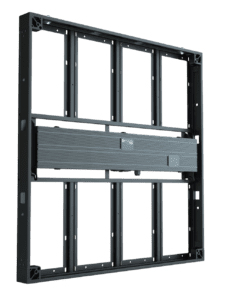
Our DVO Series cabinets ship with integrated ambient light sensors and full processor-level dimming control as standard, which removes the guesswork on sensor integration for permanent outdoor installs.
Why Auto-Brightness Alone Is Not Enough
A single sensor should not be trusted as the only control. Sensors can be affected by nearby floodlights, headlights, shadows, dirt and reflections from the screen structure itself. We use a layered approach:
- Ambient light sensing to respond to real conditions.
- Scheduled control to define dusk, night and dawn modes with hard luminance caps for each band.
- Manual override for maintenance, testing and incident response.
- Logged settings so the operator can demonstrate what the screen was running if a complaint is raised.
The ramp between modes matters too. A screen that snaps from 5,000 nits to 300 nits looks crude, and the reverse can be uncomfortable for nearby viewers. We default to a 15-minute ramp on our outdoor installs and adjust from there during night commissioning — that transition period usually feels natural around retail parks, transport sites and mixed-use streets.
Light Spill, Obtrusive Light And Why It Is More Than a Brightness Number
Brightness is the easy number to talk about, but light pollution complaints are usually about perceived effect. An outdoor LED screen at 300 nits can still cause problems if it faces bedroom windows, runs high-white content, changes rapidly or sits in an otherwise dark location.

Five factors drive the real risk:
Direction and viewing cone. Outdoor LED screens emit light forward across a defined viewing angle. A screen angled towards an intended pedestrian route is different from one aimed across a residential elevation. A small change in tilt or azimuth can reduce light spill into upper-floor windows without changing the screen specification.
Distance to sensitive receptors. A screen across a wide road from offices has a different risk profile from one across a narrow street from flats. Night-time tests should be carried out from the actual receptor positions: pavements, junctions, opposite buildings and residential approaches.
Content luminance. Full-white backgrounds produce far more obtrusive light than darker creative with limited bright areas. A screen playing white adverts or rapid full-frame colour changes will feel brighter than one using darker artwork at the same nit setting. This is why content rules belong in the technical package.
Duration and repetition. A single bright frame is less likely to trigger complaints than a repeated high-brightness loop every 30 seconds. Dimming is only one control; scheduling and creative approval matter as well.
Local lighting context. A screen beside illuminated shopfronts and traffic signals sits within an already lit environment. The same luminance setting can be acceptable in a town centre and intrusive on a darker suburban road.
Under UK law, councils can issue abatement notices for artificial light that constitutes a statutory nuisance under the Environmental Protection Act 1990. The UK Government’s guidance on artificial light nuisances explains how councils deal with complaints. The Institution of Lighting Professionals publishes GN01 guidance on the reduction of obtrusive light, setting recommended maximum luminance values by environmental zone — from E0 (national parks) to E4 (city centres). Planning officers routinely reference these thresholds when setting luminance conditions.
UK Planning Conditions And Compliance Documentation
In England and Wales, illuminated advertisements fall under the Town and Country Planning (Control of Advertisements) (England) Regulations 2007. Local planning authorities can attach conditions to any advertisement consent for an outdoor LED screen, and for outdoor LED screens, luminance limits and curfew hours are standard.
A typical condition reads something like: “The luminance of the display shall not exceed 300 candelas per square metre between the hours of 23:00 and 07:00.” Some authorities go further with daytime caps, transition restrictions or requirements for the screen to switch off entirely during certain hours.
The ILP’s environmental zones scale from E0 (intrinsically dark, such as national parks) to E4 (high-district brightness, such as city centres). Night-time luminance limits scale with the zone — what is acceptable on a busy high street would trigger enforcement action outside a village pub.
The technical pack should document proposed daytime and night-time luminance, dimming method, sensor location, operating hours, content restrictions, complaint response procedure, and a method for proving settings after installation. That last point is often missed. If somebody reports that the screen was “too bright”, the operator needs to show what setting it was running and whether the schedule was active. A control log is more useful than a verbal assurance.
We provide a planning support statement as standard for any outdoor LED project heading into the consent process. Having this ready at application stage removes one of the common objections planning committees raise.
Ready to spec an outdoor LED screen with compliant dimming built in? Explore the permanent outdoor range.
Outdoor LED Night Dimming: Content Rules That Reduce Glare
The content can either support the night mode or fight it. For outdoor night operation, we recommend:
- Avoiding full-frame white backgrounds after dusk
- Using darker backgrounds with clear contrast
- Increasing type size rather than increasing brightness
- Avoiding fast flashes and abrupt full-screen transitions
- Previewing creative at the actual night cap before sign-off
Many glare complaints are triggered by bright creative rather than the screen hardware. A night playlist should be treated as its own version, not just the daytime playlist at a lower brightness setting.
For a broader look at brightness, contrast and colour performance across different LED technologies, our technical guide covers the fundamentals.
From the Field
I have stood across the road from outdoor LED screens that were technically within a sensible brightness range but still looked too aggressive because the content was mostly white. On a high-street DVO install where the planning condition was 300 cd/m² after 23:00, I measured from the bus stop opposite and from bedroom-window height on the facing terrace. My first question on site is never “what is the maximum nit output?” — it is “what does the public actually see from the pavement, the road and the nearest windows?”
When I commission night dimming, I stand well away from the screen rather than next to the cabinet. From the front, everything feels manageable because you are focused on the display. From a darker side street, the same setting can feel very different. That is where my final judgement comes from. Getting outdoor LED night dimming right upfront is always cheaper than dealing with an enforcement notice after the fact.
Outdoor LED Night Dimming: Frequently Asked Questions
What brightness should an outdoor LED screen run at during the night?
Most outdoor LED screens run between 100 and 600 nits at night, with 300 cd/m² being the most common UK planning cap after 23:00. The right setting depends on viewing distance, surrounding light, content design and the specific planning condition. A darker street or residential frontage usually needs a lower cap than a lit retail park.
Does auto-brightness stop light pollution complaints?
Auto-brightness helps, but it doesn’t remove the risk on its own. The system also needs scheduled caps, sensible sensor placement, content controls and night-time commissioning. A sensor can be fooled by local lighting or reflections, so we do not treat it as the only safeguard on public-facing outdoor LED projects.
Should dimming be based on sunset time or a lux sensor?
We prefer both. A lux sensor responds to real ambient conditions, while a sunset-based schedule prevents the screen rising above an agreed cap after dark. The schedule sets the boundary; the sensor fine-tunes within it. That combination is more predictable than relying on either method alone.
Can content design reduce night-time glare?
Yes. Darker backgrounds, larger text, slower transitions and fewer full-white frames can make a measurable difference. Many glare complaints are triggered by bright creative rather than the screen hardware. We often recommend separate day and night content versions for sites near roads, homes or darker public spaces.
What happens if the ambient light sensor fails?
A well-specified system includes a fallback. The processor can be configured with a timed schedule that enforces a maximum brightness regardless of sensor input. If the sensor fails, the schedule takes over and keeps the screen within compliant limits. Specifying a secondary sensor provides additional redundancy for sensitive sites.
Does night-time dimming reduce the lifespan of LED modules?
It extends lifespan. LED diodes degrade faster under sustained high-current operation. Running at reduced brightness during night hours lowers thermal stress on the modules and slows the gradual decline toward the half-brightness point. For permanent outdoor LED screens expected to operate for seven to ten years, dimming contributes meaningfully to long-term reliability.
Do planning authorities set exact luminance limits for outdoor LED screens?
Conditions vary by site and local authority. They may specify maximum luminance, curfew hours, transition restrictions or complaint procedures. We recommend agreeing the control strategy early and documenting the final settings so the operator can demonstrate compliance after installation. Our planning support documentation covers what planners expect to see.
Conclusion
Get outdoor LED night dimming specified properly before installation and you avoid enforcement headaches later. Night mode needs a separate control curve, separate content checks, and sign-off from actual public viewpoints — not just the brightness slider wound down at handover.
To discuss night dimming specifications for your outdoor LED project, call us on +44 (0)203 489 9878 or get in touch through our contact page. We provide full planning support and can walk you through the DVO outdoor LED range to find the right screen for your site.