Home cinema installers in Primrose Hill rarely get asked for this: a 4 m × 2 m fine-pitch LED wall beside an indoor pool. In May 2016 Dynamo LED Displays engineered and installed a P1.92mm poolside LED display at a private residence in Eglon Mews, waterproofed in-house and controlled through the house Crestron system.
Updated September 2026: added a key takeaways box, extended FAQ, outbound references and an enquiry route. Project facts unchanged.
Key takeaways
- A 4 m × 2 m P1.92mm LED wall installed poolside at a private residence in Eglon Mews, Primrose Hill, in May 2016.
- No off-the-shelf fine-pitch LED existed for a humid, chlorinated, splash-risk room, so each tile was conformally coated and resin-sealed in-house.
- The wall serves as home cinema screen, digital art canvas and gaming display, switched by scene presets.
- Control runs through the property’s Crestron system from keypads, iPad, phone and tablet, with source, brightness and colour temperature recalled per scene.
- The installation has operated in that environment since 2016 and set the template for Dynamo’s bespoke residential LED work.
In May 2016 we installed a 4m × 2m P1.92mm LED wall poolside at a private residence in Eglon Mews, Primrose Hill — the former home of film director Tim Burton. The property had been reconfigured around an indoor pool that retracts into the floor, leaving an open entertaining space when closed. The brief was a cinema-grade display that could sit metres from the water, switch between film, art and gaming, and be driven from anywhere in the house.
No off-the-shelf fine-pitch LED product existed for that environment. Standard indoor LED tiles are not rated for humidity, splash or condensation, and in 2016 resin-sealed fine-pitch panels were not commercially available. We engineered the solution in-house — conformally coating and resin-sealing each P1.92mm tile before assembly — making this one of the earliest known applications of resin coating to fine-pitch LED in a UK residential setting.
The Brief
The client wanted a single large-format display that could serve three roles: a home cinema screen, a digital canvas for high-resolution artwork when the room was idle, and a gaming display. The display had to be seamless — no bezels, no tiling artefacts at close viewing distance — and had to sit poolside, within the humid envelope of an indoor pool room.
Control was the second half of the brief. The client runs a Crestron system across the property and wanted the LED wall brought onto the same control layer, operable from fixed keypads, iPad, smartphone and tablet. Source switching, brightness, scene recall and content changeover all needed to sit behind a single user interface.
The third constraint was the room itself. The pool retracts into the floor, which means the space doubles as an entertaining area. The LED wall had to work as a focal point both when the pool was open and when it was closed, at viewing distances ranging from roughly two metres to the far end of the room.
The Technical Challenge
Fine-pitch LED panels are built for dry, climate-controlled commercial interiors — broadcast studios, control rooms, corporate lobbies. The LEDs, driver ICs and surface-mounted components on the module face are exposed. In a pool environment three things attack that hardware: ambient humidity sitting well above normal indoor levels, airborne chlorine, and the risk of direct splash when the pool is in use.
Humidity alone drives condensation on cold surfaces and accelerates corrosion of fine solder joints. Chlorinated air is aggressive towards exposed metals. Splash risk, even occasional, is catastrophic for an uncoated module. A standard indoor LED wall installed in that room would have degraded within months.
In 2016 there was no commercially available fine-pitch LED product engineered for this use case. IP-rated LED existed at coarser pitches for outdoor signage, but nothing at P1.92mm that would give the client the seamless, close-viewing image they wanted. We built the waterproofing process ourselves.
Each tile was stripped, inspected, and treated in two stages. First, a conformal coating was applied to the module face and driver-side electronics — a thin protective film that seals against moisture and airborne contaminants without altering the optical properties of the LEDs. Second, the module edges and connector interfaces were resin-sealed to close the gaps where humidity would otherwise find a path into the PCB. The process was developed and applied in-house. No formal IP rating was pursued — this was bespoke engineering for a specific room, not a product certification.
The Installation
| Specification | Detail |
|---|---|
| Property | Eglon Mews, Primrose Hill, London (former home of director Tim Burton) |
| Year installed | May 2016 |
| Screen dimensions | 4m wide × 2m high |
| Pixel pitch | P1.92mm |
| Waterproofing | Custom waterproofing process developed in-house — conformal coating plus resin sealing |
| Control system | Crestron integration — iPad, smartphone and tablet |
| Use cases | Home cinema, digital art display, gaming |
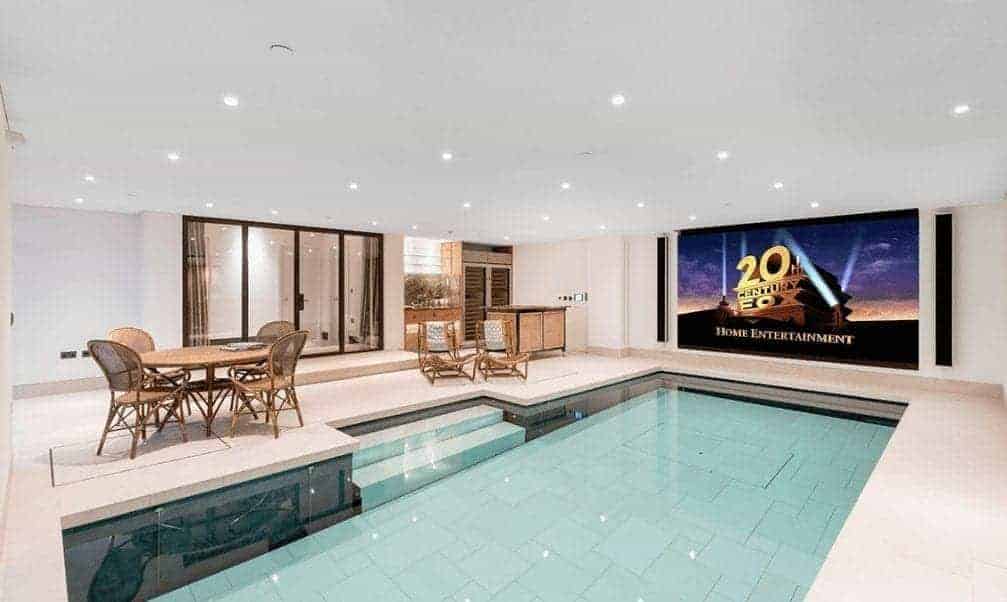
The wall was built as a single flat array of P1.92mm cabinets, aligned and calibrated to present as one continuous surface. At that pitch, pixel density is high enough that the image reads as seamless from the viewing distances in the room — there is no visible tile boundary and no screen door effect at normal seated distance.
Mounting was engineered to hold the array rigid and serviceable in a wet-adjacent environment, with rear access for module swaps so that any future service work could be carried out without disturbing the surrounding finishes. Signal came in through a fibre backbone tied into the Crestron layer, so source switching — cinema feed, art content playlist, games console input — sat behind the same user interface the client used for the rest of the house. Commissioning included colour calibration against the room’s lighting, brightness scaling appropriate to the ambient conditions, and scene presets for cinema, ambient art and gaming modes. Each scene recalls its own colour temperature, brightness and source, so the wall shifts role with a single tap rather than a sequence of menu selections.
The Result
The client received a seamless 4m × 2m display in a room where no off-the-shelf product could go. From an iPad or in-wall keypad, the wall switches between cinema mode, a rotating gallery of high-resolution artwork, and gaming inputs. When the pool is open, the screen sits as a live visual feature across the water. When the pool retracts into the floor, the space becomes a cinema or games room with a display that is larger, brighter and more consistent than any projector or tiled TV solution would deliver at that scale.
The installation has operated in that environment since 2016. For us it set the template for a category of work we’ve continued to deliver — bespoke fine-pitch LED engineered for spaces that standard AV integrators write off as impossible. A comparable example is our Westminster Tower marketing suite, where fine-pitch LED was specified into a high-end interior with its own technical constraints.
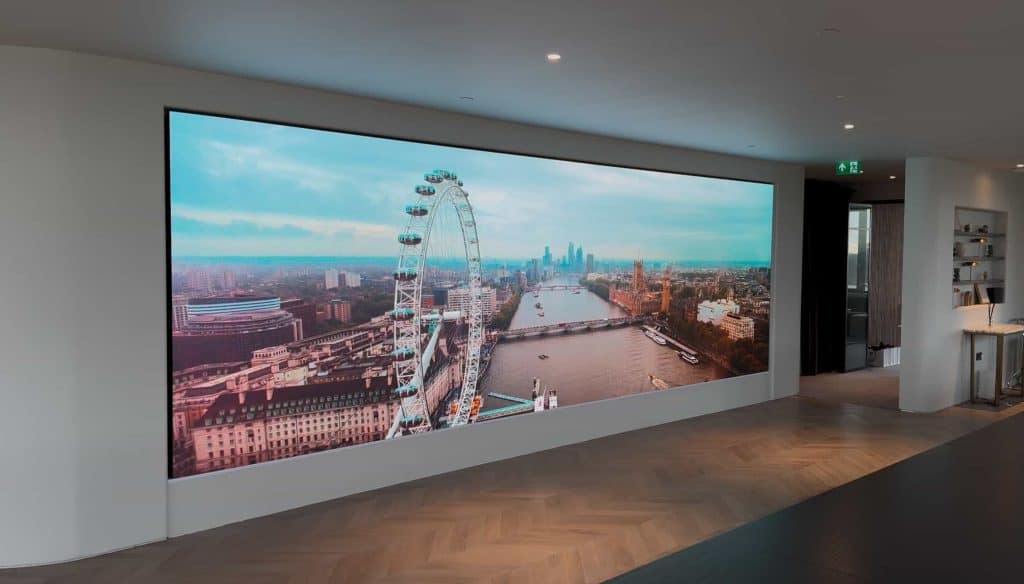
The Crestron integration proved as important to the client experience as the display engineering itself. Running cinema content, stepping the wall into art mode for an evening of entertaining, or bringing a console online for gaming all sit behind the same control surface — there is no separate remote, no input-selection menu, no technical friction. That was a defining requirement: a display that disappears into the architecture when it’s not being used, and steps forward as a focal surface when it is.
Why LED for High-End Residential
At the top of the residential AV market, LED has replaced projection and large-format OLED for several reasons. For a full view of how we approach luxury residential LED displays, see the dedicated page — the short version is below.
- Brightness and ambient light tolerance. Fine-pitch LED holds its image in rooms with daylight, accent lighting or reflective surfaces. Projection washes out; OLED is brighter but capped on size.
- Scale without compromise. A 4m × 2m wall in a single seamless surface is straightforward in LED. In OLED it means video-walling multiple panels with visible seams. In projection it means a throw distance, black levels and maintenance cycle that rarely suit a residential space.
- Serviceability and longevity. Individual modules are hot-swappable. A failed tile is a site visit, not a new screen. Commercial-grade LED is engineered for continuous operation in a way consumer displays are not.
- Environmental flexibility. With the right engineering — as at Primrose Hill — LED can be deployed into spaces where consumer and commercial displays simply cannot go. That’s where bespoke custom LED displays and site-specific LED video walls replace catalogue products.
Poolside LED Display, Primrose Hill: Frequently Asked Questions
Can LED displays be used near swimming pools?
Standard indoor LED panels cannot — they are not engineered for humidity, chlorine or splash. A pool-adjacent installation requires either an IP-rated outdoor LED product (typically at coarser pixel pitches unsuitable for close viewing) or a bespoke waterproofing process applied to fine-pitch modules. At Primrose Hill we used the latter approach: conformal coating and resin sealing applied to each P1.92mm tile in-house.
What pixel pitch should a home cinema LED wall use?
Pixel pitch is chosen against minimum viewing distance. For a home cinema or media room where viewers sit two to four metres from the wall, a pitch between P1.5mm and P2.0mm typically delivers a seamless image with no visible pixel structure (see our viewing distance guide). Primrose Hill is P1.92mm, which reads as continuous at normal seated distance on a 4m × 2m wall. Larger rooms with longer sightlines can use coarser pitches; closer viewing needs P1.2mm or finer.
How is a poolside LED display waterproofed?
On the Primrose Hill installation each LED module was treated in-house in two stages: a conformal coating applied to the module face and driver electronics to seal against humidity and airborne contaminants, followed by resin sealing of module edges and connector interfaces to close any path for moisture ingress. The process was bespoke engineering, not a certified IP rating — it was developed for a specific room and a specific use case.
Who installs home cinema LED walls in Primrose Hill and London?
Dynamo LED Displays designs, engineers and installs fine-pitch LED walls for high-end residential projects across London and the UK, including spaces with non-standard environmental conditions. Our work includes the Primrose Hill poolside installation, bespoke residential media rooms and integrated Crestron-controlled LED systems, delivered by our own crew rather than subcontracted.
Can a home cinema LED wall run on a Crestron system?
Yes. At Primrose Hill the LED wall sits on the same Crestron control layer as the rest of the house, so source switching, brightness, colour temperature and scene recall are driven from in-wall keypads, an iPad, a phone or a tablet. Cinema, art and gaming modes are single-tap presets rather than a sequence of menu selections, and the processor and media sources are hidden from the user entirely.
How has the poolside LED wall held up since 2016?
It has operated in the pool room since May 2016. The in-house conformal coating and resin sealing were designed for that specific room rather than certified to an IP rating, and the mounting was built with rear access so individual modules can be swapped without disturbing the surrounding finishes. That serviceability is why a bespoke fine-pitch wall can be specified into a space most integrators would refuse.
Planning a residential LED installation?
If you’re specifying fine-pitch LED into a luxury residential project — home cinema, media room, pool house, gallery wall or a space with environmental constraints — we can scope the display, engineer the waterproofing or mounting approach, and integrate it into your control system.
Get a quote for a residential LED wall. Send us the room dimensions, the viewing distances and any environmental constraints, and we will come back with a pitch, an engineering approach and a price. Contact Dynamo LED Displays or call 020 3489 9878.