An LED screen service contract is an agreement that commits a supplier to defined response and fix times, engineer attendance, held spares and scheduled maintenance for a display. It goes beyond a standard warranty, which repairs faulty parts but sets no timescale for getting the screen working again. In practice, that’s the difference between a dead panel being fixed this week and a dead panel greeting your customers for a month. The hardware decision gets most of the attention when a screen is specified; the support decision determines what the screen looks like in year three. The real question isn’t whether to buy cover but whether the service level matches what downtime costs you: a reception screen can usually wait until tomorrow, while a ticketed venue or advertising screen may need remote diagnosis within the hour and an engineer available outside normal working hours.
Key takeaways
- A warranty repairs parts; a service contract puts an engineer on site against a clock.
- A good service level agreement (SLA) measures acknowledgement, remote response, attendance, restoration and resolution as separate milestones.
- Set service levels by operational impact, not one response time for every fault.
- Held spares are the single biggest factor in fix speed.
- Remote monitoring turns a service contract from reactive to preventative.
- Exclusions should be listed in the contract, not discovered at claim time.
At a glance: what to check before you sign
| Contract element | What good looks like |
|---|---|
| Response time | Defined in working hours, with the clock start point stated (fault logged, not fault acknowledged) |
| Fix time | Separately defined from response time, with the spares position that supports it |
| SLA operating period | Business hours or 24/7 stated explicitly, including weekends and bank holidays |
| Spares holding | Named spare parts for your screen model, with location, quantities and a replenishment process |
| Remote diagnostics | Processor and receiving-card health visible off site before an engineer is dispatched |
| Preventative visits | Scheduled inspections with a written condition report, not just emergency call-outs |
| Exclusions | Accidental damage, vandalism, power quality and content issues listed explicitly |
| Access provisions | Who supplies powered access or scaffold for high-level screens, and who pays |
Warranty versus service contract: know which one you are relying on

Most direct-view LED hardware ships with a manufacturer-backed warranty, and ours is a 3-year return-to-base warranty as standard. Return-to-base means what it says: if a module or power supply fails, the faulty part comes back to us, gets repaired or replaced, and goes back out. That’s genuine cover, and for a screen in a low-stakes location it may be all you need.
But return-to-base cover leaves two gaps that matter for commercial installs. First, someone has to get the faulty part out of the screen. On a fine-pitch indoor screen from the LED display products range, such as a DFA Series screen with its 500×500mm front-serviceable cabinets, an experienced engineer can swap a module in minutes. On an outdoor facade screen six metres up, extraction involves powered access, a trained operative and a plan for doing it safely. The Health and Safety Executive’s work at height guidance applies to every one of those visits, and a proper service contract prices that reality in rather than leaving it as your problem. Second, a warranty has no clock on it. Nothing in a return-to-base warranty commits anyone to a timescale. A service contract exists precisely to add that clock, and to attach an engineer, a van and a box of spares to it.
The two documents also draw different boundaries, and the boundary matters. If the LED screen is working but the media player feeding it has failed, who diagnoses that and who pays? If a building-management shutdown removes power, does the event count as screen downtime? Good contracts list the exclusions (accidental and malicious damage, water ingress from building defects, unstable mains supply, changes to third-party networks and source equipment, unauthorised configuration changes) and draw the system boundary clearly. Ambiguous boundaries produce arguments at exactly the moment the screen needs attention.
Reading the SLA: five milestones, not one number
A good LED screen SLA measures five milestones separately: acknowledgement, remote response, attendance, restoration and resolution. “Response within four hours” can mean any one of them, and weaker contracts commit only to the easiest.
Acknowledgement
Acknowledgement confirms the incident has been logged. It proves nothing about diagnosis, which is why a contract that commits only to acknowledgement commits to very little.
Remote response
Remote response means a competent technician is actually reviewing the fault: checking processor status, input signals, cabinet communication and logged temperature or power warnings.
Attendance
Attendance means an engineer has arrived, and the contract should say where. The site entrance, the security desk and the screen itself aren’t the same place in a controlled building.
Restoration
Restoration returns the screen to an agreed operational state, perhaps by swapping a module from site stock or switching signal paths.
Resolution
Resolution closes the underlying fault, which can take longer if a component needs workshop assessment.
Fix time is the number your finance director cares about, and it’s the one many contracts quietly decline to state, because it depends on parts rather than promises. If the spare modules for your screen sit in a UK warehouse, a dead module is typically a same-week fix. If they have to be manufactured and freighted from the factory, no SLA wording changes that physics. Check the clock start point too: does it run from the moment a fault is logged, and does a fault reported at 22:00 on Saturday start the clock immediately or on Monday morning?
So when you compare contracts, ask three questions of each supplier. What is the response commitment, and what does “response” mean? What is the fix commitment, and what spares holding backs it? And what happens when the commitment is missed: service credits, extended cover, or a shrug? Our LED screen repair service exists for screens that arrive with us out of warranty or orphaned by a defunct supplier, and we regularly inherit screens whose SLA was never tested until the day it failed.
Already running a screen and unsure what your cover actually commits to? We write service contracts against exactly these milestones, on screens we installed and on screens we didn’t. See our LED display maintenance service, or contact us on +44 (0)203 489 9878 and we’ll set out cover for your site in writing.
Spares, monitoring and preventative visits: the substance behind the SLA
Three elements carry most of a service contract’s weight: held spares from your screen’s production batch, remote monitoring through the processor, and scheduled preventative visits. A contract missing any of them is a promise without the machinery to keep it.
Held spares
Direct-view LED is modular: the failure points are modules, receiving cards, power supplies and the processor. A supplier who holds stock of your exact module batch can colour-match a replacement invisibly; a supplier sourcing an equivalent module later will leave you with a patch that catches the eye every time the content goes white. When we commission a fixed-install screen, we specify spare modules from the same production batch at handover, written into the contract with quantities, and the contract should also state where those spares live, who can fit them, and what happens when one is used: is replenishment included, charged at the current part price or subject to approval? Without a replenishment process, a strong initial spares pack gradually becomes an empty case. On a multi-year contract, component availability should be reviewed periodically so that end-of-supply parts are stocked or a controlled upgrade planned before the risk bites.
Remote monitoring
Modern LED processors expose genuinely useful health data. Novastar control systems, which we fit across much of our fixed-install work, report receiving-card status, temperatures and input signal state, and Brompton processors offer comparable visibility on the systems that use them. A contract with remote monitoring means the supplier can often see a fault before you do, diagnose it before travelling, and arrive carrying the right part. Without it, the first site visit is frequently just a diagnostic trip, which doubles the effective fix time. Alongside monitoring access, a signed configuration backup should be stored away from the display: if a processor or receiving card is replaced, the engineer needs the approved files rather than recreating mapping and colour settings under outage pressure.
Preventative maintenance
Screens that get scheduled attention fail less, which is why an LED screen maintenance contract should include planned visits rather than emergency call-outs alone. A planned visit covers cleaning, connection checks, power supply health, calibration drift and a physical inspection of the mounting structure, with a written report separating work completed, defects needing immediate action and observations to monitor. The pattern across the screens we maintain on this model is consistent: the faults that do occur are caught smaller and earlier. Electrical work on those visits must be planned around safe isolation; the HSE’s guidance on maintaining electrical equipment safely is the reference point. For outdoor screens the case is stronger still: weather sealing, drainage and airflow paths degrade gradually, and an annual inspection catches the degradation before water does.
How much does an LED screen service contract cost?
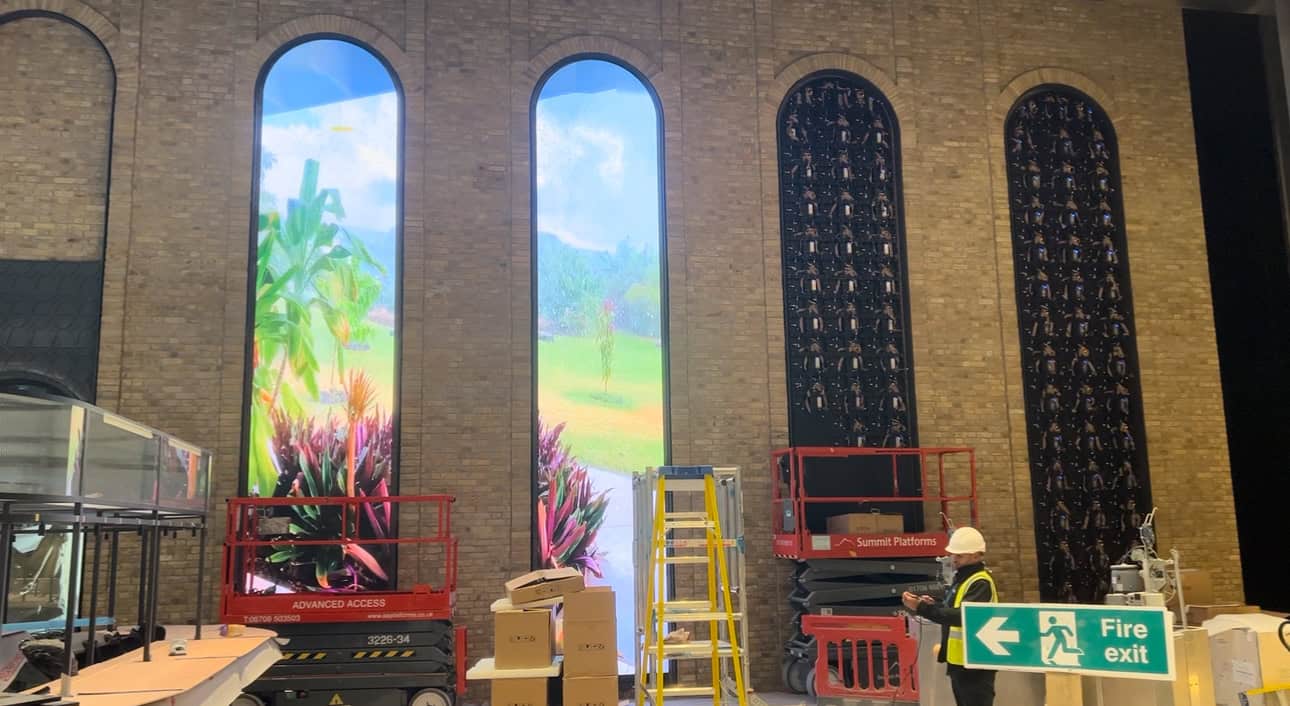
Suppliers price service contracts on risk and effort, so the drivers are predictable. Access is the big one: a front-serviceable indoor screen at floor level is quick to work on, while a high-level outdoor screen needs powered access and additional planning for every visit, planned or emergency. Location matters because response commitments are travel commitments. Criticality matters because a screen carrying paid advertising or match-day content justifies a tighter SLA and a deeper spares holding than a screen showing a lobby welcome loop. Screen construction matters too: fine-pitch indoor LED video walls carry more delicate modules than a coarser-pitch outdoor screen, which affects both spares cost and handling time. If you’re still at the specification stage, the LED screen configurator will give you a starting spec to build the support conversation around, and it’s worth pricing the screen and the cover together.
The commonest thing missing from cheap cover is the spares holding: the contract pays for an engineer’s time but leaves parts on the factory’s lead time, which turns a swap that takes minutes into a wait that takes weeks. Read the spares schedule before you read the price.
From the field
The call-outs that stick in my mind are almost never about exotic failures. They’re about time. I’ve stood in front of a retail screen with a single dead receiving card, a two-minute swap once you’re in front of it, that had been dark far longer than it should have been, because the original installer held no spares in the country and no contract obliged them to hurry. The client had a warranty document that was technically being honoured. It just wasn’t helping.
That’s why my first question in any support conversation isn’t “what response time do you want” but “what does a day of downtime cost you”. I’d also rather test the process before the screen becomes critical: prove the remote access works, locate the spares, load the configuration backup, confirm who can authorise out-of-hours entry. That exercise usually finds more risk than another page of contract wording.
LED Screen Service Contract: Frequently Asked Questions
What does an LED screen service contract typically include?
A typical contract combines a fault-response SLA, engineer call-outs, access to held spares, remote diagnostics through the processor, and one or more scheduled preventative maintenance visits per year. Better contracts state fix-time commitments and spares quantities explicitly, and define the system boundary so there’s no argument over media players, networks or content sources when a fault is logged.
Is a service contract worth it if the screen has a warranty?
Often, yes. A standard warranty is usually return-to-base: the faulty part is repaired or replaced, but nobody is committed to a timescale and nobody is contracted to attend site. If downtime costs you revenue or reputation, in retail, showrooms or advertising, the SLA and on-site response are what the service contract adds over the warranty.
Is a four-hour SLA the same as a four-hour repair?
No. A four-hour SLA may refer only to acknowledgement, remote response or attendance. The repair itself can take longer if access is restricted or a compatible part isn’t held locally. Ask for separate targets covering acknowledgement, remote response, attendance, restoration and resolution, and check what the contract says when a target is missed.
Can LED screen faults be diagnosed remotely?
Many can. Control systems from Novastar and Brompton report receiving-card status, temperature and signal health remotely, so a supplier with monitoring access can often identify the failed component before dispatching anyone. That means the engineer arrives with the right part, and some issues, including signal, configuration and content faults, can be resolved without a visit at all.
Who should hold the spare parts for my LED screen?
Ideally your service provider, in the UK, with quantities and part types written into the contract. Spares from the same production batch as your screen colour-match properly; substitutes sourced later can be visibly different. Ask where spares are physically held, how many, whether they’re reserved for your contract, and how they’re replenished once used.
How often should a permanent LED screen be serviced?
Six- or twelve-month intervals are common starting points. Outdoor, dusty, high-duty or difficult-to-access installations justify more frequent inspection. The right interval should come from the environment and the recorded fault history rather than being copied from another site, and planned work must fit the venue’s operating and isolation procedures.
Does an LED screen service contract cover accidental damage?
Usually not as standard. Impact damage, vandalism and water ingress from third-party works are typically excluded, and so are faults caused by poor mains power quality, one of the exclusions that bites most often in practice. Cover for these usually means an optional extension or separate insurance, agreed before signing rather than after an incident.
Getting the right cover in place
The hardware conversation and the support conversation belong together. Specify the screen and its cover at the same time, insist on fix-time commitments backed by named spares, and treat remote monitoring and preventative visits as core rather than extras. We write cover on exactly those terms through our maintenance contracts, on screens we supplied and on screens we didn’t. For an existing display, a condition survey and service-history review will expose the gaps before the first response target is ever agreed.
If you want a straight answer on what an LED screen service contract should include for your site, talk to our service team or call +44 (0)203 489 9878 and we’ll set out the options in writing.