Immersive LED room for property exhibitions: Mount Anvil at the London New Home Show (case study)
Last reviewed: 11 September 2026.
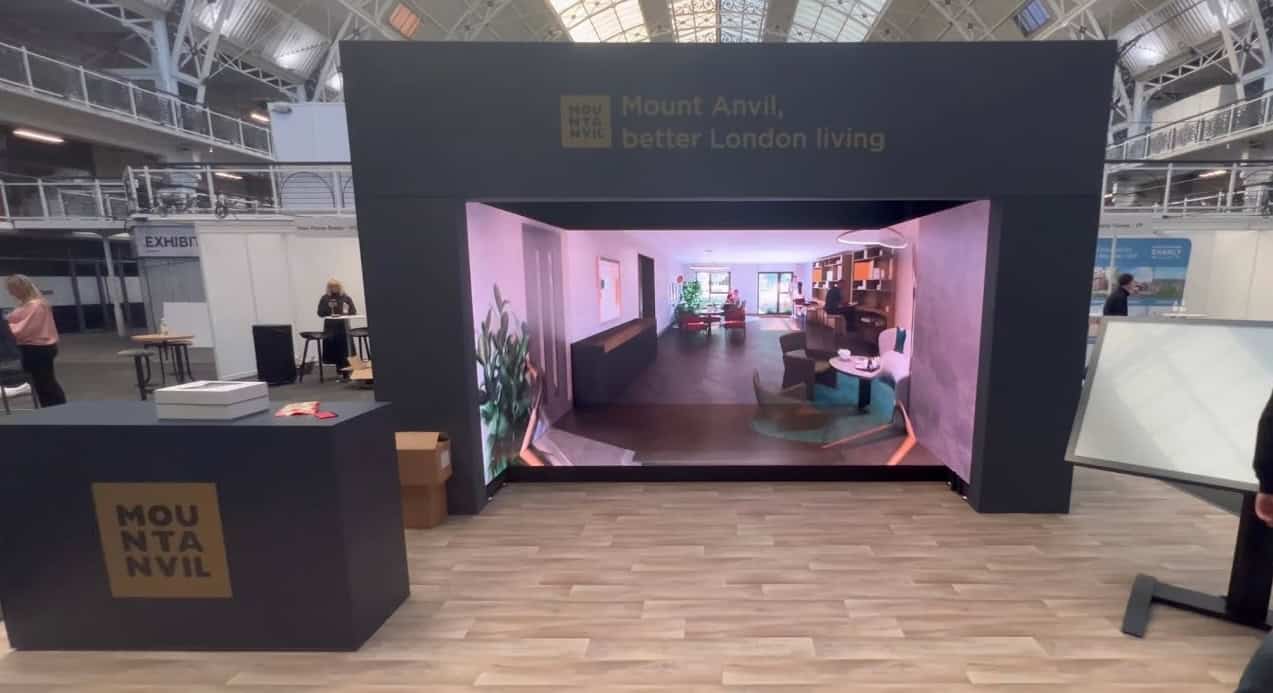
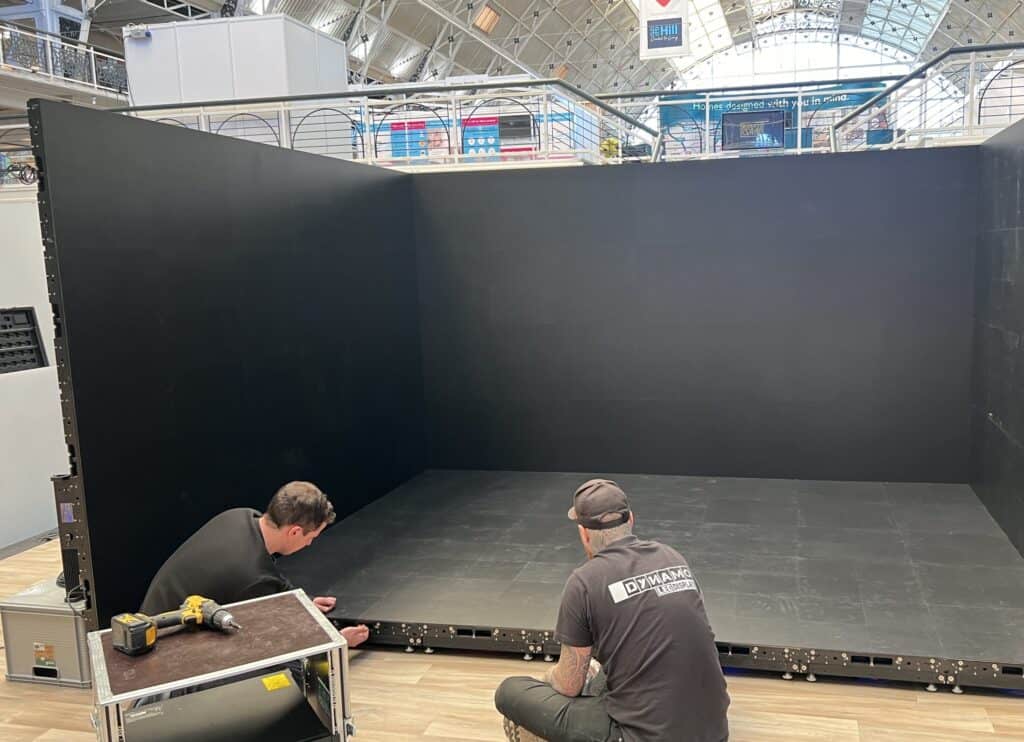
At the 2024 London New Home Show at Olympia London, Dynamo LED Displays designed and delivered a three‑sided immersive LED room with a matching LED floor for Mount Anvil. Built within an approximately six‑hour exhibition access window, the installation combined ultra‑fine pixel pitch LED and real‑time content playback to help visitors explore off‑plan developments in a more tangible way.
This case study breaks down the brief, the build approach, and the technical decisions behind a seamless wall‑to‑floor experience—plus practical guidance if you’re planning a similar immersive LED environment.
Video Walkthrough of an Immersive LED Room
Video summary (60 seconds) This walkthrough shows a three-sided immersive LED room with an integrated LED floor, running mapped content across all surfaces to create a single continuous environment. As the camera moves through the space, you can see the visuals remain aligned from wall to wall and down onto the floor, maintaining consistent colour and brightness through the transition areas. The clip demonstrates how immersive LED enables viewers to step inside a scene—useful for architectural and property visualisation where scale, light, and atmosphere need to be understood quickly in a busy exhibition setting.
What you’ll see in this 60‑second walkthrough:
Three-sided immersive LED room with a matching LED floor (open rear), built for exhibition traffic flow.
Installed within an approximately 6-hour access window at Olympia London for the 2024 London New Home Show.
~2mm pixel pitch DRE Series for close-proximity viewing, with ~900 nits brightness and 7680Hz refresh.
Content delivered via Unreal Engine, mapped across walls + floor for seamless perspective and transitions.
Multi-output control workflow using dual 4K outputs, COEX-class processing, and fibre distribution.
Project Specs
Project spec
Detail
Client
Mount Anvil
Event & venue
London New Home Show 2024, Olympia London
Environment
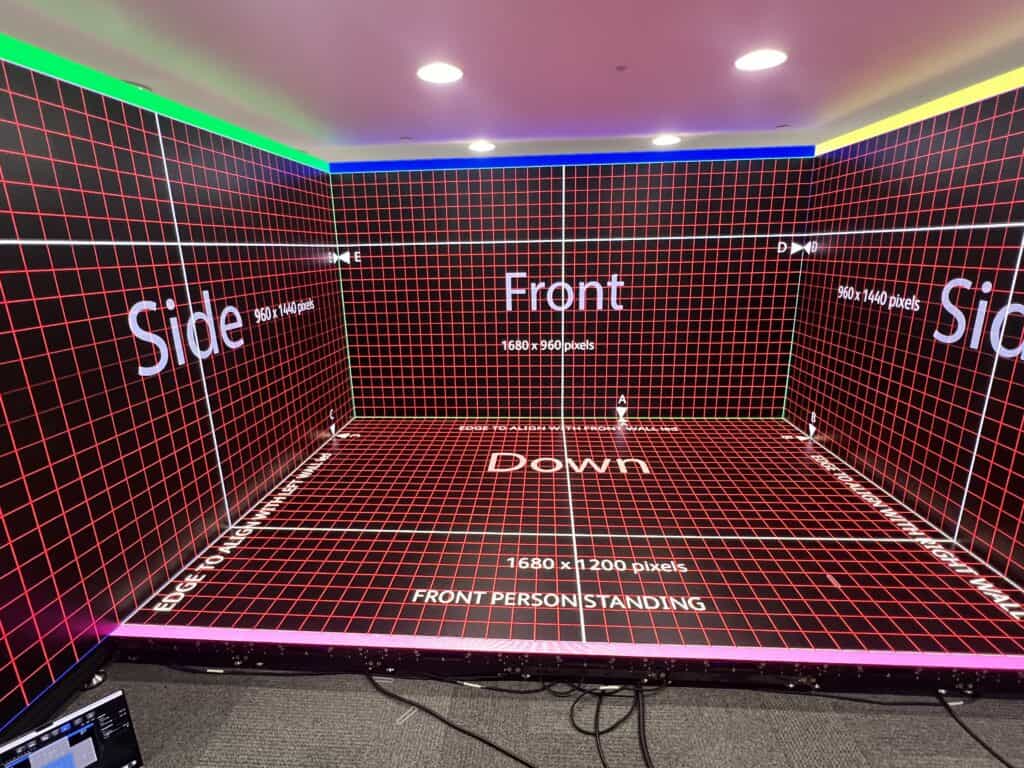
3 LED walls + LED floor (open rear)
Front wall
3472mm (W) × 1984mm (H)
Side walls (each)
2976mm (W) × 1984mm (H)
LED floor depth
2480mm
LED series / pixel pitch
DRE Series ~2mm (close-proximity)
Brightness
~900 nits
Refresh rate
7680Hz
Content workflow
Unreal Engine (mapped across walls + floor)
Processing & distribution
Dual 4K outputs → COEX-class processor → fibre distribution
Build window
~6 hours (tight exhibition access)
Property exhibitions are crowded and time‑compressed. The stand needed to do three things quickly:
1. Stop people long enough to start a conversation
2. Communicate space, light and ambience (especially for off‑plan schemes)
3. Stay robust in a live event environment (footfall, long show days, tight install windows)
Mount Anvil’s requirements were clear:
– A premium, visually refined environment that suited a high‑end residential brand
– A solution compatible with common exhibition stand‑building systems
– A layout that supported sales conversations inside the space—not just “look at a screen” viewing
– A build method that could be executed quickly and cleanly
From the field
(Daniel Reynolds)
For LED video walls for exhibitions, when the access window is tight, the install isn’t won on the show floor—it’s won in planning. For exhibition builds we treat every cable, every cabinet position and every frame junction as a “known” before we arrive, so the team can focus on speed and finish quality.
In immersive rooms specifically, we spend a disproportionate amount of time on the wall‑to‑floor transition. Even small colour or brightness shifts are noticeable when the same scene crosses multiple planes, so we plan for calibration, processing headroom and on‑site fine adjustment.
The solution: a 3‑sided immersive LED room with LED floor
Dynamo designed a three‑sided LED room with a matching exhibition grade LED floor using an ~2 mm pixel pitch DRE Series solution for close‑proximity viewing and exhibition durability.
Physical configuration
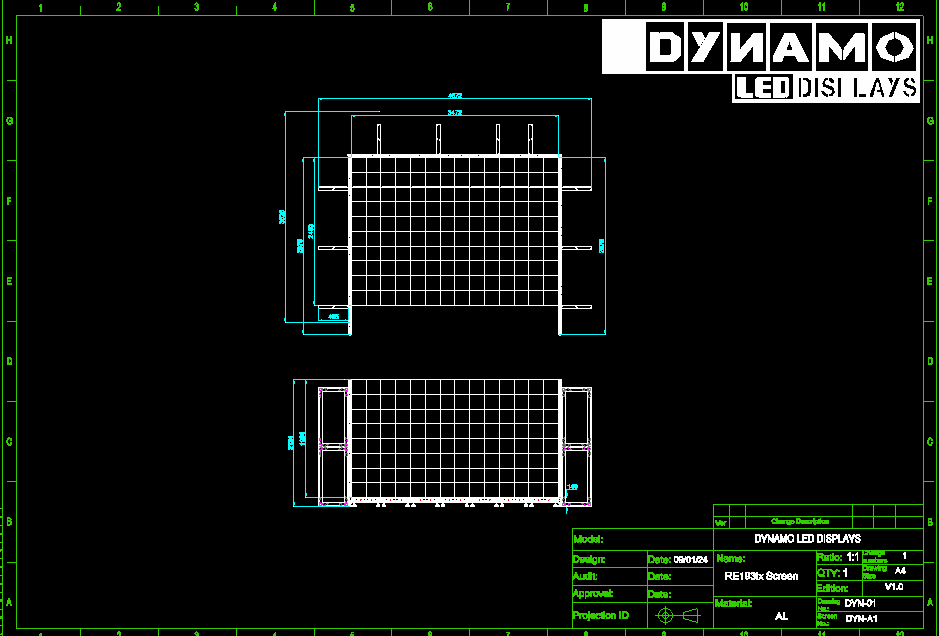
– Front wall: 3,472 mm (W) × 1,984 mm (H)
– Side walls (x2): 2,976 mm (W) × 1,984 mm (H)
– LED floor depth: 2,480 mm
– Layout: 3 walls + floor, open rear
Surface
Finished size (mm)
Cabinet grid (496 mm modules)
Cabinet count
Practical note
Front wall
3472 W × 1984 H
7 wide × 4 high
28
Primary “hero” surface — where most first impressions happen
Side wall (each)
2976 W × 1984 H
6 wide × 4 high
24
Maintains peripheral immersion and consistent perspective
LED floor
3472 W × 2480 D
7 wide × 5 deep
35
Added an extra dimension which gave a feel of movement
Display performance targets (project specific)
Brightness: ~900 nits (cd/m²)
Refresh rate: 7,680 Hz (high refresh for live viewing and camera)
Planning note:“flicker‑free”: refresh rate matters, but so do scan rate, processing, camera shutter settings, and content. For on‑camera work we always recommend a quick camera test (the specific camera + frame rate you’ll use), not just a specification check.
Why resin‑protected cabinets matter on a show floor
In exhibition environments, screens are closer to people and more exposed to knocks during build, show operation and de‑rig. For this project we used a resin‑protected LED solution (often referred to as GOB (Glue‑on‑Board) protection), which helps protect the LEDs and can improve perceived contrast in challenging ambient light.
We also selected a cabinet format designed to integrate cleanly with common exhibition frame systems (including Aluvision and BeMatrix), keeping the overall build accurate and structurally tidy.
Content creation and playback
To maximise realism and immersion, the content pipeline used Unreal Engine.
This supported:
Real‑time architectural walkthroughs (interactive or guided)
Pre‑rendered cinematic sequences for controlled “hero” moments
Continuous looping during show hours, so the stand always looked “alive”
Perspective continuity across walls and floor, helping visitors read space and depth faster
In property and placemaking, this is often the key win: you’re not asking someone to imagine a space from a brochure—you’re letting them experience it.
Processing and control architecture
Immersive rooms behave differently from single‑plane LED walls. The moment you add a floor, two technical priorities jump up the list:
Synchronisation across surfaces (walls and floor must feel like one canvas)
Consistent colour and gamma (especially at the wall‑to‑floor transition)
Dynamo works extensively with NovaStar and Brompton control ecosystems. For this installation, we specified a NovaStar COEX‑class processing workflow to handle multi‑surface synchronisation and colour management.
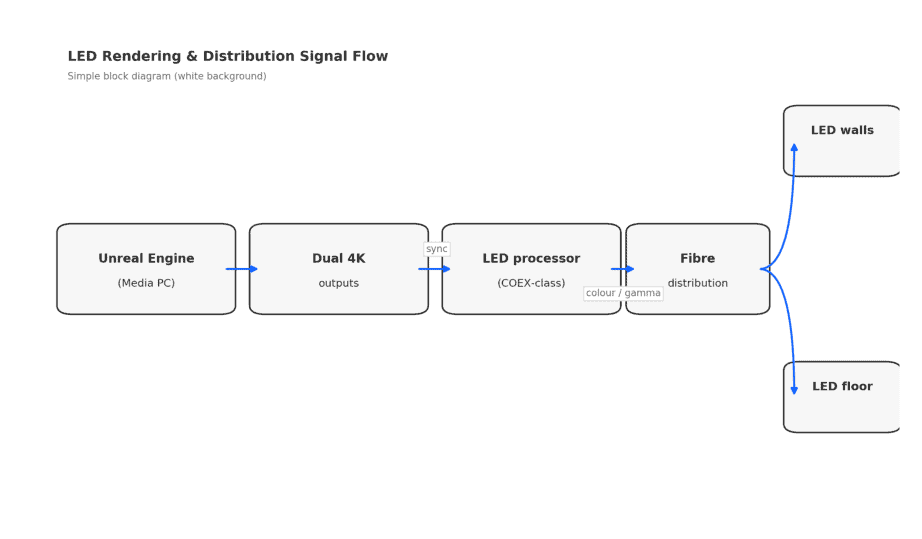
Signal flow (as deployed)
Unreal Engine → Media PC
Dual 4K outputs from the control PC
COEX MX40 Pro processor
Fibre distribution to the LED walls and floor
A clear processing and distribution workflow is essential when synchronising walls and a floor.
Why a COEX‑class processor?
The processor was selected for its ability to handle:
High‑bandwidth multi‑output workflows
Tight synchronisation between surfaces
Fine control over colour and gamma adjustment, allowing us to counteract transition‑zone shifts between vertical and horizontal planes
Build and logistics: delivering a six‑hour Immersive LED room install
Fast installs don’t happen by rushing—they happen by removing decisions on site.
For exhibition work we plan around:
Modular, repeatable cabinet layouts (predictable alignment and fewer surprises)
Stand system compatibility (e.g., frame systems such as Aluvision / BeMatrix)
Clear cable routes and labelling to avoid last‑minute rework
Spare modules and service access so faults don’t derail the schedule
The result here was a clean build delivered inside the available access window, ready for show opening.
Tight access windows demand modular design, pre‑planning, and clean installation workflows
Results and what mattered most
The immersive room became a focal point on the show floor, supporting longer dwell time and more meaningful conversations on the stand.
From a delivery standpoint, the important outcomes were:
A visually consistent room (tone and brightness matched across planes)
A robust event‑ready installation (suited to exhibition conditions)
A content workflow that kept the room engaging all day without constant operator input
Why immersive LED works for property developers
Immersive LED environments are most valuable when they solve a specific problem in the sales journey:
Off‑plan clarity: show scale, finishes and atmosphere quickly
Brand control: consistent lighting and visual quality (no “washed out” projection issues)
Reusability: the same content can be re‑cut for exhibitions, sales suites, and showrooms
Engagement: people stay longer when the environment rewards attention
When immersive LED is (and isn’t) the right fit
Immersive LED is a strong fit when:
You need impact in a noisy environment (shows, launch events, high‑traffic spaces)
Viewers are close to the screen (fine pixel pitch matters)
You want premium finish and predictable brightness
You plan to reuse the system or content across multiple activations
It may not be the best fit when:
The space is extremely constrained on power or weight and you can’t mitigate it
Viewing distances are long enough that a simpler LED wall (no floor) will do the job
Practical checklist for your own immersive LED room
Use this as a starting point when scoping a project.
1) Room geometry and sightlines
What is the minimum viewing distance (in metres)?
Do you need a floor, or will 2–3 walls achieve the brief?
Will the room be open rear (typical for exhibitions) or fully enclosed?
Where do people enter, stand, and turn? (This drives seam placement and content framing.)
2) Pixel pitch and finish
For close viewing, specify an appropriate pixel pitch and ensure the surface finish suits the lighting conditions.
Define LED type where relevant:
SMD (Surface‑Mounted Device): common for many LED walls
COB (Chip‑on‑Board) / protective coatings: can improve robustness and perceived contrast in challenging environments
3) Processing, sync and calibration
Confirm how many outputs you need (and the total pixel canvas)
Plan for genlock / synchronisation strategy where camera work is expected
Include time for on‑site calibration checks (colour, brightness uniformity, gamma)
4) Power, safety and compliance
For exhibition and public‑facing installs, plan early for safe power distribution and lifting / rigging compliance:
Lifting operations: follow HSE guidance on LOLER and competent planning.
Electrical safety: align with HSE guidance on the Electricity at Work Regulations and safe working practices.
Installation standards: ensure electrical design and testing aligns with BS 7671 (IET Wiring Regulations).
5) Content workflow (don’t leave this to last)
Decide early: real‑time engine (e.g., Unreal Engine) vs pre‑rendered video
Confirm aspect ratios, camera paths, and transitions between floor and wall planes
Build a loop that looks good even when someone joins mid‑sequence
Test content on the actual canvas resolution (or a close simulation), not just on a laptop
Decision area
What to define
Why it matters
Viewing distance
Closest viewer position and typical dwell zones
Drives pixel pitch, camera comfort and perceived image quality
Room layout
3 walls vs 2 walls; floor yes/no; open or closed rear
Determines immersion level, traffic flow and safety access
Processing
Outputs, total pixel canvas, sync strategy
Prevents tearing, mismatch and artefacts across surfaces
Power and distribution
Available supply, cable runs, backup planning
Avoids last-minute compromises and helps maintain uptime
Content pipeline
Engine choice, formats, loop behaviour, testing plan
Immersive rooms reward good content—and expose weak content quickly
Support, warranty and ongoing service
For purchased systems, Dynamo LED Displays provides a standard 3‑year return‑to‑base (RTB) warranty (set out on our company fact page), with optional full service contracts available (typically 24–48 hour response) depending on requirements.
For permanent installs, content can be managed via Dynamo CMS either through cloud access (remote management) or a local connection for on‑site updates and scheduling.
If you’re planning repeated shows or a permanent sales suite, we can advise on the right support model—especially for high‑footfall or business‑critical environments.
Considering an immersive LED room?
If you’re a property developer, marketing team or exhibition partner planning an immersive LED environment, we’re happy to advise on layout, pixel pitch, processing, content workflow and installation planning. Recent related work includes luxury showroom LED walls for Sotheby’s International Realty in London (premium, close‑viewing indoor installations).
We operate from London (146a Brick Lane, E1 6RU) and Oxfordshire (Rowan House, Long Toll, RG8 0RR) and deliver projects across the UK and Europe.
FAQ: LED Immersive Room
What is an immersive LED room?
An immersive LED room is a multi‑surface LED environment—typically 2–3 walls, sometimes with an LED floor—designed so content surrounds the viewer and creates a stronger sense of presence than a single flat display.
What pixel pitch do I need for an immersive LED room?
It depends on your closest viewing distance and content detail. For exhibition experiences where visitors stand close, finer pixel pitches (around 1–2 mm) are commonly specified. We’ll recommend pitch based on sightlines, budget, and how “photoreal” the content needs to feel.
Can an LED floor be safely walked on?
Yes—provided it’s a floor‑rated solution and the installation is designed for the expected load, traffic flow, cable routing, and slip/trip management. Always include a proper risk assessment and plan for edge detailing and access routes.
How long does it take to install an immersive LED room at an exhibition?
It varies with size, venue access, and stand build. With proper pre‑planning and modular design, immersive rooms can be installed in overnight access windows—but it’s critical to lock down geometry, cable paths, and processing requirements in advance.
What processing is needed to synchronise LED walls and a floor?
You’ll typically need a processor capable of multi‑output, high bandwidth, and tight synchronisation—plus the ability to fine‑tune colour/gamma across surfaces. The moment you add a floor, the wall‑to‑floor transition becomes a priority for calibration and control.
Do we need Unreal Engine, or can we use standard video playback?
Both can work. Unreal Engine is strong for real‑time walkthroughs and perspective‑correct immersive scenes. Standard video playback can be effective for pre‑rendered sequences—especially when you want a simple, reliable loop. The right choice depends on interactivity, timelines, and content budget.
How much does an immersive LED room cost to hire for an exhibition?
Indicative and ex VAT: across Dynamo’s 2026 event-hire quotes for 6–35 m² of DRE Series LED, the median was about £520 per m² per event (range £260–£810). A three-sided room with a floor sits at the larger end of that area band, and the price moves with pixel pitch, show duration, crew and the venue access window, so every quote is written against the actual venue and show schedule.
External standards and guidance (authoritative references)
Where immersive LED rooms involve public access, floor loading, temporary structures, or electrical distribution, installation and operation should align with recognised UK and international standards. The following guidance documents are commonly referenced during planning, risk assessment, and commissioning:
– HSE – Lifting Operations and Lifting Equipment Regulations (LOLER)
Covers safe planning and execution of lifting operations for temporary and permanent structures.
Two later published immersive builds use the same approach at different pixel pitches. At CPHI Worldwide 2025 at Frankfurt Messe, Dynamo installed two vertical DEX Series LED walls at a 2.06 mm pixel pitch to create an immersive stand inside a standard exhibition footprint. At the Pixel Artworks Lighthouse in London, the immersive room is a 1.9 mm DRE Series build with curved corners to reduce breaks in perspective, alongside an interactive LED wall and an LED bar.
Daniel Reynolds — Managing Director, Dynamo LED Displays
13 years of hands-on experience in the LED display industry with oversight of design, logistics, installation planning and commissioning.
Daniel Reynolds
Daniel Reynolds is Managing Director and founder of Dynamo LED Displays (est. 2013). He leads the specification and delivery of LED display solutions, with expertise in IP networking and both synchronous and asynchronous LED video systems across a range of control environments, including NovaStar and Brompton. Daniel also works as an LED consultant on international projects, supporting clients with system design, technical due diligence, and delivery planning.