Rental LED is the right choice when the screen moves between venues; fixed-install LED is the right choice when it stays in one location for two or more years. Most real projects sit somewhere in between — here’s how to decide.
If the screen moves within 12 months, hire DRE. If it stays put, install DFC or DX. But the detail matters, because the biggest cost drivers aren’t the cabinets themselves — structure, power, labour and storage typically account for 40–60% of total project cost. One central London fashion retailer hired DRE rental panels for a six-week window campaign, measured the footfall uplift, then moved to a permanent DX install once the data justified the capital spend — see our project portfolio for examples of both rental and permanent installations. That hire-then-buy path is more common than most people expect. If you are still weighing up display types more broadly, our guide to LED displays covers the fundamentals.
Key takeaways
- Choose DRE rental LED for touring, exhibitions, pop-ups and any project where the screen ships to a new venue within 12 months.
- Choose fixed-install LED — DFC for premium or DX for mid-range — when the LED video wall stays in one location for two or more years.
- DRE cabinets use diecast aluminium with quick-lock connections; a two-person crew can build a 12 m² wall in roughly an hour.
- Fixed-install panels run thinner (37–47 mm depth versus 55–62 mm for rental), draw less power, and suit flush integration into walls and joinery.
- Hybrid projects are common: hire DRE for a launch campaign, then transition to fixed-install once the brief is confirmed.
- The cost crossover between rental and fixed-install sits at approximately 18–24 months of continuous use in the same location, depending on screen size and pixel pitch.
How do DRE rental LED and fixed-install LED compare?
| Factor | DRE (Rental) | DFC (Fixed – Premium) | DX (Fixed – Mid-range) |
|---|---|---|---|
| Pixel pitch range | P1.55–P3.875 mm | P1.58–P1.9 mm | P1.9–P5.9 mm |
| Cabinet depth | 55–62 mm | 37 mm | 47 mm |
| Brightness | 800–3,500 nits | 600–1,500 nits | 600–3,000 nits |
| Refresh rate | 3,840 Hz | 3,840 Hz | ≥2,880 Hz |
| Curving | 0–10° adjustable | No | No |
| IP rating (outdoor variant) | IP65 front / IP54 rear | Indoor only | Indoor only |
| Ownership model | Hire or short-term project cost | Capital project or fit-out budget | Capital project or fit-out budget |
| Typical use period | 1 day to several weeks | 5–10 years permanent | 5–10 years permanent |
When rental LED is the right call
Rental panels exist because events don’t. A conference runs for three days. A product launch lasts a weekend. A festival season spans eight weeks. In each case, the LED video wall needs to arrive on a truck, go up fast, survive the gig, come down, and ship to the next venue without damage.
The DRE series is built around that cycle. Diecast aluminium cabinets take repeated rigging without warping. Quick-lock M6 screw connections mean assembly doesn’t require specialist tools — two crew members, an hour, and you’ve got a 12 m² LED video wall ready for content. The optional S-lock safety redundancy adds a second mechanical retention point for overhead or flown configurations.
Curving matters here too. The DRE’s 0–10° adjustable concave/convex capability lets a single inventory of panels wrap around stage sets, curve into retail window displays, or run flat across a conference backdrop. Fixed-install panels are typically flat or require custom mounting frames to achieve any curve.
Rental also transfers operational risk. The production supplier is normally responsible for preparation, delivery, build, operation, de-rig and post-event testing. That matters when the show date is fixed and the team doesn’t want to carry spares, flightcases and trained LED technicians.
Rental makes sense when:
- The screen will be used at more than one venue within 12 months.
- Build and strike time is constrained (exhibition halls often allow a single day for each).
- The brief might change — screen size, aspect ratio or location could shift between events.
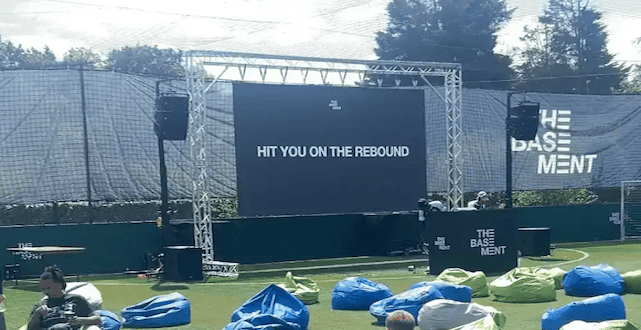
- You need outdoor-rated panels for festivals or building-mounted activations (DRE outdoor variant runs at IP65 front).
If you’re planning an event or short-term activation, our LED screen hire service covers supply, crew and content management from a single point of contact.
When fixed-install wins
Once an LED video wall stays in one place for more than a year, the economics shift. Rental cabinets are over-engineered for a wall that never moves — you’re paying for diecast aluminium, quick-lock hardware and road-case tolerances that add weight and depth you don’t need.
Fixed-install panels strip all of that out. The DFC series (our premium COB line) sits at just 37 mm deep. That’s thin enough to flush-mount into a plasterboard wall recess or hang on a standard VESA bracket without the screen dominating the room. Power consumption drops too — COB flip-chip technology in the DFC draws roughly half the power of a comparable SMD panel at the same pixel pitch, which matters when the LED video wall runs 12 hours a day, 365 days a year.
The DX series covers the mid-range. At 47 mm deep with pixel pitches from P1.9 to P5.9 mm, it suits retail, houses of worship, education spaces and hospitality venues where the budget needs to stretch further without sacrificing reliability.
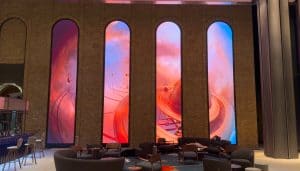
A fixed LED video wall can also be designed around the building: proper power distribution, hidden data routes, agreed service access, wall structure, cooling strategy, processor location and content control. These details decide whether the system is easy to live with.
Fixed-install makes sense when:
- The LED video wall will be in place for two years or more.
- Depth and weight matter — a thin profile keeps the screen from protruding into the room.
- Running costs matter — lower power draw and zero logistics costs compound over time.
- Daily operation needs to be simple enough for reception staff or facilities teams, not a trained LED operator.
For outdoor permanent installations, DVO (IP65, up to 8,000 nits, P3.9–P10 mm) is the correct family. For lightweight transparent or draped applications, LVW (over 60% transparency, under 12 kg/m²) may be a better fit. Browse the full LED display products range to compare specs across all Dynamo series.
The cost crossover: hire period versus ownership
As a general guide, the cost crossover between rental LED and fixed-install sits at approximately 18–24 months of continuous use in the same location, depending on screen size and pixel pitch. The crossover point isn’t a single number, but there are useful benchmarks.
If the LED video wall is needed for a few days, rental is the cleaner commercial answer. If it’s needed for months in the same location, fixed-install deserves serious comparison. If it’s needed repeatedly for 18 to 24 months, the fixed-install case often becomes stronger.
The right comparison isn’t cabinet cost versus hire cost. It should include screen hardware, processing, rigging or sub-frame, power distribution, labour for build and de-rig, storage between uses, insurance, spares, maintenance, content workflow, and downtime risk. A rental package may look higher per day, but it includes labour and responsibility that a buyer would otherwise need to own. A fixed LED video wall may look more expensive at the start, but the daily cost falls sharply when it’s used often and maintained properly.
A central London fashion retailer hired DRE P2.58 panels for a six-week window campaign, measured footfall uplift, then moved to a permanent DX P2.5 install. The fixed panel reduced depth from 55 mm to 47 mm, cut ongoing power costs, and eliminated the monthly hire fee. The rental phase gave them the data to justify the capital spend — and confirmed the right pixel pitch and wall size before committing.
Use our fixed-install LED display systems to model both options — input your wall dimensions and viewing distance, and it returns panel counts and pixel pitch recommendations to frame your brief.
Pixel pitch: the spec that crosses both categories
A common misconception is that rental panels have coarser pixel pitches than fixed-install. Both categories now overlap across fine-pitch territory. DRE rental cabinets start at P1.55 mm — fine enough for close-viewing corporate presentations. DFC fixed-install starts at P1.58 mm.
The deciding factor for pixel pitch is viewing distance, not whether the LED video wall is rental or permanent. As a rough planning guide, multiply the pixel pitch in millimetres by 1,000 to get the minimum comfortable viewing distance in millimetres. A P2.5 panel suits viewing from about 2.5 metres. This rule works as a starting point but breaks down below P1.5 mm and in high-ambient outdoor environments — content type and ambient light matter as much as raw pitch.
For rental, the question is often: what pitch gives a good result across several event types without becoming too fragile or expensive to tour? For fixed-install, the question is different: what pitch gives the right result at the actual viewing positions for the next few years?
Processing also matters. Both rental and fixed-install LED video walls run on the same platforms — we typically specify Brompton for camera-facing broadcast work where colour accuracy under IMAG matters, and Novastar where budget and input flexibility are the priority. The operational difference is in deployment: rental projects run the processor from a temporary rack or flight case, while fixed installations integrate into a permanent AV rack with remote management.
From the field
The first question I ask every client is: how many times will this exact screen be needed in this exact place? If the answer is once, DRE rental is the sensible starting point. If the answer is every week for the next three years, we should be talking about DFC, DX or DVO depending on the space.
I also look hard at access and cost-of-ownership. A rental LED wall has zero capital outlay but the cumulative hire fees add up fast — I’ve watched clients spend more on 18 months of rental than a permanent DX install would have cost outright. On the other hand, I’ve seen fixed installs that were specced too early, before the client knew the right wall size or pixel pitch, and they ended up living with a compromise for five years. My advice is to hire DRE first if there is any doubt, prove the brief with real content and real footfall data, then commit to a permanent screen once the numbers are confirmed. That hire-then-buy path avoids the two most expensive mistakes: over-committing capital too early, and renting indefinitely when ownership would have paid for itself twice over.
— Daniel, Dynamo LED Displays
Rental LED vs Fixed Install: Frequently Asked Questions
Is rental LED cheaper than fixed-install LED?
Rental LED is typically cheaper than fixed-install for any project under 18 months of continuous use, because the hire fee packages labour, spares, transport and preparation that a buyer would otherwise own. For an LED video wall used repeatedly in the same place, fixed-install becomes cheaper over time because transport, build labour and repeated hire charges fall away. The crossover sits around 18 to 24 months of continuous use, depending on screen size and pitch.
Can DRE rental LED be installed permanently?
DRE is designed for rental use, not as our default fixed-install route. It can be wall-mounted on a permanent frame, but you’d live with the extra depth (55–62 mm versus 37–47 mm) and higher power consumption. For anything beyond 12 months, we’d normally recommend transitioning to DFC, DX or DVO, which are designed around permanent structure, cabling and long-term maintenance.
What pixel pitch should we choose for rental LED vs fixed install?
Start with viewing distance, then check content and camera requirements. Event screens often use pitches around 2.6 mm to 3.9 mm where viewers are several metres back. Close-viewing fixed LED video walls may need finer pitches, often around 1.5 mm to 2.5 mm. Both rental and fixed-install ranges overlap, so the choice between them doesn’t limit your resolution options.
How quickly can a rental LED video wall be installed?
A two-person crew can assemble a standard 12 m² DRE video wall in approximately one hour using the quick-lock M6 connections. Larger builds or flown configurations take longer — a 30 m² curved stage backdrop typically needs a four-person crew and half a day including rigging and content check.
Can we combine a fixed LED wall with rental LED for events?
Yes, and it’s often the most practical model. A venue may install a fixed main wall for daily use, then hire DRE rental LED for stage wings, sponsor areas, overflow rooms or seasonal productions. This avoids overspecifying the permanent screen for occasional layouts while keeping the main display ready every day. Our LED screen hire service handles the rental elements, while the permanent wall runs from the venue’s own LED display products install.
Do fixed-install screens need ongoing maintenance?
Less than rental screens, which accumulate wear from repeated assembly and transport. Fixed-install panels in a controlled indoor environment typically need an annual calibration check and occasional module replacement. Power supply units have a finite lifespan and may need swapping after several years of continuous operation. Problems mainly occur when an LED video wall is built into a wall with no access strategy planned from the start.
Do we need a different processor for rental and fixed LED?
Not always. Brompton and Novastar are both used across professional LED projects. Brompton suits broadcast and camera-facing work where colour accuracy is critical; Novastar handles high-input-count projects where budget and flexibility are the priority. Rental projects often prioritise flexible show control, while fixed installations need reliable daily operation and simple user control.
Choosing between rental LED and fixed-install LED
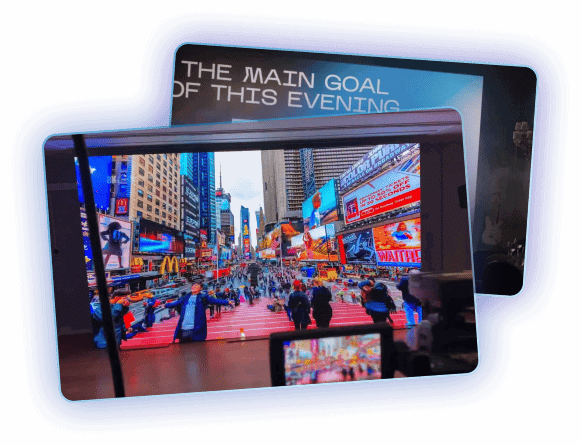
The rental LED vs fixed-install decision comes down to duration, repeatability and responsibility. If the screen moves, changes or only exists for a defined event period, DRE rental is the right route. If it belongs to the site and needs to run as part of the building, venue or operational workflow, design it as a fixed-install.
For fixed indoor projects, DFC and DX are the usual starting points. For outdoor permanent LED video walls, look at DVO. For flexible curtain applications, LVW may be the better fit. DRE stays in its lane as the rental product, where fast build, transport and event flexibility are the point.
Model your rental vs fixed-install project here, call us on +44 (0)203 489 9878, or get in touch via our contact page and we’ll come back to you within one working day.