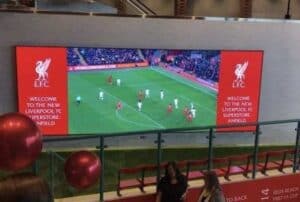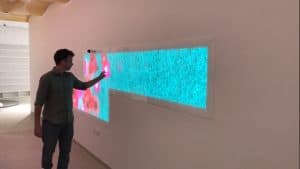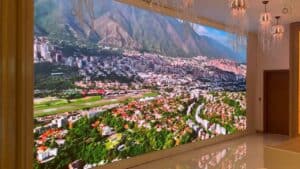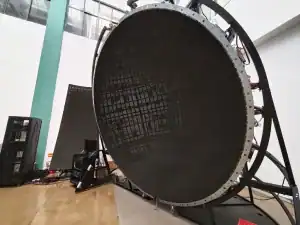
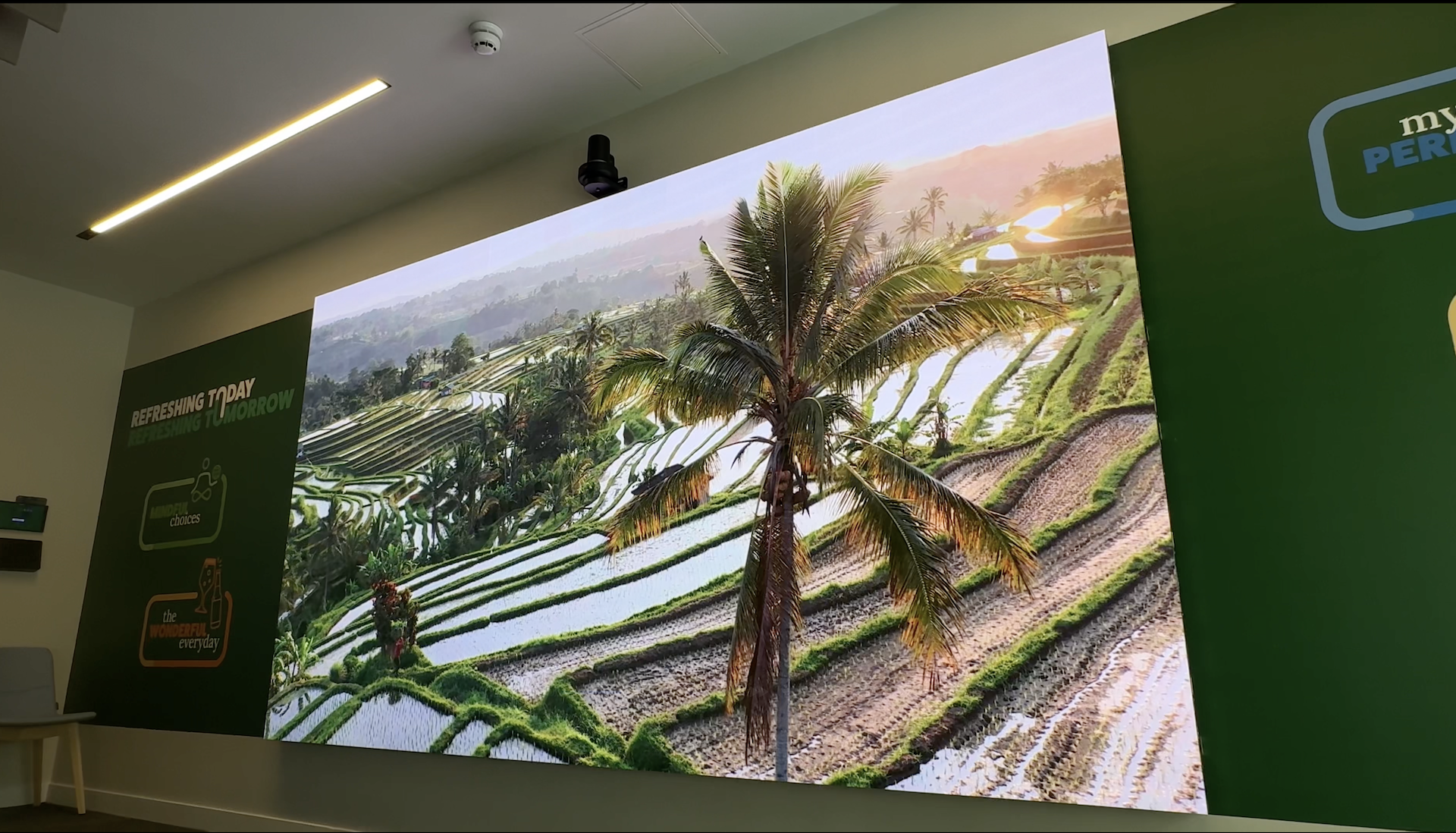
A corporate reception LED wall is a building decision as much as an AV decision. The standard specification sits between P1.5 mm and P2.5 mm pixel pitch, 500–800 nits brightness, with front-service access and a dedicated electrical circuit. The screen has to fit the architecture, work within electrical and heat limits, suit real viewing distances, and give comms teams a canvas they can keep up to date without calling an engineer every week.
This guide covers the practical decisions that shape a successful corporate reception LED wall project: which panel specification suits a close-viewing lobby, how to brief installers on structural requirements, what content management looks like day-to-day, and the maintenance commitments you should plan for over a five-to-ten-year lifespan.
Key takeaways
- Pixel pitch between 1.5 mm and 2.5 mm is the standard range for reception viewing distances under 4 metres
- A 4.8 m × 2.7 m P2.5 mm wall gives roughly 1920 × 1080 pixels, which suits standard 16:9 content without scaling surprises
- Fixed-install corporate reception projects should use Dynamo DFC Series (our premium fixed-install cabinet) or Dynamo DX Series (mid-range fixed-install), not rental product. See our LED video walls page for the full range
- Brightness is not the headline figure indoors. Uniformity, grey scale, refresh rate, and calibration matter more
- Plan service access before sign-off. Front-service LED is usually the cleaner route where there is no rear void
- The biggest hidden cost is often content. A technically sound wall still looks poor if brand assets are the wrong resolution or motion style
- A well-specified reception LED wall should deliver 50,000+ hours of operational life with scheduled maintenance
Corporate Reception LED Wall: Project Facts at a Glance
| Decision area | Typical reception range | What facilities teams should check |
|---|---|---|
| Pixel pitch | P1.5 mm to P2.5 mm | Closest viewing distance and content type |
| Common wall size | 3 m to 8 m wide | Wall structure, fire routes, fixing zones |
| Aspect ratio | 16:9, 32:9, or architectural custom | Content workflow and source resolution |
| Indoor brightness | 500 to 800 nits | Ambient light, glazing, reflections, dimming control |
| Refresh rate | 3,840 Hz or above | Camera use, town halls, filming |
| Service access | Front service in most receptions | Module removal clearance, safe working |
| Power consumption | 150–350 W per m² (average) | Dedicated circuit, peak vs average draw |
| Product fit | Dynamo DFC or DX fixed install | Finish quality, budget, support requirements |
Pixel pitch: where the money really moves
Pixel pitch, the distance in millimetres between each LED cluster, is the single most consequential specification for a corporate reception LED wall. Get it wrong and visitors standing two metres away will see individual pixels rather than a crisp image. Whether you call it a lobby LED display or an LED feature wall, the physics are the same, and they apply just as much to a reception LED tenant board like the one Dynamo built for Facebook’s London headquarters.
Smaller pixel pitch means higher resolution at close range, but higher cost per square metre. A common rule of thumb: minimum comfortable viewing distance in metres is roughly 1.5× the pixel pitch in millimetres.
| Pixel pitch | Practical viewing distance | Typical reception use |
|---|---|---|
| P1.2 mm to P1.5 mm | Around 1.5 m to 2.5 m | Close-up viewing, detailed text, premium reception walls |
| P1.8 mm | Around 2 m to 3.5 m | Main reception walls with mixed brand, video, and text |
| P2.5 mm | Around 3 m to 6 m | Larger walls, atriums, wider viewing zones |
For most reception areas, a P2.5 mm indoor LED display handles viewing distances from around 2.5 metres comfortably. If your lobby is compact and visitors will stand within 2 metres of the screen, a 1.5 mm or 1.9 mm pitch is worth the uplift. For a deeper look at how pixel pitch affects image quality, our guide to pixel pitch covers the technical detail.
When a supplier quotes a fine-pitch panel at a significantly lower price than competitors, check the LED chip specification. The driver IC and LED binning grade directly affect colour consistency and long-term brightness uniformity. Cheap diodes drift faster, and a reception LED wall that looks patchy after 18 months is worse than a slightly lower resolution screen that stays uniform for years.
To test how pixel pitch and wall size translate to resolution for your specific lobby, try our corporate reception LED video walls.
Structural, electrical, and access requirements
Structural loading and mounting
LED cabinets are not light. A typical fine-pitch indoor cabinet weighs between 25 and 38 kg per square metre, and a 3 m × 2 m reception LED wall will put 150–230 kg of static load on your wall or mounting frame. Facilities teams need a structural survey before signing off on any specification, not after. See how we have handled structural challenges on past reception installs in our project portfolio.
Wall-mounted installations require the substrate to handle distributed load across multiple fixing points. Plasterboard on timber stud framing will not support a direct mount without reinforcement. For retrofit projects where the wall construction is unknown, an independent mounting frame (floor-standing or ceiling-braced) avoids the structural question entirely.
Electrical supply and power
Electrical supply should be on a dedicated circuit. A 3 m × 2 m fine-pitch wall at average brightness draws around 600–900 W. Add the media player or processor, and you need a clean 13 A supply (UK standard) with no shared loads that could introduce electrical noise.
Heat management and ventilation
Indoor LED panels generate moderate heat, enough to raise ambient temperature in an enclosed recess. Allow 100 mm clearance behind the panels for passive airflow. If the screen sits in a sealed alcove, forced ventilation may be necessary. In a small reception, heat can affect comfort. In a large atrium, it may be less noticeable but still needs coordination with building services.
Service access
Access is where many reception projects either succeed or become difficult. Front-service LED is often the right route because the wall can be maintained from the front without a rear corridor. If the wall is five metres high, facilities need a plan for how modules, receiving cards, and power supplies will be reached later. For full guidance on safety and structural considerations, see our installation safety guide.
Dynamo DFC or DX: choosing the right fixed-install LED feature wall
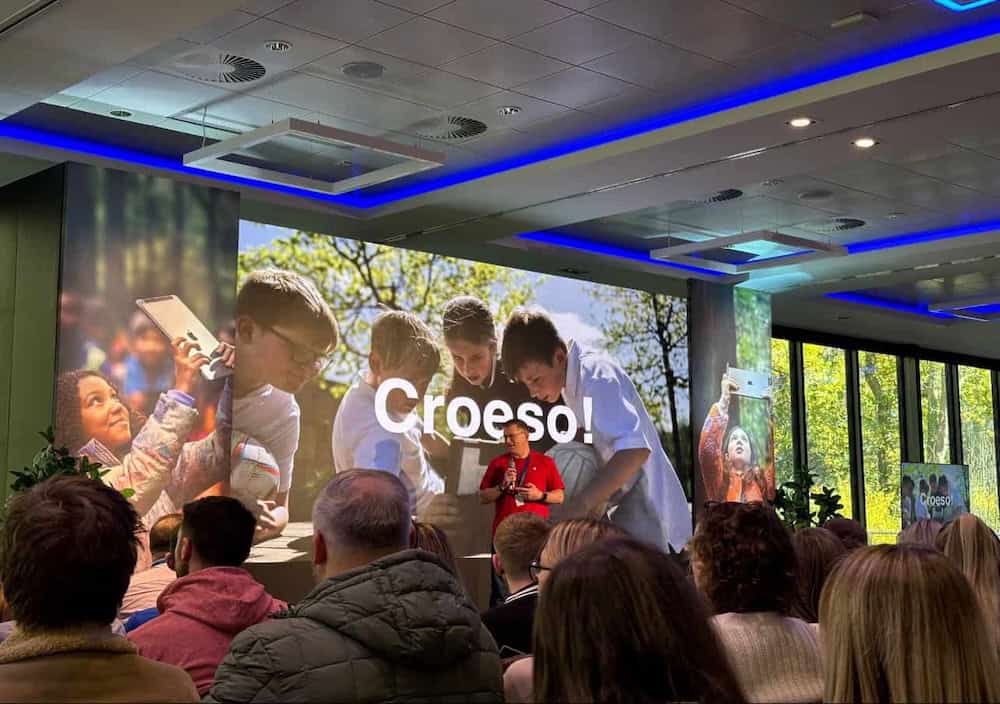
Corporate reception LED walls are fixed installations. The cabinet design, service method, alignment, and finish expectations differ from rental LED, so the product choice matters.
Dynamo DFC Series is the premium route: tighter cabinet tolerances, finer seam alignment, and a higher-grade finish built for spaces where the wall is the first thing visitors see. Dynamo DX Series is the mid-range option for projects where the budget matters more than the last millimetre of alignment. Both are permanent fixed-install platforms, not repurposed rental stock.
We do not default to rental product for reception projects because rental LED is built for frequent build and strike, not for sitting in a finished corporate environment where millimetre alignment, quiet running, front access, and architectural integration carry more weight.
Brightness, reflections, and eye comfort
The recommended brightness for a corporate reception LED wall is 500 to 800 nits, adjusted after installation to suit ambient light and glazing conditions. Indoor LED is often overspecified on brightness. A reception wall does not need outdoor levels of output, and uniformity and contrast matter as much as peak output when the wall faces glazing, polished stone, or glossy finishes.
Facilities teams should think about where sunlight enters during the day, whether the screen faces waiting areas or security desks, and how the wall behaves at low brightness in the evening. The UK Health and Safety Executive has practical guidance on display screen equipment that covers the fundamentals of glare, contrast, and visual comfort. CIBSE also publishes useful guidance for building services engineers on lighting coordination. On real projects, the reception LED wall, architectural lighting, and daylight control should be reviewed together.
Control, content, and day-to-day management
The question facilities teams ask most is not about the hardware. It is who updates the screen and how. Modern reception digital signage connects to content management systems that make this operationally simple.
Brompton and Novastar are the two processor ecosystems you will encounter most often. We typically spec Brompton for reception-scale walls because of its colour management and calibration workflow at close viewing distances. Novastar comes into play on larger installations or where input-switching flexibility is a priority. Both publish technical information on their own sites: Brompton Technology and NovaStar.
A practical content note: supply content at the screen’s native resolution. If your wall is 3840 × 1080 pixels, create assets at exactly that size. Upscaled or mismatched content looks soft and undermines the investment. For a 4.8 m × 2.7 m P2.5 mm wall, Full HD content maps cleanly. For a custom 7 m × 2 m wall, the canvas may be a non-standard format that needs bespoke layouts. Our content management page covers the detail.
A useful question for procurement meetings is: who can change the content at 8:30 on a Monday morning, and what happens if that person is off site?
Maintenance and long-term ownership
A corporate reception LED wall is a long-term asset. Plan for it accordingly.
Preventive maintenance should happen annually at minimum: visual inspection for dead or stuck pixels, cleaning of panel surfaces with a microfibre cloth, checking cable connections, and verifying processor firmware. Our maintenance guide covers the full checklist.
One practical advantage of reception LED walls over LCD is repairability. If a section develops faults, individual LED modules can be swapped without replacing the entire panel. This keeps long-term repair costs proportionate. Ask your supplier what their response time is for module failures. A reception wall with a visible dead patch is not something that can wait two weeks for a replacement part.
Reception LED walls also degrade more gradually than LCD and can be recalibrated to restore brightness uniformity, extending useful life by several years. Our calibration guide explains how this works.
From the field
Daniel Reynolds, Dynamo LED Displays
I see the same issue on reception projects again and again: the client has picked a screen size because it looks right on an elevation, but nobody has checked what that means in pixels. My first question is always the viewing distance, then the content. If the wall is going to show fine text two metres from the visitor, the pitch decision changes quickly.
I also look hard at service access. A wall can look clean on day one and still be a problem if the only way to reach a power supply is to remove finished joinery. My preference is to solve that on the drawing, not during the first service visit. Browse our project portfolio to see how different reception spaces have been handled.
Corporate Reception LED Wall: Frequently Asked Questions
What pixel pitch do I need for a corporate reception LED wall?
Most reception projects sit between P1.5 mm and P2.5 mm. P1.5 mm and P1.8 mm suit closer viewing and detailed content. P2.5 mm works well on larger walls where people stand further back. The right answer depends on closest viewing distance, screen size, content detail, and budget. Measure the space before committing.
How much does a corporate reception LED wall cost?
A full turnkey corporate reception LED wall project typically costs £15,000 to £40,000 for a 3 m × 1.5 m screen, with panel prices ranging from £1,500 to £4,000 per square metre depending on pixel pitch. Fine-pitch P1.5 mm sits at the upper end of that range; P2.5 mm sits at the lower end. Use our LED video wall options to model costs for your wall size, or request a quotation.
Can a reception LED wall show Teams calls and live presentations?
Yes, if the control system is designed for it. The wall needs a processor, scaler, local input plate, and agreed source switching. Test real laptops, presentation formats, and video calls before handover, especially if the wall has a wide or custom aspect ratio.
Can our reception team manage the content themselves?
Yes. Modern reception LED walls connect to content management systems that allow non-technical staff to upload images, videos, and scheduled playlists through a web browser or dedicated app. Training typically takes under an hour. Most reception teams manage day-to-day updates independently after a short handover session.
How long does installation take?
The visible installation may take a few days on a straightforward wall, but the full programme includes design, drawings, approvals, manufacture, delivery, mounting preparation, electrical works, installation, calibration, and training. Lead times vary by product and project conditions, so the LED package should be planned alongside the wider fit-out.
What is the lifespan of an indoor reception LED wall?
Quality indoor LED panels are rated for 50,000 to 100,000 hours to half-brightness. In a reception area running 12 hours a day, five days a week, that equates to roughly 16 to 32 years before the LEDs reach half their original brightness. Practical lifespan depends on thermal management, power quality, and regular maintenance.
Does a corporate reception LED wall need special maintenance?
It needs planned access, cleaning guidance, spare modules, and a clear service process. LED modules and power supplies are serviceable parts, so facilities teams should know how the wall is isolated, who can access it, and where spares are stored. Front-service designs are common where there is no rear access.
Is a corporate reception LED wall better than a projector?
For permanent reception displays, LED outperforms projection on ambient light handling, image consistency, and maintenance. Projectors require lamp or laser source replacement, struggle in bright areas with natural light, and need a clear throw distance. A reception LED wall is self-emitting, works in any lighting condition, and sits flat against the wall.
Conclusion
Pitch matters, but service access, power, heat, control, and content ownership all need locking down before procurement. For fixed corporate installations, Dynamo DFC Series suits reception spaces where finish and long-term presentation carry more weight. Dynamo DX Series suits permanent installations where the brief needs a controlled balance between performance and budget. The right choice comes from the site conditions, not from a generic product list.
If you are planning a corporate reception LED wall, start with our view Dynamo LED video walls to model screen size, resolution, and pixel pitch for your space. To discuss your project with our team, call +44 (0)203 489 9878 or get in touch here.