A second-hand LED screen can cut 40–60% off the hardware price, but permanent brightness loss, discontinued modules, missing calibration files and the lack of any enforceable warranty typically shrink the real saving to 10–30% against a new installed system. Here are the risks, the checks and the honest arithmetic.
The listing shows a working wall, the price is half what a new system costs, and the seller says it came out of a working venue last month. Sometimes that is exactly what you get. More often, the discount is quietly paying for worn diodes, missing calibration data, discontinued modules and a control system you cannot get firmware for. We supply and install new LED displays across retail, sports, events and corporate sites, and we also get the phone calls when a pre-owned purchase goes wrong. This guide sets out what actually wears out, what the discount really buys, and the checks to run before any money moves.
Key takeaways
- LEDs dim permanently with use. A screen rated for 100,000 hours to half brightness that has run bright content for years has lost output you can never recover.
- The purchase price is not the project price. Once inspection, spares, processing, structure, recommissioning and installation are priced, a ‘50% off’ second-hand screen commonly lands at 70–90% of the cost of new.
- Batch matching is the hidden killer. If the module line is discontinued, one dead module can mean a visible patch or a dead wall.
- Ex-rental cabinets are built for touring, not for permanent walls. Repurposing rental stock for a fixed installation usually costs more than it saves.
- No warranty means you carry all the risk. New systems from us come with a 3-year return-to-base warranty; second-hand screens almost never come with anything enforceable.
- If you do buy, insist on a powered demonstration of every cabinet, the original calibration files, and at least 5% spare modules from the same batch.
At a glance: second-hand versus new
| Factor | Second-hand | New (fixed-install system) |
|---|---|---|
| Typical price | Often 40–60% below new | Full price, itemised |
| Warranty | Usually none, or unenforceable | 3-year return-to-base |
| Remaining brightness | Unknown without test data | 100% of rated output |
| Spares | Same-batch only, often discontinued | Factory-supplied attic stock |
| Calibration | Frequently lost with the seller | Supplied with the system |
| Control system | Whatever it shipped with | Current-generation processing |
| Suitability | Built for its old job | Specified for your site |
What wears out on a second-hand LED screen
An LED screen does not fail the way a projector lamp does. It fades, drifts and loses pieces.
The diodes dim with every hour of use, and the loss is permanent. Manufacturers quote lifespan to half brightness, not to failure, so a heavily used screen can power on, look ‘fine’ in a warehouse, and still have lost a large share of its original output. That matters most in bright environments: a typical indoor screen is specified at around 800–1,200 nits, while a shop window fighting direct daylight needs 2,500 nits and upwards, and a tired screen may no longer have that headroom to give. Our guide to how long LED displays last covers the decay curve in more detail.
Hours alone do not tell the story either. A studio wall run at controlled brightness in an air-conditioned room has had a different life from a touring screen exposed to transport, dust, heat and moisture, even if the logged hours match. Controller logs can be reset or replaced, so check the claimed hours against service records and the physical condition of the hardware: dust loading, fan noise, discoloured plastics and repair labels all tell you something.
Power supplies age faster than diodes. They are the most common failure point on any wall more than a few years old, and on a second-hand screen you inherit them at an unknown point in their life. Receiving cards, ribbon connectors and data cabling all take wear too, especially on ex-rental stock.
Then there is the damage you cannot see powered off: dead pixels that only show on full white, colour drift between cabinets that only shows on low grey, and moisture ingress on outdoor stock that will not announce itself until winter.
Spare parts for a second-hand LED screen: batch matching and discontinued modules
LED modules are colour-matched by production batch at the factory, and module lines are revised or discontinued every few years. On a second-hand LED screen with a discontinued module line, one failed module means a visible mismatched patch, a hunt for old stock of unknown provenance, or a section rebuild. It is the most common way a used purchase becomes uneconomic.
The batch problem is physical, not administrative. Two modules of the same model from different batches can sit next to each other and visibly mismatch, because the diodes were binned differently at manufacture. A spare from another batch can fit, illuminate, and still show as a patch on skin tones and low-grey content. When you buy new, the supplier holds attic stock — spare modules from the same production batch, kept back for future repairs — so replacements blend in. When you buy second-hand, you get whatever the seller kept, which is frequently nothing, and any loose modules included need testing under the same patterns as the main display after years in uncontrolled storage.
We see all three outcomes of a discontinued line in our LED screen repair work, and the section rebuild erases every pound the purchase saved. Before buying, get the exact module model and batch numbers in writing, confirm the line is still in production, and treat ‘no spares included’ as a serious price objection rather than a footnote.
Processing, control and calibration: the part sellers forget
A second-hand screen is only half a system. The other half is the processing that drives it, and this is where listings go quiet.
Check what the deal actually includes: the sending hardware or processor, receiving cards, configuration and calibration files, spare power supplies, cabling, any control computer, and the passwords and administrator access to all of it. Novastar and Brompton Technology are the two processing ecosystems you will most commonly meet, and neither is interchangeable with the other: a wall fitted with one brand’s receiving cards needs that brand’s processing, and compatibility still has to be confirmed at card, firmware and configuration level. If the seller is keeping the processor, price a replacement before you bid, because on smaller screens it can be a meaningful fraction of the whole deal.
Ask for the calibration files, and ask for a backed-up configuration before the wall is dismantled. Factory calibration data lives in the receiving cards and in files the original installer holds. Lose those and a recommissioning session is needed to get cabinets matched again — skilled work that sits inside the installation and calibration line of the worked example below.
Finally, check compliance. Grey-import screens bought from overseas liquidations may never have been assessed for the UK market at all. The government’s guidance on UKCA marking is worth reading before you buy anything without paperwork, because your insurer and your landlord will care even if the seller did not.
Second-hand LED screen cost: a worked example
The headline discount overstates the saving. In the worked example below, a 57% saving on the cabinet price becomes roughly a 12% saving on the completed project once inspection, spares, processing, structure and installation are priced. Pixel pitch, size and condition all move the numbers, so treat this as the shape of the sum rather than a quote.
Consider a 4 metre by 2.25 metre P2.5 indoor display, where a seller offers the used cabinets at £18,000 against a £42,000 new-system budget:
| Cost item | Worked example |
|---|---|
| Used cabinets and available spares | £18,000 |
| Independent inspection and test work | £1,200 |
| Additional modules and electronic parts | £3,000 |
| Processor and control-system changes | £2,500 |
| New mounting structure, power and data | £4,500 |
| Transport, installation and calibration | £5,000 |
| 15% contingency on the used equipment purchase | £2,700 |
| Indicative completed cost | £36,900 |
These are illustrative figures, not a quotation. Run the sum honestly and a ‘50% off’ screen commonly lands at 70–90% of the cost of new, with unknown remaining life and no warranty behind it. Against a new mid-range DX fixed-install system with a 3-year return-to-base warranty and factory attic stock, the gap is thinner than the listing suggests. Our LED display cost guide breaks down what drives new pricing, and the LED screen configurator will produce a new specification to set against any listing.
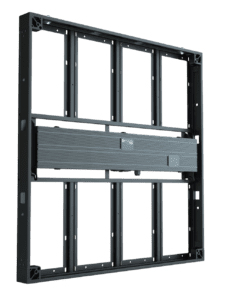
One structural point on ex-rental stock. Rental cabinets, like our DRE range, are engineered for fast rigging, curving and touring, and you pay for those strengths in the cabinet design whether you need them or not. A wall that will hang on one bracket for seven years does not. A fixed-install cabinet is specified for the duty you actually have: DFC at the premium end, DX in the mid-range. Buying ex-rental for a permanent installation means paying for the wrong strengths and inheriting touring wear on top.
If that arithmetic looks uncomfortably familiar, we can run it for your specific case. Our current LED display product ranges cover fixed-install, outdoor and rental duties, and we will price a like-for-like new specification against any listing you are considering. Call us on +44 (0)203 489 9878 or use our contact page.
Checks to run before you hand over money
If the sums still work, and sometimes they do, buy like a professional. One note on labels first: ‘refurbished’ should mean the seller has tested the screen and replaced worn parts, so ask exactly what was done and by whom; plain ‘used’ stock has had nothing done at all.
- See every cabinet powered. The whole wall, not a selected row, showing full white, full black, solid red, green and blue, then low grey. Dead pixels hide in mixed content; colour drift and banding hide in bright footage.
- Get the hours and the history. Ask for usage records and where the screen was installed. ‘Ex-demo’ and ‘ex-rental’ are very different lives.
- Record module model and batch numbers. Then confirm the line is still manufactured.
- Confirm what is included. Processor, receiving cards, spare modules, spare power supplies, flight cases, cabling, calibration files, passwords.
- Check the paperwork. Proof of ownership, original invoices, compliance documentation, and written terms covering who pays for dismantling damage and when risk transfers to you.
- Get any warranty in writing. Read who actually honours it. A transferred manufacturer warranty from an overseas factory is rarely worth the PDF it arrives on. Compare that against what a proper UK warranty covers.
- Price the full project. Delivery, structure, installation, commissioning and spares, not just the screen.
Remember that once installed, the screen is work equipment and the responsibilities are yours. The Health and Safety Executive’s guidance on the Provision and Use of Work Equipment Regulations covers suitability, maintenance and inspection, and those duties are assessed against your site, not inherited from the previous installation.
From the field
Daniel, Dynamo LED Displays
I get sent second-hand LED listings most weeks, usually with the message “this looks like a bargain, what am I missing?” My honest answer is that about one in ten is genuinely worth a look, and even then only when the seller can produce calibration files, batch-matched spares and a powered demonstration. The purchases that go wrong all share the same story: the screen looked perfect in a warehouse, the module line turned out to be discontinued, and the first failed module left a visible scar the owner had to stare at every day.
The one that sticks in my mind was a buyer who had picked up an ex-rental wall for a shop window. The screen worked, but it had spent years running flat out at outdoor events, and a window display fighting direct sunlight needs 2,500 nits and upwards. Against the glazing it simply no longer had the output. They ended up buying new from us within the year, so the used screen was not a saving. It was a delay with a storage bill attached.
Second-Hand LED Screen: Frequently Asked Questions
Is it worth buying a second-hand LED screen?
Occasionally, if you buy with discipline. A lightly used screen with calibration files, same-batch spares and a still-manufactured module line can be a fair deal. Most listings fail at least one of those tests, and once you add spares, recommissioning and the absence of any warranty, the true saving over new is usually far smaller than the sticker suggests.
How long will a second-hand LED screen last?
It depends on the hours already consumed and how they were consumed. LED lifespan is rated to half brightness rather than outright failure, often around 100,000 hours for quality diodes, but heavy use at high brightness accelerates the decay. A screen with plenty of ‘on’ time left may still lack the output your environment needs.
What should I check before buying a second-hand LED screen?
Insist on seeing every cabinet powered with full white, black, red, green, blue and low-grey test patterns. Get module model and batch numbers, usage history, and confirmation the module line is still in production. Confirm exactly what is included: processor, receiving cards, calibration files, spares and cabling. Then price the complete installed project, not just the hardware.
How many dead pixels are acceptable on a second-hand LED screen?
There is no useful universal number. A few scattered faults may be invisible at long viewing distances but distracting in a boardroom or shop window. Agree the acceptance criteria in writing before purchase: maximum defect count, permitted clustering, the test patterns used and the observation distance. Without that, “a couple of dead pixels” means whatever the seller wants it to mean.
Can you get spare parts for a second-hand LED screen?
Sometimes, and this is the deciding question. Modules must match by production batch to blend visually, so you need same-batch spares or a module line still in manufacture. If the line is discontinued, a single failure can leave a visible mismatch or force a larger rebuild. No confirmed spares route should mean a substantial price reduction or walking away.
Do second-hand LED screens come with a warranty?
Rarely, and almost never one worth relying on. Manufacturer warranties often do not transfer between owners, and a warranty honoured by an overseas factory is difficult to enforce in practice. New systems supplied by us carry a 3-year return-to-base warranty with a UK company behind it, which is a real cost difference the used price never shows.
Are ex-rental LED screens suitable for fixed installation?
Usually not the right tool. Rental cabinets are built for repeated rigging, curving and transport, so you pay for engineering a permanent wall never uses while inheriting touring wear. A purpose-designed fixed-install cabinet is specified for the actual duty. If the price still tempts you, scrutinise connectors, edges and power supplies, which take the most punishment on tour.
Where can I buy a second-hand LED screen?
Rental companies clearing stock, trade sellers and liquidation auctions are the usual sources. We supply new systems rather than trading used stock, but we will gladly appraise a listing you are considering: send it via our contact page and we will flag what is missing and what a comparable new system costs.
The verdict
The used market is not a scam, but it is a market where the seller knows more than the buyer and the discount is doing a lot of quiet work. The right question is not whether the cabinets switch on; it is whether the complete display can meet your brief at a defensible installed cost, with enough matching spares and support to stay serviceable. That combination is rare. For most permanent installations, a new system with factory spares, current processing and a 3-year warranty costs less over its life than a used screen costs to keep respectable.
If you are weighing a second-hand LED screen against buying new, send us the listing. We will tell you what it is really worth, flag what is missing, and price a new alternative so you can compare like for like. Call +44 (0)203 489 9878 or send the details through our contact page and we will come back to you the same working day.